
BIDU(09888)

Search documents
李彦宏亲掌AI:王海峰失职与何俊杰转岗背后的百度困局
3 6 Ke· 2025-11-26 00:34
Core Insights - Baidu's recent restructuring of its AI research and development framework indicates a significant shift in its AI strategy, with the new foundational model R&D department and application model R&D department reporting directly to CEO Li Yanhong, sidelining CTO Wang Haifeng [1][4] - Li Yanhong's dissatisfaction stems from the lack of market impact despite substantial technological investments, highlighting a disconnect between technological achievements and market performance [3][5] Company Restructuring - Wang Haifeng's authority has been gradually diminished, losing key responsibilities in the smart cloud business group in May 2022 and now being excluded from core AI business management [4][6] - The restructuring reflects Li Yanhong's direct involvement in AI development, aiming to shorten decision-making processes and regain competitive advantage in the AI sector [5][6] Performance and Market Position - Despite over 100 billion yuan invested in R&D over the past decade, Baidu's AI products, including the Wenxin model, have not achieved significant market success, contrasting sharply with competitors like Alibaba [3][5] - Baidu's AI development has been characterized by a focus on technology without sufficient market application, leading to missed opportunities during the AI industry's growth phase [3][4] Leadership and Talent Management - The appointment of He Junjie as a key figure in the organizational change indicates a shift towards a more cost-focused management approach, which has resulted in high executive turnover and challenges in retaining AI talent [6][6] - Baidu's high executive compensation contrasts with its cost-cutting measures, leading to a perception of a double standard in its human resource strategy [6][6] Future Outlook - Li Yanhong's personal involvement in AI strategy is seen as a last-ditch effort to revitalize Baidu's market position, recognizing the need for a more agile and market-oriented approach [6][6]


智通港股沽空统计|11月26日
智通财经网· 2025-11-26 00:26
Summary of Key Points Core Viewpoint - The report highlights the top short-selling stocks in the market, indicating significant investor sentiment and potential market movements based on short-selling ratios and amounts. Group 1: Top Short-Selling Ratios - Great Wall Motor-R (82333) has the highest short-selling ratio at 100.00% [1] - JD Group-SWR (89618) follows with a short-selling ratio of 94.41% [1] - Bank of China Hong Kong-R (82388) ranks third with a short-selling ratio of 93.33% [1] Group 2: Top Short-Selling Amounts - Alibaba-SW (09988) leads in short-selling amount with 4.633 billion [2] - Xiaomi Group-W (01810) has a short-selling amount of 1.448 billion [2] - Tencent Holdings (00700) follows with a short-selling amount of 1.011 billion [2] Group 3: Top Short-Selling Deviation Values - Bank of China Hong Kong-R (82388) has the highest deviation value at 56.68% [1] - China Ping An-R (82318) comes next with a deviation value of 51.38% [1] - China National Offshore Oil Corporation-R (80883) has a deviation value of 48.09% [1]




中经评论:平台企业缘何着迷“点评”业务
Jing Ji Ri Bao· 2025-11-26 00:08
Core Insights - The recent surge in interest from major internet companies in user reviews and ratings is driven by the need to find new growth avenues in the service consumption era, as traditional e-commerce growth has plateaued [1][2] - Platforms like JD.com and Gaode are expanding their roles beyond traditional functions to become influential in consumer decision-making, particularly in the restaurant and entertainment sectors [1] - The competition for consumer attention is intensifying, with platforms aiming to create high-frequency touchpoints through review content [1] Industry Dynamics - The service consumption market remains robust, with significant demand for experiences such as dining and entertainment, which are often subjectively evaluated [1] - The introduction of new review platforms is seen as a way for businesses to connect directly with consumers, especially in a high marketing cost environment [1] Consumer Behavior - Consumers are generally receptive to multiple review channels, appreciating the opportunity to discover new places and potential discounts [2] - There is a growing skepticism towards "water reviews," with consumers preferring authentic experiences over generic positive reviews [2] Trust and Credibility - Trust is fundamental to the review ecosystem, with users relying on genuine feedback to guide their choices, while platforms must maintain impartiality to build credibility [2][3] - The challenge lies in balancing the dual role of platforms as both arbiters of authenticity and profit-driven entities, which can lead to conflicts of interest [2] Future Considerations - New entrants in the review space must focus on rebuilding trust mechanisms rather than merely replicating existing functionalities [3] - The long-term success of review platforms hinges on their ability to foster genuine interactions and maintain consumer trust, as losing credibility can undermine even the most attractive data and interfaces [3]


智通ADR统计 | 11月26日
智通财经网· 2025-11-25 22:22
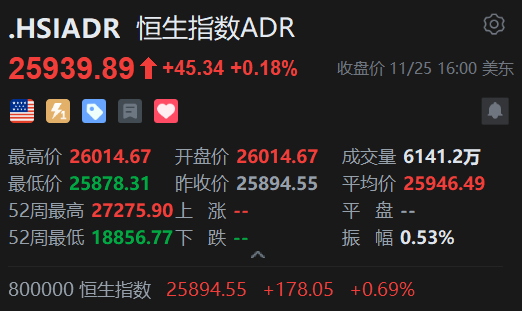
Core Viewpoint - The Hang Seng Index (HSI) showed a slight increase, closing at 25,939.89, up by 0.18% from the previous day, indicating a mixed performance among large-cap stocks in the Hong Kong market [1]. Group 1: Market Performance - The HSI closed at 25,939.89, with a daily increase of 45.34 points or 0.18% [1]. - The highest price during the day was 26,014.67, while the lowest was 25,878.31, resulting in a trading range of 0.53% [1]. - The average price for the day was 25,946.49, with a trading volume of 61.41 million shares [1]. Group 2: Individual Stock Performance - HSBC Holdings closed at 108.109 HKD, up by 1.23% compared to the previous close [2]. - Tencent Holdings closed at 622.043 HKD, down by 0.47% from the previous close [2]. - Alibaba Group's stock price increased by 2.14% to 157.800 HKD, while its ADR price was 152.624, reflecting a decrease of 3.28% [3]. - Other notable performances include Meituan, which rose by 0.10% to 98.250 HKD, and BYD, which increased by 0.95% to 95.750 HKD [3].




百度新设俩人工智能大模型研发部 负责人向李彦宏汇报
Nan Fang Du Shi Bao· 2025-11-25 16:24
Core Insights - Baidu has established new research departments focused on developing advanced AI models, indicating a strategic push towards enhancing its capabilities in artificial intelligence [2] - The company reported significant growth in its AI business revenue, with a year-on-year increase of over 50%, highlighting the success of its AI initiatives [3] Group 1: Organizational Changes - Baidu has created a new Basic Model Research Department led by Wu Tian, focusing on high-intelligence, scalable general AI models [2] - An Application Model Research Department has also been established, led by Jia Lei, to optimize specialized models for business applications [2] - Both departments report directly to Baidu's CEO, Li Yanhong, reflecting a higher management level for AI research [2] Group 2: Leadership Background - Wu Tian has been with Baidu since 2006 and has made significant contributions in machine learning, natural language processing, and computer vision [2] - Jia Lei, a leader in AI voice technology, has a strong academic background and has previously worked at Panasonic and IBM before joining Baidu [3] Group 3: Financial Performance - Baidu's AI business revenue reached approximately 10 billion yuan, with AI cloud revenue growing by 33% to 4.2 billion yuan and AI native marketing service revenue increasing by 262% to 2.8 billion yuan [3] - The company reported a long-term asset impairment of 16.2 billion yuan, attributed to the need for improved computing efficiency in its asset portfolio [4] Group 4: Investment Strategy - Baidu has invested over 100 billion yuan in AI since March 2023, indicating a strong commitment to advancing its AI capabilities [4] - The company recently launched the Wenxin 5.0 model, which utilizes a unified modeling technique and supports multi-modal input and output [4]
查资料、劝老板、写周报,给上班人准备的大模型评测
晚点LatePost· 2025-11-25 15:01
Core Insights - The article highlights the rapid growth in the usage of large model assistants in China, with over 100 million daily users, marking a 900% increase since April last year [3] - A comprehensive evaluation of 14 large models was conducted, focusing on their performance in everyday work-related tasks rather than programming or deep research [3][5] - The evaluation involved blind assessments of the models' responses to various prompts, revealing differences in their capabilities and user experiences [5][8] Model Performance Summary - The evaluation included models from companies like OpenAI, Anthropic, Google, and several Chinese firms, with most models priced around $20 per month [4] - ChatGPT received the highest scores in the blind assessments, followed by StepFun and SenseNova, while MiniMax Agent scored the lowest due to its simplistic approach [8][13] - The models were tested on their ability to handle complex tasks, such as role-playing and brainstorming, with varying degrees of success [6][7] User Interaction and Feedback - Users reported that while the models showed improvements in their capabilities, the practical experience did not always align with the benchmark scores advertised by the companies [3][5] - The models were assessed on their ability to provide coherent and contextually relevant responses, with some models struggling with longer contexts or complex queries [8][23] Long Text Processing and Document Handling - The models were tested on their ability to process long documents, with none achieving perfect results, indicating ongoing challenges in this area [23][25] - Gemini and Yuanbao performed relatively well in extracting participant information from a lengthy conference manual, but issues like hallucinations and incomplete data were noted [25][26] Search and Information Retrieval - The article discusses the models' capabilities in replacing traditional search engines, with some models successfully retrieving specific articles and documents, while others struggled [53][60] - ChatGPT and Kimi excelled in finding relevant content, while models like DeepSeek and Qwen failed to provide accurate links or information [69] Conclusion - The evaluation indicates that while large models have made significant strides in user engagement and task performance, there are still notable gaps in their practical application and reliability [3][5][23]


百度:11月25日新设两研发部,均向李彦宏汇报
Sou Hu Cai Jing· 2025-11-25 14:48
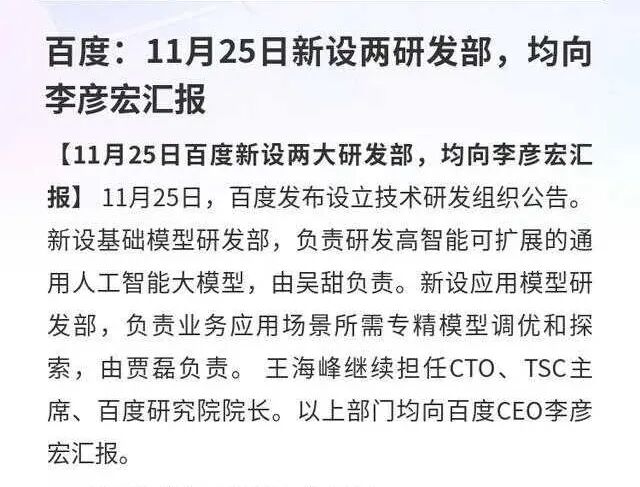
本文由 AI算法生成,仅作参考,不涉投资建议,使用风险自担 【11月25日百度新设两大研发部,均向李彦宏汇报】11月25日,百度发布设立技术研发组织公告。新设 基础模型研发部,负责研发高智能可扩展的通用人工智能大模型,由吴甜负责。新设应用模型研发部, 负责业务应用场景所需专精模型调优和探索,由贾磊负责。王海峰继续担任CTO、TSC主席、百度研究 院院长。以上部门均向百度CEO李彦宏汇报。 ...
百度新设两个大模型研发部,均直接向李彦宏汇报
Sou Hu Cai Jing· 2025-11-25 14:37
Core Insights - Baidu has announced the establishment of two new departments: the Basic Model Research Department and the Application Model Research Department, both reporting directly to CEO Robin Li [1][3] - The Basic Model Research Department will focus on developing highly intelligent and scalable general AI models, while the Application Model Research Department will specialize in fine-tuning models for specific business application scenarios [3] Group 1 - The new departments were formed by splitting the Technology Platform Group (TPG), which was previously led by Baidu's CTO Wang Haifeng [3] - Wang Haifeng continues to hold multiple roles, including CTO, Chairman of the Technical Strategy Committee, and Director of Baidu Research Institute [3] - Baidu is recognized as one of the earliest internet companies in China to invest in AI, having launched the generative AI product Wenxin Yiyan [3] Group 2 - On November 13, Baidu released the Wenxin 5.0 model, which achieved notable rankings on the LMArena evaluation platform, including second globally for text and first domestically, as well as first domestically for visual understanding [3] - Baidu's Q3 2025 financial report revealed that AI revenue grew by over 50% year-on-year, encompassing AI cloud, AI applications, and AI-native online marketing services [3]

百度新设两个大模型研发部,直接向CEO李彦宏汇报
Xin Lang Ke Ji· 2025-11-25 14:29
Core Insights - Baidu has announced the establishment of a new technology research organization, including a foundational model research department and an application model research department, aimed at enhancing its capabilities in artificial intelligence [1] Group 1: Organizational Changes - The foundational model research department will focus on developing highly intelligent and scalable general AI models, led by Wu Tian [1] - The application model research department will be responsible for fine-tuning specialized models based on business application needs, led by Jia Lei [1] - Both departments will report directly to Baidu's CEO, Li Yanhong, indicating a strategic elevation in the management hierarchy of AI research [1] Group 2: Talent Development - Wu Tian and Jia Lei are both products of Baidu's internal talent development, showcasing the company's commitment to nurturing technical and managerial talent [1] - The restructuring reflects Baidu's ongoing efforts to promote younger leadership within the organization [1] Group 3: Technological Advancements - On November 13, Baidu launched the Wenxin 5.0 model, which utilizes a native multimodal unified modeling technology and an ultra-sparse mixture of experts architecture [1] - Wenxin 5.0 supports integrated understanding and generation capabilities across various modalities, including text, images, audio, and video [1] Group 4: Competitive Performance - The Wenxin 5.0 Preview model achieved notable rankings in the global LMArena competition, securing a tie for second place globally in text and first place domestically, as well as first place domestically in visual understanding [1]
百度新设两个大模型研发部,直接向李彦宏汇报
Ju Chao Zi Xun· 2025-11-25 14:09
Core Insights - Baidu has announced the establishment of a new technical research organization, including a foundational model research department and an application model research department, aimed at enhancing its capabilities in artificial intelligence [1] Group 1: Organizational Changes - The foundational model research department will focus on developing highly intelligent and scalable general AI models, led by Wu Tian [1] - The application model research department will be responsible for fine-tuning specialized models for business applications, led by Jia Lei [1] - Wang Haifeng continues to serve as CTO, TSC Chairman, and head of Baidu Research Institute, with both new departments reporting to CEO Li Yanhong [1] Group 2: Strategic Focus - Baidu is enhancing the management level of its large model technology research departments, adopting a strategy of collaborative advancement to strengthen its core advantages in AI [1] - This restructuring aims to better meet customer and user demands in AI applications [1] Group 3: Product Development - On November 13, Baidu released the native multimodal large model, Wenxin Model 5.0, which utilizes native multimodal unified modeling technology and an ultra-sparse mixture of experts architecture [1] - The new model supports integrated understanding and generation capabilities across various information types, including text, images, audio, and video [1]