
BIDU(09888)

Search documents
于轲离职创业,李彦宏的短剧实验未满一年
Xin Lang Cai Jing· 2025-11-10 13:57
Core Insights - The departure of Yu Ke, the former head of Baidu's short drama division, raises questions about the future direction and stability of the short drama business at Baidu [1][2] - Yu Ke's leadership saw significant growth in daily active users (DAU) for short dramas, reaching 40 million within six months, driven by a strategy focused on free short dramas [1][4] - The transition of leadership to Fan Tingting, who has extensive experience in content operations, may influence the continuity and strategic direction of Baidu's short drama initiatives [1][2] Group 1: Yu Ke's Contributions - Yu Ke previously built the short drama business from the ground up at Kuaishou, implementing diverse content strategies and achieving significant commercial success [3][4] - Under Yu's leadership, Kuaishou's short drama segment saw a nearly tenfold increase in paid user numbers, with over 40% of new paying users converting from new customers [3][4] - Yu's approach emphasized quality content over mere production volume, positioning Kuaishou's short dramas as a balance of scale and quality [3] Group 2: Baidu's Short Drama Strategy - After joining Baidu, Yu Ke shifted the focus to free short dramas, leveraging Baidu's vast user base and search capabilities, which quickly made short dramas the fastest-growing content category on the platform [4][5] - Baidu's short drama strategy included a mixed monetization model of "paid to free," enhancing user engagement and content quality [4][6] - The platform has produced over 30 collaborative works with various content agencies, transitioning from exclusive self-produced content to broader distribution across platforms like Douyin [6][7] Group 3: Future Considerations - The change in leadership may lead to a reassessment of content investment and long-term collaboration confidence among partners, highlighting the need for strategic coherence amidst personnel changes [2][8] - Baidu's short drama segment, while growing, is still seen as a supplementary business rather than a core focus, primarily serving to enhance the main Baidu app's traffic [7][8] - The industry consensus suggests that content investments in large internet companies like Baidu are often evaluated based on user engagement metrics, making it challenging to quantify the return on investment for content initiatives [6][7]


百度第二次做AI眼镜,售价超过2000元
第一财经· 2025-11-10 12:50
Core Insights - Baidu has re-entered the AI glasses market with the launch of its AI Smart Glasses Pro, priced at 2299 yuan, marking its return after 11 years since its initial attempt with BaiduEye [3][5][6] - The new product focuses on features such as photography, AI translation, AI object recognition, AI reminders, and AI recording, but lacks a display function, distinguishing it from "AI + AR" glasses [3][6] - The competitive landscape is heating up with major players like Xiaomi, Huawei, and Alibaba also entering the "Hundred Glasses War," raising questions about Baidu's ability to stand out in this crowded market [6][7] Company Overview - Baidu's first foray into smart glasses was with BaiduEye in 2014, which aimed to serve as a new search interface but ultimately did not succeed due to limitations in technology and market readiness [5][6] - The current iteration, the AI Smart Glasses Pro, is positioned as an AI assistant, leveraging advancements in hardware and deep learning algorithms that have emerged in recent years [6][7] Market Dynamics - The smart glasses market in China is projected to see significant growth, with an expected shipment of 2.907 million units by 2025, representing a year-on-year increase of 121.1% [7] - Audio and audio photography glasses are anticipated to dominate this growth, with expected shipments of 2.165 million units, reflecting a 178.4% increase [7] - Despite the influx of competitors, challenges remain in AI integration, system connectivity, and user experience, indicating that the market's potential may take time to fully realize [7]


百度第二次做AI眼镜 售价超过2000元
Di Yi Cai Jing· 2025-11-10 12:16
Core Insights - Baidu has re-entered the AI glasses market with the launch of its AI Smart Glasses Pro, priced at 2299 yuan, marking its return after 11 years since its initial attempt with BaiduEye [2][3] - The new product offers features such as photography, AI translation, AI object recognition, AI reminders, and AI recording, but lacks display functionality, distinguishing it from "AI + AR" glasses [2][4] - The competitive landscape includes major players like Xiaomi, Huawei, and Alibaba, raising questions about Baidu's ability to stand out in the "hundred glasses war" [3][4] Product Features and Market Position - The AI Smart Glasses Pro's pricing exceeds that of competitors like Xiaomi and Huawei, as well as the basic model of Ray-Ban Meta priced at 299 USD [4] - The glasses are positioned as a systematic output of Baidu's AI ecosystem, leveraging its semantic understanding capabilities, search and mapping support, and years of accumulated voice interaction technology [4] - The product's market penetration may depend on improving distribution channels and enhancing online service experiences [4] Industry Trends - The "hundred glasses war" indicates a low entry barrier in the smart glasses industry, with rapid product replication possible due to mature supply chains [5] - IDC forecasts that by 2025, China's smart glasses market will reach an estimated shipment volume of 2.907 million units, with audio and audio photography glasses expected to see significant growth [4] - Despite the influx of products, challenges remain in AI integration, system connectivity, and user experience, suggesting that market growth will require time and development [5]
百度萝卜快跑启动阿布扎比全无人商业化运营
Di Yi Cai Jing· 2025-11-10 12:13
Core Insights - The company "萝卜快跑" has received the first batch of fully autonomous commercial operation licenses from the Abu Dhabi Integrated Transport Centre (ITC) [2] - This marks the company's first large-scale public deployment of fully autonomous operations outside of China [2] - The company entered the Abu Dhabi market in March 2023 and has formed a strategic partnership with the UAE autonomous driving company AutoGo to deploy sixth-generation autonomous vehicles in specific areas, aiming for full autonomous operation by 2026 [2]
百度第二次做AI眼镜,售价超过2000元
Di Yi Cai Jing Zi Xun· 2025-11-10 11:59
Core Viewpoint - Baidu has re-entered the AI glasses market with the launch of its AI Smart Glasses Pro, priced at 2299 yuan, marking its return after 11 years since its initial attempt with BaiduEye [1][3][4] Company Summary - Baidu's first foray into smart glasses began in 2014 with BaiduEye, which aimed to serve as a new search interface but ultimately did not succeed due to limitations in hardware capabilities and privacy concerns [3][4] - The new Baidu AI Smart Glasses Pro focuses on features such as photography, AI translation, AI object recognition, AI reminders, and AI recording, but lacks a display function, differentiating it from "AI + AR" glasses [1][4] - The pricing of 2299 yuan positions Baidu's product above competitors like Xiaomi and Huawei, as well as the basic model of Ray-Ban Meta priced at 299 USD [4] Industry Summary - The smart glasses market is experiencing a competitive landscape referred to as the "Hundred Glasses War," with major players like Xiaomi, Huawei, and Alibaba entering the fray [4][5] - IDC projects that by 2025, the shipment volume of smart glasses in China will reach 2.907 million units, representing a year-on-year growth of 121.1%, with audio and audio photography glasses expected to account for 2.165 million units [5] - Industry experts note that while the entry barriers are low, the core competitiveness of smart glasses extends beyond mere hardware, with challenges in AI integration, system connectivity, and user experience still needing to be addressed [5]

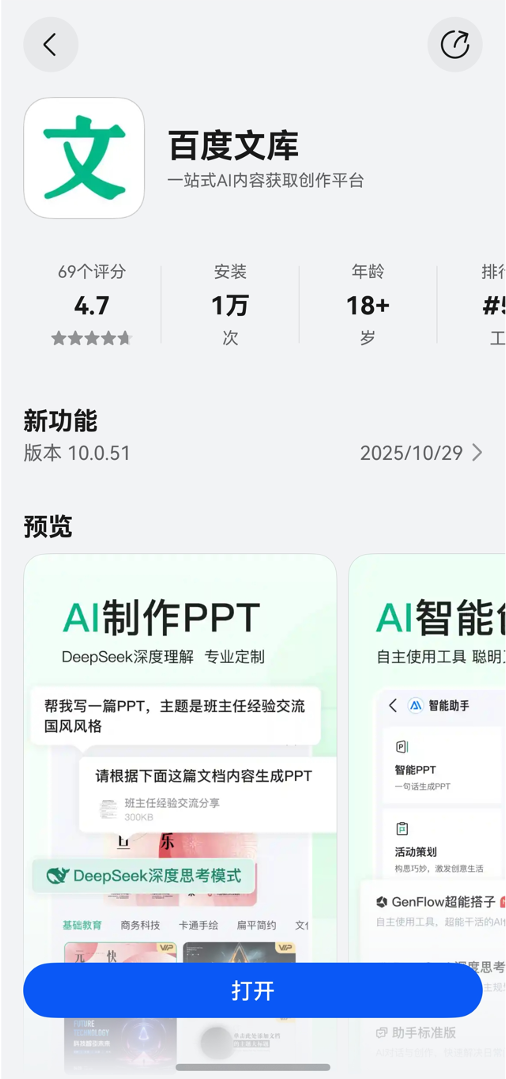
鸿蒙版百度文库上架!18亿文档+多样AI工具,让创作更专业、高效
Cai Fu Zai Xian· 2025-11-10 09:46
Core Insights - The launch of the HarmonyOS version of Baidu Wenku marks a significant advancement in the professional content domain, providing over 1.8 billion professional documents and diverse AI creation tools for users [1][3]. Group 1: Product Features - Baidu Wenku offers over 1.8 billion professional documents, including academic papers, industry reports, and teaching resources, enabling users to quickly access materials for various needs such as report writing and exam preparation [3][5]. - The platform includes comprehensive AI creation tools that support the intelligent generation of documents, presentations, mind maps, and research reports, enhancing content production efficiency [3][5]. - Users can utilize AI features for summarizing content, refining text, and rewriting, which aids in improving understanding and optimizing document quality [5][6]. Group 2: User Experience - The app allows for multi-device data synchronization, enabling users to access recently viewed, saved, and downloaded content seamlessly across devices [5][6]. - The integration of practical tools such as voice transcription, image-to-text conversion, and translation enhances efficiency in both office and learning environments [6]. - User feedback highlights the comprehensive functionality of the app, with many expressing satisfaction with its features and the long-awaited availability of the HarmonyOS version [7]. Group 3: Future Developments - Baidu Wenku plans to continue evolving with the introduction of a universal agent called "Wenku GenFlow," which will leverage multi-modal AI capabilities to provide users with a personalized AI expert team, enhancing the collaborative experience [8].
谷歌前CEO:中国正在塑造未来
Guan Cha Zhe Wang· 2025-11-10 09:33
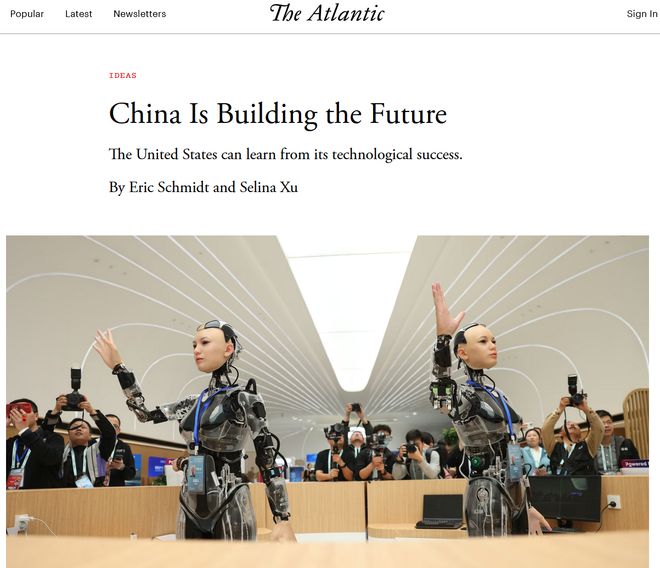
Core Viewpoint - The article emphasizes China's remarkable resilience and innovation in technology and manufacturing, showcasing its position as a global leader despite economic slowdowns [1][4][6]. Group 1: China's Technological and Manufacturing Dominance - China is the world's largest manufacturer and exporter, producing over two-thirds of global electric vehicles, four-fifths of photovoltaic components and battery cells, and approximately 60% of wind turbines [1][4]. - The country processes the majority of the world's rare earth materials, essential for various technologies from chips to military aircraft [1]. - China's industrial robot installations account for about half of the global total, with high-speed rail mileage and 5G base stations also representing over 70% and 50% of the global totals, respectively [4]. Group 2: Success Stories of Chinese Companies - Xiaomi, once seen as an imitator of Apple, has become one of China's most valuable companies with a market capitalization of approximately $150 billion and is set to launch its first electric vehicle in 2024 [4]. - Huawei has expanded from telecommunications equipment to producing automotive components, while Alibaba is developing AI inference chips for its AI models [5]. - The article highlights the importance of China's existing supply chain, infrastructure, and skilled workforce in supporting the rapid development of these companies [4][5]. Group 3: Open Source AI and Global Influence - The open-source movement in China's AI sector is flourishing, with major companies like Alibaba, ByteDance, and Baidu releasing open-source AI models, which could enhance China's technological competitiveness and attract more developers [5][6]. - China holds 70% of global AI patent authorizations and leads in clean energy technology patent applications, indicating its growing influence in these fields [6]. Group 4: Implications for the U.S. and Global Dynamics - The article suggests that if the U.S. aims for re-industrialization, it must focus on supporting research, attracting talent, and removing regulatory barriers, while acknowledging its shortcomings in hardware and AI diversity [6][7]. - A warning is issued that if the U.S. continues to adopt a hostile stance towards China, it risks becoming more closed off and protectionist, potentially losing its status as a leading global power [7].



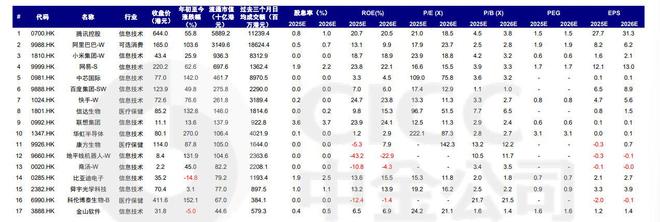
中金发布2026年港股市场展望:关注联想(00992)、腾讯(00700)、百度(09888)等
Zhi Tong Cai Jing· 2025-11-10 09:08
Core Viewpoint - The outlook for the Hong Kong stock market in 2026 is optimistic, with 2025 being characterized as a bull market driven by various factors including industry trends, fundamental improvements, and liquidity narratives [1] Group 1: Market Trends - The Chinese market in 2025 is expected to exceed expectations, driven by real industry trends such as AI and improvements in fundamentals due to fiscal stimulus and private credit recovery [1] - The Hang Seng Tech Index has seen a 30% increase, primarily attributed to risk premium contributions [1] - Notable market phenomena include simultaneous rises in assets with differing underlying logic, such as gold, dividends, and growth stocks [1] Group 2: Stock Performance - A small number of stocks (15) contributed to 70% of the index's gains, indicating a highly concentrated market performance [1] - There is a significant rotation in stock performance across sectors, with internet stocks performing well in Q1, new consumption in Q2, innovative pharmaceuticals in Q3, and a return to internet stocks in Q4 [1] Group 3: Future Considerations - The key factors driving the market's upward movement include liquidity narratives, fundamental improvements, and technology trends, with the sustainability of these factors being crucial for assessing the next steps in the bull market [1]


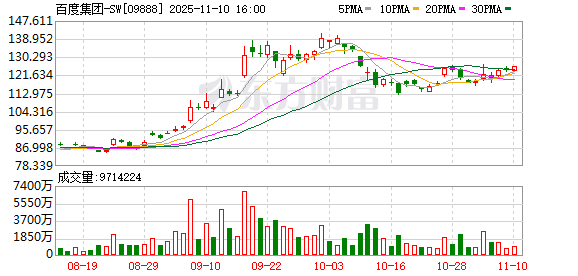
里昂:料百度集团-SW第四季收入及利润开始改善 维持“跑赢大市”评级
Zhi Tong Cai Jing· 2025-11-10 08:03
Core Viewpoint - The report from Credit Lyonnais indicates that due to the accelerated transformation towards AI search, Baidu Group's core business total revenue and adjusted EBITDA are expected to reach RMB 24.6 billion and RMB 2 billion respectively, maintaining an "outperform" rating [1] Group 1: Financial Projections - Baidu's AI-related revenue is projected to exceed 40% of its core business revenue as the AI search transformation peaks [1] - Revenue and profit are expected to show quarterly improvement starting from Q4 2025 [1] Group 2: Market Position and Future Plans - Baidu is applying for primary listing status on the Hong Kong Stock Exchange, with the earliest potential qualification for Stock Connect being March 2026 [1] - The company may begin to distribute dividends and spin off new businesses following the listing [1]
里昂:料百度集团-SW(09888)第四季收入及利润开始改善 维持“跑赢大市”评级
智通财经网· 2025-11-10 07:59
Core Viewpoint - The report from Credit Lyonnais indicates that Baidu Group's core business revenue and adjusted EBITDA are expected to reach 24.6 billion and 2 billion RMB respectively, maintaining an "outperform" rating due to the accelerated transformation towards AI search [1] Group 1: Financial Projections - Baidu's core business revenue is projected to be 24.6 billion RMB [1] - Adjusted EBITDA is expected to be 2 billion RMB [1] - Revenue and profit are anticipated to improve quarterly starting from Q4 2025 as AI-related income grows to over 40% of Baidu's core business revenue [1] Group 2: Strategic Developments - Baidu is applying for primary listing status on the Hong Kong Stock Exchange, with the earliest potential qualification for Stock Connect being March 2026 [1] - The company may begin to distribute dividends and spin off new businesses following the listing [1]