BIDU(09888)

Search documents
深夜突发!全球资产暴跌!
证券时报· 2025-10-10 15:52
Market Overview - On October 10, U.S. stock markets experienced a significant drop, with the Dow Jones down 1.03%, S&P 500 down 1.53%, and Nasdaq down 2.24% [1][2] - The Nasdaq China Golden Dragon Index fell sharply by 4.28%, with major Chinese stocks like Kingsoft Cloud down over 9%, NIO, Bilibili, Alibaba, and Xpeng down over 7%, and Baidu, Futu Holdings, and JD down over 6% [2][3] Consumer Confidence and Inflation - The preliminary consumer confidence index from the University of Michigan for October is reported at 55, the lowest since May, slightly above the forecast of 54.2 and down from the previous value of 55.1 [2] - Current personal financial conditions and future business environment perceptions improved, but expectations for future personal finances and evaluations of current durable goods purchasing conditions declined, leading to a net neutral effect [2] - Short-term inflation expectations decreased from 4.7% to 4.6%, while long-term inflation expectations remained stable at 3.7% [3] International Markets - The FTSE A50 index futures dropped over 3%, and the Hang Seng Index futures fell nearly 4% [4][6] - European stock markets also declined, with the UK FTSE 100 down nearly 1%, and both the French CAC40 and Italian MIB indices down over 1% [8] Commodity Prices - International oil prices saw a significant decline, with WTI crude oil down over 3% and Brent crude oil down nearly 3% [9] - Conversely, international gold prices rebounded, with London gold and COMEX gold rising over 1% [9] Trade Relations - In response to U.S. restrictions on Chinese shipping and shipbuilding industries, China announced countermeasures, including special port fees for U.S.-flagged vessels, effective October 14 [7]




热门中概股中,阿里巴巴、百度、京东跌超6%
Mei Ri Jing Ji Xin Wen· 2025-10-10 15:44
Core Viewpoint - Major Chinese concept stocks experienced significant declines on October 10, with Alibaba, Baidu, and JD.com dropping over 6%, Pinduoduo falling by 4%, and Xpeng, NIO, and Bilibili decreasing by over 7% [1] Company Performance - Alibaba's stock declined by over 6% [1] - Baidu's stock also fell by over 6% [1] - JD.com experienced a drop exceeding 6% [1] - Pinduoduo's stock decreased by 4% [1] - Xpeng's stock fell by over 7% [1] - NIO's stock saw a decline of over 7% [1] - Bilibili's stock dropped by over 7% [1]

2025年全网十大小程序平台深度分析报告
Sou Hu Cai Jing· 2025-10-10 15:37
Market Overview - By 2025, China's mini-program market is expected to show significant head concentration and parallel development in vertical segmentation, with user scale and ecological maturity reaching historical highs [1] - The industry landscape has evolved from the early "WeChat, Alipay, Baidu" trio to a new "big three" of "WeChat, Alipay, Douyin," with leading platforms controlling core traffic entry while vertical fields and long-tail markets release structural growth opportunities [1][3] Leading Platforms and Competitive Barriers - The current mini-program market exhibits an "one super, two strong" oligopoly structure, with WeChat dominating due to its social ecosystem, while Douyin achieves rapid growth through content scenarios [3][4] - The combined market concentration of the top three platforms (CR3) reaches 71.6%, forming a diverse traffic matrix of "social entry (WeChat) + content entry (Douyin) + service entry (Alipay)" [3] Evolution of the Landscape: Marginalization of Baidu's Search Entry Model - The early dominance of "WeChat, Alipay, Baidu" has weakened due to the replacement of search-based interaction with scenario-based interaction [4] - WeChat mini-programs have over 1 billion monthly active users, accounting for over 85% of the domestic market share, with an average daily usage frequency of nearly 70 times [4] - Douyin mini-programs have 283 million monthly active users, with an annual growth rate of 65%, capturing a market share of 22% by 2024 [4] - Alipay mini-programs maintain 890 million monthly active users, focusing on payment scenarios and commercial services, but with relatively slow growth [4] Core Conclusions - The mini-program market in 2025 will exhibit a dual-track feature of "strengthened head concentration and active long-tail innovation" [5] - Leading platforms are building competitive barriers through traffic ecosystems, while low-code technology and vertical scene innovation provide breakout paths for smaller players [5] Ranking and Core Analysis of Major Mini-Program Platforms - WeChat mini-programs lead the ecosystem with over 1 billion monthly active users, capturing over 85% of the market share, and achieving a daily active user count of 600 million [6] - Douyin mini-programs have 283 million monthly active users, with a daily usage time of 2.3 hours, benefiting from the integration of content and commerce [18] - Alipay mini-programs have 890 million monthly active users, focusing on life service scenarios and maintaining a high trust level [14] User Behavior and Scene Penetration - WeChat mini-programs cover over 200 industries, with a user behavior pattern showing a balance among entertainment, consumption, and service [13] - Douyin mini-programs leverage short video content to drive high conversion rates, with an average conversion rate of 8.2% [24] Vertical Platform Rise - Platforms like Kuaishou, Xiaohongshu, and Pinduoduo are building differentiated ecosystems based on specific scenarios, with Pinduoduo's mini-programs focusing on the lower-tier market and achieving a 210% year-on-year growth in Q1 2025 [12] - The low-code technology market is expected to exceed 10 billion by 2025, significantly lowering the entry barrier for small and medium enterprises [12] Government Services and Digital Transformation - The government service mini-programs have achieved nationwide coverage, integrating over 300 high-frequency services, and significantly improving service efficiency [50][51] - The average processing time for government services has been reduced by 75%, with a 90% reduction in the number of visits required [51] Industry Trends and Challenges - The industry is undergoing a technological transformation driven by AI and immersive experiences, with 30% of mini-programs adopting intelligent customer service [53] - Regulatory pressures are increasing, with compliance costs rising as the industry enters a "strong compliance era" [54]


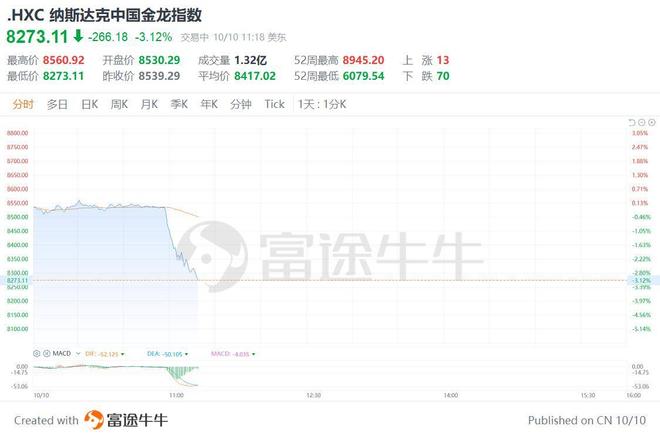
纳斯达克中国金龙指数跳水跌超3%
Ge Long Hui A P P· 2025-10-10 15:31
Core Viewpoint - The Nasdaq China Golden Dragon Index experienced a significant drop of over 3%, marking the largest decline since August 27 [1] Company Performance - Kingsoft Cloud fell by 9% [1] - GDS Holdings, Daqo New Energy, and NIO all dropped by over 7% [1] - Upstart, JinkoSolar, Xiaopeng Motors, Zhihu, and WeRide saw declines of over 6% [1] - Bilibili, Alibaba, Baidu, and JD.com each fell by over 5% [1]

建信基金|港股通基金:一键布局中国优质资产的双重机会
Xin Lang Ji Jin· 2025-10-10 09:45
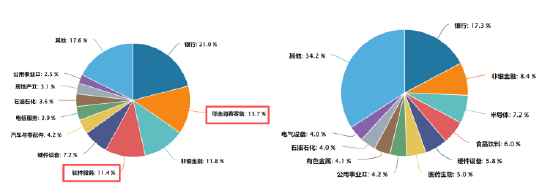
Core Insights - Hong Kong stock market has become a significant window for capturing China's growth dividends, with Hong Kong Stock Connect funds being a primary tool for investors to access this market without the need for currency exchange or separate accounts [1][2] Group 1: Investment Opportunities - Hong Kong Stock Connect funds allow investors to conveniently allocate to Hong Kong stocks without needing QDII qualifications or foreign exchange quotas [2] - The Hang Seng Index has a higher proportion of consumer discretionary and software services sectors compared to the Shanghai Composite Index, indicating a strong growth potential in these areas, particularly in new consumption and technology sectors [3] - The valuation of Hong Kong stocks is relatively low compared to other major global markets, with the Hang Seng Index's current price-to-book ratio at 51.32%, suggesting a high cost-performance ratio for investors [6] Group 2: Market Trends - Southbound capital has seen a cumulative net inflow of HKD 979 billion in 2025, a 21% increase compared to the entire year of 2024, with a focus on technology, pharmaceuticals, and consumer sectors [9] - The overall performance of Hong Kong stocks has been strong this year, driven by the revaluation of Chinese assets in sectors like new consumption, technology, and innovative pharmaceuticals [10] Group 3: Fund Selection Criteria - Investors should assess the risk characteristics of different Hong Kong Stock Connect funds to ensure alignment with their risk tolerance, noting that funds focused on technology and innovative pharmaceuticals typically carry higher risk [14] - It is essential to choose fund managers with extensive experience in Hong Kong investments to better capture investment opportunities [15] - Investors are encouraged to adopt a systematic investment approach, planning regular contributions to take advantage of market fluctuations [17][18]

港股午后加速回调,科技股领跌,恒生科技指数跌超3%,恒指跌1.8%!中芯国际跌近7%,华虹半导体、百度、快手跌超5%




Ge Long Hui· 2025-10-10 06:46
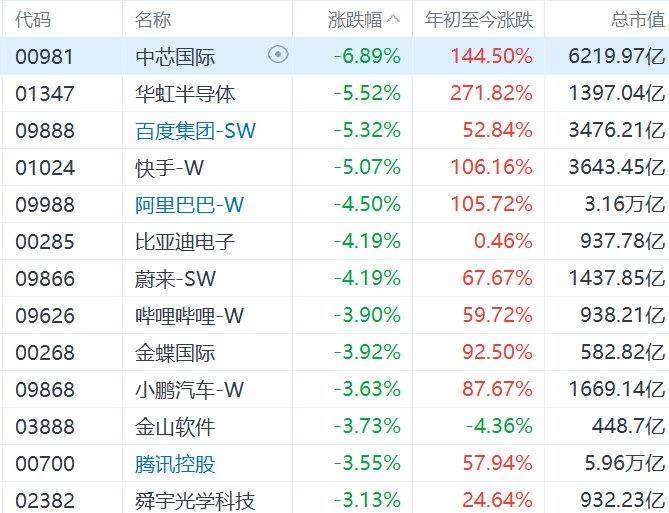
Core Viewpoint - The Hong Kong stock market experienced a significant decline in the afternoon session, with technology stocks leading the drop, as the Hang Seng Technology Index fell over 3% and the Hang Seng Index dropped by 1.8% [1] Group 1: Market Performance - The Hang Seng Technology Index decreased by more than 3% [1] - The Hang Seng Index fell by 1.8% [1] Group 2: Individual Stock Movements - Semiconductor stocks were notably affected, with SMIC (中芯国际) dropping nearly 7% and Hua Hong Semiconductor (华虹半导体) falling by 5.52% [1][2] - Other major declines included Baidu (百度) down 5.32%, Kuaishou (快手) down 5.07%, and Alibaba (阿里巴巴) down 4.50% [1][2] - NIO (蔚来) and Bilibili (哔哩哔哩) both saw declines of 4.19% and 3.90% respectively [2] - Tencent (腾讯) and Sunny Optical Technology (舜宇光学科技) also experienced drops of 3.55% and 3.13% respectively [2] Group 3: Year-to-Date Performance - Despite the recent declines, SMIC has seen a year-to-date increase of 144.50% [2] - Hua Hong Semiconductor has increased by 271.82% year-to-date [2] - Baidu and Kuaishou have also shown positive year-to-date performance, with increases of 52.84% and 106.16% respectively [2] - Alibaba's year-to-date increase stands at 105.72% [2]
Asia Markets Grapple with China’s Export Curbs, Geopolitical Tensions, and Tech Volatility
Stock Market News· 2025-10-10 03:38
Group 1: China's Industrial Policies and Market Impact - China is implementing new export controls on technologies essential for electric vehicle (EV) battery production and rare-earth materials, requiring government approvals for related exports, aimed at protecting intellectual property and maintaining strategic advantages [3] - Tesla is viewed as the top U.S. automaker positioned to navigate China's rare-earth restrictions due to its significant manufacturing presence in Shanghai, which provides insulation from potential supply constraints [4] Group 2: Hong Kong's Financial Developments - The offshore RMB overnight HIBOR has surged by 107 basis points to 2.45182%, indicating tightening liquidity in the offshore yuan market, marking its highest level since April 7 [5] - HashKey Group, operator of Hong Kong's largest licensed crypto exchange, has filed for an Initial Public Offering (IPO) aiming to raise up to $500 million, reflecting the evolving regulatory environment in Hong Kong that supports crypto asset innovation [6] Group 3: Chinese Tech Sector Performance - Baidu's shares have declined over 5%, contributing to a broader drop in Chinese ADRs, as the Nasdaq Golden Dragon China Index fell 2%, indicating mixed market performance and profit-taking after a strong rally [7] - JD Logistics is acquiring a 36.43% stake in Kuayue-Express for up to $892 million, enhancing its on-demand delivery capabilities and competitiveness in the express logistics sector [9] Group 4: Commodity Markets and Consumer Demand - Iron ore prices have risen due to restocking at Chinese steel mills, but profit margins are under pressure from high coke prices and potential trade restrictions on steel [10] - Demand for China's baijiu is slow to recover, with a 20% year-on-year decline in holiday sell-through during the recent Golden Week, indicating challenges in the consumer market [11] Group 5: Taiwan's Defense Strategy - Taiwan is accelerating AI-powered defense upgrades and increasing military spending to counter threats from China, with plans to enhance its air defense system and develop a "Smart Defence Combat System" [12][13] - The government aims to increase defense spending to 5% of GDP by 2030, up from a proposed 3.32% for the next year, amidst U.S. pressure for Taiwan to bolster its defense capabilities [13]

中芯国际、蔚来、小鹏、百度、小米,集体下跌!
Di Yi Cai Jing Zi Xun· 2025-10-10 02:22
Core Viewpoint - The Hang Seng Technology Index and the Hang Seng Index experienced significant declines, indicating a bearish sentiment in the market [1] Company Performance - SMIC (Semiconductor Manufacturing International Corporation) saw a drop of over 5.5% [1] - NIO and Xpeng Motors both fell nearly 5% [1] - Baidu Group and Hua Hong Semiconductor declined by more than 3% [1] - Xiaomi Group and Bilibili experienced a decrease of over 2% [1]

中芯国际、蔚来、小鹏、百度、小米,集体下跌!
第一财经· 2025-10-10 02:12
Group 1 - The Hang Seng Technology Index fell over 2% in early trading on October 10, indicating a negative market sentiment towards technology stocks [1] - The Hang Seng Index also experienced a decline of more than 1%, reflecting broader market weakness [1] - Notable declines were observed in several companies, with SMIC down over 5.5%, NIO and Xpeng both dropping nearly 5%, and Baidu and Hua Hong Semiconductor falling over 3% [1]


港股早评:三大指数低开 科技股普跌 金叶国际集团首日上市高开500%
Ge Long Hui· 2025-10-10 01:42
Market Overview - US stock indices collectively declined overnight, with the Chinese concept index dropping by 2.03% [1] - Hong Kong's three major indices opened lower, with the Hang Seng Index down by 0.85%, the National Index down by 0.94%, and the Hang Seng Tech Index down by 1.4% [1] Sector Performance - Major technology stocks experienced a collective decline, with Alibaba, Baidu, and JD.com falling over 2%, and NetEase, Kuaishou, Meituan, and Xiaomi dropping over 1% [1] - Tencent saw a decrease of 0.96% [1] - Gold stocks led the decline in the non-ferrous metal sector, with China Gold International, Zijin Mining International, and Shandong Gold each falling nearly 4% [1] - Lithium battery stocks, automotive stocks, home appliance stocks, semiconductor stocks, Chinese brokerage stocks, and biopharmaceutical stocks also saw declines [1] Rising Stocks - Conversely, telecom equipment stocks, new consumption concept stocks, and rare earth concept stocks generally rose, with ZTE Corporation increasing by 3.4% and Jinli Permanent Magnet and Hu Shang Ayi rising over 2.4% [1] New Listings - Two new stocks debuted on the Hong Kong market, with Jinye International Group opening 500% higher, achieving an oversubscription rate of over 9030 times, marking the highest oversubscription rate for a new stock in Hong Kong history [1] - Zhida Technology opened 183% higher, with a global offering of 597.89 million shares, where the Hong Kong public offering accounted for 10% and international offering for 90% [1]