
AKESO(09926)

Search documents
吸引力显著增强!摩根士丹利:中国创新药“出海”大时代拉开帷幕
券商中国· 2025-08-25 04:00
Core Insights - The article highlights the significant transformation occurring in China's biotechnology sector, driven by international investor interest and the competitive advantages of Chinese biotech companies [2][5]. Group 1: Investment Trends - Morgan Stanley has sponsored notable IPOs in the Hong Kong market, including projects from companies like Heng Rui Medicine and Ying En Biology, and has facilitated multiple refinancing projects totaling billions [1][3]. - The Hong Kong Stock Exchange has emerged as the world's second-largest biotechnology financing center, with 12 healthcare companies raising a total of $2.5 billion in the first half of 2025 [3]. - New listings have shown strong market performance, with an average first-day increase of 23.1% for the 12 healthcare companies [3]. Group 2: Financing Activities - Morgan Stanley has assisted Chinese issuers in raising over $5 billion in financing by the end of July, with notable projects including WuXi AppTec's $980 million share placement [4]. - The financing activities reflect a growing demand for biotech stocks, with significant oversubscription and reduced discount rates for recent offerings [4]. Group 3: Global Expansion of Chinese Biotech - Chinese biotech companies are increasingly pursuing international clinical registrations and market entries, with a notable rise in "License-out" agreements [5][6]. - The gap in innovation capabilities between Chinese and U.S. biotech firms has narrowed, with Chinese companies demonstrating significant advancements in drug development efficiency and cost [5][6]. - The total value of transactions related to antibody-drug conjugates (ADCs) has reached approximately $44 billion, indicating robust international collaboration [6]. Group 4: Strategic Collaborations - Chinese biotech firms are forming strategic partnerships with international giants, exemplified by Heng Rui Medicine's $12.5 billion deal with GlaxoSmithKline [6][7]. - The collaboration models are evolving from simple licensing to joint development and new company formations, showcasing increased confidence in Chinese biotech capabilities [6][7]. Group 5: Future Outlook and Challenges - The article emphasizes the need for Chinese biotech companies to overcome regulatory complexities and market entry barriers to enhance their global presence [8][9]. - Recommendations include building international talent teams, improving communication with regulatory bodies, and optimizing government support for innovation [9].





新药周观点:WCLC、ESMO即将召开,多个数据披露催化值得关注-20250824
Guotou Securities· 2025-08-24 13:33
Investment Rating - The report maintains an investment rating of "Outperform" [5] Core Insights - The new drug sector has shown significant price movements, with notable gains from companies such as Beihai Kangcheng (+35.52%) and Jiahua Biological (+24.66%) during the week of August 18 to August 22, 2025 [1][16] - Upcoming academic conferences, including WCLC and ESMO, are expected to be key catalysts for the innovative drug sector, with numerous data disclosures anticipated from domestic companies [2][3][20] Summary by Sections Weekly New Drug Market Review - The new drug sector experienced substantial fluctuations, with the top five gainers being Beihai Kangcheng (+35.52%), Jiahua Biological (+24.66%), and others, while the top five losers included Geely Pharmaceutical (-16.29%) and Weichip Bio (-10.40%) [1][16] Recommended Stocks - The report suggests focusing on several potential catalysts, including overseas licensing opportunities for differentiated GLP-1 assets and upgraded PD-1 products, as well as drugs likely to benefit from medical insurance negotiations and innovative drug directories [2][20] Key Industry Analysis - Academic conferences are highlighted as crucial catalysts for the innovative drug sector, with WCLC and ESMO being particularly significant for Chinese pharmaceutical companies [20][21] New Drug Approval and Acceptance Status - No new drug approvals were reported for the week, but five new drug applications were accepted, including those from Janssen and AstraZeneca [27][28] Clinical Application Approval and Acceptance Status - A total of 47 new drug clinical applications were approved, and 28 new drug clinical applications were accepted during the week [29][30]
康方生物涨超5%创新高 AK111治疗强直性脊柱炎III期临床研究达到全部疗效终点
Zhi Tong Cai Jing· 2025-08-22 03:48
Core Viewpoint - Kangfang Biopharma (09926) shares rose over 5%, reaching a new high of 177.9 HKD, following positive results from a key Phase III clinical trial for its novel humanized anti-IL-17A monoclonal antibody, AK111, in treating active ankylosing spondylitis (AS) [1] Group 1: Clinical Trial Results - The Phase III clinical trial for AK111 demonstrated positive results, achieving primary efficacy endpoints ASAS20 and ASAS40, along with several pre-specified secondary endpoints, all showing statistical significance and clinical relevance [1] Group 2: Financial Projections - According to Minsheng Securities, the company's product sales revenue is projected to reach 2.002 billion CNY in 2024, representing a year-on-year growth of 24.88% [1] - The two core products, Cadonilimab and Ivorisumab, are expected to be included in the national medical insurance catalog by the end of 2024, which will accelerate hospital access and coverage efforts [1] Group 3: Product Pipeline - The company’s non-oncology product, Inusumab, has been approved for market launch, and the commercialization process for future products like Ivorisumab (under NDA review) and AK111 (under NDA review) is expected to accelerate [1]
港股异动 | 康方生物(09926)涨超5%创新高 AK111治疗强直性脊柱炎III期临床研究达到全部疗效终点
Zhi Tong Cai Jing· 2025-08-22 03:37
Core Viewpoint - 康方生物's stock price increased over 5%, reaching a new high of 177.9 HKD, following positive results from its Phase III clinical trial for AK111 in treating ankylosing spondylitis [1] Group 1: Clinical Research Results - 康方生物 announced that its novel humanized anti-IL-17A monoclonal antibody, AK111, achieved positive results in its Phase III clinical trial for active ankylosing spondylitis, meeting all primary efficacy endpoints including ASAS20 and ASAS40, along with several pre-specified secondary endpoints, demonstrating statistical significance and clinical relevance [1] Group 2: Financial Projections - According to Minsheng Securities, 康方生物 is projected to achieve product sales revenue of 2.002 billion CNY in 2024, representing a year-on-year growth of 24.88% [1] - The company's two core products, 卡度尼利单抗 and 依沃西单抗, are expected to be included in the national medical insurance directory by the end of 2024, which will accelerate hospital access and coverage efforts [1] Group 3: Product Development and Commercialization - 康方生物's non-oncology product, 伊努西单抗, has been approved for market launch, and the commercialization process for other non-oncology products, including 依若奇单抗 and 古莫奇单抗, is expected to accelerate as they undergo NDA review [1]
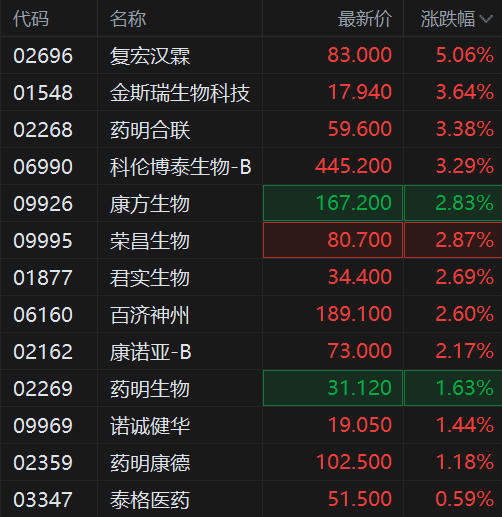
港股异动丨生物医药股普涨 复宏汉霖涨5% 百济神州涨约3%
Ge Long Hui· 2025-08-21 02:03
Core Viewpoint - The Hong Kong biopharmaceutical stocks experienced a general increase, driven by government support for the industry, particularly emphasized by Premier Li Qiang during his recent visit to Beijing [1] Industry Summary - The biopharmaceutical sector in Hong Kong saw significant stock price increases, with notable gains including 5% for Fuhong Hanlin, 3.6% for King’s Ray Biopharmaceutical, and over 3% for WuXi AppTec [1] - Premier Li Qiang highlighted the need for enhanced high-quality technological supply and policy support to promote the development of the biopharmaceutical industry, aiming to produce more high-quality and efficient new drugs [1] - Continuous high-level endorsements from the government signal a strong commitment to supporting the biopharmaceutical industry, especially in the current economic context [1] Company Summary - Fuhong Hanlin (02696) latest price: 83.000, change: +5.06% [1] - King’s Ray Biopharmaceutical (01548) latest price: 17.940, change: +3.64% [1] - WuXi AppTec (02268) latest price: 59.600, change: +3.38% [1] - Other companies with notable increases include: - Keren Biotechnology (06990) +3.29% - Kangfang Biopharmaceutical (09926) +2.83% - Rongchang Biopharmaceutical (09995) +2.87% - Junshi Biosciences (01877) +2.69% - BeiGene (06160) +2.60% [1]

智通港股通资金流向统计(T+2)|8月19日
智通财经网· 2025-08-18 23:37
Key Points - The top three stocks with net inflows from southbound funds are China Life (02628) with 1.58 billion, Southern Hang Seng Technology (03033) with 768 million, and Alibaba-W (09988) with 452 million [1][2] - The top three stocks with net outflows are Tencent Holdings (00700) with -1.20 billion, Anta Sports (02020) with -697 million, and Rongchang Biopharmaceutical (09995) with -584 million [1][2] - In terms of net inflow ratio, Datang Renewable (01798) leads with 74.45%, followed by Shenzhen Expressway (00548) with 50.53%, and Bosideng (03998) with 50.23% [1][3] - The top three stocks with the highest net outflow ratios are Chongqing Rural Commercial Bank (03618) at -58.46%, Kington Services (09666) at -54.34%, and Poly Property Group (00119) at -51.88% [1][3] Net Inflow Rankings - The top ten stocks by net inflow include: - China Life (02628): 1.58 billion, 34.91% increase, closing price 23.620 (+3.60%) [2] - Southern Hang Seng Technology (03033): 768 million, 14.65% increase, closing price 5.475 (-0.90%) [2] - Alibaba-W (09988): 452 million, 4.38% increase, closing price 121.800 (-1.54%) [2] - Other notable stocks include Li Auto-W (02015) with 349 million and AIA Group (01299) with 317 million [2] Net Outflow Rankings - The top ten stocks by net outflow include: - Tencent Holdings (00700): -1.20 billion, -5.56% decrease, closing price 590.000 (+0.68%) [2] - Anta Sports (02020): -697 million, -40.49% decrease, closing price 92.450 (+2.72%) [2] - Rongchang Biopharmaceutical (09995): -584 million, -33.65% decrease, closing price 77.450 (+13.65%) [2] - Other notable stocks include Meituan-W (03690) with -387 million and China Construction Bank (00939) with -366 million [2] Net Inflow Ratio Rankings - The top stocks by net inflow ratio include: - Datang Renewable (01798): 74.45%, net inflow of 14.5175 million, closing price 2.360 (+0.85%) [3] - Shenzhen Expressway (00548): 50.53%, net inflow of 8.719 million, closing price 7.020 (0.00%) [3] - Bosideng (03998): 50.23%, net inflow of 6.728 million, closing price 4.630 (+0.65%) [3]




瑞银:将康方生物(09926)加入亚太主要推荐股票名单 上调目标价至224.3港元
智通财经网· 2025-08-18 07:52
Core Viewpoint - UBS has added Kangfang Biotech (09926) to its list of major recommended stocks in the Asia-Pacific region, citing that the overseas potential of its main asset, Edafo, is not fully reflected in the stock price [1] Group 1: Company Analysis - UBS believes that reports of potential collaborations with multinational companies and the upcoming HARMONi study presentation at the 2025 World Lung Cancer Congress will serve as positive catalysts for the stock price [1] - The target price for Kangfang Biotech has been raised from HKD 197.5 to HKD 224.3, with a "Buy" rating assigned [1] - The valuation of Kangfang Biotech is approximately at the median of the biotech stocks covered by UBS, indicating potential for further outperformance [1] Group 2: Sales Forecasts - UBS has increased its peak sales estimate for Edafo from USD 14.6 billion to USD 16.3 billion [1] - The peak sales estimate for another key asset, Kantani, has been raised from USD 2.2 billion to USD 3.4 billion [1]
康方生物涨超4%破顶 公司具备多项正面催化剂 瑞银上调目标价至224.3港元
Zhi Tong Cai Jing· 2025-08-18 07:05
Group 1 - Kangfang Biotech (09926) shares rose over 4%, reaching a new high of 173.8 HKD, with a trading volume of 1.212 billion HKD [1] - The 2025 World Lung Cancer Conference (WCLC) will take place from September 6 to 9 in Barcelona, Spain, where Kangfang's partner Summit Therapeutics will present the results of the HARMONi study, a pivotal Phase III clinical trial for the PD-1/VEGF bispecific antibody drug, Ivoris [1] Group 2 - UBS has added Kangfang Biotech to its list of major recommended stocks in the Asia-Pacific region, citing the overseas potential of its main asset, Ivoris, which is not fully reflected in the stock price [2] - The firm believes that reports of potential collaborations with multinational companies and the upcoming HARMONi study results will act as positive catalysts for the stock price [2] - UBS raised its peak sales forecast for Ivoris from 14.6 billion USD to 16.3 billion USD and for another key asset, Kantan, from 2.2 billion USD to 3.4 billion USD, increasing the target price from 197.5 HKD to 224.3 HKD with a "Buy" rating [2]
港股异动 | 康方生物(09926)涨超4%破顶 公司具备多项正面催化剂 瑞银上调目标价至224.3港元
智通财经网· 2025-08-18 07:04
Group 1 - 康方生物's stock price increased over 4%, reaching a new high of 173.8 HKD, with a trading volume of 1.212 billion HKD [1] - The 2025 World Lung Cancer Conference (WCLC) will take place in Barcelona, Spain, where 康方生物's partner Summit Therapeutics will present the results of the HARMONi study, a pivotal Phase III clinical trial for the PD-1/VEGF bispecific antibody drug [1] Group 2 - UBS has added 康方生物 to its list of major recommended stocks in the Asia-Pacific region, citing the overseas potential of its main asset, Edafo, which is not fully reflected in the stock price [2] - The firm believes that news regarding potential collaborations with multinational companies and the upcoming HARMONi study results will act as positive catalysts for the stock price [2] - UBS raised its peak sales forecast for Edafo from 14.6 billion USD to 16.3 billion USD and for another key asset, Okan, from 2.2 billion USD to 3.4 billion USD, while increasing the target price from 197.5 HKD to 224.3 HKD with a "Buy" rating [2]
大行评级|瑞银:上调康方生物目标价至224.3港元 加入亚太主要推荐股票名单
Ge Long Hui· 2025-08-18 05:55
Core Viewpoint - UBS has added Kangfang Biopharma to its list of major recommended stocks in the Asia-Pacific region, believing that the overseas potential of its key asset, Edafo, is not fully reflected in its stock price [1] Group 1: Company Potential - UBS highlights that reports of potential collaborations with multinational companies and the upcoming HARMONi study presentation at the 2025 World Lung Cancer Congress serve as positive catalysts for the stock price [1] - The company is also advancing the global registration and research of another key asset, Okanani [1] Group 2: Financial Estimates - UBS has raised its peak sales forecast for Edafo from $14.6 billion to $16.3 billion and for Okanani from $2.2 billion to $3.4 billion [1] - The target price for Kangfang Biopharma has been increased from HKD 197.5 to HKD 224.3, maintaining a "Buy" rating [1]