
TRIP.COM(09961)

Search documents
智通ADR统计 | 10月1日
智通财经网· 2025-09-30 22:59
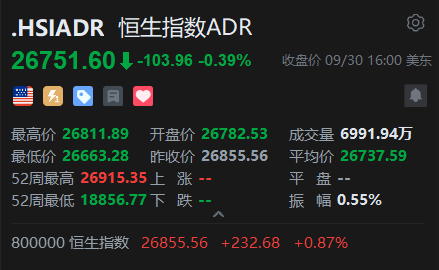
Market Overview - The Hang Seng Index (HSI) closed at 26,751.60, down by 103.96 points or 0.39% as of September 30, 16:00 Eastern Time [1] - The index reached a high of 26,811.89 and a low of 26,663.28 during the trading session, with an average price of 26,737.59 [1] - The 52-week high for the index is 26,915.35, while the 52-week low is 18,856.77, indicating a trading range of 0.55% for the day [1] Blue-Chip Stocks Performance - Major blue-chip stocks mostly declined, with HSBC Holdings closing at HKD 110.477, up by 0.98% compared to the Hong Kong close [2] - Tencent Holdings closed at HKD 662.66, down by 0.05% compared to the Hong Kong close [2] Individual Stock Movements - Tencent Holdings (00700) saw a price increase of HKD 3.00, or 0.45%, with an ADR price of HKD 662.660, which is a decrease of HKD 0.340 compared to its Hong Kong price [3] - Alibaba Group (09988) increased by HKD 3.60, or 2.08%, with an ADR price of HKD 173.866, down HKD 3.134 from its Hong Kong price [3] - HSBC Holdings (00005) rose by HKD 0.60, or 0.55%, with an ADR price of HKD 110.477, up HKD 1.077 from its Hong Kong price [3] - Other notable movements include Kuaishou (01024) increasing by HKD 5.70, or 7.22%, and BYD Company (01211) rising by HKD 1.60, or 1.47% [3]

携程集团副总裁许一心:推动恶意差评治理,鼓励酒店对可疑不当行为进行主动反馈
Bei Jing Shang Bao· 2025-09-30 13:08
Group 1 - The core viewpoint of the article is that Ctrip is implementing measures to combat malicious hotel reviews to promote higher quality and sustainable development in the hotel industry [1] - Ctrip's Vice President highlighted the growing influence of online reviews and the emergence of "professional negative reviewers" who disrupt fair competition and affect the credibility of genuine user feedback [1] - Ctrip encourages hotels to proactively report suspicious behaviors, allowing them to refuse extortion attempts and ensuring that malicious reviews do not count towards the hotel's overall rating [1] Group 2 - Ctrip will fully upgrade its hotel review governance mechanism starting October 22, focusing on combating malicious reviews and extortion by professional negative reviewers [1] - The application of AI technology in identifying and defining malicious reviews involves analyzing hotel reports in conjunction with multidimensional data from the platform, including order characteristics and related complaint features [2] - The AI system is designed to learn and identify abnormal and potentially malicious behavior patterns from vast amounts of data, focusing on concentrated and high-frequency abnormal review patterns [2]
中秋国庆出游火爆,旅游产业链都有哪些投资机会?
智通财经网· 2025-09-30 07:21
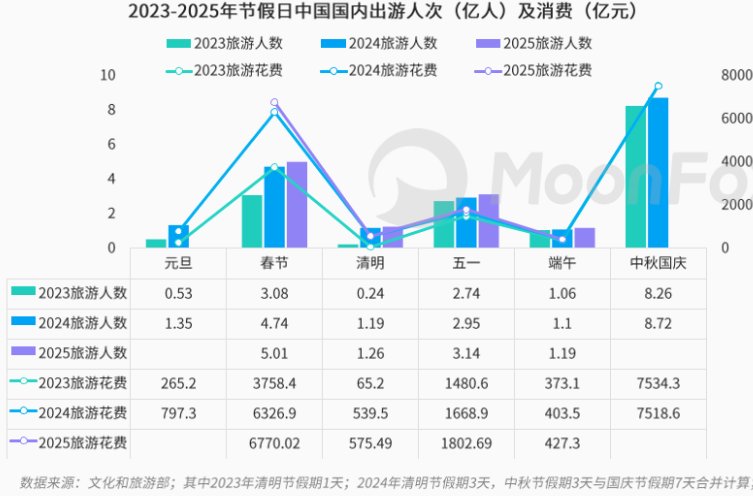
Core Insights - The tourism industry has been experiencing a strong recovery since 2022, with a double-digit compound growth rate in tourist numbers, and is expected to maintain high growth into 2025 [1][2] - Major holidays in 2025, including the upcoming National Day, have seen record-high travel enthusiasm, with significant increases in both domestic and international travel bookings [1][2] - The recovery in the tourism sector is anticipated to create investment opportunities, particularly in the OTA (Online Travel Agency) sector, with companies like Ctrip and Tongcheng Travel showing substantial stock price increases [1][7] Industry Trends - Domestic tourism in China has shown a remarkable increase, with 3.285 billion trips taken in the first three quarters of 2025, reflecting a year-on-year growth of 20.6% [2] - International tourism is also recovering, with 690 million international tourists globally in the first half of the year, a 5% increase, largely driven by China's performance [2] - The trend of mass tourism is evident, with a notable rise in travel from lower-tier cities, as rural tourism outpaces urban tourism growth [4] Structural Changes - The tourism structure is being reshaped, with a focus on experiential travel and innovative tourism models, such as high-end customized tours and luxury cruises [5] - AI technology is evolving within the industry, leading to the emergence of new demand avenues and enhancing user experiences across the tourism value chain [5][6] - Government policies are increasingly supportive, with measures aimed at fostering cultural and tourism consumption, contributing to the sector's stability and growth [6] Investment Opportunities - The ongoing recovery in the tourism sector and the rise of AI in travel are creating investment opportunities, particularly for leading companies in the OTA space like Ctrip and Tongcheng Travel [7][9] - Ctrip has shown robust growth in its accommodation and transportation booking segments, with revenue growth exceeding 20% [7] - Tongcheng Travel has become a major player in the lower-tier city market, with 87% of its registered users coming from non-first-tier cities, and has maintained double-digit growth in its core business segments [8]
“算法之手”任性改价 住客酒店两头“叫苦” ——部分旅游预订平台“调价助手”问题调查
Xin Hua Wang· 2025-09-30 06:50
Core Viewpoint - The article highlights the manipulation of hotel prices on travel booking platforms, driven by an algorithmic tool called "Price Adjustment Assistant," which undermines the pricing autonomy of small and medium-sized businesses while consolidating the market power of these platforms [2][5][8]. Group 1: Price Fluctuations and Consumer Experience - Consumers have reported erratic price changes on booking platforms, leading to suspicions of unfair practices [3][4]. - Many users feel that the price variations do not align with market demand, and some have expressed frustration over not receiving the expected value for their expenditures [3][4]. - Hotel operators have also experienced unexpected price adjustments made by platforms, which they claim result in financial losses [4][5]. Group 2: Impact on Small and Medium-Sized Businesses - The "Price Adjustment Assistant" tool allows platforms to automatically modify hotel prices without notifying the operators, impacting their business operations [4][5]. - Some hotel owners have reported that their prices are adjusted to be lower than competitors, often without their consent, which can lead to unsustainable business practices [4][6]. - The platforms' commission rates, typically ranging from 10% to 15%, further exacerbate the financial strain on these businesses [6][8]. Group 3: Regulatory Concerns and Market Dynamics - Regulatory bodies have begun to take action against platforms like Ctrip for violating e-commerce laws and engaging in unfair competition practices [5][8]. - The article discusses the dual role of platforms as both arbiters and participants in the market, which creates a conflict of interest and can lead to market chaos [7][8]. - Experts suggest that new regulations aimed at curbing unfair competition will take effect soon, which may help restore balance in the market [8][9]. Group 4: Recommendations for Improvement - Industry experts recommend that regulatory authorities conduct audits of platform algorithms to ensure compliance with market regulations and to understand the extent of data manipulation [9]. - There is a call for platforms to enhance user experience while also addressing the legitimate concerns of small and medium-sized businesses [8][9].

智通ADR统计 | 9月30日





智通财经网· 2025-09-29 22:56
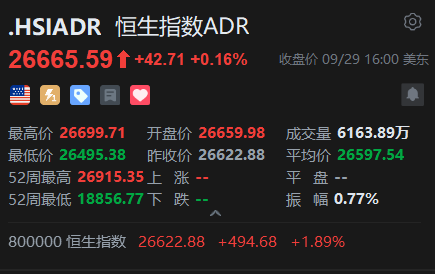
Market Overview - The Hang Seng Index (HSI) closed at 26,665.59, up by 42.71 points or 0.16% on September 29 [1] - The index reached a high of 26,699.71 and a low of 26,495.38 during the trading session, with a trading volume of 61.6389 million [1] - The 52-week high for the index is 26,915.35, while the 52-week low is 18,856.77, indicating a trading range of 0.77% [1] Major Blue-Chip Stocks Performance - HSBC Holdings closed at HKD 109.701, up 0.83% from the previous close [2] - Tencent Holdings closed at HKD 661.446, reflecting a 0.22% increase from the previous close [2] ADR and Stock Price Movements - Tencent Holdings (ADR) increased by 2.48% to HKD 660.000, with an ADR conversion price of HKD 661.446, showing a rise of HKD 1.446 compared to its Hong Kong stock price [3] - Alibaba Group (ADR) rose by 4.14% to HKD 173.400, with an ADR conversion price of HKD 175.032, indicating an increase of HKD 1.632 [3] - HSBC Holdings (ADR) saw a 1.97% increase to HKD 108.800, with an ADR conversion price of HKD 109.701, up by HKD 0.901 [3] - Other notable movements include a 2.66% increase for Trip.com Group and a 3.09% increase for JD.com [3]
港股科网股午后震荡走高,快手涨超4%
Mei Ri Jing Ji Xin Wen· 2025-09-29 06:41
每经AI快讯,9月29日,港股科网股午后震荡走高,阿里巴巴(09988.HK)、快手(01024.HK)均涨超4%, 腾讯控股(00700.HK)涨超3%,携程集团-S(09961.HK)、美团(03690.HK)、百度(09888.HK)、网易 (09999.HK)等个股跟涨。 ...


中秋国庆旅游市场迎热潮深度体验成主流
Zhong Guo Zheng Quan Bao· 2025-09-28 20:46
Core Insights - The upcoming "super golden week" during the Mid-Autumn and National Day holidays is expected to significantly boost travel demand, with a notable increase in cross-province and outbound travel bookings compared to last year [1][2][5] - Travelers are increasingly prioritizing travel experiences over mere sightseeing, focusing on emotional value, time efficiency, and cost-effectiveness in their travel decisions [1][2] Travel Preferences Transformation - Cross-province travel orders have surged by 45% year-on-year, with travelers favoring destinations that offer rich experiences within limited time [1] - Orders for inter-provincial border cities have increased by 58%, with specific cities like Zhaotong and Hezhou seeing growth rates of 95% and 88% respectively [1] Emotional Value and Experience Focus - Emotional value is becoming a core factor in destination selection, with a shift from "check-in tourism" to "immersive vacations" [2] - Hotel searches for long-distance destinations have risen by 60%, indicating a demand for nature and wellness experiences [2] Cost-Effectiveness Pursuit - The trend of flexible travel dates and cost-effective options is evident, with some destinations still offering lower prices compared to last year [2][3] - Travelers are increasingly opting for "late departure and return" strategies, with significant savings on airfare [3] Diverse Travel Modes - The preference for group travel has led to a rise in multi-room and multi-bed accommodation bookings, with a 1.6 times increase in SUV and business vehicle rentals [4] - Family travel demand has surged, reflected in a 1.7 times increase in rentals equipped with baby seats [4] Outbound and Inbound Travel Growth - Both outbound and inbound travel markets are experiencing strong growth, with popular short-haul destinations like Japan and Thailand leading the way [4][5] - Long-distance outbound travel is gaining traction, with countries like Uzbekistan and Georgia emerging as new popular destinations [5] - The recent visa-free policies between China and Russia have resulted in a 75% year-on-year increase in Russian tourist bookings to China [5]
携程、去哪儿等平台回应“抢票加速包是噱头”
新浪财经· 2025-09-27 06:35
Core Viewpoint - The investigation by Jiangsu Consumer Protection Committee reveals that third-party train ticket platforms' "acceleration packages" do not effectively increase ticket purchasing success rates, as all requests must ultimately queue through the official 12306 system [2][4][6]. Group 1: Investigation Findings - Nine third-party platforms were investigated, all claiming that purchasing "acceleration packages" could enhance ticket success rates, but the actual experience showed that 12306 was the first to issue tickets [2]. - Prices for these "acceleration packages" range from 48 to 60 yuan, marketed under names like "all-in-one ticket" and "worry-free ticket" [2][7]. - 12306's official response indicates that they do not provide acceleration services and have not authorized third-party platforms, which cannot guarantee faster ticket acquisition [4][6]. Group 2: Customer Responses and Behavior - Despite over 30% of surveyed consumers expressing doubts about the effectiveness of "acceleration packages," many still purchase them due to anxiety over ticket availability [11]. - Consumers indicated that the pressure to secure tickets leads them to consider these packages, even when they are aware of their questionable efficacy [11]. Group 3: Legal Perspectives - Legal experts suggest that if third-party platforms exaggerate the effectiveness of "acceleration packages," they may be guilty of false advertising and could face legal consequences [13][14]. - The potential for these services to disrupt fair competition and market order raises concerns about their legality and ethical implications [13][14].

智通ADR统计|9月27日
智通财经网· 2025-09-27 00:06
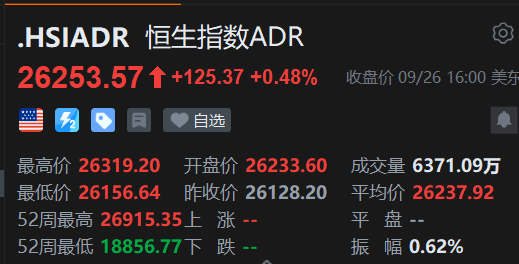
Market Overview - The Hang Seng Index (HSI) closed at 26,253.57, up by 125.37 points or 0.48% as of September 26, 16:00 [1] - The index reached a high of 26,319.20 and a low of 26,156.64 during the trading session, with a trading volume of 63.71 million [1] Major Blue-Chip Stocks Performance - HSBC Holdings closed at HKD 108.633, an increase of 1.081% from the previous close [2] - Tencent Holdings closed at HKD 648.733, up by 0.73% compared to the last trading session [2] ADR Performance Summary - Tencent Holdings (ADR: TCEHY) increased by HKD 4.733, or 0.73% [3] - Alibaba Group (ADR: BABA) rose by HKD 0.672, or 0.40% [3] - HSBC Holdings (ADR: HSBC) saw an increase of HKD 1.933, or 1.81% [3] - Xiaomi Group (ADR: XIACY) gained HKD 0.584, or 1.07% [3] - AIA Group (ADR: AAGIY) increased by HKD 0.222, or 0.31% [3] - Meituan (ADR: MPNGY) rose by HKD 0.534, or 0.53% [3] - Ctrip Group (ADR: TCOM) increased by HKD 8.120, or 1.39% [3] - JD.com (ADR: ID) rose by HKD 1.696, or 1.28% [3]
创新营销“组合拳” 助力景区强势出圈
Qi Lu Wan Bao· 2025-09-25 23:32
Core Insights - The article highlights the innovative marketing strategies adopted by the Laoshan Scenic Area to enhance its visibility and visitor numbers amidst evolving consumer demands in the tourism industry [1][2][3][4][5] Group 1: Innovative Marketing Strategies - The scenic area has shifted from traditional sightseeing marketing to innovative cross-industry collaborations, launching themed marketing activities to attract visitors [1][2] - A notable initiative involved the promotion of the animated film "Liao Zhai: Lan Ruo Si," where the scenic area partnered with Wanda Film to convert movie popularity into tourism revenue through ticket giveaways and discounts [2] - The scenic area has implemented a "ticket root economy," offering half-price admission to visitors holding movie or concert tickets, significantly boosting visitor numbers during events like the Qingdao International Beer Festival [2] Group 2: Targeted Marketing Approaches - The scenic area has developed precise marketing strategies tailored to different customer segments, utilizing data analysis to understand visitor preferences and behaviors [3] - A mechanism for analyzing holiday trends and visitor demographics has been established, leading to successful promotional campaigns that increased out-of-province visitor numbers [3] - Efforts to expand international visitor markets have been made, focusing on partnerships with international travel agencies to attract tourists from Japan, South Korea, Southeast Asia, and Europe [3] Group 3: Digital Transformation - The scenic area is advancing its digital transformation by creating immersive marketing experiences that enhance visitor engagement and satisfaction [4][5] - Collaborations with online travel agencies (OTAs) like Meituan and Ctrip have improved the visitor experience through multilingual ticketing and integrated entry systems [4] - The implementation of online platforms for reservations and smart navigation has streamlined visitor access and reduced wait times, contributing to higher satisfaction levels [5] Group 4: Overall Impact - The combination of innovative marketing, targeted strategies, and digital enhancements has led to a significant increase in both brand influence and visitor numbers for the Laoshan Scenic Area [5] - The scenic area aims to continue its marketing innovations, contributing valuable insights for the high-quality development of the tourism industry [5]