
BABA(09988)

Search documents
南向资金丨盈富基金逆势遭净卖出37.63亿港元
Xin Lang Cai Jing· 2026-02-03 09:50
Group 1 - Southbound funds recorded a net purchase of 9.52 billion HKD [1] - Tencent Holdings, Southern Hang Seng Technology, and China Mobile were the top three net purchases, with net buys of 19.55 billion HKD, 6.69 billion HKD, and 4.08 billion HKD respectively [1] - On the sell side, the Yingfu Fund, SMIC, and Alibaba-W experienced net sales of 37.63 billion HKD, 15.77 billion HKD, and 11.98 billion HKD respectively [1]




西部证券:CDN需求有望高速增长 行业有望开启新一轮成长周期
智通财经网· 2026-02-03 09:25
Core Viewpoint - The CDN industry is expected to experience rapid growth due to increasing demand driven by the expansion of Agent numbers and user frequency, alongside a shift in cloud service pricing trends that may lead to a new phase of growth characterized by both volume and price increases [1][4]. Group 1: CDN Functionality and Demand - The core function of CDN is to accelerate data transmission, addressing issues such as limited bandwidth, high user traffic, and uneven distribution of network nodes [1]. - The demand for CDN is proportional to the number and usage of AI Agents, which require frequent access to external web content to support real-time interactions [2]. Group 2: Evolution of CDN Technology - CDNs are evolving towards edge computing, transforming from mere transmission units to distributed intelligent units that integrate computing, storage, and AI inference capabilities [3]. - Companies like Akamai and domestic leader Wangsu Technology are advancing their CDN nodes to include features such as storage, computation, and security, aligning with customer needs and enhancing their technology solutions [3]. Group 3: Pricing Trends in Cloud Services - Major cloud providers are raising service prices, breaking the long-standing trend of declining cloud service prices, which is expected to benefit the CDN industry by initiating a new growth phase characterized by increased volume and pricing [4]. - Google Cloud announced significant price increases for data transmission services, with North America seeing a 100% increase, Europe a 60% increase, and Asia approximately a 42% increase, reflecting the value and performance of these services [4].


天猫启动“镇馆之宝”计划,国家博物馆、故宫博物院等十大文博机构加入
Xin Lang Cai Jing· 2026-02-03 09:22
Core Insights - Tmall has launched the "Treasure of the Museum" initiative, aiming to invest significantly by 2026 to support cultural and creative products from museums, with a goal to incubate 100 new products each year that achieve over 1 million in sales [1][3] - The initiative involves collaboration with 10 major museums and various brands, focusing on cross-industry partnerships to enhance the visibility and sales of museum-related cultural products [1][3] Group 1 - Tmall is the largest online platform for museum cultural products, with 77 museums having official flagship stores on the platform, and plans to introduce over 5,000 quality cultural products by 2025 [1][3] - In the past year, 700 million visits were recorded on Tmall and Taobao for museum-related browsing, with users aged 18 to 34 accounting for over 80% of this traffic [1][3] - Museum cultural products have maintained a sales growth rate of over 50% on Tmall for three consecutive years [1][3] Group 2 - The "Treasure of the Museum" plan includes five major support measures, such as launching a dedicated cultural product channel, providing trend insights, and facilitating cross-industry collaborations with over 10,000 brands [2][4] - Tmall aims to create a seamless shopping experience by integrating browsing and purchasing, and will prioritize the display of quality cultural products in search results [2][4] - A dedicated team will offer comprehensive support for store operations, original protection, and incentives for achieving sales targets, including commission reductions and additional resources [2][4]
字节、阿里、腾讯AI大战全记录:一场影响命运的战争
创业邦· 2026-02-03 09:09
Core Insights - The article discusses the competitive landscape among major Chinese tech companies, particularly focusing on their advancements in AI and large language models, highlighting Tencent, Alibaba, and ByteDance's strategies and developments in this space [5][7][10]. Group 1: Tencent's Strategy - Tencent has been cautious in its AI investments over the past two years but began to change its approach in 2025 by hiring top talent and restructuring its AI teams, with the recruitment of Yao Shunyu marking a significant turning point [5][6][10]. - Yao Shunyu identified issues with Tencent's existing large language model, "Hunyuan," noting that its performance was compromised by data contamination from leaderboard-focused training [4][5]. - Tencent's "Yuanbao" AI product, initially lagging behind competitors, saw a significant increase in daily active users after integrating the DeepSeek model, achieving a tenfold growth in just one week [27][44]. Group 2: Alibaba's Approach - Alibaba introduced the concept of "Tongyun," integrating AI, cloud computing, and chip development, positioning itself as a full-stack AI company [7][10]. - Despite lower profitability compared to its competitors, Alibaba plans to increase its investment in AI infrastructure from 380 billion to 480 billion yuan over the next three years [7][10]. - The "Qianwen" app, previously known as "Tongyi," has become a central player in Alibaba's AI strategy, rapidly iterating and developing capabilities to compete with ByteDance's "Doubao" [54][62]. Group 3: ByteDance's Competitive Edge - ByteDance's "Doubao" became the first AI product in China to surpass 100 million daily active users by the end of 2025, showcasing its rapid growth and user engagement [9][33]. - The company has focused on aggressive investment in AI talent and infrastructure, aiming to become a global leader in large models, with a target to rank at least third worldwide [10][66]. - ByteDance's strategy includes leveraging its existing platforms like TikTok to enhance user acquisition for its AI products, demonstrating a strong synergy between its core business and new AI initiatives [9][59]. Group 4: Industry Dynamics - The competition among these tech giants is likened to a "Midway battle," where losing could mean losing the future, emphasizing the high stakes involved in AI development [16][17]. - The article highlights the importance of internal collaboration and resource sharing among different business units within these companies to enhance their AI capabilities [56][58]. - The talent war in AI is intensifying, with companies like Tencent actively recruiting from competitors to bolster their AI teams, reflecting the critical role of human resources in this technological race [66][70].


华创证券:算力稀缺性凸显 AIDC产业或迈入结构性扩张新周期
智通财经网· 2026-02-03 07:59
Core Insights - The global AIDC demand continues to grow rapidly, with positive signals from cloud vendors regarding capital expenditure, business promotion, and pricing strategies. The price increase and expansion of AI spending are reshaping the AIDC industry logic, enhancing the return expectations of computing assets and elevating the industry's scale ceiling, transitioning AIDC from a heavy asset industry to a core infrastructure sector with high barriers and certainty [1][5]. Group 1: Market Trends - The global cloud computing market is expected to grow from approximately $1.29 trillion in 2025 to about $2.28 trillion by 2030, with a CAGR of around 12%. However, supply-side constraints are evident, as the prices of storage chips and CPUs are rising, leading to increased cloud service costs [1][2]. - NAND flash prices are predicted to rise by 33% to 38% in Q4 2025, with similar increases expected in Q1 of the same year. Additionally, Intel and AMD plan to raise server CPU prices by 10-15%. Energy costs are also rising, with U.S. electricity costs increasing by 6.7% year-on-year in December last year, cumulatively up by about 38% since 2020 [2]. Group 2: Competitive Landscape - The domestic AI model competition is accelerating the deployment of computing infrastructure, with companies like DeepSeek, Kimi, and Alibaba launching model upgrades that highlight the significant demand for training and inference computing power. The focus of competition has shifted from individual model performance to the overall capability of computing supply and system engineering efficiency [3]. - In the application layer, competition is intensifying, with Tencent's Yuanbao rapidly increasing its user base by integrating the DeepSeekR1 model and leveraging extensive marketing resources. This growth is expected to translate into high-frequency demand for backend intelligent computing centers and high-speed networks, further accelerating the deployment and upgrade of related technologies [4]. Group 3: Industry Outlook - The AIDC industry is likely entering a structurally expanding cycle with high barriers. Innovations such as liquid cooling and high-density power supply solutions are penetrating the market, addressing the technical challenges posed by the increase in power consumption per rack from traditional 5-15 kW to 200 kW. The domestic chip ecosystem is maturing, with Alibaba's "Zhenwu 810E" performance matching international mainstream products, facilitating the optimization of the domestic computing system [5]. - The AIDC market is expected to expand at a compound annual growth rate of 31.5%, with the core barriers of the industry shifting from capital investment to technology integration and operational efficiency. The price increases from cloud vendors and the expansion of AI spending are jointly reshaping the AIDC industry logic, benefiting leading companies with technological iteration capabilities and resource integration efficiency [5]. Group 4: Investment Recommendations - Suggested investment targets include: 1. Cloud Computing: Alibaba-W (09988), Cloudflare (NET.US), Shenxinfu (300454.SZ), Kingsoft Cloud (03896), New Intent Group (01688), and UCloud (688158.SH) [6]. 2. AIDC: Runze Technology (300442.SZ), Baoxin Software (600845.SH), Data Port (603881.SH), Guanghuan New Network (300383.SZ), Aofei Data (300738.SZ), and Yunsai Zhili (600602.SH) [6]. 3. Computing Power Services: Xiechuang Data (300857.SZ), Hongjing Technology (301396.SZ), Dawi Technology (600589.SH), Youfang Technology (688159.SH), Litong Electronics (603629.SH), Zhiwei Intelligent (001339.SZ), and Coreweave (CRWV.US) [6]. 4. CDN: Wangsu Technology (300017.SZ) [7]. 5. Chips: Haiguang Information (688041.SH), Cambrian-U (688256.SH), Muxi Shares-U (688802.SH), Tianshu Zhixin (09903), Moer Thread-U (688795.SH), and Longxin Zhongke (688047.SH) [7]. 6. Large Models: Minimax-WP (00100), Zhipu (02513), and iFlytek (002230.SZ) [7].
黑湖科技发布产销协同方案,与1688平台达成合作
Cai Jing Wang· 2026-02-03 06:51
Core Insights - Black Lake Technology announced a deep collaboration with Alibaba's 1688 platform, achieving a technical integration of "Black Lake Small Orders" with "1688 Wan Cai Wan Lian" to create the industry's first full-link digital solution for "order-production-delivery" [1] - This solution addresses challenges faced by numerous factories, such as "difficulties in order-taking, chaotic management, and slow delivery," enabling real-time synchronization of 1688 order progress and ensuring customized parameters reach the production line [1] - The initiative enhances order fulfillment certainty, improves buyer experience, and helps factories reduce operational risks while increasing collaborative efficiency, facilitating their transition from "manufacturing" to "intelligent manufacturing" [1] Company and Industry Summary - Black Lake Technology empowers over 35,000 factories in China and the Asia-Pacific region, with 30,000 of these being long-ignored small and micro enterprises [1] - The founder and CEO of Black Lake Technology, Zhou Yuxiang, emphasized that the seamless closed loop of "order-production-delivery" ensures factories can maintain stable and agile production rhythms in the face of high-frequency and fast-paced delivery demands, truly achieving data-driven flexible manufacturing [1]
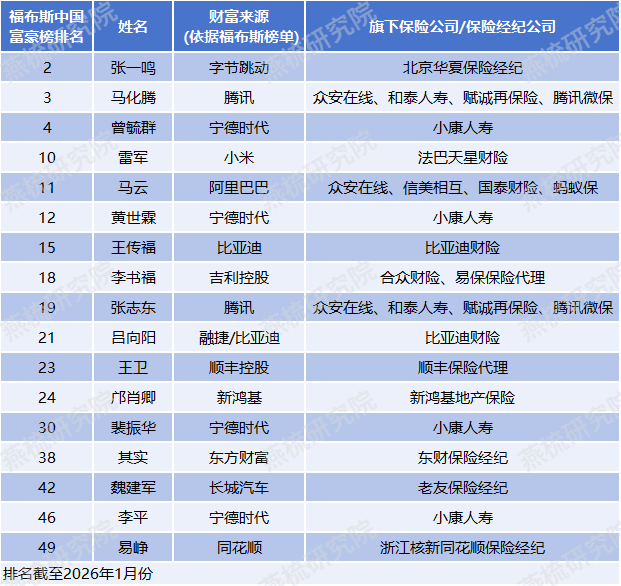
2026福布斯中国富豪榜揭晓,超三成头部富豪扎堆布局保险业
Jin Rong Jie· 2026-02-03 06:43
Core Insights - The Forbes China Rich List reveals that tech, new energy, and consumer sectors continue to lead, with many billionaires diversifying into the insurance industry, indicating its potential [1] - Over one-third of the top 50 billionaires have ventured into insurance, with 17 having established or invested in insurance companies or brokerage licenses [1][2] Group 1: Tech Giants' Insurance Strategies - Tencent has built a comprehensive insurance ecosystem through multiple platforms, including ZhongAn Online and WeChat Insurance, covering product development to sales [4] - Alibaba has also established a strong presence in insurance with entities like ZhongAn Online and Ant Insurance, simplifying the insurance purchasing process for users [4] - ByteDance, while entering the insurance space later, leverages its user base and algorithmic capabilities to create a unique competitive edge in the insurance market [4] Group 2: New Energy and Automotive Sector Involvement - New energy and automotive billionaires are increasingly participating in the insurance sector, aiming to create a full lifecycle management system from car sales to insurance services [5] - Companies like BYD and Geely have established their own insurance entities, integrating insurance with automotive services to enhance value [5] - The collaboration between insurance and the new energy sector is expected to open new growth opportunities, reflecting a long-term recognition of insurance's value [5] Group 3: Other Industries' Insurance Integration - Other industry billionaires are also penetrating the insurance market by integrating it with their core business scenarios, such as logistics and real estate [6] - SF Express has launched insurance products tailored to logistics, embedding insurance into its business model [6] - Real estate firms like New World Development are providing various insurance products to protect their assets, demonstrating a dual empowerment of their main business and insurance [6] Group 4: Trends in Insurance Industry - The insurance industry is becoming a standard for billionaires due to its stable cash flow and risk management capabilities, making it an attractive long-term investment [7] - The integration of insurance into various business ecosystems allows companies to enhance user engagement and reduce operational risks [7] - The ongoing trend of cross-industry collaboration is reshaping the competitive landscape of the insurance sector, pushing traditional insurers to accelerate digital transformation [7]



港股科技股盘中跳水!快手跌超7%,B站百度腾讯跌超6%,传闻扰动引发市场关注
Jin Rong Jie· 2026-02-03 06:19
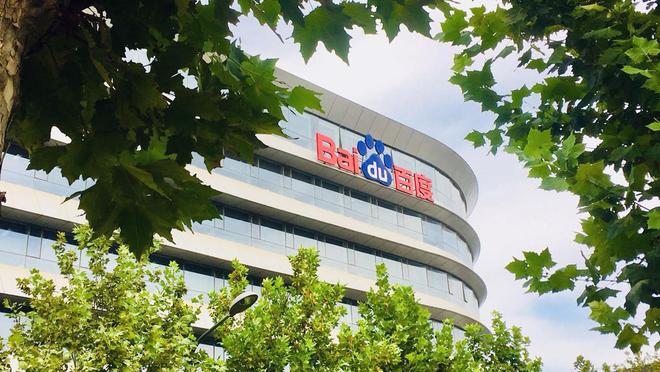
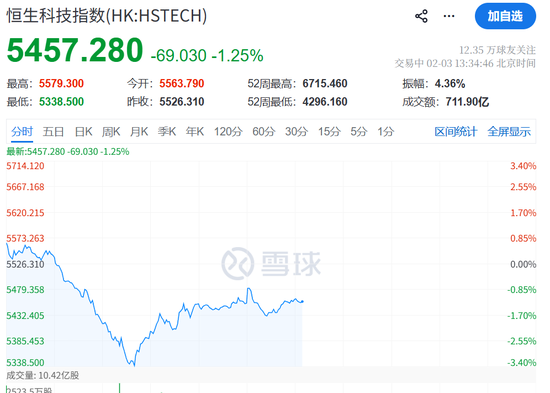
Group 1 - The Hong Kong stock market experienced a significant drop in the Hang Seng Tech Index, which fell by 3.37% at one point, with major internet companies like Kuaishou, Bilibili, Baidu, Tencent, and Alibaba seeing declines of over 6% [1][3] - The decline in tech stocks was triggered by rumors regarding adjustments to the recognition of high-tech enterprises and related tax policies in China, which have circulated since 2019 without any concrete implementation [3] - Huachuang Securities believes that the rumors are an over-interpretation without solid evidence, and that increasing taxes on internet companies would contradict the current policy aimed at promoting consumption [3] Group 2 - As of January 30, 2026, the Hang Seng Index's price-to-earnings (PE) ratio is at 12.47 times, which is in the 82nd percentile since 2010, while the price-to-book (PB) ratio is at 1.27 times, in the 63rd percentile since 2010 [3] - Galaxy Securities indicates that the tech sector remains a long-term investment focus, with multiple favorable factors such as price increases in the supply chain, domestic substitution, and accelerated AI applications expected to drive upward momentum [3] - Guangfa Securities suggests that the current global dollar cycle is peaking and receding, with the RMB entering a mild appreciation phase, creating a favorable re-pricing window for Chinese equity assets [3]



突然大跳水!原因,找到了!
Xin Lang Cai Jing· 2026-02-03 06:05
Core Viewpoint - The market experienced a significant drop due to rumors regarding potential tax rate increases for the gaming industry, which were deemed unfounded by analysts [2][11]. Group 1: Market Reaction - On February 3, the Hang Seng Technology Index fell over 3% at one point, with major internet companies like Tencent, Alibaba, and Baidu also experiencing sharp declines [3][8][10]. - The stock price of Cambricon Technologies plummeted following rumors about its revenue guidance for 2026 being significantly lower than market expectations [4][13]. Group 2: Tax Rumors Analysis - Analysts from Everbright Securities refuted the rumors about a potential tax rate increase for the gaming industry, clarifying that the comparison to the liquor industry's consumption tax was misleading [2][11]. - The current tax rate for financial services and internet value-added services, including gaming, is 6%, as per the Value-Added Tax Law effective from January 1, 2026 [3][13]. - The adjustment of tax rates requires a rigorous legislative or administrative process, making arbitrary changes unlikely [3][12]. Group 3: Policy Context - The current macroeconomic policy focus is on "stabilizing growth, promoting innovation, and supporting industrial upgrades," which contradicts the idea of a blanket tax increase on key industries [12]. - Future tax regulations are more likely to involve the review of tax incentives for certain companies rather than an increase in statutory tax rates [12].

影视飓风Tim、黄圣依、杨子、冯唐等主播入淘开播
Xin Lang Cai Jing· 2026-02-03 06:05
Core Insights - Tmall's New Year Festival has seen the introduction of various "knowledgeable" hosts in Taobao Live, including actors and educators, enhancing the platform's content diversity [1][3] - The live streaming debut of Tim, founder of Yingshijufeng, will showcase the performance of DLSS 4.5 technology in popular games, with RTX 50 series gaming laptops available for purchase during the event [1][3] - The platform is systematically integrating professionals with expertise in specific fields to create sustainable live streaming businesses, providing comprehensive support from initial broadcasts to long-term operations [2][4] Group 1 - The introduction of "knowledgeable" hosts includes figures like Huang Shengyi, Yang Zi, and writer Feng Tang, who will engage audiences with their expertise [1][3] - Tim's live stream will feature real-time demonstrations of video editing, 3D modeling, and AI effects, highlighting the capabilities of graphics cards supporting DLSS 4.5 [1][3] - The RTX 50 series gaming laptops will be available with a 15% national subsidy during the live stream, covering major brands like ASUS, HP, Lenovo, and Mechanical Revolution [1][3] Group 2 - Taobao Live is focusing on matching new hosts with suitable products and content strategies based on their professional backgrounds, ensuring effective audience engagement [2][4] - The launch of the content IP "Qiyu Radio" during the New Year Festival will provide practical references on topics ranging from technical analysis to fashion advice, delivered by knowledgeable hosts [2][4] - Successful hosts from previous events, such as Cao Ying, have demonstrated the potential for significant audience engagement and sales, with over one million followers and substantial transaction volumes [1][3]