
Cambricon(688256)

Search documents
“AI+制造,才是真正的科技革命!”寒武纪涨超5%,科创人工智能ETF(589520)拉升1.9%!AI芯片加速国产替代
Xin Lang Cai Jing· 2026-01-08 02:26
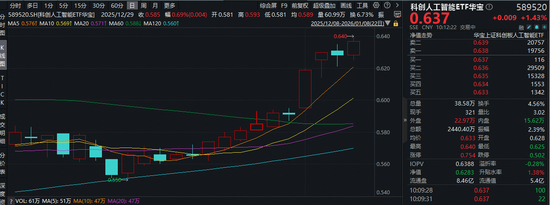
1月8日早盘,重点布局国产AI产业链的科创人工智能ETF华宝(589520)场内涨幅盘中上探1.91%,现 涨1.43%,当前站在所有均线上方,近15个交易日中,有10个交易日上涨,或已走出坚定的"上行台 阶"。 成份股方面,芯原股份领涨超6%,寒武纪涨逾5%,晶晨股份、云天励飞涨超3%,思看科技、安路科 技、恒玄科技等个股跟涨。 | 序号 | 名称 | 涨跌幅 ▼ | 两日图 | 申万一级行业 | 申万二级行业 | 申万三级行业 | 总市值 | 成交額 | | --- | --- | --- | --- | --- | --- | --- | --- | --- | | 1 | 公园服装 | 6.08% | 5 | 电子 | 来参详 | 数字芯片设计 | 8494Z | 19.60亿 | | 2 | 意武纪-U | 5.38% | And | 电子 | 米島体 | 数字芯片设计 | 619062 | 112.07 亿 | | 3 | 盟 首届最美 | 3.67% | ww | 电子 | 未导体 | 数字芯片设计 | 401亿 | 4.43亿 | | 4 | 云大励飞-U | 3.15% | Mar | 计算 ...


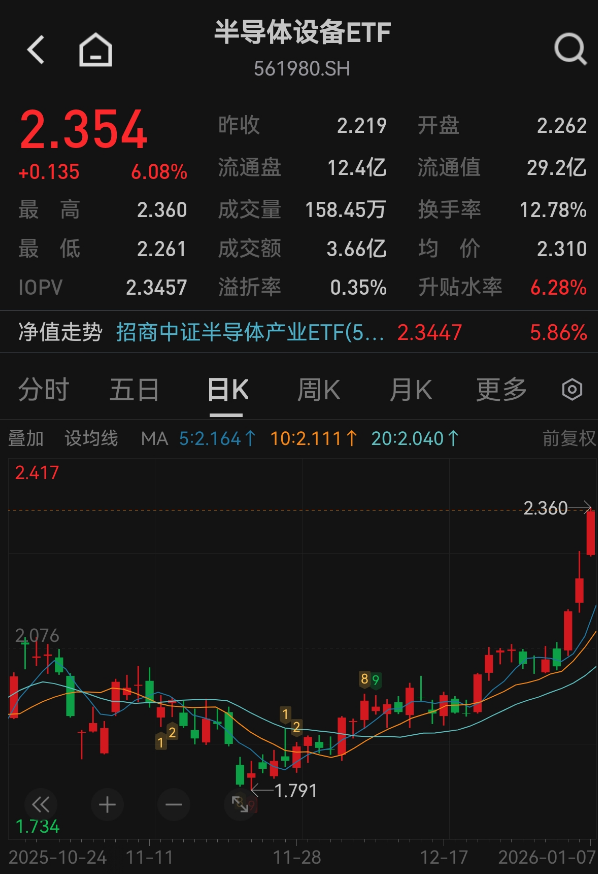
北方华创、中微公司等多设备股新高 半导体设备ETF(561980)规模、净值齐创上市以来新高
Jin Rong Jie· 2026-01-08 01:45
Core Viewpoint - The semiconductor equipment sector is experiencing significant growth driven by a global semiconductor "super cycle" and the deepening of domestic chip replacement, leading to record highs for major equipment manufacturers and ETFs tracking this sector [1][2]. Industry Cycle - The semiconductor equipment sales are projected to reach a historical high in 2025, driven by AI-induced price increases in storage and advancements in process technology, which will boost domestic wafer fab utilization rates [2]. - SEMI forecasts that global semiconductor manufacturing equipment sales will reach $156 billion by 2026-2027, indicating a sustained growth trend [2]. Domestic Replacement Acceleration - The domestic semiconductor equipment localization rate is expected to rise to 22% by 2025, with significant breakthroughs in etching, cleaning, and CMP processes [2]. - Recent government and capital support initiatives, including increased investments in leading wafer fabs and mergers in the equipment sector, signal an acceleration in the self-sufficiency of the semiconductor supply chain [2]. Capital and Policy Support - The ongoing capital investment in advanced processes and the rising localization rate of equipment present historic development opportunities for domestic semiconductor equipment, with new order growth expected to exceed 30% and potentially reach over 50% [2]. Semiconductor Equipment ETF Overview - The semiconductor equipment ETF (561980) tracks the CSI semiconductor index, focusing on the upstream segment of the semiconductor industry, which has a nearly 60% equipment content [3]. - The top ten holdings in the ETF account for nearly 80% of its weight, including leading companies like Zhongwei Company (etching equipment) and Northern Huachuang (multi-field equipment) [3]. Performance Metrics - The CSI semiconductor index is projected to increase by 62.33% in 2025, with a maximum drawdown of 15.73%, outperforming other semiconductor indices since 2018 [4]. - The index has shown significant elasticity, indicating a more aggressive stance in the upcoming semiconductor cycle [4].




特朗普一句话令美损失5万亿,而这位“中国天才”在制裁中崛起
Sou Hu Cai Jing· 2026-01-08 01:26
Group 1 - The core argument of the article revolves around the impact of U.S. policies on the semiconductor industry, particularly focusing on the competition with China and the implications of Trump's potential return to power [2][4][5] - The U.S. government has implemented significant measures to restrict high-end chip equipment exports to China, collaborating with allies like the Netherlands and Japan to tighten the technology supply chain [4][9] - Trump's approach to the semiconductor industry emphasizes tariffs over subsidies, proposing to impose tariffs ranging from 25% to 100% to encourage domestic production, which has led to significant market reactions, including a sharp decline in U.S. stock indices [5][7][9] Group 2 - The article highlights the resilience of China's semiconductor industry, which has accelerated its self-reliance and innovation in response to U.S. sanctions, with companies like Huawei and Cambrian Technology making significant advancements [9][20] - The narrative includes the story of Chen Yunqi and his brother, who have made notable contributions to AI chip development in China, showcasing how domestic firms have adapted and thrived despite external pressures [12][18][20] - The emergence of new AI models and frameworks, such as DeepSeek, is reshaping the global semiconductor landscape, allowing Chinese companies to gain recognition and market share, further solidifying their position in the industry [21][25]
国产AI芯片:推理赛道起飞,谁能再破寒武纪神话?
Nan Fang Du Shi Bao· 2026-01-07 23:14
Core Insights - The domestic AI chip industry is experiencing a significant transformation in 2025, driven by the launch of DeepSeek, which has accelerated the demand for AI computing power and domestic alternatives [2][3] - Major domestic companies like Cambrian, Moore Threads, and Muxi are making headlines with their stock performances and upcoming IPOs, indicating a capital market boom for domestic AI chips [2][5] - The market is witnessing a shift in focus from training to inference, with a projected market size for AI inference chips in China expected to grow from 162.6 billion yuan in 2024 to 310.6 billion yuan in 2025 [3][4] Trend 1: Domestic AI Chip Opportunities - The launch of DeepSeek has ignited enthusiasm for domestic AI chips, particularly in the inference sector, as companies like Huawei and Cambrian quickly adapt to support this new model [2][3] - The inference chip market is expected to see explosive growth, with significant contributions from companies focusing on inference applications, such as Huawei, Cambrian, and Muxi [3][4] Trend 2: IPO Surge of Domestic AI Chip Manufacturers - 2025 marks a pivotal year for domestic AI chip manufacturers, with several companies successfully listing on the stock market, including Moore Threads and Muxi, which saw substantial initial stock price increases [5][6] - Despite the IPO successes, the market share of domestic chip manufacturers remains low, with major players like Nvidia and AMD dominating the market [6][7] Trend 3: Nvidia's Market Dynamics - Nvidia has faced challenges in the Chinese market, including export restrictions and security concerns, which have opened opportunities for domestic chip manufacturers [9][10] - The approval of Nvidia's H200 chip for sale in China could impact the domestic market, as it offers competitive performance, although concerns about dependency on foreign technology persist [10][11] Trend 4: Advanced Process Limitations - Domestic AI chip manufacturers are constrained by limitations in advanced process technologies, with most using 7nm or 14nm processes compared to Nvidia's 4nm technology [12][13] - Companies are exploring alternative solutions, such as switching to domestic supply chains and developing "super nodes" to enhance performance despite process limitations [13][14] Outlook: Future Opportunities for Domestic AI Chips - The domestic AI chip market is expected to exceed 300 billion yuan by 2026, driven by the rapid development of intelligent computing centers and increasing AI demands from internet companies [15][16] - The industry is anticipated to split into two main directions: self-developed ASICs by CSPs and local suppliers, with a focus on lower-spec AI inference chips presenting significant growth opportunities [16]

八部门发文强化人工智能算力供给,AI芯片及操作系统等关键领域公司受益
Xuan Gu Bao· 2026-01-07 15:09
Group 1 - The Ministry of Industry and Information Technology and eight other departments issued the "Implementation Opinions on the Special Action of 'Artificial Intelligence + Manufacturing'" which emphasizes strengthening the supply of artificial intelligence computing power [1] - The opinions promote the development of intelligent chips and support breakthroughs in key core technologies such as high-end training chips, edge inference chips, AI servers, high-speed interconnection, and intelligent cloud operating systems [1] - By 2027, China's key core technologies in artificial intelligence are expected to achieve safe and reliable supply, with the industry scale and empowerment level remaining among the world's top [1] Group 2 - The analysis indicates that the safe and reliable supply of key artificial intelligence technologies is crucial for achieving a fully autonomous and controllable industrial ecosystem, reducing dependence on external technologies [2] - The focus has shifted from "technology selection" to "strategic necessity," which will accelerate the replacement of domestic computing power, algorithms, and security technologies in the short term [2] - In the long term, this will reshape the global AI industry landscape and provide a "secure foundation" and "innovation engine" for the high-quality development of China's digital economy [2] Group 3 - Haiguang Information is a leading enterprise in the domestic high-end processor R&D field, with its CPU and DCU driving growth, and the upcoming release of the next-generation Haiguang 5 and Deep Computing 4 is expected to maintain rapid revenue growth [3] - Cambrian is a leading company in the domestic AI chip sector, focusing on AI chip R&D and technological innovation, with a product matrix covering cloud, edge, and terminal scenarios [3] - Cambrian's products include the Siyuan 590 and Siyuan 370 cloud training and inference chips, which meet the AI application needs across various industries such as internet, finance, transportation, and energy [3]

寒武纪-U1月7日大宗交易成交348.72万元
Zheng Quan Shi Bao Wang· 2026-01-07 14:43
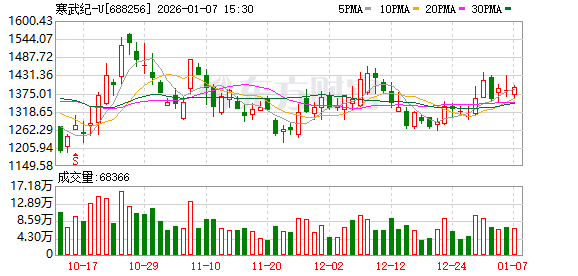
Summary of Key Points Core Viewpoint - The recent large transaction of Cambrian-U shares indicates active trading interest, with significant capital inflow and a stable stock price performance over the past few days [2] Group 1: Transaction Details - On January 7, a large transaction of Cambrian-U occurred with a volume of 0.25 million shares and a transaction amount of 3.4872 million yuan, at a price of 1394.88 yuan per share [2] - The buyer was Guangfa Securities Co., Ltd. Headquarters, while the seller was China Merchants Securities Co., Ltd. Beijing Jinghui Street Securities Business Department [2] - In the last three months, Cambrian-U has recorded a total of 13 large transactions, amounting to 139 million yuan [2] Group 2: Stock Performance - Cambrian-U closed at 1394.88 yuan, reflecting an increase of 0.85% on the same day, with a turnover rate of 1.63% and a total trading volume of 9.416 billion yuan [2] - Over the past five days, the stock has risen by 2.68%, with a total net capital inflow of 461 million yuan [2] Group 3: Margin Trading Data - The latest margin financing balance for Cambrian-U is 15.174 billion yuan, showing a decrease of 272 million yuan over the past five days, which is a decline of 1.76% [2]
深沪北百元股数量达203只,科创板股票占43.84%
Zheng Quan Shi Bao Wang· 2026-01-07 09:49
Market Overview - The average stock price in A-shares is 14.44 yuan, with 203 stocks priced over 100 yuan as of January 7 [1] - The Shanghai Composite Index closed at 4085.77 points, up 0.05%, while stocks over 100 yuan had an average increase of 1.88%, outperforming the index by 1.83 percentage points [1] High-Value Stocks - The highest closing price among stocks over 100 yuan is Kweichow Moutai at 1423.36 yuan, down 0.33%, followed by Cambrian and Yuanjie Technology at 1394.88 yuan and 700.70 yuan respectively [1] - In the past month, stocks priced over 100 yuan have seen an average increase of 19.43%, compared to a 4.69% increase in the Shanghai Composite Index [1] Sector Distribution - Among the high-priced stocks, the electronics sector is the most represented with 76 stocks, accounting for 37.44% of the total [2] - The mechanical equipment and computer sectors each have 21 stocks, making up 10.34% of the high-priced stocks [2] Stock Performance - Kema Technology's stock price has recently crossed the 100 yuan mark, closing at 109.34 yuan with a 9.55% increase and a turnover rate of 21.61% [2] - The total trading volume for Kema Technology reached 3.452 billion yuan, with a net inflow of 255 million yuan from main funds [2] Notable High-Value Stocks - A list of notable high-value stocks includes: - Kweichow Moutai: 1423.36 yuan, -0.33% - Cambrian: 1394.88 yuan, +0.85% - Yuanjie Technology: 700.70 yuan, +8.47% [2][3] - Other significant stocks include: - Zhongji Xuchuang: 619.60 yuan, +2.37% - Moer Thread: 617.54 yuan, +0.58% [2][3] Recent Trends - The recent trend shows that stocks like Andar Intelligent, Feiwo Technology, and Chaojie Co. have experienced significant increases of 131.72%, 131.36%, and 130.17% respectively over the past month [1]

科创板平均股价45.74元,89股股价超百元
Zheng Quan Shi Bao Wang· 2026-01-07 09:49
Group 1 - The average stock price of the Sci-Tech Innovation Board is 45.74 yuan, with 89 stocks priced over 100 yuan and the highest being Cambricon Technologies at 1394.88 yuan, which increased by 0.85% [1] - Among the stocks priced over 100 yuan, 371 stocks rose while 221 stocks fell, with an average increase of 2.67% for the hundred-yuan stocks today [1] - The average premium of the hundred-yuan stocks relative to their issue price is 503.71%, with the highest premiums from companies like Shunwei Materials, Anji Technology, and Cambricon Technologies at 5135.96%, 2105.01%, and 2066.30% respectively [1] Group 2 - The net inflow of main funds for hundred-yuan stocks today was 384 million yuan, with the highest inflows from companies like Dekoli, Huahong Company, and Changguang Huaxin at 461.27 million yuan, 261.75 million yuan, and 216.65 million yuan respectively [2] - The total margin financing balance for hundred-yuan stocks is 1138.94 billion yuan, with the highest balances from Cambricon Technologies, SMIC, and Haiguang Information at 151.74 billion yuan, 133.88 billion yuan, and 72.36 billion yuan respectively [2]
寒武纪1月7日现1笔大宗交易 总成交金额348.72万元 溢价率为0.00%
Xin Lang Zheng Quan· 2026-01-07 09:48
Group 1 - The stock of Cambrian Holdings closed at 1,394.88 yuan on January 7, with an increase of 0.85% [1] - A block trade occurred with a total volume of 2,500 shares and a transaction amount of 3.4872 million yuan, with a transaction price of 1,394.88 yuan and a premium rate of 0.00% [1] - Over the past three months, Cambrian Holdings has recorded 13 block trades with a total transaction amount of 139 million yuan [1] Group 2 - In the last five trading days, the stock has increased by 2.68%, with a net inflow of 456 million yuan from main funds [1]
寒武纪西安集成电路公司注册资本增至1.8亿元
Zheng Quan Ri Bao Wang· 2026-01-07 08:46
Group 1 - The core point of the article is that Hanwujing (Xi'an) Integrated Circuit Co., Ltd. has increased its registered capital from 100 million yuan to 180 million yuan [1] Group 2 - The business change was officially recorded in the industrial and commercial information system [1] - The increase in registered capital indicates potential growth and investment in the company's operations [1]