SMIC(688981)

Search documents
中芯国际涨2.93%,成交额17.44亿元,主力资金净流入1.07亿元
Xin Lang Cai Jing· 2025-12-24 01:41
来源:新浪证券-红岸工作室 12月24日,中芯国际盘中上涨2.93%,截至09:35,报123.41元/股,成交17.44亿元,换手率0.71%,总市 值9873.23亿元。 资金流向方面,主力资金净流入1.07亿元,特大单买入4.12亿元,占比23.62%,卖出4.42亿元,占比 25.34%;大单买入6.30亿元,占比36.15%,卖出4.94亿元,占比28.31%。 中芯国际今年以来股价涨30.43%,近5个交易日涨8.93%,近20日涨9.49%,近60日跌3.97%。 今年以来中芯国际已经1次登上龙虎榜,最近一次登上龙虎榜为8月28日,当日龙虎榜净买入-4.22亿 元;买入总计16.55亿元 ,占总成交额比6.10%;卖出总计20.77亿元 ,占总成交额比7.66%。 资料显示,中芯国际集成电路制造有限公司位于上海市浦东新区张江路18号,香港中环康乐广场8号交易 广场1期29楼,成立日期2000年4月3日,上市日期2020年7月16日,公司主营业务涉及提供0.35微米至14 纳米多种技术节点、不同工艺平台的集成电路晶圆代工及配套服务。主营业务收入构成为:集成电路晶 圆代工93.83%,其他6.17% ...

港股开盘 | 恒指高开0.02% 芯片概念强势 中芯国际涨超2%
智通财经网· 2025-12-24 01:39
Group 1 - The Hang Seng Index opened slightly higher by 0.02%, while the Hang Seng Tech Index rose by 0.07%. Semiconductor stocks showed strength, with SMIC up over 2% and Hua Hong Semiconductor up over 1%. Conversely, tech stocks like Meituan experienced declines, falling nearly 1% [1] - Huatai Securities indicated that the market is still in a left-side layout phase, with the right-side turning point not yet clear. There is strong consensus on an early spring rally, but year-end supply and demand pressures remain, leading to uncertainty regarding the "Santa rally." The first quarter may present a higher probability phase for gains [1] - Guotai Junan Securities noted that as the "Christmas rally" window approaches, historical data shows that U.S. stocks often perform strongly at year-end. Despite ongoing disagreements regarding interest rate hikes and inflation paths for 2026, the recent financing capabilities and capital expenditure commitments from tech giants have instilled confidence in institutional investors regarding the ongoing AI-driven growth narrative [1] - Galaxy Securities recommended focusing on the technology sector as a long-term investment theme, which has seen valuation corrections after previous adjustments and is expected to rebound due to multiple favorable factors. The consumer sector is also anticipated to receive significant policy support, with current valuations at relatively low levels, indicating substantial medium to long-term upside potential [1] Group 2 - GF Fund stated that liquidity disturbances are likely to have a short-term impact, but the adjusted Hong Kong stock market may still be worth monitoring. Amid weak economic data and the upcoming change in the Federal Reserve chair, a rate cut cycle by the Fed is likely to continue next year. Short-term pressures from the Bank of Japan's rate hike signals and significant unlocking pressures in the Hong Kong market may temporarily dampen risk appetite [2] - The upward trend in the AI industry cycle remains unchanged, and if the short-term factors suppressing the Hong Kong market are alleviated, the market structure is expected to remain intact, driven by the influx of new capital and the advantages of scarce assets [2]
中芯国际部分产能涨价10%,晶圆代工行业产能紧张
Xin Lang Cai Jing· 2025-12-24 01:37
Core Viewpoint - SMIC has implemented a price increase of approximately 10% on certain capacities due to rising demand in mobile applications and AI, alongside increased raw material costs and adjustments in competitor capacity [1][5]. Group 1: Price Increase and Market Demand - SMIC's price increase is driven by strong market demand, particularly in the server market, and rising costs of raw materials, especially metals [1][5]. - The company has stated it will follow industry pricing trends rather than being the first to raise prices, aligning with adjustments made by competitors like TSMC [1][5]. - The overall semiconductor product demand is growing, influenced by the increasing demand for chips [1][5]. Group 2: Capacity Utilization and Financial Performance - Both SMIC and Huahong's capacity utilization rates are increasing and nearing full capacity or exceeding it [1][5]. - In Q3, SMIC reported a 3.8% increase in average selling price due to more complex product shipments, with continued growth expected despite the typical seasonal slowdown in Q4 [6]. - SMIC's Q4 revenue guidance indicates a stable to 2% growth, with an expected annual revenue exceeding $9 billion, marking a new milestone for the company [8]. Group 3: Competitor Insights - Huahong's overall capacity utilization reached 109.5% in Q3, with high utilization rates in its 8-inch wafer fabs and significant output from its 12-inch fab [9]. - ADI, an Apple supplier, has announced a price increase of about 15% effective February 1, 2026, due to ongoing inflationary pressures in raw materials, labor, energy, and logistics [4][9].


滚动更新丨A股三大指数集体高开,有色金属板块持续走强
Di Yi Cai Jing· 2025-12-24 01:35
Group 1 - The photovoltaic glass, energy metals, memory storage, gold, and fluorochemical concept stocks are performing strongly [1][3] - The non-ferrous metal sector has been rising for several consecutive days, with silver and non-ferrous metals increasing over 4%, and individual stocks such as Shengda Resources and Northern Copper Industries also seeing gains [1] - SMIC's A-shares and H-shares have both risen over 2%, with reports indicating a price increase of approximately 10% on some of its production capacity [1][4] Group 2 - The A-shares opened with all three major indices rising slightly, with the Shanghai Composite Index up 0.01%, the Shenzhen Component Index up 0.07%, and the ChiNext Index also up 0.07% [2][3] - The Hong Kong stock market opened with the Hang Seng Index up 0.02% and the Hang Seng Tech Index up 0.07%, with notable gains in stocks like SMIC and Huahong Semiconductor [4][5] - The People's Bank of China conducted a 260 billion yuan reverse repurchase operation with a rate of 1.40%, while 468 billion yuan of reverse repos are set to mature today [3]

金融界财经早餐:超高规格央企负责人会议释放关键战略信号!贵金属牛市继续;中芯国际对部分产能涨价;北京发放首批L3级车辆专用号牌(12月24日)
Jin Rong Jie· 2025-12-24 01:33
Economic Policy and Market Overview - President Xi Jinping emphasized the need for central enterprises to focus on their main responsibilities and enhance core competitiveness, while promoting technological innovation and deepening reforms [1] - Premier Li Qiang highlighted the importance of providing strong support for major infrastructure projects and ensuring the resilience of industrial supply chains [1] - The Ministry of Housing and Urban-Rural Development aims to stabilize the real estate market by implementing city-specific policies to control inventory and improve supply [1] Capital Market Developments - A-shares have achieved a historic annual trading volume exceeding 400 trillion yuan, with an average turnover rate approaching 1.74% [4] - Major foreign institutions, including Goldman Sachs and Morgan Stanley, have released optimistic forecasts for the Chinese stock market in 2026, citing improving corporate earnings and attractive valuations [4] - The issuance of Sci-Tech bonds surpassed 1.7 trillion yuan in 2025, enhancing financing channels for innovative enterprises [4] Industry Highlights - The commercial aerospace sector is witnessing growth, with the Long March 12 rocket achieving a 90% domestic production rate and a design for 50 reuses [6] - The medical device industry is set for improvement as a new round of high-value medical consumables procurement begins, with expectations for performance recovery in Q4 and 2026 [6] - The launch of L3-level autonomous driving vehicle license plates in Beijing marks a significant milestone in the mass production of autonomous vehicles [6] Company News - Semiconductor manufacturer SMIC has implemented a price increase of approximately 10% on certain production capacities [8] - Sunac China has completed all prerequisites for its overseas debt restructuring, resulting in the release of approximately 9.6 billion USD in existing debt [8] - Geely Automobile has officially merged with Zeekr, with the transaction valued at approximately 2.399 billion USD [10] - Shanghai Birun Technology is seeking to raise up to 623 million USD through a Hong Kong IPO, marking a potential significant year for AI company listings [10] - Tesla's sales in Europe continued to decline, while its competitor BYD saw a significant increase in sales, capturing a growing market share [12]


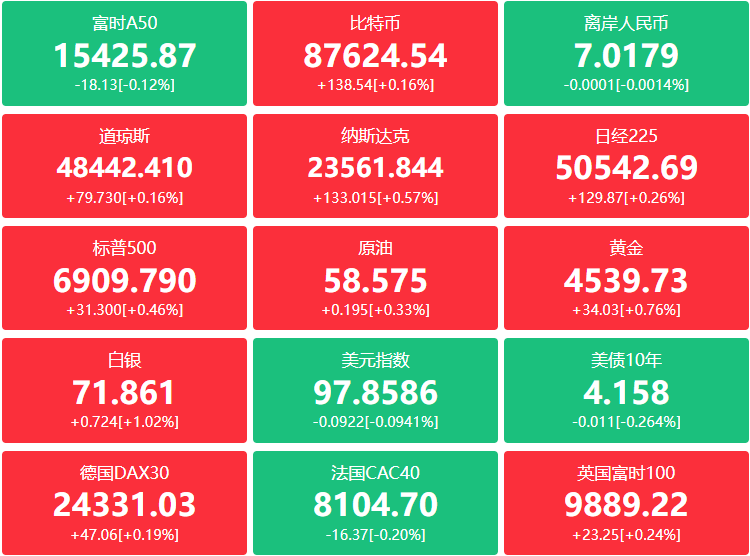
中芯国际高开逾2% 中芯国际对部分产能实施涨价 涨幅约为10%
Zhi Tong Cai Jing· 2025-12-24 01:32
Core Viewpoint - SMIC (00981) has increased its prices for certain production capacities by approximately 10%, driven by rising demand in mobile applications and AI, as well as raw material cost increases [1][1][1] Company Summary - SMIC's stock opened over 2% higher, currently trading at HKD 70.35 with a transaction volume of HKD 50.4761 million [1] - The price increase is expected to be implemented soon, following previous price hikes in storage products due to low pricing [1] - The company's capacity utilization rates are continuously increasing and are nearing or exceeding full capacity [1] Industry Summary - The overall semiconductor product demand is growing, fueled by increased demand for chips in mobile applications and AI [1] - TSMC's confirmation of consolidating 8-inch capacity and plans to shut down certain production lines by the end of 2027 may also contribute to price increase expectations among wafer foundries [1] - The semiconductor industry is experiencing a robust demand environment, leading to increased capacity utilization across companies like SMIC and Huahong [1]
港股早评:三大指数小幅高开,有色金属股继续活跃,中芯国际开涨超2%
Ge Long Hui· 2025-12-24 01:27
隔夜美股四连涨,中概指数跌0.58%。港股三大指数小幅高开,恒指涨0.02%,国指涨0.09%,恒生科技 指数涨0.07%。权重科技股集体飘绿,金银价格持续创新高,黄金股、铜业股等有色金属股齐涨,中芯 国际据称已经对部分产能实施了涨价,涨幅约为10%,中芯国际涨超2%。另外,海运股、航空股、重 型机械股部分下跌。(格隆汇) ...
港股异动 | 中芯国际(00981)高开逾2% 中芯国际对部分产能实施涨价 涨幅约为10%
智通财经网· 2025-12-24 01:26
消息面上,据上海证券报报道,从多个渠道求证获悉,中芯国际已经对部分产能实施了涨价,涨幅约为 10%。有公司反映,预计涨价会很快执行。但由于之前存储产品价格过低,晶圆厂早已率先对其实施了 涨价。"由于手机应用和AI需求持续增长,带动套片需求,从而带动了整体半导体产品需求的增长。" 报道称,对于中芯国际涨价的原因,有半导体业内人士解读,原材料涨价也是其中因素。此外,台积电 确认整合8英寸产能,并计划在2027年末关停部分生产线,或也引发晶圆厂涨价预期。事实上,由于需 求旺盛,中芯国际、华虹公司的产能利用率持续增长,并已接近满载或超过满载。 智通财经APP获悉,中芯国际(00981)高开逾2%,截至发稿,涨2.1%,报70.35港元,成交额5047.61万港 元。 ...
英伟达放风春节前向中国客户交付H200芯片 中芯国际对部分产能实施涨价
Xin Lang Cai Jing· 2025-12-24 00:46
《科创板日报》12月24日讯,今日科创板早报主要内容有:习近平对中央企业工作作出重要指示;北京 发放首批L3级高速公路自动驾驶车辆专用号牌;第六批国家高价值耗材集采启动;海博思创智造拟投 建20亿元储能工厂项目。 《科创板日报》主播小K为您播报。 商务部:坚决反对美针对无人机领域增列"不可信供应商清单" 商务部新闻发言人就美针对无人机领域增列"不可信供应商清单"事答记者问。有记者问:近日,美国联 邦通信委员会(FCC)发布公告,宣布将所有外国生产的无人机系统及其关键零部件等列入"不可信供 应商清单"(Covered List),请问中方对此有何回应?答:美方以所谓"国家安全"为由,将所有外国生 产的无人机系统及其关键零部件等列入"不可信供应商清单",中方对此坚决反对。近年来,美方不顾中 美两国企业开展正常商业交易和贸易往来,不顾中美两国业界的强烈呼声,一再泛化国家安全概念,动 用国家力量打击包括中国企业在内的他国企业,这是典型的市场扭曲和单边霸凌做法。中方敦促美方停 止错误做法,立即撤销有关措施。若美方继续一意孤行,中方将坚决采取必要措施,坚定维护中国企业 的正当权益。 北京发放首批L3级高速公路自动驾驶车辆 ...
A股头条:第六批国家高价值耗材集采启动;中芯国际对部分产能实施涨价;日本核反应堆泄漏水,浓度被认为“较高”
Jin Rong Jie· 2025-12-24 00:30
Group 1 - The Ministry of Commerce of China strongly opposes the U.S. decision to include all foreign-produced drone systems and key components in the "untrusted supplier list," citing market distortion and unilateral bullying practices [1] - The sixth batch of national high-value medical consumables procurement has been officially launched, introducing new mechanisms such as anchor pricing and multiple reactivation mechanisms to prevent malicious low pricing [2] - Shanghai Gold Exchange has issued a notice to strengthen market risk control due to recent volatility in precious metal prices, urging members to enhance risk awareness and maintain market stability [3] Group 2 - Beijing has issued the first batch of L3-level highway autonomous vehicle special license plates, marking a significant milestone in the production of autonomous vehicles in China [4] - LME copper prices have reached a historical high of $12,001.99 per ton, indicating a strong upward trend in upstream resources, including gold and silver [5] - Semiconductor company SMIC has implemented a price increase of approximately 10% on certain production capacities, driven by rising demand from mobile applications and AI [6] Group 3 - U.S. third-quarter GDP growth exceeded expectations, leading to a collective rise in major U.S. stock indices, with the Dow Jones up 79.73 points and the Nasdaq up 133.02 points [7] - The U.S. dollar index fell by 0.34%, while gold and silver prices saw significant increases, with silver reaching a historical high of $71.5784 [9] - Despite the overall rise in indices, approximately 3,600 individual stocks declined, indicating a lack of coordination among stocks [10] Group 4 - A radioactive water leak incident occurred at a nuclear reactor in Japan, with approximately 20 milliliters of water leaking, but no significant radiation exposure to workers has been reported [11] - New regulations will be implemented in China starting January 1, 2026, prohibiting kindergartens from charging fees beyond tuition and care fees under various names [12] - Companies such as Guolian Aquatic Products and Dahu Co. are highlighted as potential investment targets in light of upcoming regulatory changes [12]