SPD BANK(600000)

Search documents
ESG解读|浦发信用卡境外盗刷频发,消费者知情权保障不足,长效防护机制待补位
Sou Hu Cai Jing· 2025-09-17 06:18
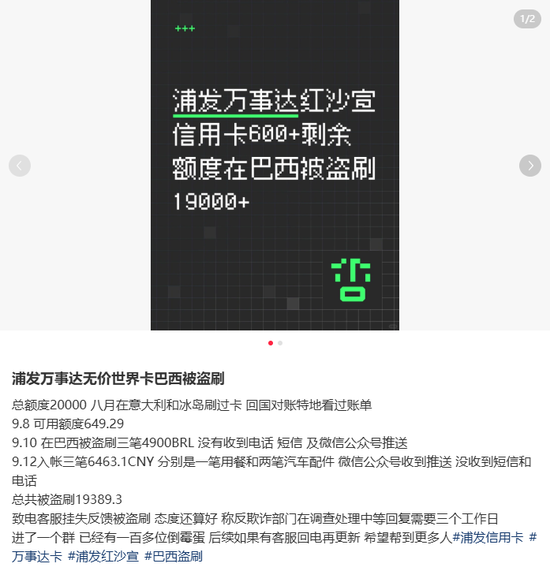
资料来源:浦发银行2024年度可持续发展报 告 编者按:ESG年报解读为搜狐财经及价值公司100联合发起的针对各公司ESG报告披露情况的解读专 栏。 参考上交所《上市公司治理准则》、港交所《环境、社会及管治守则》等文件,搜狐财经迭代完善各行 业ESG测评体系标准,并以最新标准为依托,以2024年公司ESG报告为主要数据来源,对公司环境资 源、社会责任及公司管治进行了评价。 本文为"浦发银行"篇。 出品 | 搜狐财经 研究员 | 张子豪 2025年9月,浦发银行信用卡出现大规模境外盗刷事件,涉及众多持卡人。 本次被盗刷的多为浦发银行红沙宣卡,也就是浦发银行与万事达卡合作发行的万事达"无价世界卡"。这 是一款面向境外消费需求较高用户的国际信用卡产品。 资料来源:小红书 众多客户反映,盗刷交易的消费地点大多在境外巴西。例如,有客户在9月9日、10日两天,信用卡在巴 西被盗刷多笔,金额从数千元到数万元不等。 多数客户在信用卡被盗刷时,并未收到任何短信、微信或APP内的交易预警和提示。例如,有客户信用 卡在9月9日、10日被盗刷,却在消费当日未收到任何通知,仅在入账日微信公众号收到推送。 此外,部分客户出现信用卡可用额 ...


浦发银行:补充“金融维生素”,守牢百姓“钱袋子”
Zhong Jin Zai Xian· 2025-09-17 06:13
Group 1 - The core theme of the financial education campaign is "Protecting Financial Rights and Supporting a Better Life," initiated by the National Financial Supervision Administration in collaboration with the People's Bank of China and the China Securities Regulatory Commission [1] - SPDB (Shanghai Pudong Development Bank) is actively participating in this nationwide financial knowledge dissemination initiative, conducting various engaging activities to educate consumers about financial literacy [1][4] - The campaign includes innovative and immersive methods to make financial knowledge more accessible and relatable to the public, enhancing the efficiency and reach of the education efforts [4][11] Group 2 - SPDB has introduced interactive activities such as the "Fraud Vision Chart" to help elderly customers identify key phrases in scam messages, thereby increasing their awareness of financial fraud [4][6] - The "Rational Balance" activity in Wuhan allows participants to visualize the importance of budgeting and rational spending, akin to how Vitamin B promotes metabolic balance [4][7] - Financial education sessions are being held in universities and rural areas, focusing on the significance of personal credit and the dangers of illegal intermediaries, similar to how Vitamin C strengthens immunity [7][9] Group 3 - The campaign employs various channels, including live streaming, community events, and public transport advertisements, to continuously remind consumers about financial risks and enhance their financial literacy [9][11] - The overall goal is to transform professional financial knowledge into easily digestible information, fostering a culture of rational financial awareness among consumers [11]

浦发银行上海分行落地展业改革跨境人民币业务,优质客户“凭指令秒办”跨境结算
Xin Lang Cai Jing· 2025-09-17 04:11
Core Viewpoint - Shanghai Branch of SPDB is pioneering foreign exchange business reform, enhancing digital capabilities and risk management to streamline processes for qualified clients [1] Group 1: Foreign Exchange Business Reform - SPDB Shanghai Branch is one of the first branches to implement foreign exchange business reform starting October 2024, guided by the Shanghai Bureau of the State Administration of Foreign Exchange [1] - The bank is focusing on building an intelligent risk control system throughout the entire process of foreign exchange business, ensuring both risk prevention and operational convenience [1] Group 2: Cross-Border RMB Service Model - In September 2025, the People's Bank of China and the State Administration of Foreign Exchange encouraged banks to handle cross-border RMB business in accordance with the new regulations [1] - SPDB has defined the scope of cross-border RMB business for its qualified clients based on their characteristics and risk profiles, allowing them to conduct transactions with just payment instructions [1] Group 3: Efficiency in Cross-Border Transactions - On September 12, SPDB Shanghai Branch facilitated a rapid cross-border RMB payment of approximately 22.8 million for a shipyard client, significantly reducing the documentation burden and processing time [1] - The new process allows qualified enterprises to complete transactions without extensive documentation, enhancing the efficiency of cross-border fund settlements [1] Group 4: Future Directions - SPDB Shanghai Branch plans to refine service scenarios, enhance market sensitivity, and strengthen cross-border financial innovation to further improve the quality and efficiency of its services [2] - The bank aims to leverage policy incentives to benefit more market participants and contribute to the healthy development of foreign-related economies [2]
财智乐章,赋能未来 浦发银行济南分行成功举办金融教育宣传活动之行庆音乐会
Qi Lu Wan Bao· 2025-09-17 01:47
Core Viewpoint - The event organized by SPD Bank's Jinan branch celebrates its 24th anniversary while promoting financial education and consumer rights protection through a music concert, aiming to create a harmonious financial environment [1][5]. Group 1: Event Overview - The music concert took place on September 14, with over 1,500 attendees from various sectors, emphasizing the theme "Protecting Financial Rights, Supporting a Better Life" [3]. - The event creatively combined symphonic music with financial consumer protection knowledge, enhancing the outreach of financial education [3][5]. Group 2: Consumer Protection Initiatives - Volunteers distributed informational brochures and explained various types of scams, such as telecom fraud and online gambling traps, to raise awareness among consumers [3]. - Interactive segments like a "Financial Knowledge Quiz" were included, where participants could win commemorative fans featuring anti-fraud slogans, increasing customer engagement [3][5]. Group 3: Commitment to Customer-Centric Service - SPD Bank continues to prioritize customer-centric service, enhancing product and service quality to safeguard consumer rights amidst a complex consumption environment [5]. - The Jinan branch actively fulfills its social responsibility by promoting consumer rights protection knowledge and improving financial literacy and risk prevention capabilities among consumers [5].

普惠千万家|以创新服务破解融资难题 浦发银行着力书写金融支持实体经济“民生答卷”
Sou Hu Cai Jing· 2025-09-17 01:44
Core Viewpoint - The article highlights the challenges faced by small and micro enterprises in securing financing, emphasizing the innovative measures taken by SPD Bank's Wuhan branch to address these issues through digital technology and inclusive financial products [1][2][5]. Group 1: Financing Challenges and Innovations - Small and micro enterprises in Hubei face significant difficulties in financing, often encountering high costs and limited access [1]. - SPD Bank is focusing on innovative financing mechanisms, such as "Knowledge Value Credit Loan" and "Commercial Value Credit Loan," to help transform intangible assets into financing capabilities [2]. - The bank is leveraging a provincial platform to create precise credit profiles for enterprises by integrating data from various departments, thus enhancing risk management [2]. Group 2: Digital Empowerment and User Experience - SPD Bank has developed the "PuHui LaiLe" app, allowing businesses to apply for loans quickly and conveniently, with a credit limit assessed in just three minutes [3]. - The app integrates various services, including credit assessment and legal support, providing a comprehensive solution for small and micro enterprises [3]. - The bank's digital platform has enabled faster loan disbursement, with a recent case showing a loan of 8.8 million yuan processed in one week at lower interest rates compared to traditional loans [3]. Group 3: Regional Development and Support - SPD Bank has established nine specialized branches in key development zones to provide targeted services for technology-driven industries [4]. - The bank has successfully facilitated quick loan approvals for innovative companies, demonstrating its commitment to supporting local economic development [4]. - The bank's efforts have resulted in significant loan disbursements, with over 167.3 billion yuan in credit loans issued to small and micro enterprises in Hubei [6]. Group 4: Inclusive Financial Services - SPD Bank is implementing a dynamic equity system to address the unique financing needs of small and micro enterprises, offering discounts that can reduce financing costs by up to 20% [5]. - The bank has introduced a "one-click renewal" feature for personal business loans, streamlining the renewal process and improving efficiency [5]. - The bank's initiatives aim to enhance the accessibility of financial services, ensuring that small enterprises can continue to thrive [5]. Group 5: Collaborative Ecosystem and Future Outlook - The bank is actively participating in the integration of technology and industry innovation in Hubei, having served over 20,000 small and micro enterprises with a total inclusive loan scale exceeding 53 billion yuan [6]. - SPD Bank's approach emphasizes the importance of collaboration between government, banks, and enterprises to foster a supportive ecosystem for innovation [7]. - The bank aims to continue enhancing its services to help small and micro enterprises convert intellectual property into financial assets, contributing to regional economic growth [7].
跨国盗刷“突袭”浦发信用卡!多名用户深夜收巴西异国账单,银行称已阻断风险
Xin Lang Cai Jing· 2025-09-17 01:04
Core Viewpoint - A coordinated technical attack targeting specific credit cards has breached bank security, leading to unauthorized transactions for hundreds of cardholders, prompting the bank to respond urgently and promise to cover losses [1][9][10]. Group 1: Incident Overview - On September 9-11, a large-scale overseas fraud incident occurred involving the credit cards of Shanghai Pudong Development Bank (SPDB), primarily affecting cardholders of the Mastercard "Priceless World Card" [3][4]. - Affected cardholders reported unauthorized transactions occurring without their knowledge, with amounts ranging from thousands to tens of thousands of yuan [3][4]. - The fraud pattern involved small initial test transactions followed by larger consecutive charges, with total losses for many users around 20,000 yuan [4]. Group 2: Bank's Response - SPDB's credit card center issued an emergency statement on September 13, confirming the detection and blocking of risks in collaboration with Mastercard [1][10]. - The bank assured customers that they would not bear losses that should not be their responsibility, and some affected cardholders have already seen their fraudulent charges cleared [8][14]. - Mastercard also announced the initiation of an emergency investigation and the establishment of a special team to trace the source of the risk and protect cardholders' funds [13]. Group 3: Regulatory Context - The incident highlights ongoing challenges in cross-border payment security, despite existing regulatory requirements aimed at enhancing risk management for credit cards [22][24]. - Regulatory measures have been implemented to improve the monitoring of overseas transactions, including daily reporting of significant transactions by issuing banks [23]. - The industry consensus indicates that while banks have developed risk monitoring models, evolving technical methods for fraud continue to pose significant challenges [24].
“隔空”盗刷信用卡,为何屡禁不止?
第一财经· 2025-09-16 15:58
Core Viewpoint - The article discusses the recent incidents of credit card fraud involving Shanghai Pudong Development Bank's Mastercard "Priceless World Card" and highlights the vulnerabilities in overseas credit card transactions, particularly the risks associated with magnetic stripe cards and the lack of password verification in many international payment scenarios [3][4]. Group 1: How Fraud Occurs - Credit card transactions overseas often require only the card number, expiration date, and CVV code, making it easier for stolen information to be used for unauthorized transactions [4]. - The CVV code is a critical element for offline transactions and can be stolen through various means, including data breaches, dark web sales, phishing scams, and physical theft [5]. - Criminals often wait to use stolen information by binding it to NFC-enabled mobile wallets, leading to a surge in fraudulent transactions after a delay [6]. Group 2: Unusual Fraud Amounts - Some users reported fraudulent charges significantly exceeding their credit limits, attributed to the offline transaction mechanism that allows merchants to process payments without real-time verification [8]. - The delay in updating available credit balances allows criminals to exploit the system, leading to inflated available balances during the fraud [9]. Group 3: Responsibility Allocation - The responsibility for credit card fraud is often debated, with banks typically bearing the burden of proof in disputes. If banks fail to identify fraudulent transactions, they may be held liable for losses [10][11]. - In practice, banks often cover over 70% of the losses in fraud cases, although cross-border transactions complicate the process of claiming refunds [11][12]. Group 4: Payment Security Measures - The continued use of magnetic stripe cards is a significant factor in the prevalence of fraud, as they are more vulnerable compared to EMV chip cards [13]. - The transition to chip cards is essential for enhancing payment security, and efforts are being made to phase out magnetic stripe cards in favor of more secure options [14].

浦发信用卡盗刷背后:不明交易频现 安全盾牌为何“缺位”
Bei Jing Shang Bao· 2025-09-16 14:56
Core Viewpoint - A sudden wave of cross-border credit card fraud has caused anxiety among users of Shanghai Pudong Development Bank (SPDB) credit cards, raising questions about the security of digital payments and the effectiveness of existing fraud prevention measures [2][11]. Group 1: Incident Overview - Users, including international students and domestic cardholders, have reported unauthorized transactions across multiple countries, indicating a sophisticated and organized attack rather than isolated incidents [3][6]. - The fraud attempts began with small transactions in Africa and Canada, escalating to multiple unauthorized charges in Brazil, highlighting the attackers' ability to bypass security measures [4][5]. Group 2: User Experiences - Affected users, such as Noah and Xiao He, expressed concerns over the lack of real-time notifications for suspicious transactions and the absence of a unified response from the bank [3][4]. - Users reported that despite locking their cards, unauthorized transactions still occurred, suggesting a significant flaw in the bank's fraud detection and notification systems [4][10]. Group 3: Nature of the Fraud - The fraud exhibited characteristics of organized and targeted attacks, focusing on specific card types and transaction locations, particularly in Brazil, while avoiding thresholds that would trigger alerts [6][8]. - The shift from physical card cloning to digital intrusion indicates a new level of sophistication in fraud techniques, with attackers potentially breaching core payment systems [7][10]. Group 4: Industry Response and Challenges - The incident has prompted banks to reassess their payment security frameworks, with some initiating internal investigations to identify potential vulnerabilities in cross-border transaction processes [11][12]. - Current fraud prevention systems face challenges in balancing rapid transaction processing with effective risk interception, particularly in the context of evolving fraud tactics [12][14]. Group 5: Recommendations for Improvement - Experts suggest that banks need to upgrade their real-time fraud detection systems, implement dynamic verification mechanisms for cross-border transactions, and enhance data security measures to prevent database breaches [12][13]. - Collaborative efforts among financial institutions to share information on fraudulent activities and improve overall defense capabilities are essential to combat the rising threat of organized fraud [13][14].
浦发信用卡盗刷背后:不明交易频现,安全盾牌为何“缺位”
Bei Jing Shang Bao· 2025-09-16 14:45
Core Insights - A sudden wave of cross-border credit card fraud has caused anxiety among users of Shanghai Pudong Development Bank (SPDB) credit cards, breaking their conventional understanding of card security [1][3] - The incident highlights a significant trust crisis among users and poses a critical security challenge for the entire credit card industry [1][11] Fraud Characteristics - The fraud incidents are characterized by organized and targeted attacks, focusing on specific card types and concentrated in countries like Brazil, indicating a sophisticated understanding of banking risk control rules by the criminals [6][10] - Unlike traditional fraud methods, this incident involved digital intrusion rather than physical card duplication, suggesting a breach of the payment system's core database or transaction verification processes [7][10] User Experience and Response - Users reported a lack of real-time notifications for unauthorized transactions, raising concerns about the effectiveness of existing risk control systems [8][10] - SPDB has initiated internal investigations and is attempting to identify potential risk vulnerabilities in overseas transaction scenarios [11][12] Industry Implications - The incident has prompted a reevaluation of the effectiveness of banks' payment security systems, especially as credit cards evolve from magnetic stripe to chip technology [11][12] - Experts suggest that banks need to upgrade their real-time risk control systems and enhance cross-institutional collaboration to effectively counter sophisticated fraud threats [10][14] Recommendations for Improvement - The industry is advised to implement advanced technologies such as neural networks for fraud detection, dynamic tokens, and multi-factor authentication to strengthen security measures [14][15] - Continuous upgrades to risk management capabilities and the establishment of a comprehensive fraud risk management system are essential for banks to adapt to evolving threats [14][15]

一线调研 | 探路未来产业新引擎 浦发银行助力企业成长
Guo Ji Jin Rong Bao· 2025-09-16 14:29
Group 1: Future Industries and Financial Support - The Chinese government aims to establish a growth mechanism for future industries, focusing on sectors like biomanufacturing, quantum technology, embodied intelligence, and 6G by 2025 [1] - Banks are encouraged to innovate financial service models to support industrial transformation, as highlighted by the collaboration between Shanghai Pudong Development Bank and various companies in Shanghai, Nanjing, and Hangzhou [1] Group 2: Embodied Intelligence Development - "Embodied intelligence" was included in the government work report during the National People's Congress, indicating a strategic shift in AI development towards practical applications in industries such as robotics, healthcare, and services [2] - Shanghai Qingtong Intelligent Technology Co., Ltd. is a leading company in the global service robot industry, having deployed over 100,000 robots across more than 60 countries and 600 cities [4] Group 3: Robotics and Automation - Estun Automation Co., Ltd. is recognized as the highest domestic brand in industrial robots, with a comprehensive product line that meets various operational needs [5][7] - Estun has established a strategic partnership with Shanghai Pudong Development Bank, which has provided financial support during critical phases of the company's growth [7] Group 4: Financial Services for Emerging Companies - Zhejiang Hongshun Intelligent Technology Co., Ltd. focuses on commercial robots and has received 120 million yuan in loans from Shanghai Pudong Development Bank to support its development [10] - The biopharmaceutical sector is highlighted as a strategic and inclusive field, with companies like Jiachen Xihai Biotechnology Co., Ltd. leading in mRNA technology and receiving 60 million yuan in comprehensive credit from Shanghai Pudong Development Bank [11][13] Group 5: Comprehensive Financial Services Strategy - Shanghai Pudong Development Bank has established a "digital intelligence" strategy, focusing on technology finance, supply chain finance, inclusive finance, cross-border finance, and treasury finance as key areas of development [16] - The bank has served over 240,000 technology enterprises, including more than 70% of companies listed on the Science and Technology Innovation Board, with technology finance loans exceeding 1 trillion yuan [17]