SPD BANK(600000)

Search documents
海南自贸港跨境资管试点落地!首批6家机构抢先布局
券商中国· 2025-10-16 23:35
Core Viewpoint - The establishment of cross-border asset management pilot business in Hainan Free Trade Port marks a significant advancement in financial openness, entering a substantive operational phase with the approval of the first batch of pilot institutions [1][2]. Summary by Sections Pilot Institutions - The first batch of pilot institutions includes six entities: Jinyuan Securities, Wanhua Securities, Huibaichuan Fund, Peng'an Fund, Industrial Bank Haikou Branch, and Shanghai Pudong Development Bank Haikou Branch, which have completed the filing process [2][3]. - The four issuing institutions are responsible for designing and managing cross-border asset management products aimed at overseas investors, while the two banks will handle sales and service [3]. Implementation Details - The pilot program follows the release of the "Implementation Rules for Cross-Border Asset Management Pilot Business in Hainan Free Trade Port" in July, which supports overseas investors in investing in various financial products issued by Hainan's financial institutions [6][7]. - The initial total scale limit for the pilot is set at 10 billion yuan, covering multiple product categories including public funds, private asset management products, and insurance asset management products [7]. Market Opportunities - The pilot program presents new opportunities for wealth management institutions to internationalize their operations, leveraging the growing wealth of Chinese residents and the increasing interest in global asset allocation [8]. - Institutions are encouraged to integrate domestic and international resources and collaborate with global financial entities to adopt advanced concepts and practices from overseas markets [8].




“白衣骑士”频登场、多数仍陷转股难 银行可转债背后“冰火两重天”
Bei Jing Shang Bao· 2025-10-16 14:47
Core Viewpoint - The convertible bond market for banks in October is experiencing a significant divergence, with some banks like Shanghai Pudong Development Bank achieving a high conversion rate due to support from institutional investors, while many others are struggling with near-zero conversion rates [1][2][4] Group 1: Performance of Convertible Bonds - Shanghai Pudong Development Bank has achieved a conversion rate of 76.50%, with a total conversion amount of 38.25 billion yuan, alleviating repayment pressure ahead of its 50 billion yuan convertible bond maturity [2][4] - The market shows a stark contrast, with over half of the existing bank convertible bonds having conversion rates close to zero, indicating a significant disparity in performance [1][4] - Five banks have successfully exited the market through forced redemption, with a total issuance amount of 56 billion yuan involved [4][5] Group 2: Role of Institutional Investors - Institutional investors, referred to as "white knights," have played a crucial role in supporting the conversion of bonds into stocks, enhancing market confidence and improving the financing environment for banks [2][3] - Notable investors include China Mobile and Dongfang Asset, which have increased their holdings in Shanghai Pudong Development Bank through bond conversions [2][3] Group 3: Challenges for Smaller Banks - Smaller banks are facing challenges due to their stock prices being below the conversion price, leading to a lack of motivation for investors to convert bonds [6][7] - The low conversion rates directly limit banks' ability to supplement their core tier one capital, which is essential for risk management [6][7] Group 4: Future Outlook and Strategies - Analysts predict that the divergence in conversion rates will continue, with larger banks likely to achieve higher rates through stock price recovery or strategic investor involvement, while smaller banks may struggle [8][9] - Banks are encouraged to explore diversified capital-raising strategies beyond relying solely on convertible bonds to address core tier one capital pressures [8][9]
“白衣骑士”频登场、多数仍陷转股难,银行可转债背后“冰火两重天”
Bei Jing Shang Bao· 2025-10-16 14:33
Core Viewpoint - The convertible bond market for banks in October is experiencing a significant divergence, with some banks like Shanghai Pudong Development Bank (SPDB) achieving high conversion rates due to support from institutional investors, while many others are struggling with near-zero conversion rates, highlighting a clear divide between strong and weak banks [1][6]. Group 1: SPDB's Convertible Bond Performance - SPDB has achieved a conversion rate of over 76.5% for its 50 billion yuan convertible bonds, alleviating repayment pressure ahead of maturity [3][5]. - Key institutional investors, referred to as "white knights," such as China Mobile and Dongfang Asset, have significantly increased their holdings through conversion, enhancing SPDB's capital structure [3][4]. - The involvement of strategic investors is expected to boost market confidence and improve the financing environment for SPDB, mitigating liquidity risks associated with bond maturity [5][11]. Group 2: Market Divergence - The overall bank convertible bond market has shown a stark contrast, with some banks successfully triggering redemption clauses and completing conversions, while others have conversion rates close to zero [6][8]. - Five banks have exited the market through forced redemption this year, indicating a trend of successful conversions among stronger banks [6][7]. - In contrast, several banks, including Shanghai Bank, have seen minimal conversion activity, with some bonds having conversion rates as low as 0.11% [7][8]. Group 3: Factors Affecting Conversion Rates - The low conversion rates are primarily attributed to the performance of underlying stocks, investor sentiment, and the banks' operational conditions [8][9]. - When stock prices remain below conversion prices, investors are discouraged from converting due to potential immediate losses, particularly in banks with high conversion premiums [8][9]. - Regulatory policies also restrict conversion prices from falling below net asset values, which has diminished the attractiveness of conversions for many banks [8][9]. Group 4: Future Capital Supplementation Strategies - The increasing market divergence necessitates banks to explore diversified capital supplementation methods, especially for those with low conversion rates [10][12]. - Larger state-owned banks and quality joint-stock banks may achieve higher conversion rates through stock price recovery or strategic investor involvement, while smaller banks face ongoing challenges [10][12]. - Banks are encouraged to enhance their operational fundamentals, optimize regional strategies, and communicate effectively with investors to improve market perceptions and conversion rates [9][10].

中国移动驰援 浦发银行化解500亿可转债到期兑付压力“最后冲刺”
Jing Ji Guan Cha Wang· 2025-10-16 10:36
Core Viewpoint - China Mobile has become the third "white knight" to assist Shanghai Pudong Development Bank (SPDB) in alleviating the pressure of 50 billion yuan in convertible bond maturity due on October 27, 2025, by converting its holdings into ordinary shares [2][3]. Group 1: Convertible Bond Details - SPDB issued 500 million convertible bonds in October 2019, with a face value of 100 yuan each, totaling 50 billion yuan, maturing in six years [3]. - As of the end of June, only 144 million yuan worth of convertible bonds had been converted, indicating a low conversion rate [3]. - By September 30, the total amount of unconverted convertible bonds decreased to approximately 245.72 billion yuan, representing only 49.14% of the total issuance [5]. Group 2: Impact of Conversion - The conversion of 56,314,540 convertible bonds by China Mobile will relieve SPDB of approximately 6.194 billion yuan in maturity repayment pressure [6]. - If all convertible bonds are converted, SPDB's core Tier 1 capital adequacy ratio could increase by 48 basis points to 9.39%, enhancing its capital strength [6]. - The ongoing trend of rising bank stock prices has encouraged more bondholders to consider conversion, driven by potential returns exceeding 10% [8]. Group 3: Strategic Investors - The involvement of strategic investors, referred to as "white knights," is crucial for SPDB to manage its convertible bond maturity effectively [4][7]. - Previous instances of strategic investments, such as those from Xinda Investment and Dongfang Asset, have already contributed to reducing the pressure on SPDB [5][8]. - The governance participation rights granted to these investors upon conversion highlight the strategic importance of their involvement in SPDB's capital structure [8].

浦发银行(600000) - 上海浦东发展银行股份有限公司关于“浦发转债”转股数量累计达到转股前公司已发行普通股股份总额10%暨股份变动的公告
2025-10-16 10:02
公告编号:临2025-061 证券代码:600000 证券简称:浦发银行 优先股代码:360003 360008 优先股简称:浦发优1 浦发优2 转债代码:110059 转债简称:浦发转债 上海浦东发展银行股份有限公司 关于"浦发转债"转股数量累计达到转股前 公司已发行普通股股份总额 10%暨股份变动的公告 本公司董事会及全体董事保证本公告内容不存在任何虚假记载、误导性陈述 或者重大遗漏,并对其内容的真实性、准确性和完整性承担法律责任。 重要内容提示: 一、浦发转债的发行上市概况 经中国证券监督管理委员会《关于核准上海浦东发展银行股份有限公司公开 发行可转换公司债券的批复》(证监许可〔2019〕1857号)核准,上海浦东发展 银行股份有限公司(以下简称"公司")公开发行了50,000万张可转换公司债券 (以下简称"可转债""浦发转债"),每张面值人民币100元,发行总额人民 币500亿元,期限6年。 截至 2025 年 10 月 15 日,累计已有人民币 38,250,818,000 元浦发转债转为 公司普通股,累计转股股数为 3,027,598,144 股,占浦发转债转股前公司已发行 普通股股份总额的 10 ...
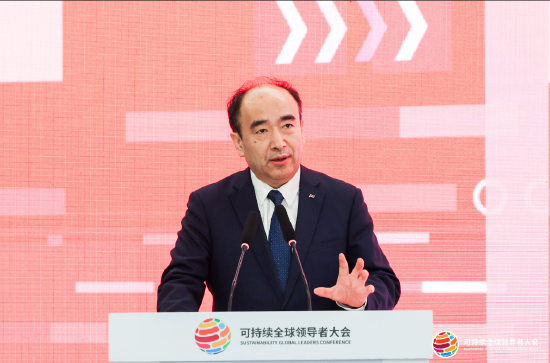
浦发银行薛宏立:转型金融成必答题发展空间依托两大核心驱动力
Xin Lang Cai Jing· 2025-10-16 10:02
Core Insights - The 2025 Sustainable Global Leaders Conference is being held from October 16 to 18 in Shanghai, focusing on the critical role of transition finance in supporting high-quality economic development and achieving carbon neutrality goals [1] Group 1: Transition Finance - Transition finance has shifted from an optional strategy to a necessary approach, driven by global carbon neutrality efforts and national strategies, particularly China's dual carbon goals [1] - The issuance of transition bonds has rapidly increased, with over 240 bonds issued nationwide by the end of last year, highlighting the growing importance of transition finance in the green ecosystem [1] - Regulatory support and high-level policy guidance have bolstered the development of transition finance, with the People's Bank of China and seven other departments issuing guidelines to accelerate the establishment of transition standards [1] Group 2: Strategic Response and Innovation - Companies are encouraged to enhance top-level design and integrate low-carbon development concepts into strategic considerations, fostering a culture of low-carbon transition [1] - A new model combining commercial banking and investment banking is proposed, focusing on low-carbon energy, energy conservation, and green infrastructure to provide diverse financial services [1] - The development of a multi-layered financial product system is emphasized, including equity financing, securities products, and insurance guarantees to support high-carbon industries in their transition [1] Group 3: Digital Empowerment and Risk Management - The application of digital technologies in green finance is highlighted, aiming to improve efficiency in project evaluation, customer service, and ESG management [2] - A three-pronged mechanism integrating research, business, and risk management is proposed to support the risk management of green low-carbon transitions [1] Group 4: Company Initiatives - The company has been a pioneer in exploring green low-carbon services, aiming to strengthen its green innovation brand and expand its network of green finance partnerships [3] - Notable achievements include the launch of the first industrial low-carbon transition loan and the establishment of various green bond indices, demonstrating the company's commitment to innovative financial products [3] - The company emphasizes its role in sustainable development and collaboration with various stakeholders to build a new ecosystem for green finance [3]

海南自贸港跨境资管试点落地 首批6家机构完成证监会备案
Zhong Guo Jing Ying Bao· 2025-10-16 09:44
Core Viewpoint - The China Securities Regulatory Commission (CSRC) announced that six institutions have completed the filing for cross-border asset management pilot business in Hainan Free Trade Port, marking the first batch of pilot institutions since the implementation guidelines were released [1]. Group 1: Institutions Involved - The six institutions that have been approved include four issuing institutions: Jinyuan Securities Co., Ltd., Wanhua Securities Co., Ltd., Huibaichuan Fund Management Co., Ltd., and Peng'an Fund Management Co., Ltd. Additionally, two sales institutions are involved: Industrial Bank Co., Ltd. Haikou Branch and Shanghai Pudong Development Bank Co., Ltd. Haikou Branch [1]. Group 2: Regulatory Framework - The implementation guidelines for the cross-border asset management pilot business were jointly issued by several regulatory bodies, including the People's Bank of China Hainan Branch, the National Financial Supervision Administration Hainan Regulatory Bureau, the CSRC Hainan Regulatory Bureau, the Hainan Provincial Local Financial Management Bureau, and the State Administration of Foreign Exchange Hainan Branch on July 21 [1]. Group 3: Investment Opportunities - The guidelines support foreign investors in investing in financial products issued by financial institutions within the Hainan Free Trade Port, including wealth management products, private asset management products from securities and futures institutions, public securities investment funds, and insurance asset management products [1].
浦发银行薛宏立:转型金融成必答题 发展空间依托两大核心驱动力
Xin Lang Cai Jing· 2025-10-16 09:25
Core Insights - The 2025 Sustainable Global Leaders Conference is being held from October 16 to 18 in Shanghai, emphasizing the importance of transition finance as a critical tool for supporting high-quality economic development and as an opportunity for financial institutions to enhance their own quality [1][4]. Group 1: Transition Finance Development - Transition finance has become essential, driven by global carbon neutrality efforts and national strategies, with China's "dual carbon" strategy and the 14th Five-Year Plan promoting a comprehensive green and low-carbon transformation [3][4]. - China's green industry accounts for 10% of the total economy, with traditional industries needing to transition at an even higher rate, making transition finance a vital component of the green system [3][4]. - As of last year, over 240 transition bonds have been issued in China, with a total issuance scale exceeding 220 billion, indicating a release of market vitality [3][4]. Group 2: Regulatory Support and Policy Guidance - Regulatory channels and high-level policy guidance have provided strong support for the development of transition finance, including the People's Bank of China's guidelines to accelerate the establishment of transition standards and support for transition bonds [5][6]. - Pilot programs for transition finance standards have been initiated in 16 provinces and cities across key sectors such as steel, coal power, building materials, and agriculture, offering clear action guidelines for commercial banks [5][6]. Group 3: Strategic Response and New Models - There is a need to strengthen top-level design and integrate low-carbon development concepts into strategic considerations, enhancing the organizational system for green finance management [6][7]. - The company aims to innovate a model combining commercial banking and investment banking, focusing on low-carbon energy, energy conservation, and green infrastructure to provide various services for green and low-carbon enterprises [6][7]. - A multi-layered transition finance product system is being developed, including equity financing, securities products, and insurance guarantees [6][7]. Group 4: Enhancing Green Financial Services - The company has integrated research, business, and risk management to support green and low-carbon transitions, enhancing the efficiency of investment and financing decisions [6][7]. - As of mid-2023, the bank's green loan balance exceeded 670 billion, a growth of over 17% from the previous year, while green bond balances reached over 23 billion, increasing by 9% [6][7]. - The bank has launched innovative transition finance products, including the first industrial low-carbon transition loan, supporting projects in high-carbon emission industries [7].
银行OCI账户储备大盘点:下半年银行还会大幅卖债吗?
ZHESHANG SECURITIES· 2025-10-16 08:48
Investment Rating - The industry investment rating is maintained as "Positive" [3] Core Insights - It is expected that large banks will increase their bond purchases while small banks will sell bonds to improve performance [3] - The behavior of banks in the secondary bond market is influenced by three main factors: passive allocation behavior, active allocation behavior, and risk indicator constraints [3][9][10] - In the first half of 2025, the core revenue growth rates for different types of banks varied, with state-owned banks showing a slight decline while city commercial banks experienced growth [18][24] Summary by Sections 1. Factors Influencing Bank Bond Trading Behavior - Passive allocation behavior involves using remaining liquidity to participate in the secondary market, enhancing fund utilization [9] - Active allocation behavior is driven by performance pressures, leading banks to adjust positions to enhance revenue or mitigate risks [10] - Risk indicator constraints require banks to adjust their bond maturity structure based on liquidity and interest rate risks [11] 2. Reasons for Significant Bond Selling in March to June 2025 - The primary reason for the significant bond selling was the performance pressure on small banks, which needed to realize gains from OCI/AC accounts to improve earnings [12] - Remaining liquidity did not significantly decrease during this period, indicating that the selling behavior was more related to active management rather than passive allocation [13] - The performance pressure was particularly acute for small banks, which had to sell older bonds to support their revenue [17][18] 3. Different Motivations for Bond Trading Among Bank Types - State-owned banks are primarily constrained by remaining liquidity and are expected to focus on buying bonds [3] - Joint-stock banks are experiencing significant performance pressure, leading to a reduction in AC account sizes [3] - City and rural commercial banks are also facing performance pressures, resulting in a contraction of both AC and OCI account sizes [3] 4. Future Expectations for Bank Bond Selling - In the coming months, large banks are expected to focus on buying bonds, while small banks may continue to sell older bonds to improve their performance [3] - The passive allocation behavior is anticipated to remain strong due to increased remaining liquidity, while small banks may increase their selling activities [4] - Risk indicator pressures are expected to ease as supply pressures diminish, leading to a reduction in bond selling by state-owned banks [4] 5. Investment Recommendations - The report recommends focusing on small banks in economically developed regions and stable high-dividend large banks, with specific recommendations for banks such as Shanghai Pudong Development Bank and Nanjing Bank [4]




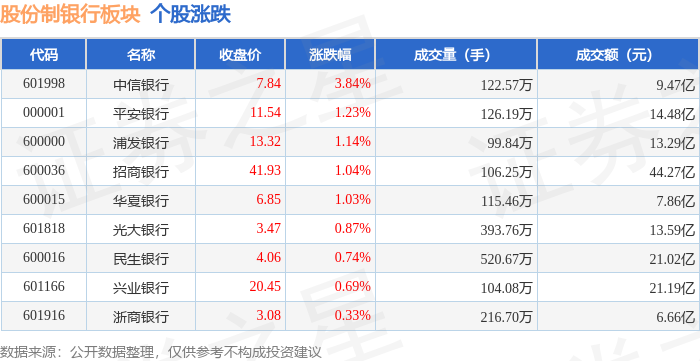
股份制银行板块10月16日涨1.29%,中信银行领涨,主力资金净流出2.4亿元
Zheng Xing Xing Ye Ri Bao· 2025-10-16 08:27
证券之星消息,10月16日股份制银行板块较上一交易日上涨1.29%,中信银行领涨。当日上证指数报收 于3916.23,上涨0.1%。深证成指报收于13086.41,下跌0.25%。股份制银行板块个股涨跌见下表: 从资金流向上来看,当日股份制银行板块主力资金净流出2.4亿元,游资资金净流出1783.73万元,散户 资金净流入2.58亿元。股份制银行板块个股资金流向见下表: 以上内容为证券之星据公开信息整理,由AI算法生成(网信算备310104345710301240019号),不构成投资建议。 | 代码 | 名称 | 收盘价 | 涨跌幅 | 成交量(手) | 成交额(元) | | --- | --- | --- | --- | --- | --- | | 601998 | 中信银行 | 7.84 | 3.84% | 122.57万 | 9.471Z | | 000001 | 平安银行 | 11.54 | 1.23% | 126.19万 | 14.48 Z | | 600000 | 浦发银行 | 13.32 | 1.14% | 99.84万 | 13.29亿 | | 600036 | 招商银行 | 41.93 | ...