
CMBC(600016)

Search documents
民生银行2025年罚没近9500万元,2026年1月罚没超245万元
Jing Ji Guan Cha Wang· 2026-03-08 06:45
Core Viewpoint - Minsheng Bank is facing compliance issues, highlighted by multiple fines and a significant drop in net profit despite revenue growth, indicating operational challenges and risks associated with regulatory compliance [1][3]. Compliance Issues - Since 2026, Minsheng Bank has received multiple fines totaling at least 2.45 million yuan, related to mortgage loans and credit certificate reviews across its branches in Xi'an, Nanjing, and Huzhou [1]. - In 2025, the bank faced over 72 fines, with a total penalty amount nearing 95 million yuan, reflecting internal control pressures [1]. Stock Performance - The stock price of Minsheng Bank showed volatility from March 2 to March 6, 2026, closing at 3.88 yuan with a price fluctuation of 4.12% [2]. - A significant block trade of 45.93 million yuan occurred on March 4, coinciding with a 2.04% drop in stock price [2]. - As of March 6, the bank's market capitalization stood at 169.876 billion yuan, with a price-to-earnings ratio (TTM) of 5.60 and a price-to-book ratio of 0.30 [2]. Financial Performance - For Q3 2025, Minsheng Bank reported operating income of 108.5 billion yuan, a year-on-year increase of 6.74%, but net profit attributable to shareholders fell by 6.38% to 28.5 billion yuan, indicating a "revenue growth without profit growth" scenario [3]. - The decline in profit was primarily due to a 28% increase in credit impairment losses, which reached 40.2 billion yuan, with a provision coverage ratio of only 143%, the lowest among A-share listed banks [3]. - The net interest margin improved to 1.47%, but asset quality remains under pressure with a non-performing loan ratio of 1.48% [3]. Institutional Perspectives - Institutional ratings for Minsheng Bank are generally neutral, with CICC maintaining an "outperforming the industry" rating and a target price of 6.40 yuan, suggesting a potential upside of 67.98% from the current price [4]. - Despite the optimistic target price, forecasts indicate a 4.01% decline in net profit for 2025, reflecting ongoing fundamental challenges [4]. - Market sentiment appears moderate, with a low proportion of fund holdings indicating general market interest [4].

广期所:核准中国银行等三家银行为境外客户期货保证金指定存管银行
Sou Hu Cai Jing· 2026-03-06 13:13
Core Viewpoint - The Guangzhou Futures Exchange has approved three banks as designated custodians for margin deposits from overseas clients, enhancing the infrastructure for international participation in the futures market [2] Group 1: Regulatory Developments - The Guangzhou Futures Exchange has issued a notice on March 6 regarding the management of designated custodial banks for margin deposits [2] - The approved banks include Bank of China, Bank of Communications, and China Minsheng Bank, which will serve overseas clients [2]




富时中国50指数调整:纳入新华保险、潍柴动力 剔除民生银行、中兴通讯
Zhi Tong Cai Jing· 2026-03-06 12:43
Group 1 - FTSE Russell announced the new candidate stocks for the FTSE China 50 Index, which include China Aluminum (601600)(02600), China Duty Free Group (601888)(01880), Hansoh Pharmaceutical (03692), Shandong Gold (600547)(01787), and Sanhua Intelligent Control (002050)(02050) [1] - The quarterly review changes for the FTSE China Index Series were announced, with adjustments effective after the market close on March 20, 2026 [2] - The FTSE China 50 Index will include New China Life Insurance (601336)(01336) and Weichai Power (000338)(02338), while excluding Minsheng Bank (600016)(01988) and ZTE Corporation (000063)(00763) [2]

2025年中国手机银行APP监测报告
艾瑞咨询· 2026-03-05 00:08
Market Overview - The mobile banking app industry in China is transitioning to a mature stage, with user behavior becoming more efficient as the user base stabilizes. The focus is shifting from prolonged browsing to high-frequency, short-duration, and purpose-driven usage, necessitating refined operations [1][7][9]. Technology Trends - AI and ecosystem integration are driving a transformation in service delivery. AI and large models are becoming core infrastructures, enhancing business operations and interactions, while native adaptations and smart risk control improve user experience and security [2][11]. Policy Environment - Regulatory frameworks are tightening, emphasizing compliance and innovation. The "Five Major Articles" guide innovation directions, while new rules on data security and existing user base management establish compliance as a prerequisite for development [3][14]. Competitive Landscape - The competitive landscape is increasingly defined by ecological and regional capabilities. State-owned banks leverage embedded ecosystems for a competitive edge, while joint-stock banks survive through professional differentiation. Regional banks grow through local market penetration, and private banks are becoming relatively marginalized [4][16]. User Engagement and Demographics - The core user demographic for mobile banking apps consists predominantly of males (56.7%), with 63.3% under 40 years old and 66.5% being married. The user base is heavily concentrated in new first-tier and lower-tier cities, with a significant portion of users belonging to the middle-income group [6][45][48]. User Behavior Insights - From March 2023 to December 2025, the frequency of app usage is expected to slightly decline, while the effective usage duration will stabilize after a decrease. This indicates a shift from passive browsing to more efficient, functional usage, highlighting the need for banks to enhance service value and user experience [9][11]. Monthly Active Users (MAU) Rankings - The top mobile banking apps by average MAU in 2025 include Agricultural Bank of China (249 million), Industrial and Commercial Bank of China (194 million), and China Construction Bank (108 million). The rankings reflect a strong presence of state-owned banks in the top tier [5][18][21]. Case Studies of Leading Banks - Agricultural Bank of China aims to enhance user experience through its mobile banking version 11.0, focusing on intelligent service matching and comprehensive security [30]. - Industrial and Commercial Bank of China emphasizes smart financial services with its app version 1.0, offering features like wealth management and consumer loans [33]. - Postal Savings Bank of China targets a more companion-like service approach with its app version 11.0, enhancing user engagement [35]. - China Merchants Bank leads among joint-stock banks with a focus on wealth management and digital loan processing in its app version 14.0 [37]. - Ping An Bank's app version 8.0 emphasizes AI-driven service enhancements and personalized insights [39]. - Beijing Bank's app version 10.0 aims to provide a comprehensive financial ecosystem for users [41]. Future Outlook - The mobile banking app market is expected to continue evolving, with a focus on integrating advanced technologies and enhancing user engagement through tailored services, particularly for the core demographic of young and middle-aged users [11][14][48].





民生银行(01988) - 截至二零二六年二月二十八日止股份发行人的证券变动月报表
2026-03-04 11:00
股份發行人及根據《上市規則》第十九B章上市的香港預託證券發行人的證券變動月報表 截至月份: 2026年2月28日 狀態: 新提交 致:香港交易及結算所有限公司 公司名稱: 中國民生銀行股份有限公司(在中華人民共和國註冊成立的股份有限公司) 呈交日期: 2026年3月4日 I. 法定/註冊股本變動 | 1. 股份分類 | 普通股 | 股份類別 | H | | 於香港聯交所上市 (註1) | 是 | | | | --- | --- | --- | --- | --- | --- | --- | --- | --- | | 證券代號 (如上市) | 01988 | 說明 | H 股 | | | | | | | | | 法定/註冊股份數目 | | | 面值 | | 法定/註冊股本 | | | 上月底結存 | | | 8,320,295,289 | RMB | | 1 RMB | | 8,320,295,289 | | 增加 / 減少 (-) | | | 0 | | | RMB | | 0 | | 本月底結存 | | | 8,320,295,289 | RMB | | 1 RMB | | 8,320,295,289 | ...
富时中国50指数调整:纳入新华保险、潍柴动力,剔除民生银行、中兴通讯
Zhi Tong Cai Jing· 2026-03-04 10:48
Group 1 - FTSE Russell announced changes to the FTSE China Index Series during its quarterly review, with adjustments effective after market close on March 20, 2026 [1] - The FTSE China 50 Index will include new constituent stocks and remove certain Hong Kong stocks [1] - A new list of candidate stocks for the upcoming season of the FTSE China 50 Index has been published, featuring several Hong Kong companies [1]
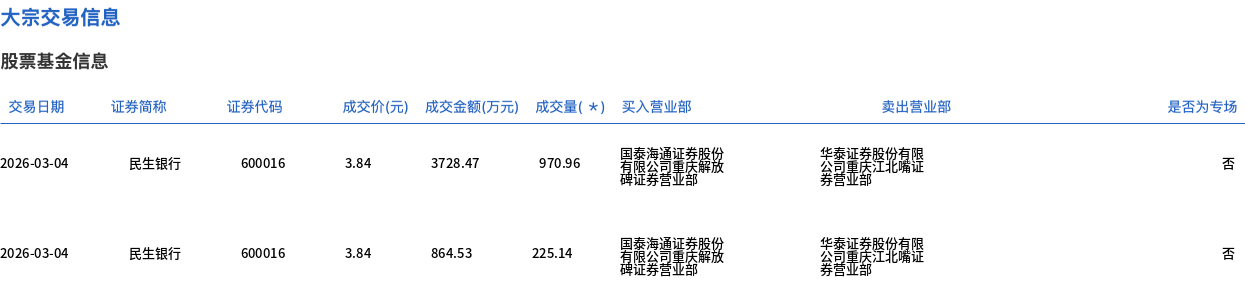
民生银行今日大宗交易平价成交1196.1万股,成交额4593万元
Xin Lang Cai Jing· 2026-03-04 09:36
Group 1 - The trading date for the transactions is March 4, 2026, indicating recent activity in the market [1] - The security involved is Minsheng Bank, with the stock code 600016, and the trading price was 3.84 yuan [1] - The total transaction amount for Minsheng Bank was 4,592.99 million yuan, with a total trading volume of 1,196.10 thousand shares [1] Group 2 - The buying brokerage firms include Guotai Junan Securities and Huatai Securities [1] - The selling brokerage firm is also Huatai Securities, indicating potential internal trading dynamics [1]
中国民生银行将开展工商注吊销单位银行结算账户清理工作
Jin Tou Wang· 2026-03-03 03:37
Core Viewpoint - China Minsheng Bank announced the closure or cleaning of bank settlement accounts for units that have had their business licenses revoked or canceled, have not conducted any transactions for over a year, and do not owe any debts to the bank [1] Group 1 - The announcement is based on the regulations of the People's Bank of China regarding the management of RMB bank settlement accounts [1] - Units affected by this policy are required to complete the account closure procedures within 30 days from the date of the announcement [1] - After the 30-day period, the bank will begin to process the closure or cleaning of eligible accounts in batches [1]
民生银行南京分行商户收单创新服务强劲赋能
Jiang Nan Shi Bao· 2026-03-02 02:56
Group 1: Consumer Market Performance - The 2026 Spring Festival is expected to bring the "longest holiday ever," leading to a consumption boom in Jiangsu, with 75.81 million tourists and total spending of 60.963 billion yuan, reflecting year-on-year growth of 10.1% and 10.5% respectively [1] - The vibrant consumer market is supported by active participation from numerous merchants, who face challenges in transaction efficiency, cash flow, and financial management, especially during peak consumption periods [1] Group 2: Financial Services for Cultural and Tourism Industries - During the Spring Festival, diverse consumption scenarios like night markets and cultural tourism complexes saw increased activity, but businesses faced challenges in transaction management and cost control [2] - Minsheng Bank provided customized integrated financial service solutions, including a one-stop intelligent payment system that supports various payment methods, significantly improving transaction efficiency for merchants [2][3] Group 3: Digital Solutions for Trade and Commerce - As retail chains expand, digital management becomes essential for improving operational efficiency, prompting Minsheng Bank to offer tailored solutions to enhance digital management for businesses [4] - The bank's specialized intelligent payment solutions have improved transaction speed and operational efficiency, accommodating a 56% increase in transaction volume during peak periods [4] Group 4: Financing Solutions for Brand Distributors - The Spring Festival is a critical period for brand distributors, who face multiple financial challenges, including the need for quick funding and efficient transaction management [6] - Minsheng Bank's "Minsheng Quick Loan + Payment" solution addresses these challenges by providing rapid online loan approvals and integrated payment tools, effectively supporting distributors during peak seasons [7] Group 5: Future Directions for Minsheng Bank - Minsheng Bank aims to deepen its focus on digital finance, aligning with the "expand domestic demand" development strategy, and plans to innovate and offer more customized financial products to support digital transformation for businesses [8]
流动性观察第 122 期:当同业存款定价再自律
EBSCN· 2026-03-01 10:58
Investment Rating - The report maintains a "Buy" rating for the banking industry, indicating an expected investment return exceeding the market benchmark index by over 15% in the next 6-12 months [1]. Core Insights - The report discusses the implementation of a self-regulatory mechanism for interbank deposit pricing, which aims to manage liquidity and stabilize the banking sector's cost of liabilities. The focus has shifted from merely controlling the scale of interbank liabilities to regulating pricing behavior [4][5][6]. - The introduction of self-regulation for non-bank interbank demand deposit rates is expected to enhance the efficiency of monetary policy transmission and alleviate pressure on bank interest margins [6][9]. - The report highlights the historical evolution of interbank liability management, emphasizing the transition from risk prevention to cost control, and outlines the regulatory framework established over the past decade [4][5][6]. Summary by Sections Regulatory History Review - The regulatory framework for interbank liabilities has evolved through three main phases: establishing a risk prevention framework, deepening regulation to reduce leverage and prevent fund turnover, and focusing on cost control through pricing management [4][5][6]. Cost Management of Interbank Liabilities - The report notes that the cost of interbank liabilities remains relatively high, with significant room for further reduction. The average cost of interbank liabilities for state-owned banks was reported at 2.01%, compared to 1.52% for deposits, indicating a 48 basis point spread [13][20]. - The report emphasizes the need for enhanced management of interbank deposit pricing, particularly for time deposits, which currently do not fall under self-regulatory constraints [20][21]. Future Pathways for Self-Regulation - The report suggests that future regulatory measures may include setting upper limits on the scale of interbank demand deposits priced above self-regulatory levels and implementing self-regulation for time deposit rates [22][25]. - Preliminary estimates indicate that the self-regulation of interbank time deposits could lead to a reduction in interest expenses for banks, improving net interest margins by approximately 2 basis points [25][29]. Impact on Wealth Management Products - The report assesses the impact of interbank deposit self-regulation on wealth management products, indicating that the influence on net asset values is relatively limited due to the diverse nature of interbank deposit configurations [34][37]. - It highlights that wealth management products will continue to maintain a strong allocation to deposit-like assets, with expected fluctuations in allocation ratios [34][37].