
CMBC(600016)

Search documents
【独家发布】2025年中国中小银行行业政策梳理及上下游产业链全景分析
Xin Lang Cai Jing· 2026-01-28 04:49
Core Insights - The article emphasizes the positive role of small and medium-sized banks in supporting China's long-term economic development, particularly in fostering private enterprises and local economies while advancing financial market reforms [2][16] - It highlights the significant growth in total assets and liabilities of small and medium-sized banks, indicating their expanding market presence and competitiveness [16] Summary by Sections Overview of the Small and Medium-Sized Banking Industry - Small and medium-sized banks are defined as those excluding the six major state-owned banks, encompassing various types such as national joint-stock banks, urban commercial banks, rural commercial banks, and private banks [3][17] - These banks play a crucial role in providing diverse financial services, including cash management, online banking, investment banking, and microfinance [5][19] Industry Policies - The Chinese government has shown strong support for the development of small and medium-sized banks, with policies aimed at enhancing their operational environment and promoting rural revitalization [7][21] - Key policies include the "Opinions on Further Deepening Rural Reform" and measures to support micro-enterprise financing, which guide these banks to leverage their local advantages [21][23] Industry Chain - The upstream of the small and medium-sized banking industry includes IT service providers, payment platforms, and financial market participants, which support banks in digital transformation and service innovation [10][24] - The midstream consists of the banks themselves, which provide essential financial services to meet the diverse needs of consumers and businesses [10][24] - The downstream includes consumers and enterprises that utilize banking services for consumption, investment, and financing, reflecting a growing demand for financial services [11][25] Financial Performance - In 2024, the total assets of small and medium-sized banks reached 192.25 trillion yuan, a year-on-year increase of 6.39%, while total liabilities were 177.36 trillion yuan, up 6.27% [16] - By November 2025, total assets are projected to grow to 201.6 trillion yuan, with liabilities increasing to 186.07 trillion yuan, indicating a continued upward trend in the sector [16]







漯河金融监管分局核准邢占峰民生银行漯河分行行长助理任职资格
Jin Tou Wang· 2026-01-28 03:13
二、中国民生银行应要求上述核准任职资格人员严格遵守金融监管总局有关监管规定,自中国民生银行 政许可决定作出之日起3个月内到任,并按要求及时报告到任情况。未在上述规定期限内到任的,本批 复文件失效,由决定机关办理行政许可注销手续。 三、中国民生银行应督促上述核准任职资格人员持续学习和掌握经济金融相关法律法规,牢固树立风险 合规意识,熟悉任职岗位职责,忠实勤勉履职。 2026年1月21日,漯河金融监管分局发布批复称,《关于核准邢占峰中国民生银行(600016)股份有限 公司漯河分行行长助理任职资格的请示》(民银郑发〔2025〕84号)收悉。经审核,现批复如下: 一、核准邢占峰中国民生银行股份有限公司漯河分行行长助理的任职资格。 ...
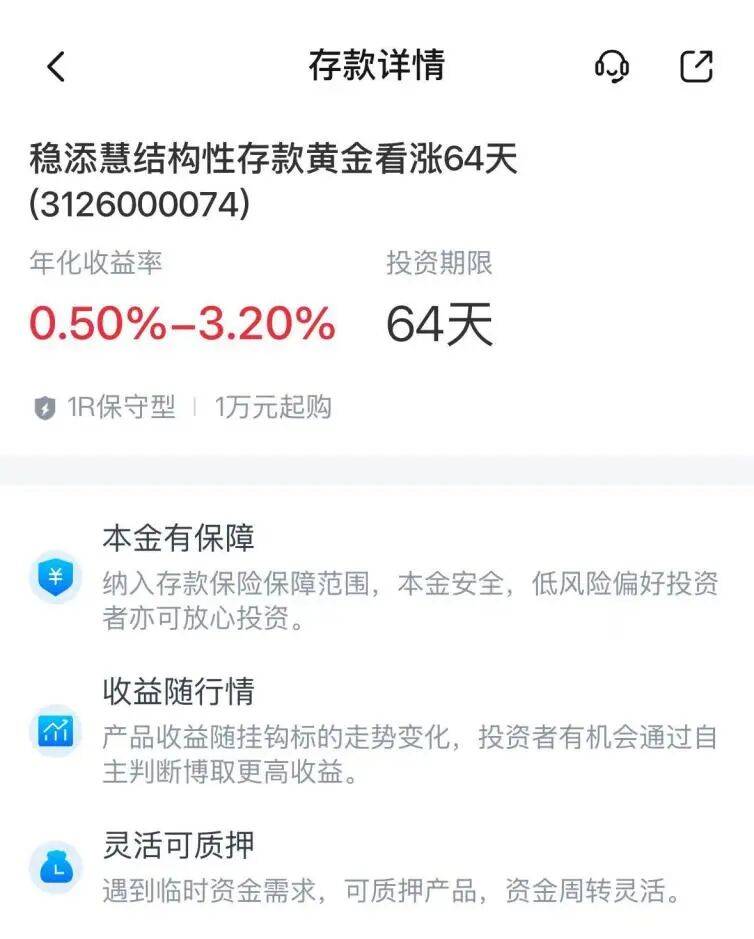
金价大涨,银行黄金挂钩结构性存款火了
Sou Hu Cai Jing· 2026-01-28 02:46
Core Viewpoint - The demand for gold-linked structured deposits is surging among banks and companies in China, driven by rising international gold prices, with many products selling out quickly [1][6]. Group 1: Bank Offerings - Multiple banks, including China Construction Bank, China Merchants Bank, and others, have launched gold-linked structured deposit products, with some experiencing high sales rates [1][6]. - The typical investment threshold for these products is around 10,000 yuan, with some popular offerings starting at 50,000 yuan, and most have a maturity of less than one year [6]. - Expected annualized returns for these products generally range from 1% to 4%, with some banks offering higher rates for foreign bank products [6][7]. Group 2: Company Participation - Numerous listed companies have begun investing in gold-linked structured deposits, with a total subscription amount reaching 1.728 billion yuan, significantly higher than the same period last year [8]. - For instance, Sujiao Technology announced a purchase of 90 million yuan in structured deposits linked to gold prices, with a maturity of 364 days and an expected annualized return of 0.30% to 2.35% [8]. Group 3: Market Analysis - Analysts suggest that the surge in gold-linked structured deposits is a response to increasing investor interest in gold as a safe-haven asset amid rising geopolitical uncertainties and economic fluctuations [9]. - The expectation is that gold prices may challenge the $6,000 mark by 2026, driven by ongoing market conditions and investor sentiment [9]. - The current market environment is characterized by high prices and volatility, prompting recommendations for investors to adopt strategies like dollar-cost averaging [10].

【行业深度】一文洞察2026年中国中小银行行业发展前景及投资趋势研究报告
Sou Hu Cai Jing· 2026-01-28 02:35
Core Insights - The article emphasizes the significant role of small and medium-sized banks in supporting China's long-term economic development through flexible market mechanisms and high service efficiency [2] - It highlights the ongoing transformation and competitive pressures faced by these banks, leading to strategies aimed at enhancing market competitiveness and expanding their asset base [2][8] Group 1: Industry Overview - Small and medium-sized banks are defined as all banks excluding the six major state-owned banks, and they include various types such as national joint-stock banks, urban commercial banks, rural commercial banks, and private banks [4] - These banks have become a crucial part of China's financial ecosystem, holding a substantial share of total assets in the banking sector [2] Group 2: Financial Performance - In 2024, the total assets of China's small and medium-sized banks reached 192.25 trillion yuan, marking a year-on-year growth of 6.39%, while total liabilities were 177.36 trillion yuan, up 6.27% [2] - By November 2025, total assets increased to 201.6 trillion yuan, reflecting a growth of 6.49%, with total liabilities at 186.07 trillion yuan, a rise of 6.66% [2] Group 3: Policy Environment - The Chinese government has shown strong support for the development of small and medium-sized banks, with policies aimed at enhancing their role in financing small and micro enterprises and promoting rural revitalization [8] - Key policies include the "Opinions on Further Deepening Rural Reform" and measures to support small and micro enterprise financing, which guide these banks to leverage their local advantages [8][10] Group 4: Industry Chain - The upstream of the small and medium-sized banking industry chain includes IT service providers, payment platforms, and financial market participants, which support banks in innovation and service delivery [11] - The midstream consists of the banks themselves, which provide essential financial services to meet diverse consumer and business needs [11][12] Group 5: Competitive Landscape - As competition intensifies, small and medium-sized banks are adopting strategies such as capital supplementation, attracting strategic investors, and differentiated operations to enhance their market position [2][8] - The focus on small and micro enterprise financing has led to significant achievements in expanding the industry’s total assets [2]
深耕普惠金融沃土 做小微金融领军者
Jin Rong Shi Bao· 2026-01-28 01:02
Core Viewpoint - The article emphasizes the importance of inclusive finance as a requirement for commercial banks to serve the real economy and contribute to high-quality social development, highlighting China Minsheng Bank's commitment to small and micro enterprises over the past 18 years [2][3]. Group 1: Development of Inclusive Finance - China Minsheng Bank has focused on small and micro finance since 2008, providing services to over 20 million small enterprises, establishing itself as a leader in this sector [2][3]. - The bank's innovative approach began post-2008 financial crisis, introducing the "Shangdai Tong" loan product in 2009, which addressed the financing needs of small enterprises [3]. - By 2011, the bank expanded its services from single credit offerings to comprehensive financial services, significantly increasing its business scale and service quality [3]. Group 2: Digital Transformation and Service Innovation - With the rapid development of information technology, the bank has shifted its small micro finance services from offline to a hybrid online-offline model, utilizing big data and mobile internet [4]. - In 2021, the bank initiated a transformation of its small micro finance model, enhancing service channels and integrating personal and corporate services [4]. - The bank has developed a digital platform, the Minsheng Small Micro App, which supports various online services for small enterprises, including financial management and loan applications [12]. Group 3: Case Studies of Support for Small Enterprises - The article shares a success story of a small retail enterprise that grew from a family business to a regional brand with the support of China Minsheng Bank, highlighting the bank's role as a reliable financial partner [6][7]. - The bank provided timely financing solutions, including a 3.19 million yuan loan to support the opening of new stores, demonstrating its responsiveness to client needs [7]. - Another example includes the bank's support for a new type of elderly care enterprise, providing a 10 million yuan credit facility to enhance service quality and meet the growing demand in the aging population sector [9][10]. Group 4: Comprehensive Financial Services and Risk Management - China Minsheng Bank has established a comprehensive service ecosystem for small enterprises, integrating financing, account management, and cash management into a single service model [13]. - The bank has implemented an intelligent risk management system to enhance credit assessment and approval efficiency for small enterprises [14]. - The bank's focus on serving key customer groups includes innovative financial products tailored for technology-driven and export-oriented small enterprises, enhancing their access to financing [15][16].

银行股配置重构系列九:从主动基金 Q4 持仓看配置思路
Changjiang Securities· 2026-01-27 15:25
Investment Rating - The investment rating for the banking sector is "Positive" and is maintained [12] Core Insights - In Q4 2025, active funds did not significantly reduce their holdings in bank stocks, with a stable allocation ratio of 1.86% compared to the previous quarter. This reflects a general decline in market risk appetite. However, it is anticipated that the allocation ratio may decrease further in Q1 2026 due to a significant rebound in risk appetite and the relative underperformance of bank stocks at the beginning of the year [2][6] - The selection of individual stocks has shifted towards a focus on fundamental trends, with Ningbo Bank seeing the most significant increase in allocation due to improved asset quality and performance expectations. The bank has established a turning point in retail asset quality and is expected to lead the sector in performance [7][8] - The report suggests that the core investment strategy for 2026 should prioritize high-performing regional banks, particularly city commercial banks, as they are expected to maintain superior growth rates amid a stable credit structure [9] Summary by Sections Active Fund Holdings - As of Q4 2025, the allocation ratio of active public funds to bank stocks remained stable at 1.86%, indicating a recovery in market risk appetite. The allocation ratio is expected to hit a new low in Q1 2026 due to a resurgence in risk appetite and the underperformance of bank stocks [6][8] - City commercial banks experienced a reduction of approximately 1.7 billion in total holdings, but Ningbo Bank was notably increased by 860 million, reflecting a shift towards stocks with improving fundamentals [7][8] Stock Selection Trends - The focus on stock selection has shifted from high dividend yields to fundamental trends, with Ningbo Bank being the most significantly increased stock in Q4 2025. The bank's asset quality indicators have shown continuous improvement, and it is expected to see a growth in performance in 2026 [7][8] - Conversely, stocks like Chengdu Bank have been reduced significantly, reflecting concerns over performance volatility and ongoing adjustments in business structure [7] Market Dynamics - The banking sector has faced downward pressure due to capital outflows from active funds and index funds, leading to undervaluation in bank stocks. The report recommends seizing opportunities in quality city commercial banks at lower price levels [9][33] - The report highlights that the allocation strategy for 2026 should focus on high-quality city commercial banks, as they are expected to outperform in terms of earnings growth amid a stable credit environment [9]




民生银行首席经济学家温彬:把握存款搬家窗口期,银行理财有望再次迎来规模增长大年
Jin Rong Jie· 2026-01-27 08:59
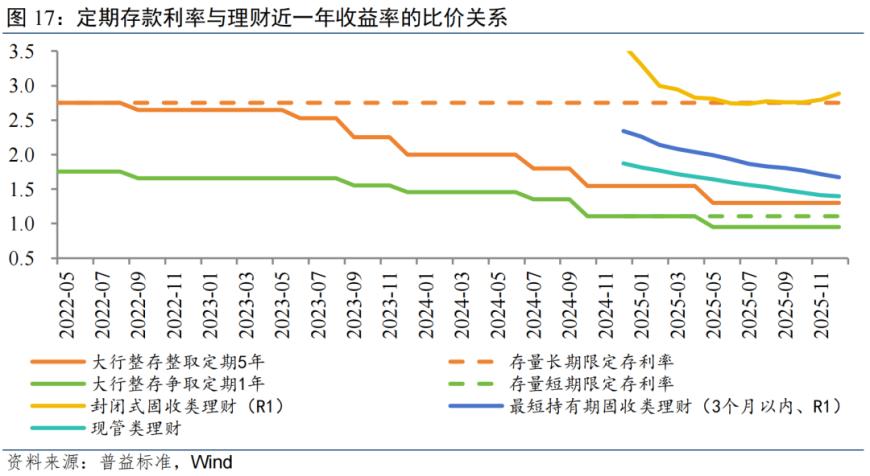
Group 1 - The core viewpoint of the article emphasizes the anticipated growth of the bank wealth management market in 2026, driven by the trend of deposit migration and the need for financial institutions to adapt to changing market conditions [3][4][5]. - In 2025, the wealth management market size is expected to reach 34 trillion yuan, showing a significant increase and outpacing public fund market growth [2]. - The structure of wealth management products is expected to further optimize, focusing on deposit replacement products, particularly short-term high liquidity fixed-income products and low-risk closed fixed-income products [5][6]. Group 2 - The average yield of current management wealth products is around 1.4%, while fixed-income products yield about 2.2%, maintaining a comparative advantage over current three-year fixed deposit rates [4]. - The investment strategy for bank wealth management is expected to continue with a low-volatility asset allocation approach, focusing on high-grade short- to medium-term credit bonds and maintaining a cautious stance on equity allocations [8][9]. - The overall wealth management yield is projected to exhibit a "weak fluctuation" pattern in 2026, influenced by economic fundamentals and policy environments, with a stable liability side expected to enhance the acceptance of wealth management yield levels [8][9].
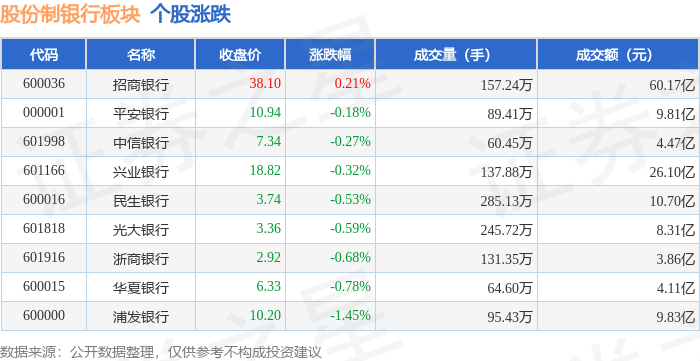
股份制银行板块1月27日跌0.35%,浦发银行领跌,主力资金净流入9.44亿元
Zheng Xing Xing Ye Ri Bao· 2026-01-27 08:49
Group 1 - The banking sector saw a decline of 0.35% on January 27, with Pudong Development Bank leading the drop [1] - The Shanghai Composite Index closed at 4139.9, up 0.18%, while the Shenzhen Component Index closed at 14329.91, up 0.09% [1] - Major banks such as China Merchants Bank and Ping An Bank experienced slight fluctuations in their stock prices, with China Merchants Bank closing at 38.10, up 0.21% [1] Group 2 - The net inflow of main funds into the banking sector was 944 million yuan, while retail investors saw a net outflow of 68.6153 million yuan [1] - Among individual stocks, China Merchants Bank had a main fund net inflow of 659 million yuan, while Ping An Bank experienced a net outflow of 3.2144 million yuan [1] - The trading volume for China Merchants Bank was 1.5724 million shares, with a transaction value of 6.017 billion yuan [1]

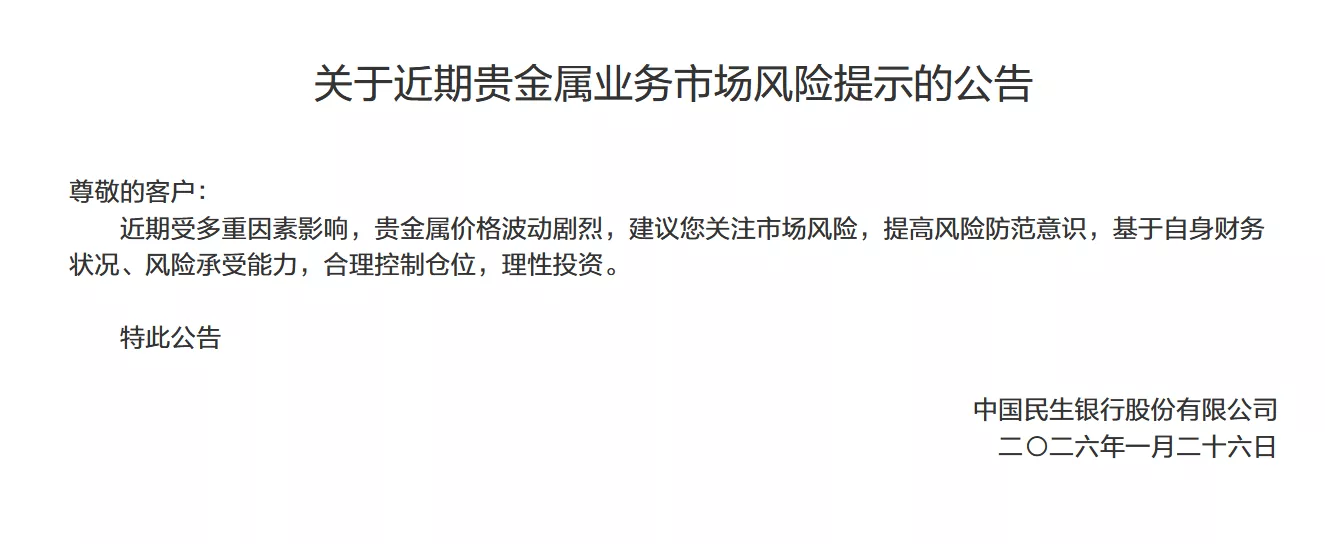
民生银行发布贵金属业务市场风险提示
Cai Jing Wang· 2026-01-27 06:07
1月26日,民生银行发布关于近期贵金属业务市场风险提示的公告,近期受多重因素影响,贵金属价格波动剧烈,建议客户关注市场风险,提高风险防范意 识,基于自身财务状况、风险承受能力,合理控制仓位,理性投资。 (民生银行) ...
民生银行:科技金融筑翼 助硬核科技企业远航
Jin Rong Jie Zi Xun· 2026-01-27 02:41
Core Insights - The article highlights the significant advancements in China's hard technology sectors, particularly in commercial aerospace and semiconductor industries, emphasizing the critical role of timely financial support and professional services in overcoming development challenges [1][4]. Group 1: Commercial Aerospace Industry - The commercial aerospace sector is characterized by high technical barriers, high risks, high capital investment, and long return cycles, with rocket model development requiring billions of yuan and taking over three years with minimal commercial income [2]. - Minsheng Bank has established a "Five Vertical and One Horizontal" technology finance service system to address industry pain points, utilizing a digital platform to integrate multi-dimensional data for enterprise assessment [2]. - The bank's collaboration with Zhongke Aerospace led to a rapid approval process for a 500 million yuan credit line, supporting the successful launch of 75 satellites and the first liquid oxygen-methane rocket [2][3]. Group 2: Semiconductor Industry - Minsheng Bank has adapted its technology finance service capabilities to the semiconductor sector, focusing on long cycles, high investment, and light asset characteristics, providing tailored financial empowerment solutions [4]. - The bank employs a "Five-Dimensional Assessment System" to evaluate core value dimensions such as market prospects, patent value, team strength, ecosystem partnerships, and capital market recognition [4]. - Specific products like "Yichuang E-loan" offer efficient funding solutions, with online credit loans processed in as little as two working days [4][5]. Group 3: Customized Services and Regional Focus - Minsheng Bank provides customized services to semiconductor companies, including stock repurchase loans and integrated services for market expansion, exemplified by its support for Jiangsu Weidao Nano Technology [5]. - The bank's "Minsheng E-chain" and "de-nuclear" service models enable efficient financing for small and medium-sized enterprises in the supply chain, breaking reliance on core enterprise credit [5][6]. - The bank aims to deepen its technology finance layout, focusing on key regions and supporting critical technological breakthroughs to foster high-quality development in hard technology [6].