
CMBC(600016)

Search documents
银行业持续强化金融法治建设
Jin Rong Shi Bao· 2025-12-04 02:00
Group 1 - The core viewpoint emphasizes the importance of legal construction in supporting the high-quality development of the financial industry in China, as highlighted by the Central Financial Work Conference [1] - The legal construction is an essential part of the socialist legal system with Chinese characteristics, as stated in the suggestions for the 15th Five-Year Plan [1] - Financial institutions are increasingly integrating legal principles into their management practices to enhance risk prevention, business innovation, and customer rights protection [1] Group 2 - Agricultural Bank of China is strengthening compliance management and incorporating legal education into leadership assessments to enhance legal awareness among all employees [2] - Industrial and Commercial Bank of China in Qinghai has established a legal education leadership group to coordinate legal education efforts across the bank [2] - Bank of Communications in Shanghai is focusing on employee legal education through various training activities to promote compliance awareness [2] Group 3 - Minsheng Bank in Chongqing is integrating legal construction with its operational development, establishing a leadership group to oversee legal initiatives [3] Group 4 - Legal compliance is viewed as the first line of defense in risk management for commercial banks, marking a significant shift in operational focus towards legality [4] - Banks are embedding legal and compliance principles throughout their business processes to ensure orderly and compliant operations [4] - Minsheng Bank in Zhengzhou emphasizes strict adherence to legal protocols in business operations to support the real economy [4] Group 5 - Postal Savings Bank is enhancing the anti-fraud capabilities of frontline staff through customized legal training conducted by practicing lawyers [5] Group 6 - The financial industry is focusing on protecting consumer rights as a reflection of its political and social responsibilities [6] - Financial institutions are actively engaging in public legal education to help citizens understand and protect their legal rights [6] - Industrial and Commercial Bank of China in Suzhou is conducting public legal education activities to enhance community awareness of financial safety [6] Group 7 - Construction Bank in Guangdong is participating in public awareness campaigns to expose illegal financial activities and educate the public on potential risks [7]






民生银行(01988) - 截至二零二五年十一月三十日止股份发行人的证券变动月报表
2025-12-03 11:00
股份發行人及根據《上市規則》第十九B章上市的香港預託證券發行人的證券變動月報表 截至月份: 2025年11月30日 狀態: 新提交 致:香港交易及結算所有限公司 公司名稱: 中國民生銀行股份有限公司(在中華人民共和國註冊成立的股份有限公司) 呈交日期: 2025年12月3日 I. 法定/註冊股本變動 | 1. 股份分類 | 普通股 | 股份類別 | H | | 於香港聯交所上市 (註1) | 是 | | | | --- | --- | --- | --- | --- | --- | --- | --- | --- | | 證券代號 (如上市) | 01988 | 說明 | H 股 | | | | | | | | | 法定/註冊股份數目 | | | 面值 | | 法定/註冊股本 | | | 上月底結存 | | | 8,320,295,289 | RMB | | 1 RMB | | 8,320,295,289 | | 增加 / 減少 (-) | | | 0 | | | RMB | | 0 | | 本月底結存 | | | 8,320,295,289 | RMB | | 1 RMB | | 8,320,295,289 ...
民生银行宁波分行:坚定民企服务战略 深耕甬城普惠金融
Feng Huang Wang Cai Jing· 2025-12-03 07:17
Core Insights - The article highlights the effective support provided by Minsheng Bank's Ningbo branch to small and micro enterprises through innovative financial services, which are crucial for their growth and development [1][5]. Group 1: Product and Service Innovation - Minsheng Bank has developed tailored financial products like "White Goose Loan" to address the specific needs of local industries, such as the white goose breeding sector, facilitating easier access to credit [2]. - The bank has introduced various online products and credit plans, including "National Subsidy Loan + Stock Loan," which offers up to 10 million yuan in credit for businesses participating in national subsidy programs [2]. Group 2: Optimizing Mechanisms for Efficiency - The establishment of a dedicated Inclusive Finance Management Committee at Minsheng Bank aims to enhance the efficiency of financial services for small and micro enterprises [3]. - The bank has initiated a "Thousand Enterprises, Ten Thousand Households" outreach program to better understand and meet the actual needs of small businesses, promoting awareness of inclusive financial products [3]. Group 3: Comprehensive Financial Support - Minsheng Bank provides a range of financial products and services, including "Talent Loans" for startups and "Intellectual Property Loans" to leverage patents as collateral, supporting the growth of small enterprises [4]. - The bank also offers digital tools and platforms to assist small businesses in their digital transformation, alongside providing advisory services in finance and taxation [4].
多地银行“开门红”营销提前开打,息差压力下揽储需求有所减弱
Feng Huang Wang· 2025-12-03 06:25
Core Insights - The banking sector is experiencing a significant transformation from traditional deposit and loan services to comprehensive financial services, with the "New Year Opening" marketing campaign reflecting this shift in search of new growth points in a changing market environment [1][3] Group 1: Early Marketing Initiatives - Many banks have started their "New Year Opening" marketing campaigns earlier than usual, with some initiating efforts as early as late November to secure quality clients and boost middle-income business [2][3] - Banks are conducting internal meetings to set sales targets for asset management products, indicating a proactive approach to marketing [2][3] Group 2: Pressure on Net Interest Margin - As of the end of Q3, the banking industry's net interest margin has dropped to 1.42%, remaining at a historical low, prompting banks to adjust their product offerings to manage interest margins more effectively [3][4] - Some banks have begun to withdraw long-term deposit products to strengthen interest margin control, with expectations of further declines in deposit rates [3] Group 3: Shift in Marketing Focus - There is a noticeable reduction in the demand for deposit acquisition among some banks, leading them to focus more on wealth management services [4][5] - Marketing strategies have evolved from traditional giveaways to more pragmatic approaches, such as fee discounts and cash rebates, to attract clients [4][5] Group 4: Wealth Management as a Priority - Wealth management has become a key focus for many banks, with initiatives like the "Wealth Growth Plan" being introduced to incentivize client participation [5] - The emphasis on wealth management reflects the increasing importance of retaining and growing client assets in the context of declining interest rates and net interest margins [5]

多家银行陆续调整代销基金风险等级
Zheng Quan Ri Bao Zhi Sheng· 2025-12-02 16:12
Core Viewpoint - Several banks, including China Construction Bank, have raised the risk levels of their distributed public funds, driven by stricter regulations and changing market conditions [1][2]. Group 1: Risk Level Adjustments - China Construction Bank announced an increase in risk levels for 87 public fund products, with 32 products moving from R2 (low to medium risk) to R3 (medium risk) and 55 products from R3 to R4 (medium to high risk) [2]. - Other banks, such as Minsheng Bank, have also adjusted risk levels for their distributed funds multiple times this year, indicating a broader trend across the banking sector [2][3]. Group 2: Market Environment Impact - The increase in risk levels is linked to rising volatility in the bond market, which affects the stability of bond fund net values, and the upward movement in equity markets, which increases the volatility of mixed funds [3]. Group 3: Implications for Wealth Management - More accurate risk ratings help banks fulfill their suitability management obligations, reduce future complaints and litigation risks, and enhance their brand reputation [4]. - However, the short-term challenge includes potential mismatches between the new risk levels and existing customer risk tolerances, which may lead to increased redemption rates and pressure on sales commissions [4]. Group 4: Investor Considerations - The adjustment in risk levels directly impacts ordinary investors, who may face decisions regarding redemption or reallocation of their investments due to mismatches in risk tolerance [4]. - Long-term, these adjustments are seen as a protective measure for investor rights, promoting transparency in risk disclosure and helping investors set realistic expectations [4]. Group 5: Recommendations for Investors - Investors are advised to reassess their risk tolerance, review their current holdings against new risk levels, and diversify their portfolios to mitigate risks [5]. - It is also recommended that investors focus on understanding product details beyond just risk ratings and maintain patience with quality products aligned with long-term goals [5].
民生银行“海运快汇”落地株洲 高效赋能外贸企业跨境结算
Chang Sha Wan Bao· 2025-12-02 14:51
Core Insights - The core viewpoint of the news is the successful implementation of the "Sea Freight Quick Remittance" service by Minsheng Bank's Zhuzhou branch, which addresses the pain points of traditional cross-border payment processes for foreign trade enterprises [1][2]. Group 1: Product Overview - "Sea Freight Quick Remittance" is an innovative smart remittance product launched by Minsheng Bank, specifically designed for the settlement of sea freight payments for foreign trade enterprises [1]. - The service allows clients to upload sea freight invoices via corporate online banking, where the system intelligently recognizes key information and automatically generates standardized remittance instructions, facilitating a fully electronic process [1][2]. Group 2: Operational Efficiency - Compared to traditional settlement methods, "Sea Freight Quick Remittance" significantly reduces manual intervention, saving time and labor costs while enhancing cross-border settlement efficiency [2]. - The Zhuzhou branch's proactive customer service included on-site guidance for the enterprise to complete online banking permissions and operational training, leading to a successful first online remittance without the need for paper documents [1][2]. Group 3: Future Plans and Commitment - The successful launch of "Sea Freight Quick Remittance" in Zhuzhou reflects Minsheng Bank's commitment to a customer-centric service philosophy and its focus on providing financial services tailored to the needs of foreign trade enterprises [2]. - Moving forward, the Zhuzhou branch aims to leverage its product innovation and professional service capabilities to continuously optimize financial service solutions for more foreign trade enterprises, thereby supporting the high-quality development of the regional foreign trade economy [2].
哪家商业银行最低持有期理财产品收益更高?
2 1 Shi Ji Jing Ji Bao Dao· 2025-12-02 10:37
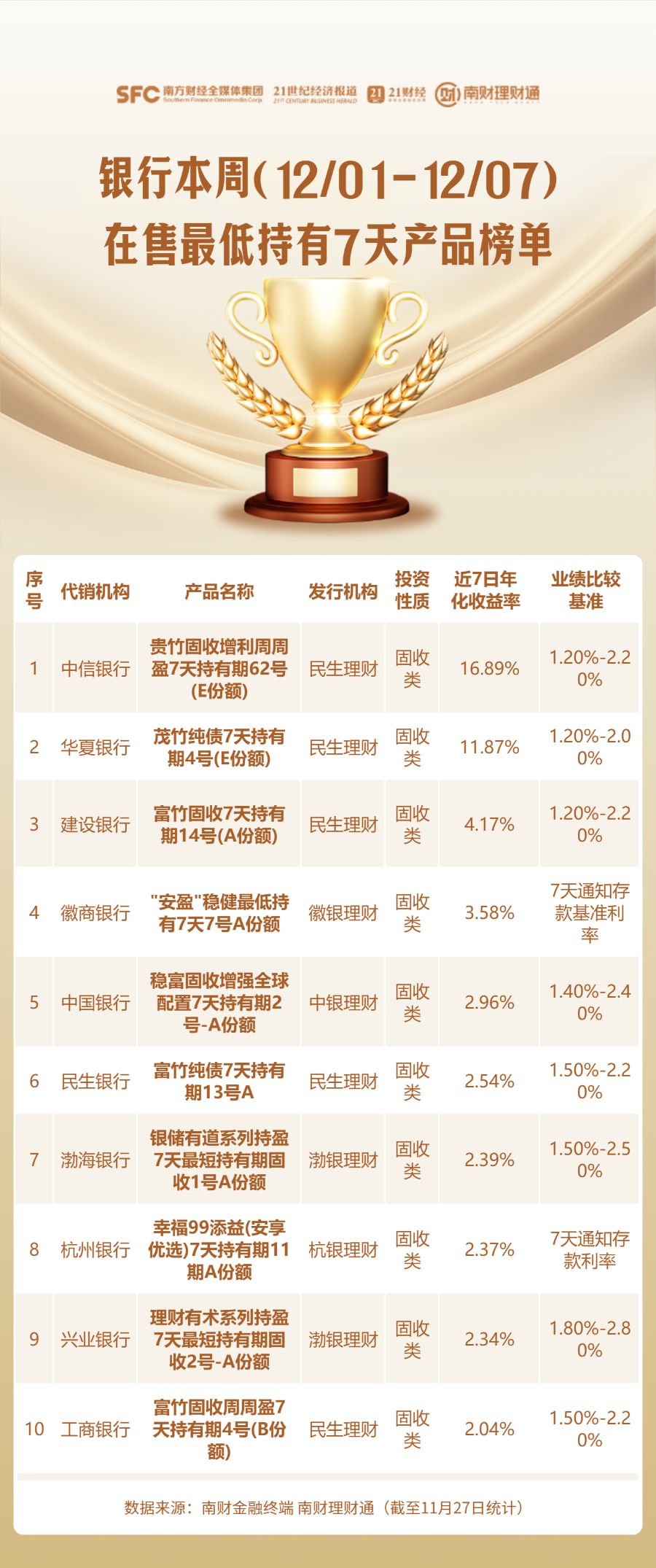
Core Insights - The article focuses on the performance of minimum holding period RMB public offering products, ranking them based on annualized returns for holding periods of 7, 14, 30, and 60 days [1][4][12] Group 1: 7-Day Holding Period Products - The top-performing product is from Minsheng Bank with an annualized return of 4.17% [3] - Other notable products include: - Huishang Bank with 3.58% [3] - Bank of China with 2.96% [3] - Minsheng Bank's Fuzhu Pure Bond with 2.54% [3] - Bohai Bank with 2.39% [3] Group 2: 14-Day Holding Period Products - Minsheng Bank's product "Jingxiang Fixed Income Incremental Dual-Week" leads with a return of 34.68% [5] - Other significant products include: - Minsheng Bank's Fuzhu Pure Bond with 5.66% [5] - WeBank's "Anying" Stable Income with 4.47% [5] - SPDB's "Wealth Management Series" with 2.33% [5] Group 3: 30-Day Holding Period Products - Minsheng Bank's "Guizhu Fixed Income Incremental Monthly" tops the list with a return of 21.23% [9] - Other key products include: - Minsheng Bank's Fuzhu Fixed Income with 13.53% [9] - Bank of China with 7.64% [9] - Huishang Bank's "Happiness 99" with 6.07% [9] Group 4: 60-Day Holding Period Products - The leading product is from Minsheng Bank with a return of 15.12% [13] - Other notable products include: - CITIC Bank's Fuzhu Pure Bond with 8.94% [14] - Bank of China with 4.57% [14] - Huishang Bank's product with 3.46% [14]





多家银行上调近100只基金风险等级
21世纪经济报道· 2025-12-02 09:45
记者丨叶麦穗 编辑|曾芳 股市出现波动,部分基金开始亏钱,银行紧急上调代销基金的风险等级。 近期, 包括建设银行、民生银行、邮储银行、中信银行在内的多家银行纷纷上调部分代销公募基金产品风险等级,有些银行年内甚至 7次上调基金的风险等级。 有分析师认为银行集中上调代销公募基金风险等级,是产品、市场与监管三方因素共振的结果。 今年前三季度市场出现明显的上涨。特别是上证指数冲上4000点之后,市场热情高涨,"日光基"再现,风险偏好大幅提升,资金涌入 市场。 日前,建设银行发布公告称,批量上调87只代销公募基金产品的风险等级。这也是该行年内第4次调整代销公募产品风险等级。 一旦市场波动,将会给投资人带来损失,因此银行上调代销基金风险等级,也是给投资人提醒,避免盲目入市遭遇亏损。 多家银行上调公募基金风险等级 展望未来,此举将趋于常态化。 这要求投资者理性看待:短期或引发部分保守投资者调整持仓,但长期看,动态评级能提升风险透明 度,减少错配。 建议投资者: 一是 养成定期检视产品风险等级的习惯; 二是 坚持分散配置,避免过度集中; 三是 主动寻求专业建议,确保自身风 险偏好与产品相匹配。 | 图/建行公告 | | -- ...

股份制银行板块12月2日跌0.26%,浦发银行领跌,主力资金净流出4.26亿元
Zheng Xing Xing Ye Ri Bao· 2025-12-02 09:05
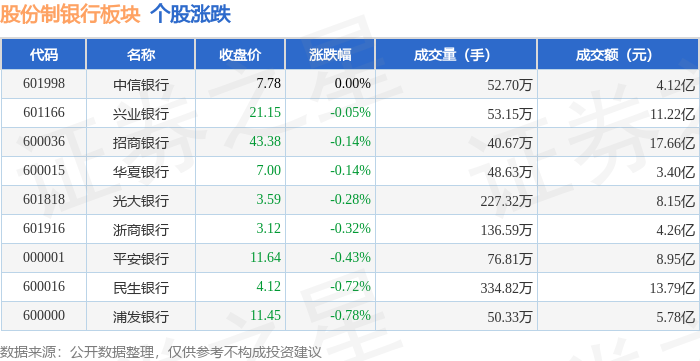
Market Overview - On December 2, the shareholding banks sector declined by 0.26% compared to the previous trading day, with Pudong Development Bank leading the decline [1] - The Shanghai Composite Index closed at 3897.71, down 0.42%, while the Shenzhen Component Index closed at 13056.7, down 0.68% [1] Individual Bank Performance - Citic Bank (601998) closed at 7.78 with no change in price, trading volume of 527,000 shares, and a transaction value of 412 million yuan [1] - Industrial Bank (601166) closed at 21.15, down 0.05%, with a trading volume of 531,500 shares and a transaction value of 1.122 billion yuan [1] - China Merchants Bank (600036) closed at 43.38, down 0.14%, with a trading volume of 406,700 shares and a transaction value of 1.766 billion yuan [1] - Huaxia Bank (600015) closed at 7.00, down 0.14%, with a trading volume of 486,300 shares and a transaction value of 340 million yuan [1] - Everbright Bank (601818) closed at 3.59, down 0.28%, with a trading volume of 2.2732 million shares and a transaction value of 815 million yuan [1] - Zhejiang Commercial Bank (601916) closed at 3.12, down 0.32%, with a trading volume of 1.3659 million shares and a transaction value of 426 million yuan [1] - Ping An Bank (000001) closed at 11.64, down 0.43%, with a trading volume of 768,100 shares and a transaction value of 895 million yuan [1] - Minsheng Bank (600016) closed at 4.12, down 0.72%, with a trading volume of 3.3482 million shares and a transaction value of 1.379 billion yuan [1] - Pudong Development Bank (600000) closed at 11.45, down 0.78%, with a trading volume of 503,300 shares and a transaction value of 578 million yuan [1] Capital Flow Analysis - The shareholding banks sector experienced a net outflow of 426 million yuan from main funds, while speculative funds saw a net inflow of 242 million yuan, and retail investors had a net inflow of 183 million yuan [1] - Citic Bank had a main fund net inflow of 56.67 million yuan, while retail investors contributed a net inflow of 8.34 million yuan [2] - Huaxia Bank saw a main fund net inflow of 20.20 million yuan, but retail investors had a net outflow of 1.99 million yuan [2] - Pudong Development Bank experienced a main fund net inflow of 0.89 million yuan, with a net outflow from retail investors of 32.71 million yuan [2] - Minsheng Bank had a significant main fund net outflow of 96.31 million yuan, while speculative funds saw a net inflow of 61.08 million yuan [2] - Industrial Bank faced a main fund net outflow of 101 million yuan, but retail investors contributed a net inflow of 82.80 million yuan [2]





股市高位震荡 银行上调近100只基金风险等级
2 1 Shi Ji Jing Ji Bao Dao· 2025-12-02 08:45
Core Viewpoint - Recent fluctuations in the stock market have led several banks to raise the risk levels of their distributed public funds, indicating a response to market volatility and regulatory requirements [1][2][3]. Group 1: Bank Actions - Multiple banks, including China Construction Bank and Minsheng Bank, have raised the risk levels of various public fund products, with some banks adjusting risk levels up to seven times this year [1][3]. - China Construction Bank announced an adjustment of 87 public fund products, with 32 moving from medium-low risk (R2) to medium risk (R3) and 55 from medium risk (R3) to medium-high risk (R4) [3]. - Minsheng Bank also raised the risk levels of eight funds from low to medium risk, marking its fourth adjustment in October alone [4]. Group 2: Market and Regulatory Context - Analysts suggest that the banks' actions are a result of a combination of product, market, and regulatory factors, particularly after a significant market rally that saw the Shanghai Composite Index exceed 4000 points [2][4]. - The adjustments are seen as a precautionary measure to protect investors from potential losses due to market volatility [2][4]. - Regulatory frameworks, such as the "Commercial Banks' Agency Sales Business Management Measures," emphasize the need for banks to independently assess and adjust risk ratings for the products they sell [5]. Group 3: Compliance and Regulatory Actions - Several banks have faced regulatory penalties for inadequate risk assessment and compliance failures in their fund sales operations, highlighting the importance of proper risk management practices [6][7]. - Regulatory bodies have issued corrective measures against banks like Zhejiang Chouzhou Bank and Huaxia Bank for failing to meet compliance standards in fund sales [6][7]. - The ongoing regulatory scrutiny is expected to lead to more frequent adjustments in risk ratings as banks strive to align with compliance requirements and protect investor interests [4][6].