Workflow
HSTD(600054)
icon
Search documents
2025年10月亚洲(中国)文旅业发展报告
3 6 Ke· 2025-11-27 07:15
Global Tourism Development Trends - The tourism industry is expected to grow at a rate higher than economic growth, driven by international leisure travel and long-distance trips [2] - Factors contributing to this trend include enhanced air connectivity and relaxed visa policies [2] - From 2024 to 2025, the share of the U.S. in global international leisure travel is projected to decrease from 8% to 7% [2] Regional Tourism Insights - **Netherlands**: Amsterdam Schiphol Airport saw approximately 6 million passengers in October, a 3% increase compared to the previous year, indicating healthy inbound tourism demand [3] - **Germany**: Significant recovery in the tourism market with a 20% increase in German tourists visiting Cyprus in October 2025 [4] - **Australia**: The tourism market showed positive growth, with major cultural and sports events attracting international visitors [6] - **Singapore**: Welcomed 14.3 million visitors in the first ten months of the year, a 3% increase year-on-year, driven by major events [7] - **Vietnam**: Received 1.73 million international visitors in October 2025, a 22.1% year-on-year increase, with a total of nearly 17.2 million visitors in the first ten months [8] - **China**: Domestic travel during the National Day and Mid-Autumn Festival saw 888 million trips, with total spending reaching 809 billion yuan, a significant increase from the previous year [9] Corporate Developments - **Personnel Changes**: Five tourism companies experienced significant personnel changes in October, including the resignation of Xi'an Tourism's board member [11] - **Investment and Equity Changes**: 32 tourism companies reported investment and equity changes, including ST United's sale of a 100% stake in Jiangxi Guogui Cultural Tourism Development [15][16] Key Project Signings and Developments - A total of 222 key tourism projects were signed in October, including the opening of two ski resorts in Xinjiang and the construction of a high-end tourism resort in Zhangjiajie [21][22] - China’s first surfing-themed resort is set to open in Hainan, enhancing the region's tourism offerings [23] - Major investments include a 20 billion yuan resort project in Guangdong and an 8.5 billion yuan project in Changbai Mountain [25][26] Industry Performance Metrics - The media and new media indices for tourism companies showed slight increases, with a focus on personnel changes and project developments [39] - The investor confidence index remained stable, reflecting ongoing project signings and developments in the tourism sector [40]
旅游及景区板块11月24日涨1.32%,天府文旅领涨,主力资金净流出4004.92万元
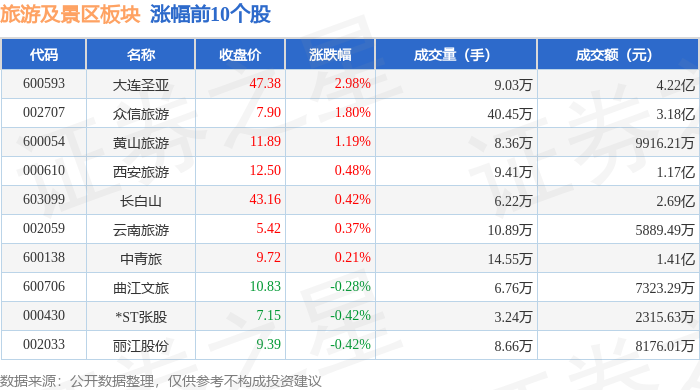
Core Viewpoint - The tourism and scenic spots sector experienced a rise of 1.32% on November 24, with Tianfu Culture and Tourism leading the gains [1] Group 1: Market Performance - The Shanghai Composite Index closed at 3836.77, up 0.05%, while the Shenzhen Component Index closed at 12585.08, up 0.37% [1] - Key stocks in the tourism sector showed significant increases, with Tianfu Culture and Tourism rising by 4.55% to a closing price of 5.51 [1] Group 2: Stock Performance - Notable performers included: - Tianfu Culture and Tourism (000558): 5.51, +4.55%, 844,600 shares traded, 463 million yuan turnover [1] - Zhongxin Tourism (002707): 6.97, +3.41%, 220,200 shares traded, 152 million yuan turnover [1] - Qujiang Culture and Tourism (600706): 10.60, +3.11%, 101,500 shares traded, 107 million yuan turnover [1] - Conversely, Caesar Travel (000796) saw a decline of 6.69% to 6.69, with a trading volume of 1,428,100 shares and a turnover of 973 million yuan [2] Group 3: Capital Flow - The tourism and scenic spots sector experienced a net outflow of 40.05 million yuan from institutional investors, while retail investors saw a net inflow of 105 million yuan [2] - Specific stock capital flows indicated: - Tianfu Culture and Tourism: -30.41 million yuan from institutional investors [3] - Zhongxin Tourism: +13.34 million yuan from institutional investors [3] - Yunnan Tourism (002059): +10.78 million yuan from institutional investors, but -33.39 million yuan from retail investors [3]
旅游及景区板块11月21日跌3.08%,大连圣亚领跌,主力资金净流出4.86亿元
Market Overview - The tourism and scenic spots sector experienced a decline of 3.08% on November 21, with Dalian Shengya leading the drop [1] - The Shanghai Composite Index closed at 3834.89, down 2.45%, while the Shenzhen Component Index closed at 12538.07, down 3.41% [1] Stock Performance - Dalian Shengya saw a significant drop of 10.00%, closing at 47.34, with a trading volume of 147,500 shares and a transaction value of 714 million [2] - Other notable declines included Tianfu Culture Tourism (-4.18%), Changzi Mountain (-4.08%), and Qujiang Culture Tourism (-3.93%) [2] Capital Flow - The tourism and scenic spots sector experienced a net outflow of 486 million from main funds, while retail investors saw a net inflow of 461 million [2] - The sector's overall capital flow indicates a mixed sentiment, with institutional investors pulling back while retail investors increased their positions [2] Individual Stock Capital Flow - Yunnan Tourism had a main fund net inflow of 10.99 million, while it faced a retail net outflow of 32.27 million [3] - Huangshan Tourism and Sanxia Tourism experienced significant net outflows from main funds, at 10.61 million and 11.62 million respectively, while both saw positive retail inflows [3]
商贸零售行业跟踪周报:2025年双十一数据复盘:综合电商平台稳健增长,即时零售表现亮眼-20251118
Soochow Securities· 2025-11-18 12:00
Investment Rating - The report maintains an "Overweight" rating for the retail industry [1] Core Insights - The 2025 Double Eleven sales period saw a total e-commerce sales of approximately 1,695 billion yuan, representing a year-on-year increase of 14.2%. The comprehensive e-commerce platforms accounted for 1,619.1 billion yuan, with a year-on-year growth of 12.3% [4][9] - Instant retail showed remarkable growth, with sales reaching 67 billion yuan during the Double Eleven period, marking a year-on-year increase of 138% [10][15] - Key product categories such as digital appliances, food and beverages, furniture, and pet products experienced significant growth, with pet sales reaching 9.2 billion yuan, up 59% year-on-year [15][16] Summary by Sections Weekly Industry Viewpoint - The Double Eleven sales period was extended, contributing to steady growth in total e-commerce sales. The sales period for 2025 was from October 7 to November 11, compared to October 14 to November 11 in 2024 [9] - Instant retail emerged as a highlight, with substantial growth compared to traditional e-commerce formats [10] Weekly Market Review - From November 10 to November 16, the Shenwan retail index increased by 4.06%, while the Shanghai Composite Index decreased by 0.18% [17] - Year-to-date performance shows the Shenwan retail index up by 8.43%, compared to a 19.06% increase in the Shanghai Composite Index [17][22] Company Valuation Table - The report includes a detailed valuation table for various companies in the retail sector, with specific metrics such as market capitalization and P/E ratios [24][25]
旅游及景区板块11月14日跌0.54%,西域旅游领跌,主力资金净流出3.59亿元
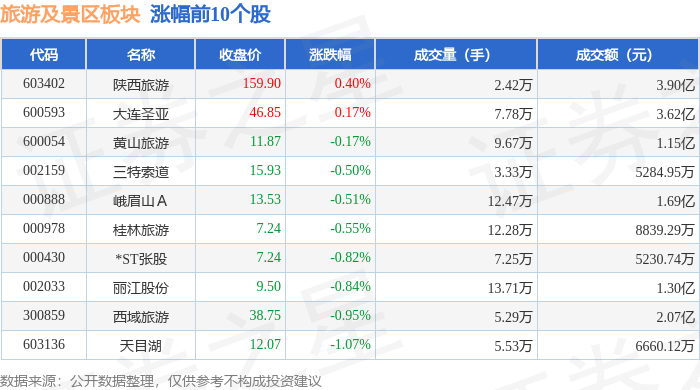
Core Insights - The tourism and scenic spots sector experienced a decline of 0.54% on November 14, with Xiyu Tourism leading the drop [1] - The Shanghai Composite Index closed at 3990.49, down 0.97%, while the Shenzhen Component Index closed at 13216.03, down 1.93% [1] Fund Flow Analysis - On the same day, the tourism and scenic spots sector saw a net outflow of 359 million yuan from main funds, while retail investors contributed a net inflow of 404 million yuan [2] - The table provided indicates specific fund flows for various companies, showing that: - Caesar Travel had a main fund net inflow of 40.13 million yuan, but a net outflow from retail investors of 0.39 million yuan [2] - Jiuhua Tourism experienced a main fund net inflow of 5.51 million yuan, with a net outflow from retail investors of 0.28 million yuan [2] - Guilin Tourism had a main fund net inflow of 3.91 million yuan, but a significant net outflow from retail investors of 1.53 million yuan [2] - Other companies like Emei Mountain A and Huangshan Tourism faced net outflows from both main and retail funds [2]
旅游及景区板块11月12日跌0.28%,岭南控股领跌,主力资金净流出5265.17万元
Core Viewpoint - The tourism and scenic area sector experienced a decline of 0.28% on November 12, with Lingnan Holdings leading the drop. The Shanghai Composite Index closed at 4000.14, down 0.07%, while the Shenzhen Component Index closed at 13240.62, down 0.36% [1]. Group 1: Market Performance - The tourism and scenic area sector saw a mixed performance among individual stocks, with notable gainers including Xiangyuan Cultural Tourism, which rose by 3.58% to close at 7.81, and Caesar Travel, which increased by 2.44% to 7.56 [1]. - Lingnan Holdings led the decline with a drop of 3.05%, closing at 12.39 [2]. - The overall trading volume for the tourism and scenic area sector was significant, with Caesar Travel recording a trading volume of 210.98 million shares and a transaction value of 1.612 billion [1]. Group 2: Capital Flow - The sector experienced a net outflow of 52.65 million from institutional investors and 71.76 million from speculative funds, while retail investors saw a net inflow of 124 million [2]. - Key stocks such as Caesar Travel and Xiangyuan Cultural Tourism had varying capital flows, with Caesar Travel seeing a net inflow of 81.60 million from institutional investors, while Xiangyuan Cultural Tourism had a net outflow of 7.78 million from speculative funds [3]. - The overall sentiment in the sector indicates a cautious approach from institutional and speculative investors, contrasted by a more favorable reception from retail investors [2][3].
黄山旅游(600054):项目多点开花,期待增长潜力
Changjiang Securities· 2025-11-11 23:30
Investment Rating - The investment rating for the company is "Buy" and is maintained [9] Core Views - In Q3 2025, the company achieved operating revenue of 595 million yuan, a year-on-year increase of 3.05%, while the net profit attributable to the parent company was 127 million yuan, a year-on-year decline of 17.17% [2][6] - The company is advancing its comprehensive layout and leveraging technology, with the AI travel assistant fully integrated with the DeepSeek model, enhancing smart interaction and service experiences [2][6] - The company is expected to benefit from improved transportation conditions and hotel renovations, leading to steady revenue growth [2][6] Summary by Sections Financial Performance - For the first three quarters of 2025, the company reported total operating revenue of 1.535 billion yuan, a year-on-year increase of 8.75%, and a net profit of 253 million yuan, down 11.02% year-on-year [6] - In Q3 2025, the company received 1.493 million visitors, a slight increase of 0.02% year-on-year, while the increase in visitor numbers did not translate into profit growth due to rising resource usage fees [12] Project Developments - The company established Huangshan Yunqu Travel Service Co., Ltd. and successfully acquired land use rights for a state-owned construction site, which is expected to diversify its tourism offerings [12] - The renovation of the Beihai Hotel was completed in Q3 2025, and it opened on September 20, which is anticipated to contribute to new revenue growth [12] Profitability Analysis - The gross margin decreased by 4.43 percentage points to 53.61% due to increased resource usage fees [12] - The net profit margin fell by 5.65 percentage points to 23.13% as a result of rising operational costs [12] Earnings Forecast - The company forecasts net profits attributable to the parent company for 2025, 2026, and 2027 to be 343 million, 382 million, and 424 million yuan, respectively, with corresponding P/E ratios of 24, 22, and 19 [12]
每周股票复盘:黄山旅游(600054)黄山景区前三季度接待375.72万人
Sou Hu Cai Jing· 2025-11-08 20:23
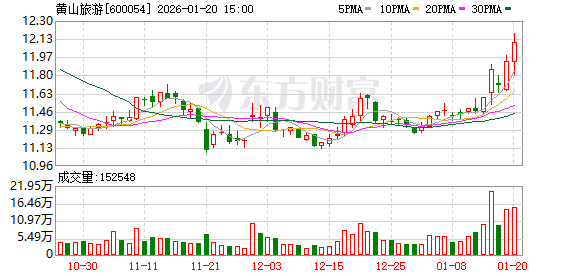
Core Viewpoint - Huangshan Tourism has shown a positive trend in visitor numbers and average spending, driven by targeted marketing strategies and digital initiatives, despite facing challenges in the broader market environment [1][2]. Group 1: Company Performance - As of November 7, 2025, Huangshan Tourism's stock price closed at 11.41 yuan, up 0.88% from the previous week, with a total market capitalization of 8.322 billion yuan, ranking 5th in the tourism sector [1]. - In the first three quarters, the Huangshan scenic area received 3.7572 million visitors, a year-on-year increase of 3.44%, with an average visitor spending of nearly 380 yuan, up 12% year-on-year [1][7]. Group 2: Marketing Strategies - The company has implemented a comprehensive digital marketing strategy, focusing on key markets and customer segments, utilizing big data analysis to enhance marketing effectiveness [1]. - Marketing initiatives include promoting through online literature, web dramas, and games, as well as reducing broad discounts in favor of personalized promotions to stimulate consumption [1]. Group 3: Visitor Demographics - The current visitor demographic shows a preference for independent travel, with a group-to-individual ratio of approximately 1.6:8.4, and a 33% increase in team travel numbers [7]. - The company has not yet introduced a free admission policy for newlyweds but is monitoring market demands for potential future offerings [3]. Group 4: Taxation and Financial Management - Huangshan Tourism's tax rate exceeds 32%, significantly higher than that of other scenic companies, which impacts profit margins despite higher revenues [6][8]. - The company adheres to tax regulations and conducts quarterly and annual tax assessments, ensuring compliance with relevant policies [8].
黄山旅游:公司高度重视投资者回报,积极通过多种方式回馈投资者
Zheng Quan Ri Bao· 2025-11-04 13:38
Group 1 - The company has established a comprehensive project investment management system and is enhancing internal controls to improve project investment decision-making and management capabilities [2] - The company places a high emphasis on investor returns and actively seeks to reward investors through various means [2]
别总怪游客不花钱!文旅行业的“盈利困局”竟然卡在这儿
Hua Xia Shi Bao· 2025-11-03 13:55
Core Insights - The tourism industry is experiencing a phenomenon of "increased revenue but decreased profit," reflecting structural challenges during recovery, including high costs, homogenized competition, and rational consumer spending [1][3][10] - Many companies are struggling to balance supply and demand, leading to blind investments without understanding market dynamics, which exacerbates the current situation [2][10] Revenue and Profit Trends - Several tourism companies reported revenue growth in Q3 2025, but profits declined significantly. For instance, Huangshan Tourism achieved a total revenue of 1.535 billion yuan, up 8.75% year-on-year, but net profit fell by 11.02% to 253 million yuan [3][4] - Similarly, Zhongxin Tourism's revenue reached 5.241 billion yuan, a 10.96% increase, while net profit plummeted by 45.73% to 67 million yuan [3][4] - The overall trend shows that less than 20% of leading companies reported profit growth, with nearly 60% experiencing revenue declines and over half reporting profit decreases [5][10] Cost and Market Pressures - Rising operational costs, including resource usage fees and labor costs, are major factors eroding profits. For example, Huangshan Tourism's profit decline was attributed to increased resource usage fees [6][10] - Companies like Zhongxin Tourism reported a significant rise in operational expenses, with total expenses reaching 485 million yuan, an increase of 28 million yuan year-on-year [6][10] - The tourism market is facing a "volume increase but price drop" trend, with consumer spending per day decreasing by approximately 13% compared to the previous year [7][10] Competitive Landscape - The industry is witnessing intensified homogenized competition, with many tourist destinations perceived as lacking uniqueness. Over 38.5% of tourists find ancient towns to be very similar [8][10] - Some companies resort to low-price competition, which may attract short-term customers but ultimately harms brand value and increases complaint rates [8][10] Financial Health and Cash Flow - Concerns about cash flow and debt levels are rising, with companies like Qujiang Cultural Tourism showing a current ratio of 0.7, indicating weak short-term solvency [7][10] - Qujiang's operating cash flow per share decreased by 10.72%, highlighting liquidity risks amid ongoing profitability challenges [7][10] Industry Transformation and Future Directions - The industry is undergoing a transformation from traditional resource-dependent models to new value-creation strategies, emphasizing product innovation and operational efficiency [11][18] - Companies are exploring differentiated experiences to attract consumers, with successful examples like the immersive geological museum in Luoyang [13][18] - The government is encouraged to balance consumer stimulation with ensuring company profitability, as seen in Huangshan's implementation of a rapid complaint handling mechanism [16][18]