CNRE(600111)

Search documents
2块钱的稀土股不是垃圾:有矿有订单,机构悄悄买了近3亿股
Sou Hu Cai Jing· 2025-10-06 23:03
Core Viewpoint - Rare earth stocks are considered undervalued, with potential for significant returns, likened to the next "Zhengzhou Coal Electricity" opportunity [1] Industry Overview - Rare earth elements are essential for industries such as renewable energy, robotics, and military applications, often referred to as "industrial vitamins" [3] - China holds 70% of the world's rare earth reserves, but has historically faced criticism for low-price exports [3] - Recent developments include Myanmar's complete halt of rare earth mining, tightening global supply chains [3] - China's tightening of export quotas has led to a surge in rare earth prices, with dysprosium oxide prices tripling compared to two years ago [3] Key Data - China's rare earth reserves account for 38% of global totals, with Northern Rare Earth holding significant resources at the Baiyun Obo mine, targeting a production capacity of 150,000 tons of high-performance magnetic materials by 2025 [4] - China Rare Earth has consolidated 80% of ion mines in Ganzhou, reporting a net profit of 72.61 million in Q1 2025, successfully turning around its financial performance [5] Company Highlights - **Northern Rare Earth (600111)**: The largest supplier of light rare earths globally, with a net profit increase of 727% year-on-year in Q1 2025 [6] - **China Rare Earth (000831)**: Recognized as a hidden champion in medium and heavy rare earths, with leading separation technology and strong military orders [8] - **Jinli Permanent Magnet (300748)**: Utilizes advanced technology to reduce neodymium usage by 60%, with a projected net profit increase of 120% in 2025 [10] Market Dynamics - Foreign investment is increasing, with Inlohua seeing significant foreign purchases, indicating confidence in the demand for magnetic materials in electric vehicles [12] - Speculative trading has surged, with Huahong Technology's stock price soaring 372% due to rare earth recycling and Tesla orders [13] - State-owned entities like China Rare Earth and Northern Rare Earth are receiving continued support from institutional investors, benefiting from policy advantages and resource monopolization [14] Price Volatility - Rare earth prices are highly influenced by policy and supply-demand dynamics, with historical examples of significant price fluctuations [15] - Potential technological advancements in non-rare earth permanent magnet materials could disrupt the current market landscape [16] International Competition - The U.S. is accelerating efforts to establish its own rare earth supply chain, with MP Materials receiving $400 million in funding from the White House, indicating increasing long-term competition [17]



趋势2025!中国储氢合金行业基本原理、技术路线、产业链全景、技术创新及未来发展前景分析:资源优势巩固行业地位,创新引领打开市场空间[图]
Chan Ye Xin Xi Wang· 2025-10-02 03:40
Core Insights - Hydrogen storage alloys are critical materials in the hydrogen energy industry due to their high safety, volumetric hydrogen density, and long-cycle stability [1][2] - China has established a complete hydrogen storage alloy industry chain driven by rare earth resources and strong policies, featuring upstream resource monopolization, midstream technological iteration, and downstream diverse applications [1][8] - The global hydrogen storage alloy market is dominated by rare earth-based alloys, with rapid iterations of magnesium-based, titanium-based, and solid-state materials [1][9] Industry Overview - Hydrogen storage alloys (HSA) are special functional materials capable of reversible absorption and release of hydrogen under normal conditions, forming metal hydrides for safe and efficient hydrogen storage [2][3] - The main hydrogen storage methods include high-pressure gas storage, low-temperature liquid storage, and solid-state storage using hydrogen alloys, each with its advantages and disadvantages [5][6] Technological Development - Current mainstream hydrogen storage methods are compared, highlighting solid-state hydrogen storage alloys as the leading technology due to their safety and volumetric density [5][6] - The preparation methods for hydrogen storage alloys significantly influence their microstructure and hydrogen absorption performance, with various techniques available [7] China's Industry Background - Hydrogen is a key carrier for building a new energy system and achieving carbon neutrality, with hydrogen storage alloys being essential materials supported by national strategies and policies [8] - The Chinese government has implemented comprehensive policies to promote the hydrogen energy industry, including standards for solid-state hydrogen storage alloys [8] Industry Chain Structure - The Chinese hydrogen storage alloy industry chain features upstream resource monopolization, midstream technological advancements, and diverse downstream applications, with companies like Xiamen Tungsten and China Rare Earth Group leading the midstream [8][9] - The industry is characterized by close cooperation among upstream, midstream, and downstream enterprises, forming a collaborative innovation model [8] Global and Domestic Market Analysis - The global hydrogen storage alloy industry is at a critical juncture of technological breakthroughs and large-scale applications, with a projected market size of $440 million by 2030 [9] - China's hydrogen storage alloy sector has seen significant advancements in technology and enterprise layout, focusing on high capacity, low working temperature, and long cycle life [9][10] Future Trends - The future of China's hydrogen storage alloy industry will focus on technological innovation, industry integration, and international competition [11][12][14] - Technological innovation will lead to performance upgrades, with a focus on developing new multi-component alloy systems and optimizing kinetic performance [11] - Industry integration will involve increased mergers and acquisitions, creating industry leaders and enhancing overall competitiveness [12] - In international competition, Chinese enterprises will leverage their scale and resource advantages while addressing high-end technology gaps through increased R&D investment [14]


拿不到中国稀土,G7反其道而行,想把对付俄罗斯的老招搬出来?
Sou Hu Cai Jing· 2025-10-01 13:49
Core Viewpoint - G7's plan to impose a price cap on rare earths, similar to the previous measure against Russian oil, may backfire due to China's dominant position in the rare earth industry, which is significantly stronger than Russia's in oil [1][2]. Group 1: China's Dominance in Rare Earths - China produces over 60% of the world's rare earth minerals and accounts for more than 90% of the processing stages [2]. - China's smelting and separation technology is far superior, making it difficult for other countries to refine rare earths even if they have access to the raw materials [4]. - The West has experienced supply shortages due to China's previous export restrictions during trade tensions, highlighting the critical role of Chinese supply in high-end manufacturing [4]. Group 2: G7's Strategy and Implications - G7 believes that setting a price floor will help local rare earth companies in Australia and Canada become profitable and reduce reliance on China [7]. - G7's approach labels China's competitive pricing as "unfair," with leading Chinese company Northern Rare Earth's production cost below $30 per kilogram, compared to over $50 for Western counterparts [7]. - If China retaliates by tightening export controls, it could severely impact Western industries reliant on rare earths, such as electric vehicles and electronics [7]. Group 3: China's Response and Future Outlook - The Chinese government views export controls as necessary for national security and argues that unilateral price caps violate market principles [8]. - China is advancing in rare earth recycling and green smelting, positioning itself not only as a resource supplier but also as a leader in technology and standards [8]. - The increasing use of the renminbi in commodity transactions may lead to significant changes in global trade dynamics [8]. Group 4: Conclusion - G7's proposed rare earth price cap may ultimately harm their own interests rather than weaken China's position [9]. - A cooperative approach in competition is suggested as a more viable solution than policy-driven market distortions [9].
有色金属ETF(512400)持续上涨,近20日资金净流入额29.4亿元,最新规模超133亿元
Ge Long Hui· 2025-09-30 12:25
Group 1 - The core viewpoint is that the non-ferrous metal sector is experiencing a sustained increase due to rising gold prices, expectations of interest rate cuts, and heightened demand for safe-haven assets [1] - The Non-Ferrous Metal ETF (512400) has risen by 3.51% today, over 11% in the past five days, and more than 71% year-to-date, making it the only ETF tracking the China Securities Index for non-ferrous metals [1] - The ETF has seen a net inflow of 2.94 billion yuan in the last 20 days, with a current scale of 13.315 billion yuan, making it the only non-ferrous industry ETF exceeding 10 billion yuan in size [1] Group 2 - Eight departments have issued the "Non-Ferrous Metal Industry Stabilization and Growth Work Plan (2025-2026)", targeting an average annual growth of around 5% in the industry's added value and a 1.5% annual growth in the production of ten non-ferrous metals [2] - Zijin Mining International has officially listed on the Hong Kong Stock Exchange with an issue price of 71.59 HKD, raising 3.49 billion shares, and saw its stock price surge by 64% on the first trading day [2] Group 3 - Spot gold has surpassed 3,850 USD, and with the Federal Reserve's interest rate cuts, frequent supply disruptions in commodities, and the seasonal demand in China, industrial metal prices are expected to continue rising [3]



有色金属行业9月30日资金流向日报
Zheng Quan Shi Bao Wang· 2025-09-30 09:09
Market Overview - The Shanghai Composite Index rose by 0.52% on September 30, with 19 out of 28 sectors experiencing gains, led by the non-ferrous metals and defense industries, which increased by 3.22% and 2.59% respectively [1] - The communication and non-bank financial sectors saw the largest declines, with decreases of 1.83% and 1.14% respectively [1] Fund Flow Analysis - The net outflow of capital from the two markets was 32.303 billion yuan, with only four sectors seeing net inflows [1] - The defense industry had the highest net inflow of capital at 2.078 billion yuan, followed closely by the non-ferrous metals sector with a net inflow of 1.984 billion yuan [1] Non-Ferrous Metals Sector - The non-ferrous metals sector increased by 3.22%, with a total net inflow of 1.984 billion yuan, and 113 out of 137 stocks in this sector rose, including five that hit the daily limit [2] - The top three stocks by net inflow were Huayou Cobalt with 719 million yuan, Northern Rare Earth with 563 million yuan, and Xiyu Co. with 440 million yuan [2] Non-Ferrous Metals Fund Inflow Rankings - The top stocks in terms of capital inflow included: - Huayou Cobalt: +9.38%, turnover rate 8.32%, net inflow 718.87 million yuan - Northern Rare Earth: +3.54%, turnover rate 5.20%, net inflow 562.95 million yuan - Xiyu Co.: +9.98%, turnover rate 3.05%, net inflow 440.06 million yuan [2] Non-Ferrous Metals Fund Outflow Rankings - The stocks with the highest capital outflow included: - Zijin Mining: +3.12%, turnover rate 1.87%, net outflow -332.52 million yuan - Jintian Co.: -0.64%, turnover rate 5.34%, net outflow -257.68 million yuan - Ganfeng Lithium: +4.07%, turnover rate 9.31%, net outflow -251.84 million yuan [3]
小金属概念涨2.58%,主力资金净流入79股
Zheng Quan Shi Bao Wang· 2025-09-30 08:59
Core Insights - The small metals sector has seen a rise of 2.58% as of September 30, ranking 8th among sector gains, with 127 stocks increasing in value, including notable gains from Shengtun Mining, Jiangxi Copper, and China Metallurgical Group, which all hit the daily limit up [1] Group 1: Sector Performance - The small metals sector recorded a net inflow of 2.58%, with significant contributions from stocks like Huayou Cobalt, which saw a net inflow of 7.19 billion yuan [2][3] - The top gainers in the small metals sector included Huayou Cobalt (9.38%), Shengtun Mining (10.02%), and Jiangxi Copper (10.01%) [3][4] - The sector's performance was contrasted by declines in stocks such as Hailiang Co., which fell by 1.89% [1][9] Group 2: Capital Inflows - The small metals sector attracted a net inflow of 25.10 billion yuan, with 79 stocks receiving net inflows, and 14 stocks exceeding 1 billion yuan in net inflows [2] - The highest net inflows were recorded by Huayou Cobalt (7.19 billion yuan), followed by Northern Rare Earth (5.63 billion yuan) and China Metallurgical Group (4.38 billion yuan) [2][3] - The net inflow ratios for leading stocks included Xiyang Co. (37.94%), China Metallurgical Group (23.86%), and Jinyuan Co. (16.33%) [3][4]


小金属板块9月30日涨3.39%,锡业股份领涨,主力资金净流入14.78亿元
Zheng Xing Xing Ye Ri Bao· 2025-09-30 08:42
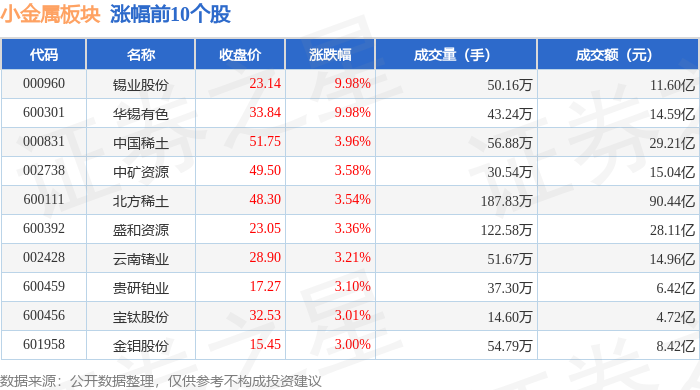
Core Insights - The small metals sector experienced a significant increase of 3.39% on September 30, with Xiyang Co. leading the gains [1] - The Shanghai Composite Index closed at 3882.78, up 0.52%, while the Shenzhen Component Index closed at 13526.51, up 0.35% [1] Small Metals Sector Performance - Aluminum Co. (000960) saw a closing price of 23.14, with a rise of 9.98% and a trading volume of 501,600 shares, amounting to a transaction value of 1.16 billion [1] - Huaxi Nonferrous (600301) also increased by 9.98%, closing at 33.84 with a trading volume of 432,400 shares, resulting in a transaction value of 1.46 billion [1] - China Rare Earth (000831) closed at 51.75, up 3.96%, with a trading volume of 568,800 shares and a transaction value of 2.92 billion [1] - Other notable performers include Northern Rare Earth (600111) with a 3.54% increase, closing at 48.30, and a transaction value of 9.04 billion [1] Capital Flow Analysis - The small metals sector saw a net inflow of 1.478 billion in main funds, while speculative funds experienced a net outflow of 603 million, and retail investors had a net outflow of 875 million [2] - Northern Rare Earth (600111) had a main fund net inflow of 560 million, but speculative funds saw a net outflow of 210 million [3] - China Rare Earth (000831) recorded a main fund net inflow of 361 million, with speculative funds experiencing a net outflow of approximately 91.47 million [3]
有色ETF基金(159880)涨超3.7%,铜价有望创下一年来最大单月涨幅
Sou Hu Cai Jing· 2025-09-30 06:57
Group 1 - The core viewpoint is that the non-ferrous metal industry is experiencing a strong rally, driven by multiple favorable factors, including government initiatives to upgrade metal consumption and a tightening global copper supply [1] - As of September 30, 2025, the Guozheng Non-Ferrous Metal Industry Index (399395) rose by 3.27%, with significant gains in constituent stocks such as Placo New Materials (300811) up 12.90%, Tin Industry Co. (000960) up 9.98%, and Huayou Cobalt (603799) up 9.93% [1] - The non-ferrous ETF fund (159880) increased by 3.70%, with the latest price reported at 1.68 yuan [1] Group 2 - On September 28, eight departments jointly issued a document to promote the upgrade of bulk metal consumption, actively expanding the application of high-end aluminum, copper, and magnesium alloys [1] - The global copper supply is tightening due to a series of production disruptions, leading to a nearly 5% increase in three-month copper prices in September, marking the largest rise since the same month in 2024 [1] - Guotou Securities noted that interest rate futures have priced in expectations for three rate cuts by the Federal Reserve this year, totaling 75 basis points, indicating that the non-ferrous sector is one of the few industries that can significantly benefit from overseas inflation [1] Group 3 - The Guozheng Non-Ferrous Metal Industry Index (399395) selects 50 securities with outstanding scale and liquidity from the non-ferrous metal industry, reflecting the overall performance of listed companies in this sector on the Shanghai and Shenzhen stock exchanges [2] - As of August 29, 2025, the top ten weighted stocks in the index include Zijin Mining (601899), Northern Rare Earth (600111), and Luoyang Molybdenum (603993), with these ten stocks accounting for 50.35% of the total index weight [2]





“反内卷”政策导向下产业转型升级进程或将提速,材料ETF(159944)连续5日上涨,跟踪标的“反内卷”含量超90%
Xin Lang Cai Jing· 2025-09-30 05:13
Core Insights - The Ministry of Industry and Information Technology and six other departments have jointly released the "Work Plan for Stable Growth in the Petrochemical Industry (2025-2026)", emphasizing strict control over new refining capacity and supporting projects that reduce oil dependency and upgrade old facilities [1] - The industrial sector has seen a significant rebound in revenue and profits in August, primarily due to a low base effect, with upstream profit growth slowing and midstream and downstream sectors growing over 25% year-on-year [1] - The cobalt export quota system implemented by the Democratic Republic of the Congo raises concerns about potential raw material shortages, with export quotas set at 18,000 tons for late 2025 and 96,600 tons annually for 2026-2027, indicating a shift from surplus to potential shortage in cobalt resources [2] Industry Summary - The petrochemical industry is expected to undergo structural optimization, with the elimination of outdated capacity and accelerated industrial transformation, creating opportunities for companies with technological advantages and extended supply chains [1] - The equipment manufacturing and raw materials sectors have shown significant profit growth, while the beverage and alcohol sectors have also improved due to short-term demand fluctuations [2] - The market for cobalt is likely to maintain high prices in the medium to long term due to the new export quota system and increased demand from downstream sectors during the peak consumption season [2] ETF Market Insights - As of September 30, 2025, the CSI All Materials Index rose by 1.52%, with the Materials ETF (159944) increasing by 2.06%, marking five consecutive days of gains [3] - The top ten weighted stocks in the index account for 30%, with notable increases in companies like Huayou Cobalt and Luoyang Molybdenum [3] - The current price-to-book ratio of the index is 2.09, lower than other similar indices, aligning with the strategy of investing in undervalued cyclical industries [3]

黄金续攀新高,有色板块全线上扬,有色金属ETF基金涨3%
Ge Long Hui A P P· 2025-09-30 03:13
Core Insights - The non-ferrous metal sector continues to show strength, with significant gains in stocks such as Huaxi Nonferrous and Xiyegong, and a notable increase in the non-ferrous metal ETF by 3.08%, expanding its year-to-date gain to 67% [1][2] Group 1: Market Performance - The current market sees a strong performance in the non-ferrous metal sector, with stocks like Jiangxi Copper and Huayou Cobalt rising over 8% [1] - Gold ETFs and gold-related stocks have also seen an increase of over 1% [1] - The spot price of gold has surpassed $3850 per ounce, marking a historical high, with a year-to-date increase of over 46% [1] Group 2: Supply and Demand Dynamics - There is a trend towards copper supply shortages, influenced by events at Freeport's Grasberg copper mine and delays in production guidance from the Congo's Kakula mine [2] - The China Nonferrous Metals Industry Association has expressed strong opposition to "involution" competition within the copper smelting industry [2] - The export quota system implemented by the Democratic Republic of Congo, the largest cobalt supplier globally, is a key driver behind the recent rise in cobalt prices [2] Group 3: Policy and Industry Initiatives - The Ministry of Industry and Information Technology, along with eight other departments, has issued a "Work Plan for Stable Growth in the Nonferrous Metals Industry," emphasizing the need for enhanced exploration of resources such as copper, aluminum, lithium, nickel, cobalt, and tin [2] Group 4: Notable Investment Targets - The non-ferrous metal ETF (516650) has increased by 3.08%, with major holdings including Zijin Mining (copper, gold), Luoyang Molybdenum (copper, molybdenum, cobalt), Northern Rare Earth (rare earth), Huayou Cobalt (cobalt, copper), and China Aluminum (aluminum) [3] - The gold stock ETF (159562) has risen by 1.13%, tracking an index dominated by gold and copper stocks, also including silver-related companies [3] - The lowest fee gold ETF, which allows T+0 trading, has increased by 1.08% [4]