
CEA(600115)

Search documents
十家航司被约谈 直指“锁座”乱象
Jing Ji Guan Cha Wang· 2025-11-27 05:00
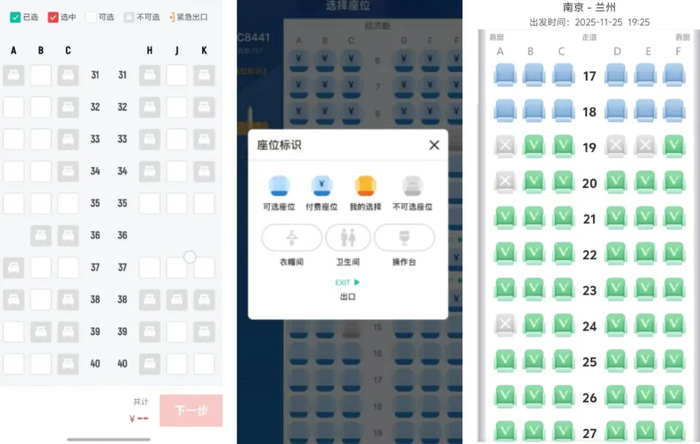
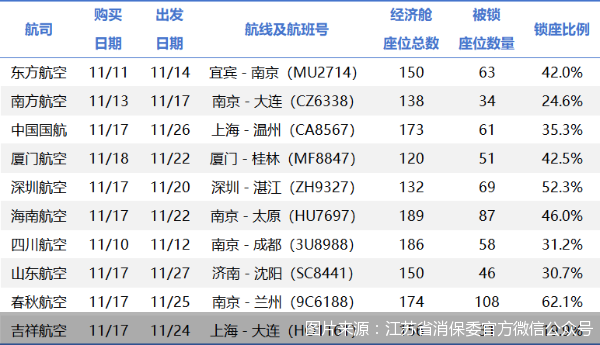
飞机"锁座"及有偿选座服务问题近日引发社会广泛关注。江苏省消费者权益保护委员会(以下简称"江 苏省消保委")一纸调查,直指航司"锁座"乱象,将国内10家主流航空公司推到了风口浪尖。 11月21日,江苏省消保委线上约谈了东方航空、南方航空(600029)、中国国航(601111)等10家主流 航空公司。11月26日,通过公众号发布有关调查结果,详细列举了机票锁座服务市场中存在的诸多问 题,亮明对"锁座"现象长期存在的"零容忍"态度,并要求各公司在15个工作日内将整改情况以书面形式 提交。 专家认为,航司"锁座"行为锁的不仅是座位,还有旅客的知情权和公平交易权。"付费选座"等霸王条款 还可能涉嫌违反《消费者权益保护法》,侵害旅客的自主选择权,属于典型变相收费行为,让旅客暗吃 了不少"哑巴亏"。长此以往,"锁座"行为最终损害的是旅客对航司服务的信任,不利于航空服务业的高 质量发展。 近四成座位被锁 所谓飞机"锁座",是指航司将经济舱前排、靠窗、靠过道等较为便利舒适的座位单独锁定,要么无法选 择,要么需额外付费或用积分兑换。从范围来看,锁定范围高度集中于经济舱前排、靠窗及靠过道等消 费者偏好的优质座位,仅开放中间区域 ...





中国东航跌2.17%,成交额1.20亿元,主力资金净流出2611.57万元
Xin Lang Cai Jing· 2025-11-27 02:13
11月27日,中国东航盘中下跌2.17%,截至09:53,报4.95元/股,成交1.20亿元,换手率0.14%,总市值 1093.34亿元。 资金流向方面,主力资金净流出2611.57万元,特大单买入1204.12万元,占比10.05%,卖出3211.43万 元,占比26.81%;大单买入2312.59万元,占比19.30%,卖出2916.85万元,占比24.35%。 中国东航今年以来股价涨23.75%,近5个交易日跌5.89%,近20日涨2.91%,近60日涨20.44%。 资料显示,中国东方航空股份有限公司位于上海市闵行区虹翔三路36号,香港金钟道95号统一中心19楼D 室,成立日期1995年4月14日,上市日期1997年11月5日,公司主营业务涉及航空客、货、邮、行李运输 业务及延伸服务;通用航空业务;航空器维修;航空设备制造与维修;国内外航空公司的代理业务。主营业 务收入构成为:客运服务收入92.50%,货运服务收入3.86%,退票费手续费收入1.74%,其他1.28%,地 面服务收入0.62%。 截至9月30日,中国东航股东户数14.99万,较上期减少3.37%;人均流通股0股,较上期增加0.00% ...
东航、南航、国航、海航、春秋等10家航司被约谈
Mei Ri Jing Ji Xin Wen· 2025-11-26 16:27
Core Viewpoint - The recent practice of airlines locking seats and charging for seat selection has raised consumer concerns, as it is perceived as a means for airlines to increase revenue at the expense of consumer rights [1][2]. Group 1: Investigation Findings - A special investigation by Jiangsu Consumer Council focused on 10 domestic airlines, revealing that seat locking is prevalent, with the proportion of locked seats in economy class ranging from 19.9% to 62.1%, averaging 38.7% [1][2]. - The locked seats are primarily desirable ones, such as those in the front row, window, and aisle, limiting consumer choice to less favorable options [1][2]. - The investigation identified four main issues: widespread seat locking, disguised payment mechanisms, lack of transparency, and unfair contractual terms [2]. Group 2: Consumer Rights and Responsibilities - Airlines are legally responsible for protecting consumer rights and must ensure transparency in seat distribution and pricing policies [3]. - Airlines should provide equal seat selection opportunities for all passengers at the same fare and respect consumer autonomy in choosing seats [3]. Group 3: Required Actions from Airlines - Jiangsu Consumer Council has mandated airlines to conduct self-assessments and rectify their seat selection rules, particularly addressing excessive locking and disguised payment models [4]. - Airlines must revise unfair contractual terms that limit consumer rights and ensure that their policies are clear and transparent [4]. Group 4: Industry Response - Representatives from Southern Airlines and Lucky Air acknowledged the situation and stated they are evaluating the requirements set by Jiangsu Consumer Council [5]. - Experts have pointed out that while some seat locking for safety or special needs is acceptable, excessive locking for profit could violate consumer rights [5][6].


机票“锁座”变相收费 10家航司被约谈
Bei Jing Shang Bao· 2025-11-26 15:54
Core Viewpoint - The Jiangsu Consumer Rights Protection Committee has released a report highlighting issues related to seat locking practices by airlines, including widespread locking behavior, excessive locking of premium seats, disguised fees for unlocking, and infringement on consumer rights [1][4]. Group 1: Investigation Findings - The average seat locking rate among the 10 surveyed airlines is 38.7%, with rates ranging from 19.9% to 62.1% [3][4]. - Spring Airlines and Shenzhen Airlines have particularly high locking rates, exceeding 60% and 50% respectively, while Juneyao Airlines has a relatively low rate of under 20% [3][4]. - The investigation focused on the locking ratio, locking range, redemption methods, and customer service explanations [3]. Group 2: Identified Issues - Widespread seat locking practices are prevalent, with premium seats being excessively locked, limiting consumer choices to less desirable seats [4][5]. - The unlocking mechanism often requires payment or points redemption, which disadvantages non-members or infrequent travelers, effectively increasing travel costs [4][5]. - There is a lack of transparency in information provided to consumers, with unclear seat selection rules and inadequate customer service responses [4][5]. Group 3: Recommendations and Actions - The Jiangsu Consumer Rights Protection Committee has urged airlines to conduct self-examinations and rectify unfair terms in their agreements regarding seat locking [1][6]. - Airlines are recommended to ensure a reasonable and balanced distribution of free seat options, limiting paid options to only those necessary for special circumstances [7]. - Continuous monitoring of airlines' compliance with these recommendations will be conducted, with potential follow-up measures if necessary [8].

买机票还要再花钱选座?10家航司被约谈!锁座比例平均超38%
Bei Jing Shang Bao· 2025-11-26 14:33
Core Viewpoint - The Jiangsu Provincial Consumer Protection Committee has raised concerns regarding the long-standing issues of seat locking and paid seat selection services among major Chinese airlines, highlighting the need for reform in these practices to protect consumer rights [1][2][3]. Group 1: Issues Identified - The practice of seat locking is widespread among the ten airlines, with the proportion of locked seats in the economy class ranging from 19.9% to 62.1%, averaging 38.7%, primarily affecting preferred seating areas [1][2]. - Airlines are increasingly using a mechanism that effectively charges consumers for seat selection, particularly disadvantaging non-members or infrequent travelers who lack the means to accumulate points for free seat selection [2]. - There is a lack of transparency in the information provided to consumers regarding seat locking rules and associated fees, with airlines often providing vague explanations that do not align with the high rates of seat locking [2]. Group 2: Required Reforms - The Jiangsu Provincial Consumer Protection Committee has mandated airlines to conduct self-assessments and rectify their seat selection rules within 15 working days, specifically addressing the excessive locking of seats and eliminating disguised paid seat selection models [3][4]. - Airlines are required to ensure a reasonable and balanced distribution of free seat options, retaining only necessary seat locks for special passengers or emergency purposes, while prohibiting the inclusion of standard economy seats in the paid category [3]. - The committee has called for a review and modification of unfair contractual terms related to seat locking, ensuring that consumer rights are not limited and that airlines' responsibilities are clearly defined within a transparent framework [4].

机票“锁座”近四成,江苏消保委约谈10家航司直指变相付费
Bei Jing Shang Bao· 2025-11-26 13:02
Core Viewpoint - The Jiangsu Consumer Rights Protection Committee has released a report highlighting issues related to seat locking practices by airlines, including widespread seat locking, excessive locking of premium seats, disguised fees for unlocking, and infringement on consumer rights [1][4]. Group 1: Survey Findings - The average seat locking rate among the 10 surveyed airlines is 38.7%, with rates ranging from 19.9% to 62.1% across different routes [2][4]. - Spring Airlines has the highest locking rate at over 60% for the Nanjing-Lanzhou route, while Juneyao Airlines has the lowest at under 20% [2][4]. - The survey included major airlines such as China Southern Airlines, China Eastern Airlines, and Hainan Airlines, focusing on their booking apps to assess seat locking practices [2][4]. Group 2: Identified Issues - The report identifies four main issues: the prevalence of seat locking, excessive locking of desirable seats, disguised fees for unlocking, and lack of transparency in information provided to consumers [4][5]. - Premium seats are predominantly locked, limiting consumer choice to less desirable options, which infringes on consumer rights [4][5]. - Airlines are increasingly charging for seat selection, which can significantly increase travel costs, especially for families seeking adjacent seating [6][8]. Group 3: Recommendations and Actions - The Jiangsu Consumer Rights Protection Committee has urged airlines to conduct self-inspections and rectify unfair terms in their agreements regarding seat locking [6][7]. - Airlines are recommended to ensure a reasonable distribution of free seat options and to eliminate disguised fees associated with seat selection [6][7]. - Continuous monitoring of airlines' compliance with these recommendations will be conducted by the Jiangsu Consumer Rights Protection Committee [8].
平均38.7%座位被锁定 江苏消保委约谈10家航司要求限期整改
Yang Shi Xin Wen· 2025-11-26 11:02
Core Viewpoint - The recent practice of airlines locking seats and charging for seat selection has raised consumer concerns, as it is seen as a way for airlines to increase revenue at the expense of consumer rights [1][2]. Group 1: Investigation Findings - A special investigation by Jiangsu Consumer Council targeted 10 domestic airlines, revealing that seat locking is prevalent, with the proportion of locked seats in economy class ranging from 19.9% to 62.1%, averaging 38.7% [1][2]. - The locked seats are primarily desirable ones, such as those in the front row, window, and aisle, limiting consumer choice to less favorable options [1][2]. Group 2: Consumer Rights Violations - The unlocking mechanism for preferred seats often requires payment through membership points or miles, disadvantaging non-members or occasional travelers who lack accumulation channels [2]. - Airlines have introduced additional paid options for unlocking seats, effectively splitting the basic seat selection rights into paid services, increasing travel costs for consumers [2]. - Information regarding seat locking rules and fees is often unclear, violating consumers' right to know, with customer service responses being inadequate and contradictory [2]. Group 3: Recommendations for Airlines - Airlines are urged to ensure transparency by clearly informing consumers about seat distribution and pricing policies [3]. - Fairness in rules must be maintained, ensuring equal seat selection opportunities for all passengers at the same fare [3]. - Airlines should respect consumer autonomy by safeguarding their right to choose and preventing disguised compulsory consumption [3]. Group 4: Required Actions - Airlines must conduct self-assessments to address excessive seat locking and eliminate disguised paid seat selection models, ensuring a reasonable and balanced distribution of free seat options [3][4]. - Unfair clauses in agreements related to seat locking should be reviewed and amended to avoid limiting consumer rights or increasing consumer responsibilities unfairly [4].
人民币升值受益板块11月26日涨0.54%,中国东航领涨,主力资金净流入9482.08万元



Sou Hu Cai Jing· 2025-11-26 09:37
Core Insights - The appreciation of the Renminbi has positively impacted certain sectors, with the Renminbi appreciation benefiting stocks rising by 0.54% compared to the previous trading day [1] - The Shanghai Composite Index closed at 3864.18, down 0.15%, while the Shenzhen Component Index closed at 12907.83, up 1.02% [1] Summary of Benefiting Stocks - China Eastern Airlines (600115) led the gainers with a closing price of 5.06, up 2.43%, with a trading volume of 1.2588 million shares and a turnover of 634 million yuan [1] - Other notable gainers include: - Pinwo Food (300892) at 34.70, up 2.18%, with a turnover of 172 million yuan [1] - Liangxing Paper (002067) at 5.51, up 1.85%, with a turnover of 4.98 million yuan [1] - Tongling Nonferrous Metals (000630) at 5.04, up 1.00%, with a turnover of 1.074 billion yuan [1] - China National Aviation (601111) at 8.08, up 0.25%, with a turnover of 716 million yuan [1] Capital Flow Analysis - The Renminbi appreciation benefiting sector saw a net inflow of 94.82 million yuan from main funds, while speculative funds had a net inflow of 248 million yuan, and retail investors experienced a net outflow of 342 million yuan [2] - Key stocks in terms of capital flow include: - China National Duty-Free (601888) with a main fund net inflow of 2.30 billion yuan and a retail net outflow of 3.19 billion yuan [3] - Tongling Nonferrous Metals (000630) with a main fund net inflow of 94.99 million yuan and a retail net outflow of 60.20 million yuan [3] - Rongsheng Petrochemical (002493) with a main fund net inflow of 13.96 million yuan and a retail net outflow of 14.28 million yuan [3]

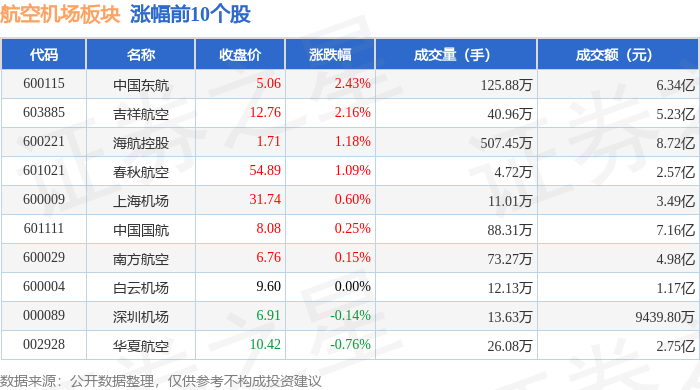
航空机场板块11月26日涨0.78%,中国东航领涨,主力资金净流出2.91亿元
Zheng Xing Xing Ye Ri Bao· 2025-11-26 09:05
Core Insights - The aviation and airport sector saw a rise of 0.78% on November 26, with China Eastern Airlines leading the gains [1] - The Shanghai Composite Index closed at 3864.18, down 0.15%, while the Shenzhen Component Index closed at 12907.83, up 1.02% [1] Stock Performance - China Eastern Airlines (600115) closed at 5.06, up 2.43% with a trading volume of 1.2588 million shares and a turnover of 634 million yuan [1] - Xiamen Airport (600897) experienced a decline of 1.73%, closing at 15.89 with a trading volume of 43,400 shares [2] - The overall performance of the aviation sector stocks varied, with some stocks like China Eastern Airlines and Spring Airlines showing positive growth, while others like Xiamen Airport and China Southern Airlines had minor declines [1][2] Capital Flow - The aviation and airport sector experienced a net outflow of 291 million yuan from institutional investors, while retail investors saw a net inflow of 132 million yuan [2] - The capital flow data indicates that retail investors were more active in the sector, with significant net inflows compared to the outflows from institutional investors [2][3] Individual Stock Capital Flow - Shanghai Airport (600009) had a net inflow of 23.84 million yuan from institutional investors, while it faced a net outflow of 40.87 million yuan from retail investors [3] - China Eastern Airlines (600115) saw a net outflow of 31.86 million yuan from institutional investors, indicating a shift in investor sentiment [3] - The data highlights the varying levels of investor interest across different stocks within the aviation sector, with some stocks attracting more retail investment while facing institutional selling pressure [3]
江苏省消保委就飞机“锁座”问题约谈10家航司 要求限期整改
Di Yi Cai Jing· 2025-11-26 05:44
据江苏省消保委消息,近期,飞机"锁座"及有偿选座服务引发热议。为厘清行业经营边界,推动消费者 合法权益得到切实保障,江苏省消保委于11月21日线上约谈东方航空、南方航空、中国国航、海南航 空、厦门航空、深圳航空、山东航空、四川航空、春秋航空、吉祥航空等十家航空公司。会上,江苏省 消保委结合调查结果,通报了机票锁座服务市场存在的四个问题:一是锁座行为普遍存在,优质座位过 度锁定;二是解锁机制变相付费,挤压普通消费者权益;三是信息不透明且解释不合理,侵犯知情权; 四是协议文本存在不公平格式条款,权利义务设置不对等。江苏省消保委就飞机票锁座问题的整改工 作,向各航司提出两点明确要求,并于15个工作日内将整改情况以书面形式进行提交。 (文章来源:第一财经) ...