China Spacesat(600118)

Search documents
中国卫星:在关键核心技术攻关、卫星及卫星应用装备制造等方面拥有较为雄厚的研究开发实力
Zheng Quan Ri Bao Wang· 2026-01-05 13:40
证券日报网讯1月5日,中国卫星(600118)在互动平台回答投资者提问时表示,公司依托"小卫星及其 应用国家工程研究中心"和"空间信息体系与融合应用全国重点实验室"两个国家级平台,在关键核心技 术攻关、卫星及卫星应用装备制造等方面拥有较为雄厚的研究开发实力。关于研发投入的具体情况可以 参阅公司定期报告主要经营情况中的研发投入部分。 ...

重回4000!超级赛道攻势延续
格隆汇APP· 2026-01-05 10:08
Core Viewpoint - The article emphasizes that 2026 will be a pivotal year for China's commercial aerospace sector, transitioning from "quantitative change" to "qualitative change" due to policy support, technological breakthroughs, and capital market momentum [42][43]. Group 1: Market Performance and Trends - On the first trading day of 2026, A-shares experienced a strong opening, with the Shanghai Composite Index rising over 1% and the ChiNext Index increasing by more than 2% [2]. - The satellite industry ETF (159218) saw a significant increase of 3.78%, with a net inflow of 211 million shares, marking a new single-day high [5][18]. - The insurance sector also showed strong performance, with major companies reaching historical highs and total premium income in the insurance industry growing by 7.6% year-on-year [15][17]. Group 2: Commercial Aerospace Developments - The commercial aerospace sector is transitioning from "experimental exploration" to "industrial mass production," becoming a core engine for national competition and economic transformation [3][6]. - In 2025, the satellite internet sector entered a phase of accelerated networking and industrialization, with multiple commercial rocket launches planned [20][24]. - The number of satellite launches in 2026 is expected to increase significantly, with private commercial rocket companies playing a crucial role in meeting high-frequency launch demands [21][26]. Group 3: Investment Opportunities - The commercial aerospace sector is projected to have a compound annual growth rate of 17%, with the global brain-computer interface market expected to reach approximately $12.4 billion by 2034 [14]. - The article suggests that the satellite industry ETF (159218) is a stable and efficient investment tool, covering the entire satellite industry chain and focusing on companies with high revenue from satellite-related businesses [36][40]. - The anticipated breakthroughs in rocket manufacturing and the reduction of launch costs are expected to significantly boost downstream demand for commercial aerospace services [30][31]. Group 4: Challenges and Considerations - The commercial aerospace industry faces challenges such as high volatility and technical uncertainties, making direct investment in individual stocks risky for ordinary investors [34]. - The complexity of the industry supply chain, from materials to satellite applications, complicates the timing of investments [35].







63股特大单净流入资金超2亿元
Zheng Quan Shi Bao Wang· 2026-01-05 09:26
Group 1 - The core point of the article highlights a significant net inflow of large orders amounting to 19.244 billion yuan across the two markets, with 63 stocks experiencing net inflows exceeding 200 million yuan, led by Shenghong Technology with a net inflow of 2.214 billion yuan [1][2] - The Shanghai Composite Index closed up by 1.38%, with a total of 2,296 stocks seeing net inflows while 2,558 stocks experienced net outflows [1] - Among the 17 industries, the electronics sector had the highest net inflow of large orders at 9.995 billion yuan, followed by the pharmaceutical and biological sector with 4.185 billion yuan [1] Group 2 - In terms of individual stocks, Shenghong Technology led with a net inflow of 2.214 billion yuan, followed by Zhaoyi Innovation with 1.996 billion yuan, and other notable stocks included Tianji Shares and Dongfang Wealth [2] - The average increase for stocks with net inflows exceeding 200 million yuan was 9.50%, outperforming the Shanghai Composite Index, with 62 of these stocks closing higher, including notable gainers like Daoshi Technology and Sanbo Brain Science [2] - The industries with the highest concentration of stocks with significant net inflows were electronics, electric power equipment, and national defense industry, with 14, 7, and 7 stocks respectively [2] Group 3 - The sectors with the largest net outflows included the national defense industry, which saw a net outflow of 2.599 billion yuan, followed by telecommunications with 1.624 billion yuan [1][4] - The top three stocks with the highest net outflows were Aerospace Electronics with a net outflow of 2.478 billion yuan, China Satellite with 1.727 billion yuan, and Aerospace Development with 1.414 billion yuan [4] - Other notable stocks with significant net outflows included New Yisheng and BlueFocus, with outflows of 1.009 billion yuan and 0.773 billion yuan respectively [4]






资金流向日报:沪指涨1.38% 83.34亿资金净流入
Zheng Quan Shi Bao Wang· 2026-01-05 09:23
Market Overview - On January 5, the Shanghai Composite Index rose by 1.38%, the Shenzhen Component Index increased by 2.24%, the ChiNext Index climbed by 2.85%, and the CSI 300 Index gained 1.90% [1] - Among the tradable A-shares, 4,185 stocks rose, accounting for 76.69%, while 1,168 stocks declined [1] Capital Flow - The net inflow of main funds was 8.334 billion yuan for the day [1] - The ChiNext saw a net inflow of 2.165 billion yuan, while the STAR Market had a net inflow of 2.446 billion yuan, and the CSI 300 constituent stocks experienced a net inflow of 13.525 billion yuan [1] Industry Performance - Out of the 26 first-level industries classified by Shenwan, the top-performing sectors were Media and Pharmaceutical & Biological, with increases of 4.12% and 3.85% respectively [1] - The sectors with the largest declines were Oil & Petrochemicals and Banking, with decreases of 1.29% and 0.34% respectively [1] Industry Capital Inflows - The Electronics industry had the highest net inflow of main funds, totaling 9.481 billion yuan, with a daily increase of 3.69% [1] - The Pharmaceutical & Biological sector also performed well, with a net inflow of 4.379 billion yuan and a daily increase of 3.85% [1] Industry Capital Outflows - The Mechanical Equipment industry saw the largest net outflow of main funds, amounting to 3.694 billion yuan, despite a daily increase of 1.48% [1] - The Defense & Military industry had a net outflow of 3.411 billion yuan, with a daily increase of 2.60% [1] Individual Stock Performance - A total of 2,394 stocks experienced net inflows, with 996 stocks having inflows exceeding 10 million yuan, and 171 stocks with inflows over 100 million yuan [2] - The stock with the highest net inflow was Zhaoyi Innovation, which rose by 10.00% with a net inflow of 2.046 billion yuan [2] - Other notable stocks included Shenghong Technology and Kweichow Moutai, with net inflows of 1.995 billion yuan and 1.222 billion yuan respectively [2] - Conversely, 113 stocks experienced net outflows exceeding 100 million yuan, with Aerospace Electronics, China Satellite, and Aerospace Development leading in outflows of 2.424 billion yuan, 1.810 billion yuan, and 1.527 billion yuan respectively [2]

上海发文推进低空经济,通用航空ETF基金(159230)持仓股海格通信、北斗星通涨停
Mei Ri Jing Ji Xin Wen· 2026-01-05 06:05
Core Viewpoint - The three major indices strengthened collectively, with brain-computer interface and medical device concepts leading the gains, while the Hainan Free Trade Zone and stablecoin concepts lagged behind [1] Group 1: Market Performance - As of 13:40, the General Aviation ETF (159230) rose by 1.72%, with holdings such as Aerospace Huanyu increasing by 12.67%, and stocks like Haige Communication and Beidou Star reaching the daily limit [1] - The Aviation and Aerospace ETF (159227) increased by 1.25% [1] Group 2: Policy and Industry Development - On January 4, Shanghai issued a notice regarding measures to accelerate the construction of a low-altitude economy advanced manufacturing cluster in the Yangtze River Delta [1] - By 2028, the core industry scale of Shanghai's low-altitude economy is expected to reach approximately 80 billion yuan, forming a complete industrial chain for new low-altitude aircraft [1] Group 3: Competitive Landscape - Huachuang Securities believes that companies in the low-altitude economy sector in China and the U.S. are the most competitive, with Chinese firms leading globally in the eVTOL field [1] - The General Aviation ETF (159230) tracks the National General Aviation Industry Index, focusing on low-altitude economy, covering sectors such as aviation materials, infrastructure, aircraft manufacturing, operational services, and application scenarios, with low-altitude economy content at 88.26% and commercial aerospace content at 65.32% [1]



业绩大幅预增股抢先看!
Zheng Quan Shi Bao Wang· 2026-01-05 03:47
Group 1 - Major market indices opened higher on the first trading day of 2026, with electronics and media sectors rising over 2%, while pharmaceuticals and non-bank financials also showed strong gains [1] - The brain-computer interface (BCI) concept surged, with the index rising over 10%, leading to a wave of stock price increases, including a 30% limit up for BeiYikang and 20% limit ups for Sanbo Brain Science, Meihao Medical, and Aipeng Medical [2] - Elon Musk announced that his BCI company Neuralink will start large-scale BCI output in 2026, planning to shift towards nearly fully automated surgeries [3] Group 2 - Open Source Securities reported that Neuralink's expectations for scaled production and automated surgical solutions signify a transition from clinical validation to commercial scalability for brain-computer interfaces [4] - Companies with positive earnings forecasts for 2025 have performed well, with C Strong rising over 10% and Salt Lake Shares and Ocean Biological both increasing over 7%. Over 40 companies have released earnings forecasts, with many expecting profit increases, including Transfar Zhilian, Baiao Saitu, and Tianci Materials, all projecting profit growth exceeding 100% [5] - Ocean Biological expects a net profit growth of 50.6% to 72.56 million for 2025 [5] Group 3 - Two new stocks are available for subscription this week, including Zhixin Co., which specializes in automotive welding parts and has become a primary supplier for major automotive manufacturers [7] - Kema Materials focuses on the research, production, and sales of dry friction plates and wet paper-based friction plates, aiming to develop new friction materials [8] Group 4 - As of December 31, 2025, the market's financing balance totaled 2.52 trillion, a decrease of 143.69 billion from the previous trading day [9] - 349 stocks received net financing purchases exceeding 10 million, with 34 stocks having net purchases over 1 billion [10] - China Satellite topped the list with a net purchase of 1.194 billion, followed by Xinwei Communication and Aerospace Electronics with net purchases of 525 million and 499 million, respectively [11]


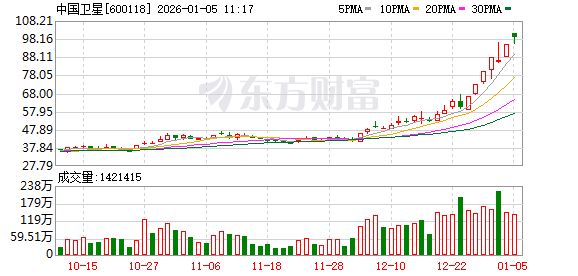
中国卫星成交额超上一日全天
Zheng Quan Shi Bao Wang· 2026-01-05 03:17
(文章来源:证券时报网) 数据宝统计,截至10:28,中国卫星成交额102.35亿元,超上一日全天。最新股价上涨2.42%,换手率 8.76%。(数据宝) ...
中国卫星网络集团星网系列商标获批
Qi Cha Cha· 2026-01-05 03:16
企查查APP显示,近日,中国卫星网络集团有限公司成功注册星网空天、星网经纬、星网纵横等星网系 列商标,国际分类涉及社会法律、设计研究、通讯服务等。 (原标题:中国卫星网络集团星网系列商标获批) ...
开门红!蓝箭航天IPO催化,卫星产业ETF(159218)大幅高开4.7%,中国卫星涨停封板
Jin Rong Jie· 2026-01-05 02:35
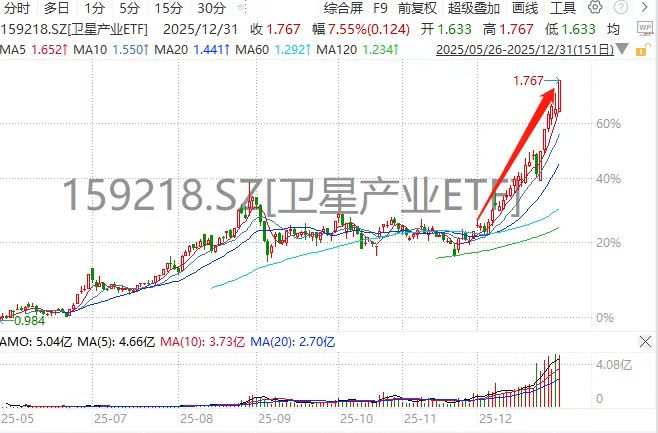
1月5日早盘,卫星产业板块迎来强势开局。卫星产业ETF(159218)大幅高开4.70%,中国卫星开盘后 迅速涨停封板,中国卫通、航天电子等权重股同步大幅拉升,显示市场情绪积极。 消息面上,产业再迎重磅催化。国内商业火箭头部企业蓝箭航天科创板IPO已于日前正式获受理,拟募 集资金75亿元,主要用于可重复使用火箭的产能建设和技术研发。其核心产品"朱雀"系列火箭及"天 鹋"液氧甲烷发动机已成为国内商业航天技术突破的标志。此外,央视新闻在"十五五"开局展望中亦提 到,2026年将有多型新型火箭迎来首飞并挑战回收,进一步明确了产业加速发展的政策与技术预期。 国际层面亦出现地缘动态催化。据报道,委内瑞拉卫星导航系统近期失去定位功能,而SpaceX旗下"星 链"随即宣布将为该国用户提供为期一个月的免费宽带服务。这一事件凸显了卫星互联网在全球通信与 战略中的关键作用,也侧面印证了低轨星座的战略价值与竞争格局。 在政策明确支持、龙头公司冲刺资本市场、技术迭代持续突破、国际事件催化的多重因素推动下,商业 航天产业景气度持续攀升。卫星产业ETF覆盖全产业链核心环节,已成为资金系统性布局"空天新基 建"主线的重要工具。 风险提示: ...
34股获融资客大手笔净买入-今日热闻
Zheng Quan Shi Bao Wang· 2026-01-05 02:10
【资料图】 截至12月31日,市场融资余额合计2.52万亿元,较前一交易日减少143.69亿元,其中,沪市融资余额 12687.96亿元,较前一交易日减少94.89亿元;深市融资余额12473.92亿元,较前一交易日减少48.57亿 元;北交所融资余额79.68亿元,较前一交易日减少2310.12万元。 证券时报·数据宝统计显示,具体到个股,12月31日共有1166只股获融资净买入,净买入金额在千万元 以上的有349只,其中34只融资净买入额超亿元。中国卫星融资净买入额居首,当日净买入11.94亿元, 其次是信维通信、航天电子,融资净买入金额分别为5.25亿元、4.99亿元,融资净买入金额居前的还有 三花智控、万向钱潮、航天发展等。 分行业统计,获融资客净买入超亿元个股中,电子、国防军工、电力设备等行业最为集中,分别有6 只、5只、4只个股上榜。板块分布上,大手笔净买入个股中,主板有24只,创业板有9只,科创板有1 只。 融资客大手笔净买入个股中,从最新融资余额占流通市值比例看,算术平均值为4.61%,融资余额占比 最高的是沃尔德,该股最新融资余额8.23亿元,占流通市值的比例为8.45%,融资余额占比较高的 ...