FOTON(600166)

Search documents
福田汽车:公司目前暂未涉及人形机器人领域
Mei Ri Jing Ji Xin Wen· 2025-11-12 08:08
Core Viewpoint - The company, Foton Motor (600166.SH), acknowledges the inquiry regarding the application of its transmission products in humanoid robots, indicating a focus on commercial vehicle business and a cautious approach to exploring new fields [2]. Group 1: Company Products and Applications - Foton Motor's manual and automatic transmission products are widely used in domestic and international markets, recognized for their excellent performance [2]. - The company possesses design, simulation, and application experience in planetary gear mechanisms, which are one of the three main types of reducers used in robotics [2]. Group 2: Business Focus and Future Plans - Currently, the company does not engage in the humanoid robot sector, prioritizing the research and manufacturing of transmission systems for commercial vehicles [2]. - Future expansion into new fields will be evaluated and considered in conjunction with the overall business development plan [2].


重汽/解放超2万辆争冠!奇瑞返前十 10月重卡大增60% 全年剑指110万辆 | 头条
第一商用车网· 2025-11-12 07:13
Core Viewpoint - The heavy truck market in China experienced significant growth in October 2025, with sales reaching 106,200 units, marking a year-on-year increase of 60% and achieving a "seven consecutive months" growth trend [1][4][20]. Sales Performance - In October 2025, the total sales of trucks (including chassis and tractors) amounted to 311,100 units, reflecting a slight month-on-month decrease of 0.3% but a year-on-year increase of 22% [4]. - The heavy truck segment's sales of 106,200 units in October 2025 represent a 1% increase from September and a 60% increase year-on-year, although the growth rate has narrowed compared to the 83% increase in September [4][11]. - The October 2025 sales figure is notably high compared to the past decade, where the average sales in October were approximately 76,500 units, with only one instance of exceeding 100,000 units in the previous ten years [4][6]. Cumulative Sales Data - From January to October 2025, the cumulative sales of heavy trucks reached 929,000 units, ranking second in the last five years and sixth in the last decade, with a year-on-year growth of 24% [8][14]. - The average monthly sales for the first ten months of 2025 were approximately 93,000 units, significantly higher than the average monthly sales of 75,000 units in both 2024 and 2023, indicating a clear recovery in the heavy truck market [8]. Market Share and Competition - In October 2025, five companies sold over 10,000 units, with the top two companies, Heavy Truck and Jiefang, maintaining sales above 20,000 units, selling 28,200 and 23,900 units respectively [11][13]. - The top ten companies accounted for 97.34% of the market share, with the top five companies alone holding 89.71% [11]. - Notably, companies like Foton, Xugong, and Chery saw substantial year-on-year growth rates of 147%, 117%, and 223% respectively, indicating a competitive landscape with significant shifts in market dynamics [13][17]. Industry Trends - The heavy truck market has shown a trend of increasing concentration, with the top five companies' market share rising from 87.74% to 90.60% compared to the previous year [17]. - The rankings of the top ten companies have seen changes, with Chery making a notable leap from 15th to 10th place, reflecting shifts in competitive positioning within the industry [18]. Future Outlook - The heavy truck market's performance in September and October 2025 has raised questions about whether the growth momentum will continue into the final months of the year, with hopes of surpassing 1.1 million units in total sales for the year [20].



商用车板块11月11日跌1.11%,江淮汽车领跌,主力资金净流出3.6亿元
Zheng Xing Xing Ye Ri Bao· 2025-11-11 08:37
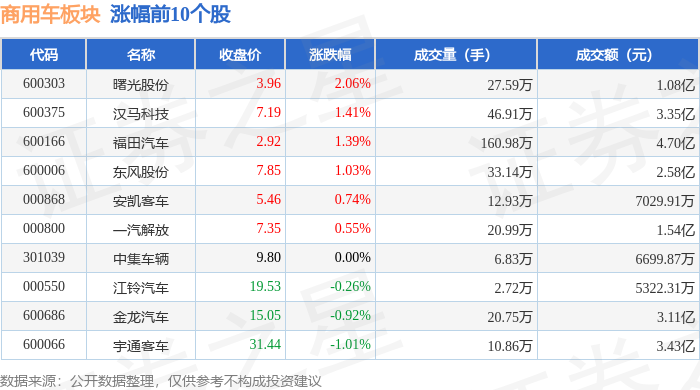
Core Points - The commercial vehicle sector experienced a decline of 1.11% on November 11, with Jianghuai Automobile leading the drop [1] - The Shanghai Composite Index closed at 4002.76, down 0.39%, while the Shenzhen Component Index closed at 13289.0, down 1.03% [1] Commercial Vehicle Sector Performance - The following companies showed notable performance: - Shuguang Co., Ltd. (600303) closed at 3.96, up 2.06% with a trading volume of 275,900 shares and a transaction value of 108 million [1] - Hanma Technology (600375) closed at 7.19, up 1.41% with a trading volume of 469,100 shares and a transaction value of 335 million [1] - Foton Motor (600166) closed at 2.92, up 1.39% with a trading volume of 1,609,800 shares and a transaction value of 470 million [1] - Dongfeng Motor (600006) closed at 7.85, up 1.03% with a trading volume of 331,400 shares and a transaction value of 258 million [1] - Jianghuai Automobile (600418) closed at 46.16, down 3.19% with a trading volume of 413,700 shares and a transaction value of 1.927 billion [2] Fund Flow Analysis - The commercial vehicle sector saw a net outflow of 360 million from institutional investors, while retail investors contributed a net inflow of 261 million [2] - The following companies had significant fund flows: - Foton Motor (600166) had a net inflow of 39.94 million from institutional investors, but a net outflow of 43.89 million from retail investors [3] - Hanma Technology (600375) had a net inflow of 13.05 million from institutional investors, with retail investors contributing a net inflow of 0.62 million [3] - Dongfeng Motor (600006) had a net inflow of 9.45 million from institutional investors, but a net outflow of 12.84 million from retail investors [3]


商用车板块11月10日跌0.28%,宇通客车领跌,主力资金净流出1.74亿元
Zheng Xing Xing Ye Ri Bao· 2025-11-10 08:50
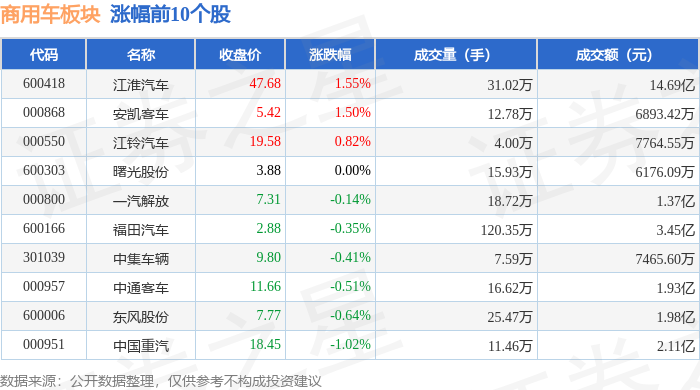
Market Overview - The commercial vehicle sector experienced a decline of 0.28% on November 10, with Yutong Bus leading the drop [1] - The Shanghai Composite Index closed at 4018.6, up 0.53%, while the Shenzhen Component Index closed at 13427.61, up 0.18% [1] Individual Stock Performance - Jianghuai Automobile (600418) closed at 47.68, up 1.55% with a trading volume of 310,200 shares and a turnover of 1.469 billion yuan [1] - Ankai Bus (000868) closed at 5.42, up 1.50% with a trading volume of 127,800 shares and a turnover of 68.9342 million yuan [1] - Yutong Bus (600066) closed at 31.76, down 2.58% with a trading volume of 124,800 shares and a turnover of 399 million yuan [3] - The overall trading data for the commercial vehicle sector shows mixed performance among individual stocks, with some experiencing gains while others faced losses [1][3] Capital Flow Analysis - The commercial vehicle sector saw a net outflow of 174 million yuan from institutional investors, while retail investors contributed a net inflow of 254 million yuan [4] - Notable capital flows include: - Foton Motor (600166) had a net inflow of 17.9142 million yuan from institutional investors [4] - Yutong Bus (600066) experienced a net outflow of 7.5470 million yuan from institutional investors [4] - Ankai Bus (000868) saw a net inflow of 0.9552 million yuan from retail investors [4] Summary of Trading Data - The trading data for key stocks in the commercial vehicle sector indicates varied performance, with some stocks showing resilience while others are under pressure [1][3][4] - The overall sentiment in the sector appears cautious, reflecting broader market trends and investor behavior [1][4]


商用车出海再提速!福田这场全球大会放出了哪些大招?
第一商用车网· 2025-11-10 07:29
Core Viewpoint - Foton Motor aims to become a world-class commercial vehicle enterprise by 2030, with over 50% of its models being new energy vehicles and overseas sales exceeding 300,000 units [3][5][22] Group 1: Global Strategy and Goals - Foton Motor is actively participating in global competition, focusing on industrial intelligence, digitalization, and connectivity to drive the development of the Chinese automotive industry [3] - The company plans to accelerate overseas industrial investment, establishing over 10 industrial bases in countries such as Thailand, Indonesia, South Africa, Brazil, Mexico, Saudi Arabia, and the EU within the next five years [5][12] - Foton's global strategy report outlines clear goals for achieving a leading position in design, manufacturing, and quality experience in the commercial vehicle sector [3][5] Group 2: Regional Cooperation and Emerging Markets - Brazil and South Africa are identified as crucial strategic points in Foton's global layout, with significant local support for the company's investments [7][10] - The Brazilian government is promoting initiatives that align with Foton's sustainable transportation strategy, encouraging investments in decarbonization and innovation [8] - Foton's local assembly plant in South Africa is highlighted as a significant automotive investment, marking the company's commitment to local production and regional development [10] Group 3: Product Innovation and Technology - Foton is transitioning from being a market participant to a global technology leader, focusing on new energy, intelligent driving, and a multi-energy approach [14] - The company has developed proprietary technologies in electric, hybrid, and hydrogen fuel cell vehicles, achieving high efficiency and extensive testing [14] - Foton's intelligent driving technologies aim to enhance operational efficiency and safety, with significant data integration into its logistics services [16] Group 4: Future Business Planning - Foton aims to achieve a target of 200,000 units in overseas sales by 2026, with significant growth expected in heavy trucks and buses [18] - The company is focused on innovative marketing models and new product promotion, particularly in the new energy sector [18] - Foton's commitment to building a comprehensive vehicle ecosystem is evident in its plans for digitalization and service expansion [16][18] Group 5: Recognition and Awards - Foton Motor recognized outstanding partners in its global development journey with various awards, emphasizing collaboration and innovation [20]

从单车净赚10万元到断崖式下跌,出口俄罗斯“退烧”,中国车商做了个大胆的决定
3 6 Ke· 2025-11-10 03:37
Core Insights - The export of Chinese automobiles to Russia has significantly declined, with a 58% drop in the first nine months of 2025 compared to the previous year, marking a shift in the export landscape [3][11][12] - Mexico has overtaken Russia as the largest destination for Chinese automobile exports, reflecting a changing dynamic in the market [3][11] - Increased taxes and economic challenges in Russia, including a rise in scrappage taxes by 70% to 85%, have negatively impacted the profitability and attractiveness of the Russian market for Chinese exporters [8][9][11] Export Trends - In the first nine months of 2025, China exported 35.77 million vehicles to Russia, a significant decrease from previous years when Russia was the top destination for Chinese car exports [3][11] - The top three destinations for Chinese automobile exports are now Mexico, the UAE, and Russia, indicating a shift in market focus [3][11] Market Challenges - Factors such as rising import taxes, scrappage taxes, and economic instability in Russia are contributing to a decline in demand for Chinese vehicles [8][9][11] - The Russian market is experiencing a structural economic decline, with inflation at 10% and high interest rates affecting consumer purchasing power [11] Industry Response - Chinese automobile manufacturers are shifting strategies from quick profits to long-term investments in local production and service networks in Russia [16][18] - Companies like Great Wall Motors and Chery are establishing local assembly plants to increase localization and reduce import costs [18][19] Future Outlook - Industry experts suggest that Chinese car manufacturers need to enhance localization, improve after-sales service, and reshape brand perception to succeed in the Russian market [19] - The transition to a more sustainable and competitive approach in the Russian market is expected to take three to five years, requiring patience and strategic planning [19]

俄罗斯大幅加税,中国汽车出口骤降58%
Mei Ri Jing Ji Xin Wen· 2025-11-10 00:41
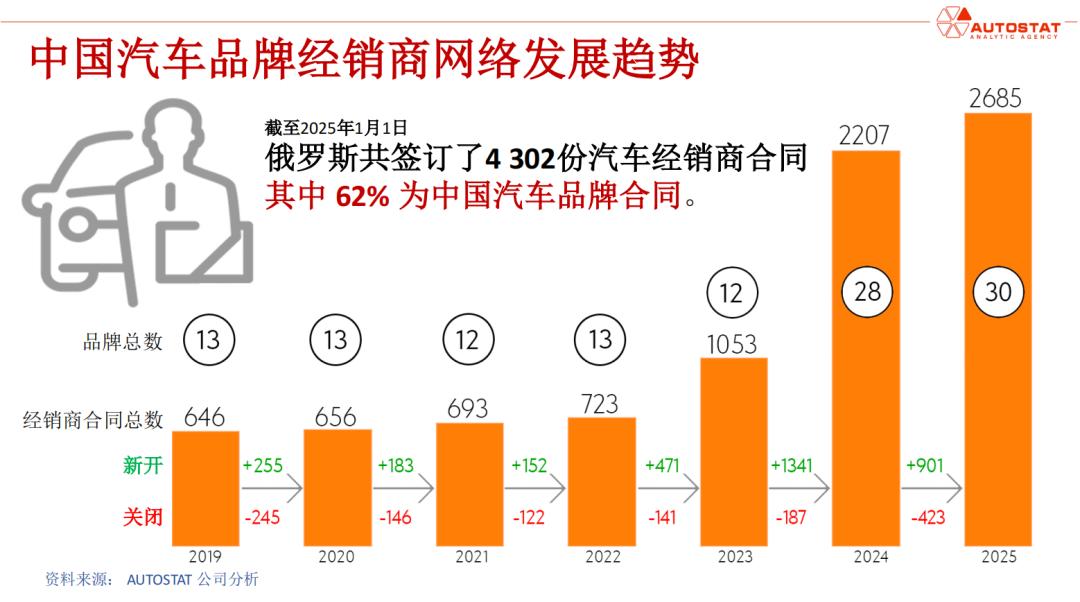
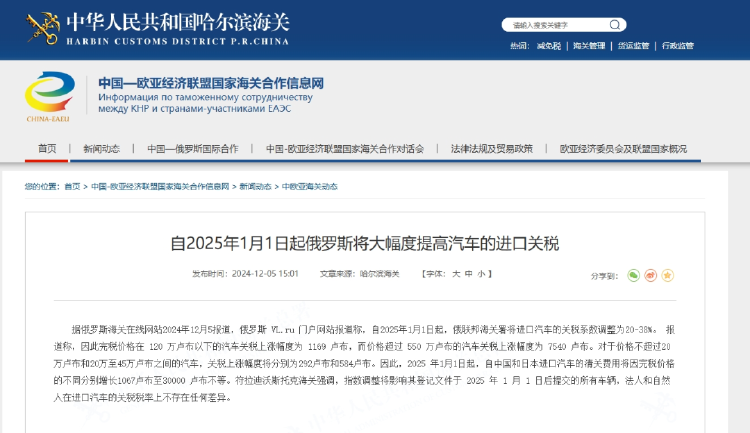
Core Viewpoint - The export of Chinese automobiles to Russia has significantly declined, with a 58% drop in the first nine months of 2025 compared to the previous year, as new taxes and changing market dynamics impact the industry [3][5][7]. Group 1: Market Dynamics - In the first nine months of 2023, China exported 5.71 million vehicles, a year-on-year increase of 21%, with Mexico becoming the largest export destination, followed by the UAE and Russia [1][3]. - Russia, which was previously the largest market for Chinese automobile exports, has now fallen to third place, with exports dropping to 357,700 units in 2025 [3][7]. - The shift in export destinations indicates a significant change in the landscape of Chinese automobile exports, moving away from reliance on the Russian market [3][7]. Group 2: Tax and Regulatory Impact - Starting October 1, 2024, the scrap tax for new imported vehicles in Russia will increase by 70% to 85%, particularly affecting used cars with engine sizes between 2 to 3 liters and over three years old, where the tax will rise from 1.3 million rubles (approximately 114,000 RMB) to 2.37 million rubles (approximately 208,000 RMB) [5][7]. - Additionally, from January 1, 2025, import tariffs on vehicles will be adjusted to 20% to 38%, leading to increased clearance costs for Chinese automobiles [5][7]. Group 3: Industry Challenges - The Russian economy is experiencing structural decline, with high inflation rates of 10% and a long-term benchmark interest rate of 21%, leading to increased car loan rates and reduced purchasing power [7][10]. - Chinese brands are facing declining sales in Russia, with significant drops reported for brands like Haval and Geely, which saw year-on-year declines of 15.5% and 39.3%, respectively [7][10]. - The closure of 274 car dealerships in Russia, with 78% being Chinese brands, highlights the challenges faced by Chinese automobile exporters in maintaining market presence [7][10]. Group 4: Strategic Shifts - Chinese automobile manufacturers are shifting from a focus on quick profits to establishing a long-term presence in the Russian market, emphasizing local production and service [13][14]. - Companies like Great Wall Motors are adopting a localized assembly model, achieving over 65% localization to mitigate high import taxes and benefit from local subsidies [14][15]. - Experts suggest that to succeed in the Russian market, Chinese manufacturers must enhance local production, improve after-sales service, and reshape their brand image to counter negative perceptions [14][15].
武汉商用车展探馆!东风/中集包场 解放推新能源 江淮秀无人车 谁最有看点?| 头条
第一商用车网· 2025-11-09 23:26
Core Insights - The 2025 China International Commercial Vehicle Exhibition in Wuhan serves as a significant indicator of new trends and opportunities in the commercial vehicle industry, coinciding with the conclusion of the 14th Five-Year Plan and the planning of the 15th Five-Year Plan [1] Group 1: New Energy Vehicles - FAW Jiefang showcased five new energy truck models, including the J6L pure electric feed transport vehicle and the J6P heavy-duty pure electric dump truck, targeting various market segments [3][4][5] - Dongfeng Commercial Vehicle presented six new heavy-duty trucks, emphasizing keywords like large battery capacity, supercharging, and hybrid technology, including the Dongfeng Tianlong KL Huawei megawatt supercharging tractor [8][12] - Shaanxi Automobile displayed four heavy-duty trucks and five engine products in collaboration with Cummins, focusing on high power, fuel efficiency, and a mix of traditional and new energy vehicles [16][20] Group 2: Diverse Product Offerings - Foton Motors presented a wide range of products across its brands, including Ouman, Auman, and others, showcasing its comprehensive approach in the commercial vehicle sector [23] - Dongfeng Liuqi introduced a full lineup of vehicles, including LNG tractors and electric models, aligning with market trends towards electrification and intelligence [31][34] - Jianghuai Automobile highlighted its upcoming Kunpeng ET9 light truck and showcased the Kara unmanned delivery vehicle, featuring L4-level autonomous driving technology [39][44] Group 3: Industry Innovations - CIMC Vehicles emphasized its "Only Star Chain" strategy, showcasing logistics, tank, and special vehicles, and announced the upcoming release of new models for 2026 [43] - BYD displayed four new energy commercial vehicles, including the T4 electric truck, and set up a dynamic experience area to demonstrate the vehicle's capabilities [48][51] - Nanjing Iveco presented its star products, including the Eurovan series, demonstrating its leadership in the light commercial vehicle market [53][54] Group 4: Market Trends - The exhibition highlighted the increasing focus on new energy, intelligence, and high power in commercial vehicles, with many companies launching products that align with these trends [83] - The presence of specialized vehicle and component manufacturers at the exhibition indicates a broader market transformation affecting all sectors [83]


俄罗斯大幅加税 中国汽车出口骤降58%!1辆净赚几万已成过去
Mei Ri Jing Ji Xin Wen· 2025-11-09 23:25
Core Viewpoint - The export of Chinese automobiles to the Russian market is facing significant challenges, with a notable decline in sales and increasing operational costs due to new taxes and changing consumer sentiment [1][4][11]. Group 1: Export Trends - In the first nine months of 2025, China's automobile exports to Russia fell to 357,700 units, a decrease of 58% year-on-year, marking a significant shift in export dynamics [4]. - Russia has dropped from being the largest export destination for Chinese automobiles to the third position, with Mexico and the UAE now leading [4][11]. - The overall export volume of Chinese automobiles reached 5.71 million units in the first nine months of the year, reflecting a 21% increase, but the focus has shifted away from Russia [1][4]. Group 2: Market Challenges - The introduction of new taxes, including a 70% to 85% increase in the scrappage tax for imported vehicles, has severely impacted the profitability of exporting to Russia [9][11]. - The economic situation in Russia, characterized by high inflation (10%) and a fluctuating ruble, has led to decreased purchasing power and rising costs for consumers [11]. - The interest in foreign brands returning to the Russian market has caused potential buyers to adopt a wait-and-see approach, further dampening demand for Chinese vehicles [15] . Group 3: Industry Response - Chinese automobile manufacturers are shifting strategies from quick profits to establishing a long-term presence in the Russian market, focusing on local production and service [20][21]. - Companies like Great Wall Motors are already implementing localized production strategies, achieving a localization rate of over 65% to mitigate import tax impacts [20]. - Industry leaders emphasize the need for improved after-sales service and brand perception to counteract negative stereotypes about quality [21].

京津冀携手筑起新能源汽车“配套圈”
Bei Jing Ri Bao Ke Hu Duan· 2025-11-08 23:48
Core Insights - The Beijing-Tianjin-Hebei Intelligent Connected New Energy Vehicle Technology Ecological Park (Shunyi) has received approval for the automotive core component standard factory project, aimed at accelerating the development of an industrial cluster and enhancing collaboration among local automotive enterprises [3][4] Group 1: Project Overview - The project covers a total construction area of over 80,000 square meters, including standardized factories and supporting facilities, providing specialized production space for automotive core component companies [3] - The ecological park is planned to occupy over 8,000 acres, divided into three zones: Shunyi in Beijing, Wuqing in Tianjin, and Langfang in Hebei [3][4] - The Shunyi zone will focus on automotive electronics, smart vehicles, and quality upgrades, aiming to create a high-efficiency, green, and intelligent operational environment [3] Group 2: Development Phases - The project is divided into three phases: - Phase 1 focuses on production services and intelligent driving systems, expected to be operational by June 2026 [4] - Phase 2 will include electric motor control systems and smart cockpit development, anticipated to be completed by December 2027 [4] - The expansion area will target new material systems and smart automotive computing platforms, aiming for completion by the end of the 14th Five-Year Plan [4] Group 3: Industry Impact - The ecological park is expected to enhance the scale of the automotive component industry, attracting high-tech and high-value-added enterprises, thereby improving the self-sufficiency of core components [4] - Once completed, the park will create a "30-minute supply circle" with local automotive production bases and a "2 to 3-hour supply circle" with Tianjin and Hebei, promoting deep integration across the industry chain [4] Group 4: Recent Developments - Two significant projects have recently been signed to establish operations in the ecological park: Shanghai Tongyu Automotive Technology and Beijing Wanjitech, both focusing on intelligent chassis and laser radar technologies [6] - Shanghai Tongyu plans to invest 500 million yuan to build its northern headquarters and establish multiple intelligent production lines [6] - The addition of these companies is expected to strengthen the critical links in the park's industrial chain and foster a collaborative innovation ecosystem [6]