
Hengrui Pharma(600276)

Search documents
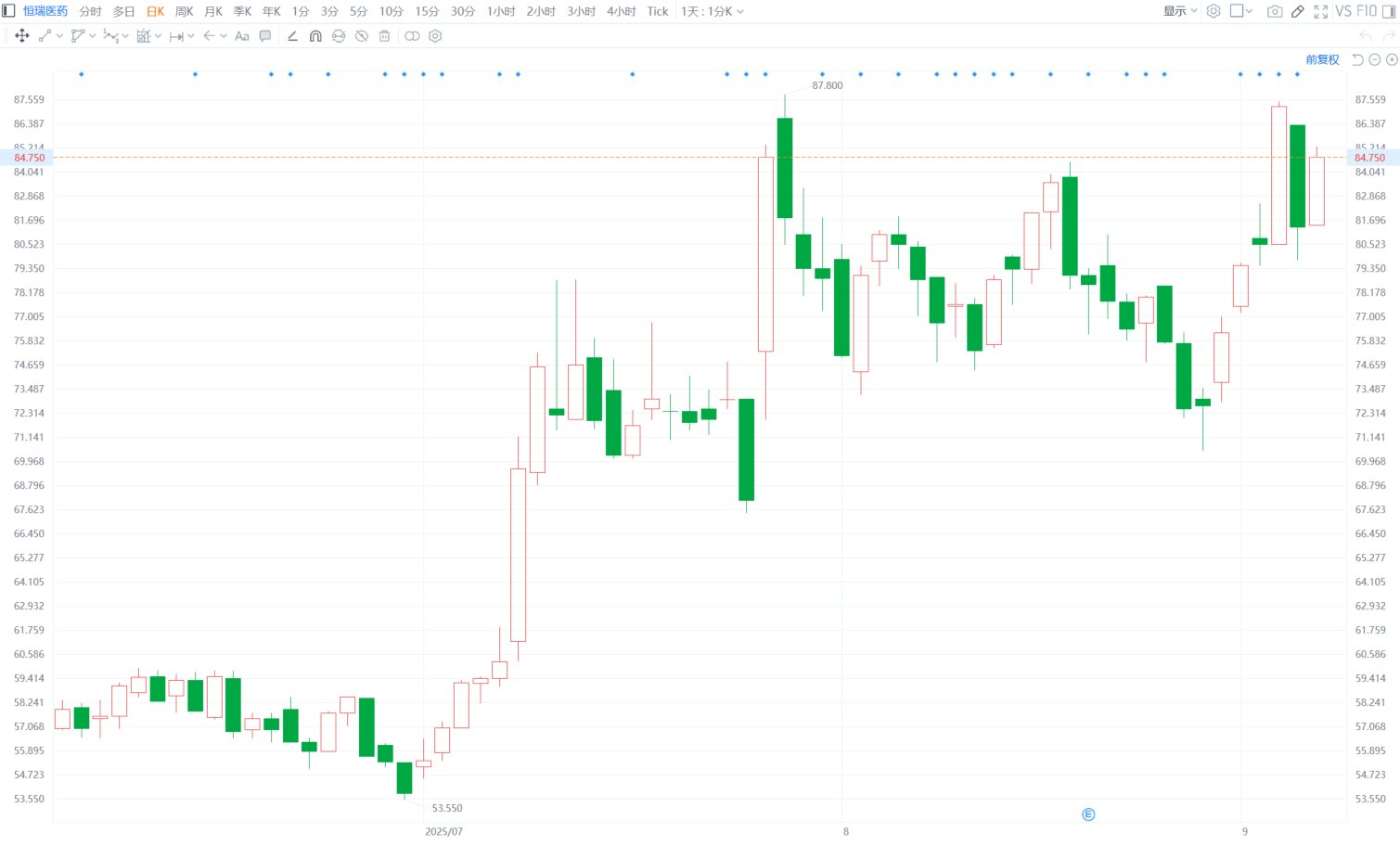
港股异动丨恒瑞医药涨超4% 新药项目授权海外 最高获益可达10.13亿美元
Ge Long Hui· 2025-09-05 07:49
Group 1 - The core point of the article highlights that 恒瑞医药 (Hengrui Medicine) has entered into an agreement with Braveheart Bio for the licensing of its innovative drug HRS-1893, which includes a total payment of $75 million, consisting of an upfront payment of $65 million and a milestone payment of $10 million after technology transfer [1] - Following the announcement, 恒瑞医药's stock price increased by 4.18% to HKD 84.75, with a trading volume of HKD 400 million, and its latest H-share market capitalization reached HKD 562.5 billion [1] - The A-shares of 恒瑞医药 also saw a rise of 5.56%, closing at CNY 72.47, marking the highest closing price since April 14, 2021 [1] Group 2 - 恒瑞医药 is eligible to receive additional milestone payments related to clinical development and sales, which could total up to $1.013 billion [1] - Braveheart Bio will also pay 恒瑞医药 a sales commission based on the sales performance of the licensed drug [1]


恒瑞医药(600276) - H股公告-翌日披露报表
2025-09-05 07:45
公司名稱: 江蘇恒瑞醫藥股份有限公司 呈交日期: 2025年9月5日 FF305 翌日披露報表 (股份發行人 ── 已發行股份或庫存股份變動、股份購回及/或在場内出售庫存股份) 表格類別: 股票 狀態: 新提交 如上市發行人的已發行股份或庫存股份出現變動而須根據《香港聯合交易所有限公司(「香港聯交所」)證券上市規則》(「《主板上市規則》」)第13.25A條 / 《香港聯合交易所有限公司GEM證券 上市規則》(「《GEM上市規則》」)第17.27A條作出披露,必須填妥第一章節 。 | 第一章節 | | | | | | | --- | --- | --- | --- | --- | --- | | 1. 股份分類 普通股 | 股份類別 A | | 於香港聯交所上市 | 否 | | | 證券代號 (如上市) 600276 | 說明 | A股(於上海證券交易所上市) | | | | | A. 已發行股份或庫存股份變動 | | | | | | | | 已發行股份(不包括庫存股份)變動 | | 庫存股份變動 | | | | 事件 | 已發行股份(不包括庫存股份)數 目 | 佔有關事件前的現有已發 行股份(不包括庫存股 份 ...
恒瑞二度Newco出海 总交易额10.88亿美元
Jing Ji Guan Cha Wang· 2025-09-05 07:05
Core Viewpoint - Heng Rui Medicine has announced a new collaboration with Braveheart Bio for the global development and commercialization of its heart disease drug HRS-1893, marking its second NewCo transaction aimed at expanding its international presence [1][3]. Group 1: Transaction Details - Heng Rui Medicine will receive a total of $65 million in upfront payments, consisting of $32.5 million in cash and $32.5 million in equity from Braveheart Bio [1]. - After the technology transfer, Heng Rui will receive an additional $10 million milestone payment, along with potential milestone payments and sales royalties that could total up to $1.013 billion, bringing the maximum potential revenue from this deal to $1.088 billion [1]. - A joint management committee will be established to coordinate the global development and commercialization of the licensed product, with equal representation from both companies [1]. Group 2: Product Development Status - HRS-1893 is currently undergoing a Phase III clinical trial in China for obstructive hypertrophic cardiomyopathy, which is a common hereditary heart disease and a leading cause of sudden cardiac death among adolescents and athletes [2]. Group 3: Previous Transactions and Company Background - This is Heng Rui Medicine's second NewCo model transaction; the first involved licensing three GLP-1 innovative drugs to a newly established U.S. company, Kailera, for an upfront payment of $100 million and a potential total deal value of $6 billion [3]. - Braveheart Bio was established in 2024 in Delaware, USA, with major investors including Forbion Capital and OrbiMed, and is led by CEO Travis Murdoch, who has a history of successful clinical project management [3][4]. - As of September 5, Heng Rui Medicine's A-shares rose by 3.35%, with a market capitalization of 470.9 billion yuan, while its Hong Kong shares increased by 3.07%, with a market capitalization of 555.9 billion HKD [4].
医药生物行业双周报(2025、8、22-2025、9、4):国家医保谈判在即-20250905
Dongguan Securities· 2025-09-05 06:51
Investment Rating - The report maintains a "Market Weight" rating for the pharmaceutical and biotechnology industry [6][29]. Core Insights - The SW pharmaceutical and biotechnology industry underperformed the CSI 300 index, declining by 1.27% from August 22 to September 4, 2025, which is approximately 3.07 percentage points lower than the index [13][29]. - Most sub-sectors within the industry recorded negative returns during the same period, with the medical research outsourcing and chemical preparation sectors showing the highest gains of 12.17% and 5.45%, respectively. In contrast, the in vitro diagnostics and raw materials sectors experienced declines of 5.96% and 4.95% [16][19]. - Approximately 22% of stocks in the industry recorded positive returns, while around 78% experienced negative returns during the reporting period [17][19]. - The overall price-to-earnings (PE) ratio for the SW pharmaceutical and biotechnology industry was approximately 55.41 times, with a relative PE ratio of 4.23 times compared to the CSI 300 index, indicating little change in industry valuation [20][29]. Summary by Sections 1. Market Review - The SW pharmaceutical and biotechnology industry underperformed the CSI 300 index, with a decline of 1.27% from August 22 to September 4, 2025 [13]. - Most sub-sectors recorded negative returns, with medical research outsourcing and chemical preparations leading in gains [16]. - About 22% of stocks in the industry had positive returns, while 78% had negative returns [17]. 2. Industry News - The National Healthcare Security Administration announced the list of drugs for the 2025 National Basic Medical Insurance, with 718 submissions and 535 passing the initial review [27]. - The report highlights the upcoming national medical insurance negotiations and the analysis of 25 traditional Chinese medicine products [27]. 3. Company Announcements - Guangzhou Baiyunshan Pharmaceutical Group announced that its subsidiary received approval for a drug to pass the consistency evaluation for generic drugs [28]. 4. Industry Outlook - The report suggests focusing on investment opportunities in the innovative drug sector and related areas, including medical devices and traditional Chinese medicine [29][32].



恒瑞医药心肌肌球蛋白抑制剂HRS-1893以NewCo模式授权海外,交易额最高达10.88亿美元
Cai Jing Wang· 2025-09-05 05:32
Core Insights - HengRui Pharma has entered into an exclusive licensing agreement with Braveheart Bio for its proprietary Myosin small molecule inhibitor HRS-1893, aimed at treating Hypertrophic Cardiomyopathy (HCM) [1][2] - The agreement grants Braveheart Bio exclusive rights to develop, manufacture, and commercialize HRS-1893 globally, excluding Greater China, with an upfront payment of $65 million and potential milestone payments totaling up to $1.013 billion [1][2] - HRS-1893 is a significant innovation in HengRui's cardiovascular portfolio, currently in Phase III clinical trials, with over 10 innovative products in clinical research stages targeting cardiovascular diseases [3] Financial Terms - Braveheart Bio will pay HengRui a total of $75 million, which includes $32.5 million in cash and $32.5 million in equity, along with a $10 million milestone payment upon successful technology transfer [1] - The potential milestone payments related to clinical development and sales could reach up to $1.013 billion, in addition to sales royalties [1] Market Potential - The CEO of Braveheart Bio expressed confidence in HRS-1893's potential as a best-in-class Myosin inhibitor, highlighting the significant unmet needs in the cardiovascular disease market [2] - HengRui's recent licensing of GLP-1 class innovative drugs to a newly established U.S. company could yield up to $6 billion in total payments, indicating a strong focus on expanding its innovative drug portfolio [2]
10.88亿美元!恒瑞医药再出海,创新药如何走稳国际化?
2 1 Shi Ji Jing Ji Bao Dao· 2025-09-05 05:29
Core Viewpoint - HengRui Pharma has entered into an exclusive licensing agreement with Braveheart Bio for its Myosin small molecule inhibitor HRS-1893, marking a strategic move to leverage international capital through the NewCo model [1][2] Group 1: Licensing Agreement Details - HengRui Pharma will receive a total of $75 million from Braveheart Bio, which includes a $65 million upfront payment and a $10 million milestone payment upon technology transfer [1] - The agreement allows Braveheart Bio to develop, produce, and commercialize HRS-1893 globally, excluding China, with potential milestone payments reaching up to $1.013 billion related to clinical development and sales [1][4] Group 2: NewCo Model Advantages - The NewCo model allows HengRui to separate R&D risks and commercialization execution, enabling quicker cash flow recovery through upfront and milestone payments [2][6] - This model is particularly suitable for large pharmaceutical companies like HengRui, which have a rich early pipeline but limited overseas clinical and commercialization capabilities [2][5] Group 3: HRS-1893 and Clinical Development - HRS-1893 is a highly selective Myosin small molecule inhibitor aimed at normalizing myocardial contractility and reducing left ventricular hypertrophy [4] - The drug has already initiated Phase III clinical trials for obstructive hypertrophic cardiomyopathy, with multiple clinical trials ongoing in HengRui's cardiovascular portfolio [4][5] Group 4: Strategic Implications - The involvement of reputable investors like Forbion and OrbiMed provides funding and international operational resources, enhancing the credibility of HengRui's technology platform [4][9] - The NewCo model is emerging as a preferred strategy for Chinese pharmaceutical companies to navigate international markets while retaining core regional rights [7][9] Group 5: Market Trends and Future Outlook - The NewCo model has gained traction since 2024, with several companies, including HengRui, exploring this approach to overcome barriers in the global biopharmaceutical market [6][9] - Future pipelines with first-in-class or best-in-class potential are likely to utilize this model for international expansion, necessitating strong collaboration among legal, financial, and medical teams during negotiations [9]
“医药一哥”,大消息!
天天基金网· 2025-09-05 05:11
Core Viewpoint - Heng Rui Medicine has signed a licensing agreement with Braveheart Bio for the innovative drug HRS-1893, which could yield milestone payments up to $1.013 billion [5][8]. Group 1: Licensing Agreement Details - The agreement allows Braveheart Bio exclusive rights to develop, produce, and commercialize HRS-1893 globally, excluding Greater China [7]. - HRS-1893 is a Myosin selective inhibitor currently in Phase III clinical development for treating obstructive hypertrophic cardiomyopathy (oHCM) [7]. - Braveheart Bio will pay an upfront fee of $65 million, including $32.5 million in cash and $32.5 million in equity, plus an additional $10 million upon technology transfer completion [8]. Group 2: Financial Implications - Heng Rui Medicine is eligible for milestone payments related to clinical development and sales, potentially reaching $1.013 billion [5][8]. - The agreement is expected to enhance Heng Rui's international market presence and improve its innovative brand and overseas performance [8]. Group 3: Recent Developments - Heng Rui Medicine has initiated its first A-share buyback, purchasing 270,000 shares at a total cost of approximately 18.31 million yuan [11]. - The company reported a revenue of 15.761 billion yuan for the first half of 2025, a year-on-year increase of 15.88%, with a net profit of 4.450 billion yuan, up 29.67% [12].

10.88亿美元!恒瑞医药再次“NewCo”出海
Guo Ji Jin Rong Bao· 2025-09-05 04:56
Core Viewpoint - HengRui Medicine has entered into an exclusive licensing agreement with Braveheart Bio for its self-developed Myosin small molecule inhibitor HRS-1893, marking a significant step in the company's international expansion strategy through the NewCo model [1][3]. Group 1: Licensing Agreement Details - The agreement grants Braveheart Bio exclusive rights to develop, produce, and commercialize HRS-1893 globally, excluding mainland China, Hong Kong, Macau, and Taiwan [3]. - Braveheart Bio will pay a total of $75 million, which includes a $65 million upfront payment (comprising $32.5 million in cash and $32.5 million in equity) and a $10 million milestone payment upon completion of technology transfer [3]. - Additionally, HengRui Medicine could receive up to $1.013 billion in milestone payments related to clinical development and sales, along with corresponding sales royalties [3]. Group 2: Product Information - HRS-1893 is a highly selective Myosin small molecule inhibitor that specifically inhibits myocardial ATPase activity, normalizing myocardial contractility, reducing left ventricular hypertrophy, and improving diastolic compliance [4]. - The drug is currently undergoing a Phase III clinical trial in China for obstructive hypertrophic cardiomyopathy and has multiple ongoing clinical trials in the cardiovascular disease field [4]. Group 3: Strategic Implications - The partnership with top-tier life science investment firms like Forbion and OrbiMed highlights HengRui's international competitiveness and the high value of its diversified R&D pipeline [6]. - The collaboration aims to accelerate the global development of innovative therapies in the cardiovascular field, addressing unmet medical needs [6]. - This agreement follows HengRui's previous successful licensing deals, including a notable transaction with GSK, which set a new record for outbound licensing agreements from China [7].
创新药再迎重磅出海BD交易,恒生创新药ETF(159316)交投活跃,盘中成交额超4亿元
Sou Hu Cai Jing· 2025-09-05 03:20
Group 1 - The Hong Kong stock market is experiencing an upward trend, with the innovative pharmaceutical sector showing strong performance, as evidenced by a 3.5% increase in the Hang Seng Innovative Drug Index and over 400 million yuan in trading volume for the Hang Seng Innovative Drug ETF (159316) [1] - Hengrui Medicine announced a significant overseas business development (BD) deal worth over 1 billion USD for its drug HRS-1893, with an upfront payment of 65 million USD, aimed at expanding its market reach and providing quality treatment options globally [1] - Guosen Securities highlighted that the innovative drug sector has performed well in the first half of the year, driven by successful BD collaborations, excellent clinical data, and supportive policies, indicating a rapid increase in the commercial value of newly launched products [1] Group 2 - The Hang Seng Innovative Drug Index has been adjusted to exclude contract research organizations (CROs), achieving a "purity" of 100% for innovative drug companies, which allows for a more accurate reflection of the overall performance of China's innovative pharmaceutical sector [2] - The Hang Seng Innovative Drug ETF (159316) is currently the only product tracking this newly adjusted index, providing investors with a precise opportunity to capitalize on the growth of the innovative drug industry [2]
恒瑞医药盘中涨超3% Myosin抑制剂HRS-1893实现海外授权-港股-金融界
Jin Rong Jie· 2025-09-05 03:11
Core Insights - Heng Rui Medicine (01276) saw its stock price increase by 2.89% to HKD 83.70, with a trading volume of HKD 162 million [1] Group 1: Business Development - Heng Rui Medicine announced an exclusive licensing agreement with BraveheartBio for its self-developed Myosin small molecule inhibitor HRS-1893 [1] - The business development (BD) transaction operates under a NewCo model, contributing to a total of over USD 15 billion in BD transactions for Heng Rui Medicine this year [1] - The agreement grants BraveheartBio exclusive rights to develop, produce, and commercialize HRS-1893 globally, excluding mainland China, Hong Kong, Macau, and Taiwan [1]