
CSICPCL(600482)

Search documents
新华时评|全球气候治理关键时刻的“中国动力”
Xin Hua She· 2025-09-26 01:35
Core Points - The article emphasizes China's commitment to global climate governance and its new contributions announced by President Xi Jinping at the UN Climate Change Summit, aiming to enhance confidence and cooperation in addressing climate change [1][2][4] Group 1: China's New Contributions - By 2035, China aims to reduce its total greenhouse gas emissions by 7%-10% from peak levels, with non-fossil energy consumption exceeding 30% of total energy consumption [2] - Wind and solar power generation capacity is targeted to exceed 360 million kilowatts, which is over six times the capacity in 2020 [2] - Forest stock is expected to reach over 24 billion cubic meters, and new energy vehicles are projected to become the mainstream of new vehicle sales [2] Group 2: Achievements in Green Development - As of June 2023, China's renewable energy installed capacity reached 2.159 billion kilowatts, accounting for approximately 59.2% of total installed capacity [3] - The share of non-fossil energy consumption increased from 15.9% in 2020 to 19.8% in 2024, with wind and solar power capacity already exceeding three times the 2020 levels [3] - China has signed 54 climate change cooperation memorandums with 42 developing countries, providing over 177 billion yuan in project funding since 2016 [3] Group 3: Vision for Global Cooperation - China advocates for a multilateral framework in climate governance, emphasizing the need for developed countries to fulfill their commitments and support developing nations with funding and technology [4] - The country aims to bridge the North-South gap through global green transformation and promote a fair and cooperative climate governance system [4] - China's actions reflect its commitment to building a community with a shared future for mankind, contributing to a sustainable and green future [4]

新华时评丨全球气候治理关键时刻的“中国动力”
Xin Hua She· 2025-09-25 14:23
新贡献的分量,折射出全球绿色转型的中国行动。过去10年间,中国不断加强应对气候变化南南合作, 坚持共建绿色"一带一路",让绿色发展成果惠及全球南方,为全球低碳产业升级和减排实践提供了丰富 的公共产品。作为全球最大清洁技术出口国,中国迄今已向全球提供了60%的风电设备、70%的光伏组 件设备,推动全球风电和光伏发电成本分别下降超过60%和80%,"十四五"期间出口风电和光伏产品累 计为其他国家减少碳排放约41亿吨。截至今年9月,中国已与42个发展中国家签署54份气候变化南南合 作谅解备忘录,累计实施300多期能力建设项目,自2016年以来已为发展中国家应对气候变化提供并动 员项目资金总额超过1770亿元,为其他发展中国家应对气候变化提供了有力支持。 新主张的远见,彰显构建人类命运共同体的中国理念。中国始终将自身发展与世界整体发展紧密联系在 一起,推动国际社会共走绿色、低碳、可持续发展之路。中国始终坚定维护《联合国气候变化框架公 约》确立的多边机制,积极参与和引领全球气候治理。中国持续为尊重发展中国家的发展权发声,呼吁 发达国家切实履约,向发展中国家提供更多资金和技术支持,通过全球绿色转型缩小南北差距,推动构 建 ...
其他电源设备板块9月24日涨2.1%,海博思创领涨,主力资金净流出2.05亿元
Zheng Xing Xing Ye Ri Bao· 2025-09-24 08:46
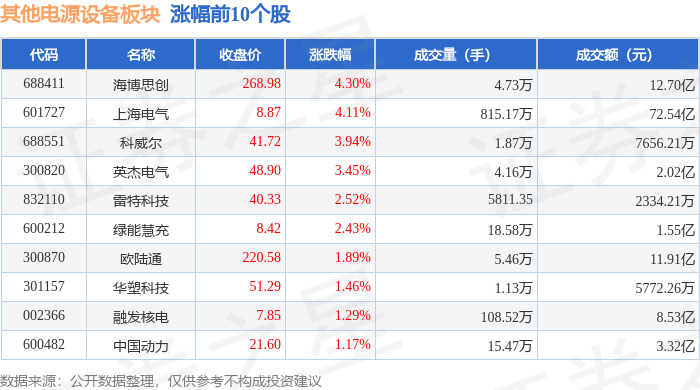
Market Performance - The other power equipment sector increased by 2.1% on September 24, with Haibo Sichuang leading the gains [1] - The Shanghai Composite Index closed at 3853.64, up 0.83%, while the Shenzhen Component Index closed at 13356.14, up 1.8% [1] Individual Stock Performance - Haibo Sichuang (688411) closed at 268.98, up 4.30% with a trading volume of 47,300 shares and a transaction value of 1.27 billion [1] - Shanghai Electric (601727) closed at 8.87, up 4.11% with a trading volume of 8.15 million shares and a transaction value of 7.25 billion [1] - Other notable performers include Kewell (688551) up 3.94%, Yingjie Electric (300820) up 3.45%, and Futec Technology (832110) up 2.52% [1] Fund Flow Analysis - The other power equipment sector experienced a net outflow of 205 million from institutional investors, while retail investors saw a net inflow of 333 million [2][3] - Major stocks like Shanghai Electric and Haibo Sichuang had mixed fund flows, with Shanghai Electric seeing a significant net outflow from both institutional and retail investors [3]




中船系概念下跌0.67%,主力资金净流出8股
Zheng Quan Shi Bao Wang· 2025-09-16 10:27
Group 1 - The China Shipbuilding sector experienced a decline of 0.67%, ranking among the top declines in concept sectors, with major companies like China Shipbuilding, China Ship Defense, and China Power seeing significant drops [1] - Among the stocks in the China Shipbuilding sector, three stocks saw price increases, with China Ship Special Gas rising by 2.35%, Kunshan Intelligent by 1.15%, and Jiuzhiyang by 0.11% [1] Group 2 - The main concept sectors with notable price changes included Reducers (+3.72%), Humanoid Robots (+3.58%), and Automotive Thermal Management (+3.28%), while the China Shipbuilding sector was among those with declines [2] - The China Shipbuilding sector saw a net outflow of 936 million yuan in principal funds, with eight stocks experiencing outflows, and seven stocks seeing outflows exceeding 10 million yuan [2] - The stock with the highest net outflow was China Shipbuilding, with a net outflow of 737.42 million yuan, followed by China Power and China Ship Defense with outflows of 65.01 million yuan and 41.50 million yuan, respectively [2]




其他电源设备板块9月16日跌0.36%,麦格米特领跌,主力资金净流出9.65亿元
Zheng Xing Xing Ye Ri Bao· 2025-09-16 08:53
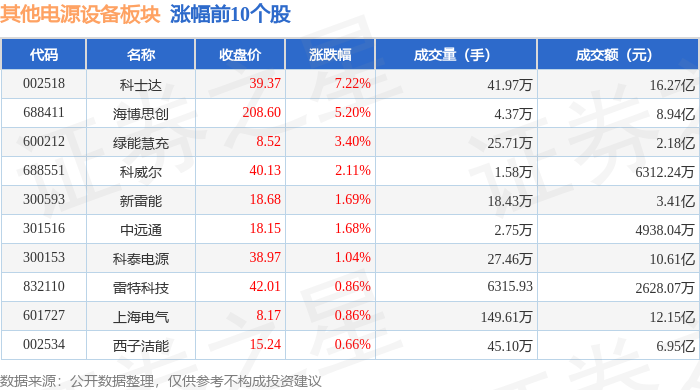
Market Overview - On September 16, the other power equipment sector declined by 0.35%, with Magpowr leading the drop [1] - The Shanghai Composite Index closed at 3861.87, up 0.04%, while the Shenzhen Component Index closed at 13063.97, up 0.45% [1] Stock Performance - Key stocks in the other power equipment sector showed varied performance, with Keda's stock price increasing by 7.22% to 39.37, and Magpowr's stock price decreasing by 3.97% to 83.41 [1][2] - The trading volume and turnover for Keda reached 419,700 shares and 1.627 billion yuan, respectively [1] Capital Flow - The other power equipment sector experienced a net outflow of 966.5 million yuan from institutional investors, while retail investors saw a net inflow of 464 million yuan [2][3] - Notable net inflows from retail investors were observed in stocks like Keda and Xizi Clean Energy, while significant outflows were noted in stocks like Green Energy Charging [3]


招商证券:25H1船舶板块股价表现承压 继续看好后续主流船型放量
智通财经网· 2025-09-16 07:56
Core Viewpoint - The shipbuilding sector is experiencing pressure on stock prices in the first half of 2025, primarily due to a decline in market volume and prices, despite strong earnings performance from shipbuilding companies [1][2]. Group 1: Stock Performance and Fund Holdings - In the first half of 2025, the shipbuilding sector's stock prices underperformed compared to the CSI 300 index, with a notable year-on-year decline in fund holdings for major shipbuilding companies [2]. - Specifically, the fund holding ratio for China Shipbuilding decreased by 3.8 percentage points and 4.9 percentage points year-on-year in Q1 and Q2 of 2025, respectively, although there was a significant increase in Q2 compared to Q1, indicating renewed institutional interest [2]. Group 2: Earnings Performance - Shipbuilding companies reported impressive earnings growth, with profits increasing significantly more than revenues, driven by high-priced orders from around 2022 entering a delivery phase and a decrease in steel costs compared to 2021 [3]. - Key subsidiaries of China Shipbuilding, such as Waigaoqiao and China Shipbuilding Industry Corporation, have shown continuous growth in net profit margins and return on equity (ROE) over multiple reporting periods [3]. Group 3: Market Conditions - The shipbuilding market is facing a downturn, with new orders and new ship prices under significant downward pressure, as the shipping market has experienced a notable decline in freight rates, with major ship types seeing average price drops exceeding 20% year-on-year [4]. - Global new ship orders fell to 1.67 million CGT in May 2025, marking the lowest monthly level in nearly four years, and the Clarkson Global Newbuilding Price Index decreased from 189.96 in September 2024 to 186.69 in May 2025 [4]. - The decline in the domestic shipbuilding market is attributed to the impact of the U.S. Section 301 sanctions and a lower willingness of leading domestic shipyards to accept new orders [4]. Group 4: Future Outlook - The order capacity ratios for bulk carriers and oil tankers are currently low at 10.4% and 15%, respectively, indicating that the shipbuilding cycle has not yet reached its peak [5]. - BIMCO estimates that the potential number of ship demolitions over the next decade will reach 16,000 vessels, totaling 700 million deadweight tons (DWT), which is significantly higher than previous estimates [5]. - Despite short-term order pressures, the low order capacity ratios for mainstream ship types, particularly bulk carriers and medium to large oil tankers, suggest potential for future market recovery, especially with the anticipated impact of U.S. interest rate cuts on supply-demand dynamics [6]. Group 5: Recommendations - The shipbuilding sector is recommended for continued investment, with strong endorsements for companies such as China Shipbuilding (600150.SH) and China Power (600482.SH), along with suggestions to monitor China Shipbuilding Defense (600685.SH), CIMC (000039.SZ), Yaxing Anchor Chain (601890.SH), and Runbang Co., Ltd. (002483.SZ) [6].

拟优化交易方案 中国动力终止收购中船柴油机超16%股权
Zhong Guo Jing Ying Bao· 2025-09-16 05:07
Core Viewpoint - China Power (600482.SH) has announced the termination of its plan to acquire a 16.5136% stake in China Ship Diesel Engine Co., Ltd. after nearly a year of planning due to changes in external circumstances [2][5]. Group 1: Transaction Details - The initial plan involved a total transaction value of approximately 3.814 billion yuan, with cash consideration of about 753 million yuan and convertible bond consideration of approximately 3.061 billion yuan [3]. - China Power intended to raise an additional 2 billion yuan to support the acquisition, with allocations for various projects and working capital [3]. - China Power currently holds a 51.8526% stake in China Ship Diesel Engine, making it the largest shareholder and allowing it to consolidate financial statements [3]. Group 2: Business Context - China Ship Diesel Engine specializes in the research, manufacturing, sales, and after-sales service of marine diesel engines [4]. - The acquisition was part of a broader strategy to consolidate the power business of the former China Shipbuilding Industry Group and eliminate competition within the diesel engine sector [4]. - The completion of the acquisition was expected to enhance China Power's control over its diesel engine business and improve decision-making efficiency [4]. Group 3: Termination Reasons - The termination of the acquisition was attributed to changes in external conditions, which the company did not specify but may relate to a decline in global new ship orders and prices [5][6]. - Following the issuance of an inquiry letter from the Shanghai Stock Exchange regarding the transaction, China Power did not respond before deciding to terminate the acquisition [6]. - The company has committed to optimizing the transaction plan and will not plan any major asset restructuring for at least one month following the announcement [7].
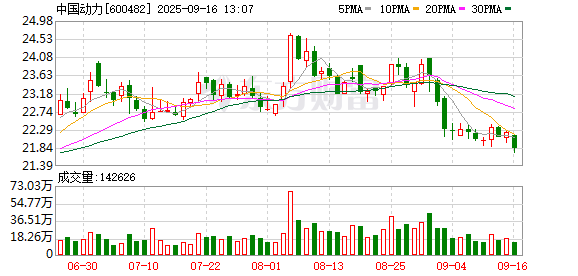
中国动力跌2.03%,成交额2.07亿元,主力资金净流出3491.54万元
Xin Lang Cai Jing· 2025-09-16 03:00
Group 1 - The core viewpoint of the news highlights the recent stock performance and financial metrics of China Power, indicating a decline in stock price and significant net outflow of funds [1][2] - As of September 16, China Power's stock price decreased by 2.03% to 21.76 CNY per share, with a total market capitalization of 49.022 billion CNY [1] - The company has experienced a year-to-date stock price decline of 10.39%, with a 5-day drop of 1.27%, a 20-day drop of 6.21%, and a 60-day drop of 4.01% [1] Group 2 - China Power's main business segments include diesel power (49.92%), chemical power (14.33%), marine platform and ship machinery (12.53%), and precious metals (7.59%) among others [1] - As of June 30, the number of shareholders for China Power was 59,300, a decrease of 13.87% from the previous period, while the average circulating shares per person increased by 16.11% to 37,967 shares [2] - For the first half of 2025, China Power reported operating revenue of 27.651 billion CNY, a year-on-year increase of 11.22%, and a net profit attributable to shareholders of 919 million CNY, a significant year-on-year growth of 93.35% [2] Group 3 - Since its A-share listing, China Power has distributed a total of 2.115 billion CNY in dividends, with 825 million CNY distributed over the past three years [3]
国产航母概念下跌1.29%,主力资金净流出28股
Zheng Quan Shi Bao Wang· 2025-09-15 10:33
Group 1 - The domestic aircraft carrier concept sector declined by 1.29%, ranking among the top declines in the concept sector, with major declines seen in companies like China Satellite, Jin Xin Nuo, and Bo Wei Alloy [1][2] - Among the domestic aircraft carrier concept stocks, six stocks experienced price increases, with China Shipbuilding, China Ship Defense, and China Power rising by 1.29%, 0.81%, and 0.50% respectively [1][2] - The domestic aircraft carrier concept sector saw a net outflow of 1.167 billion yuan from main funds, with 28 stocks experiencing net outflows, and eight stocks seeing outflows exceeding 50 million yuan [2][3] Group 2 - The top net outflow stock was China Satellite, with a net outflow of 217 million yuan, followed by Jin Xin Nuo, Taihao Technology, and Hailanxin with net outflows of 171 million yuan, 141 million yuan, and 137 million yuan respectively [2][3] - The stocks with the highest net inflow included China Shipbuilding, Zhongzhong Co., and China Ship Defense, with net inflows of 85.33 million yuan, 0.968 million yuan, and 0.955 million yuan respectively [2][3] - The domestic aircraft carrier concept sector had several stocks with significant declines, including China Satellite at -4.19%, Jin Xin Nuo at -3.78%, and Taihao Technology at -3.00% [2][3]


中国动力终止收购中船柴油机16.51%股权 原定价38亿
Zhong Guo Jing Ji Wang· 2025-09-15 06:35
Core Viewpoint - The Shanghai Stock Exchange has decided to terminate the review of China Shipbuilding Industry Group Power Co., Ltd.'s application for issuing convertible bonds and cash purchase of assets, following the company's withdrawal of the application [1][9]. Group 1: Transaction Overview - China Power planned to acquire a 16.5136% stake in China Ship Diesel Engine Co., Ltd. from China Shipbuilding Industry Group through issuing convertible bonds and cash, with a total transaction price of 381.4284 million yuan [2][3]. - The payment structure for the transaction includes 75.32629 million yuan in cash and 306.10211 million yuan through convertible bonds [3][4]. - The transaction is not expected to change the company's main business or control structure, as the controlling shareholder remains China Shipbuilding Industry Group [2][4]. Group 2: Financial Details - The valuation of the target company, China Ship Diesel Engine, was assessed at 2.39709385 billion yuan, reflecting an increase of 38.18% over its book value of 1.73480996 billion yuan [4]. - The cash dividend amounting to 87.31362 million yuan was deducted from the valuation to determine the final price for the 16.5136% stake [4]. Group 3: Fundraising and Use of Proceeds - The company intended to raise funds from no more than 35 specific investors, with the total amount not exceeding 100% of the transaction value [5]. - The proceeds were planned to cover transaction cash payments, intermediary fees, and various projects, including enhancing manufacturing capabilities and supporting working capital [6][8].
