
GXED(600617)

Search documents
我国新能源专利数占全球四成以上 新型储能规模世界第一(人民网)
Ren Min Wang· 2025-08-26 09:06
Core Viewpoint - The press conference highlighted the achievements in high-quality energy development during the "14th Five-Year Plan" period, showcasing China's leadership in renewable energy technologies and innovations [1] Group 1: Achievements in Renewable Energy - China's renewable energy technologies lead globally, with over 40% of global renewable energy patents [1] - Photovoltaic conversion efficiency and offshore wind turbine capacity have continuously set new world records [1] - The scale of new energy storage has become the largest in the world within a few years [1] Group 2: Major Projects and Innovations - Significant projects such as the Baihetan Hydropower Station and the domestically developed third-generation nuclear power plants "Hualong One" and "Guohe One" have been completed and put into operation [1] - The development of oil and gas has surpassed the 10,000-meter depth and advanced into the 1,000-meter deep sea [1] - These major projects demonstrate China's strong capabilities in technological innovation [1] Group 3: Emerging Trends and Integration - New models and business formats are thriving, with rapid development in smart microgrids and virtual power plants [1] - The scale application of vehicle-to-grid interactions is accelerating [1] - The energy industry is increasingly integrating with sectors such as industry and transportation, leading to the emergence of new fields and tracks that serve as important sources of new productive forces [1]

海外销量同比大增159.5%,比亚迪7月领跑多国新能源车市
Chang Sha Wan Bao· 2025-08-26 05:41
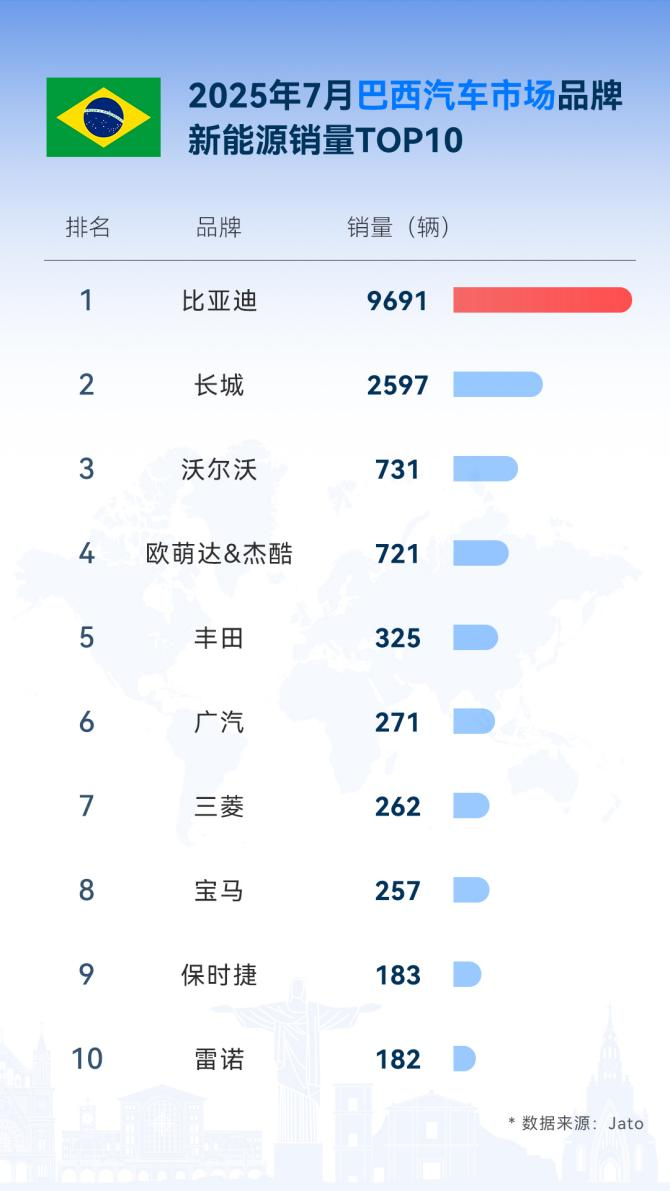
Core Insights - Chinese automaker BYD is rapidly increasing its influence in the global automotive market, with significant sales growth in July 2023, particularly in overseas markets [1] Group 1: Sales Performance - In July 2023, BYD sold 344,296 vehicles, with 80,178 units sold overseas, marking a year-on-year increase of 159.5% [1] - In Brazil, BYD sold 9,691 vehicles in July, a 60% increase year-on-year, securing the top position in the new energy vehicle (NEV) sales ranking [1][2] - In Spain, BYD achieved a monthly sales figure of 2,158 units, a remarkable 665% increase year-on-year, leading the NEV brand ranking [4] - In Italy, BYD sold 2,019 vehicles in July, capturing over 13% of the market share in the NEV segment [7] Group 2: Product Strategy - BYD's diverse product matrix, including both pure electric and plug-in hybrid vehicles, effectively meets various consumer needs, making it a preferred choice in markets like Brazil [1] - The newly launched Song PLUS EV sold 836 units in Spain, entering the top ten in the compact SUV segment, indicating strong product appeal [4] Group 3: Global Expansion and Recognition - BYD's global expansion strategy is evident, with the company achieving significant milestones such as the first vehicle rolling off the production line at its Brazilian factory and the delivery of the 90,000th NEV in Thailand [10] - BYD ranked 91st in the 2025 Fortune Global 500 list, marking its fourth consecutive year on the list and becoming the highest-ranked Chinese automaker [10] - The company has established a presence in 112 countries and regions, showcasing its commitment to global market penetration and brand recognition [10]


(活力中国调研行)产销两旺,中国新能源汽车持续火爆
Zhong Guo Xin Wen Wang· 2025-08-26 05:32
Group 1 - The core viewpoint highlights the robust growth of China's new energy vehicle (NEV) market, with production and sales figures showing significant year-on-year increases of 39.2% and 38.5% respectively for the first seven months of the year, reaching 8.232 million and 8.22 million units [1][2] - The demand for automobiles is being driven by the continuous release of consumer purchasing power, with over 70% of consumers indicating that trade-in subsidies have enhanced their willingness to purchase vehicles [1][2] - In Hubei province, the trade-in subsidy applications have surpassed 210,000, directly stimulating new car consumption by 32.5 billion yuan, with over 56% of new purchases being NEVs [1] Group 2 - The Dongfeng Automotive Mall in Wuhan is utilizing an "online live streaming + offline delivery" model to provide a comprehensive car-buying experience, achieving sales of over 400 vehicles within less than a year, with nearly half sold through live streaming, totaling over 86 million yuan in sales [2][4] - The Chinese Ministry of Commerce has initiated a campaign to stimulate NEV consumption in rural areas, aiming to activate market potential and potentially generate sales increases in the hundreds of thousands of vehicles [2] - China's NEV exports have also seen a significant increase, with a 12.8% rise in overall automobile exports and a remarkable 84.6% growth in NEV exports, totaling 1.308 million units in the first seven months [2][4] Group 3 - Emerging brands like Lantu, established in 2019, are making strides in international markets, having launched their brand and models in several European countries and aiming for global coverage in 60 countries by 2030 [4] - The COO of Lantu emphasized the necessity of international expansion to become a world-class enterprise, with plans to penetrate markets in the Middle East after establishing a presence in Europe [4] - Despite some restrictions in certain regions, the overall outlook for Chinese NEVs in global markets remains optimistic, driven by advantages in technology, cost, and supply chain [4]

五年来我国新能源发展有何特点?国家能源局概括为“四个更”
Zhong Guo Xin Wen Wang· 2025-08-26 04:22
Core Insights - The article highlights the rapid and high-quality development of renewable energy in China during the "14th Five-Year Plan" period, characterized by four key aspects: faster growth, higher electricity share, better spatial layout, and greater global contribution. Group 1: Faster Growth - The annual installed capacity of wind and solar power has reached a scale of "hundred million kilowatts," with a total installed capacity increasing from 530 million kilowatts in 2020 to 1.68 billion kilowatts by July 2023, reflecting an average annual growth rate of 28% and accounting for 80% of the newly installed power capacity in the "14th Five-Year Plan" period [1][2]. Group 2: Higher Electricity Share - The share of wind and solar power in China's total electricity consumption has risen from 9.7% in 2020 to an expected 18.6% in 2024, with an average annual increase of over 2 percentage points. In the first half of this year, wind and solar power generation reached 1.15 trillion kilowatt-hours, nearly one-quarter of the total electricity consumption, surpassing the electricity consumption of the tertiary industry and urban-rural residential use [1][2]. Group 3: Better Spatial Layout - The "Shage Desert" has emerged as a new frontier for renewable energy development, with over 130 million kilowatts of new installed capacity. Offshore wind power has added over 35 million kilowatts, providing green energy to coastal provinces. Distributed solar power has also seen significant growth, with over 40 million kilowatts of new installed capacity, including 16 million kilowatts from household solar systems, making over 7 million families "solar landlords" [2]. Group 4: Greater Global Contribution - China has maintained the world's largest installed capacity for wind power for 15 consecutive years and for solar power for 10 consecutive years. By 2024, China's total installed capacity for wind and solar will account for 47% of the global total, with new installations representing 63% of the global market, further solidifying its leading position and receiving widespread international recognition [2].
这五年我国新能源发展有何特点?国家能源局概括为“四个更”
Yang Shi Wang· 2025-08-26 03:52
Core Viewpoint - The news highlights the rapid and high-quality development of renewable energy in China during the "14th Five-Year Plan" period, characterized by faster growth, higher electricity share, better spatial layout, and greater global contribution [1][2]. Group 1: Development Speed - The annual new installed capacity of wind and solar power has reached a "billion-kilowatt" level, increasing from 530 million kilowatts in 2020 to 1.68 billion kilowatts by July 2023, with an average annual growth rate of 28%, accounting for 80% of the new power installations during the "14th Five-Year Plan" [1]. Group 2: Electricity Share - The share of wind and solar power in total electricity consumption has risen from 9.7% in 2020 to 18.6% in 2024, with an average annual increase of over 2 percentage points. In the first half of this year, wind and solar power generation reached 1.15 trillion kilowatt-hours, nearly 25% of total electricity consumption, surpassing the electricity consumption of the tertiary industry and urban-rural residents [1]. Group 3: Spatial Layout - The "Shagao Desert" has emerged as a new frontier for renewable energy construction, with over 130 million kilowatts of new installed capacity. Offshore wind power has added over 35 million kilowatts, providing green energy to coastal provinces. Distributed solar power has also seen significant growth, with over 40 million kilowatts of new installed capacity, including 16 million kilowatts from household solar systems, making over 7 million families "solar landlords" [2]. Group 4: Global Contribution - China has maintained the world's largest installed capacity for wind power for 15 consecutive years and for solar power for 10 consecutive years. By 2024, China's total installed capacity for wind and solar power will account for 47% of the global total, with new installations representing 63% of the global market, further solidifying its leading position and receiving widespread international recognition [2].
国家能源局电力司:2024年我国新能源整车制造用电量同比增长34.3%
Ge Long Hui A P P· 2025-08-26 02:51
Core Insights - In 2024, China's electricity consumption for new energy vehicle manufacturing is expected to increase by 34.3% year-on-year, while electricity consumption for internet and related services is projected to grow by 20.5% [1] - From January to July this year, electricity consumption for electric vehicle charging and swapping services has surged by over 40% [1] - The growth in emerging industries is effectively increasing the share of electricity in energy consumption, promoting adjustments in energy consumption structure and driving the green transformation of energy production [1] Infrastructure Development - To meet the electricity demand brought by the widespread adoption of new energy vehicles, significant efforts are being made to enhance charging infrastructure [1] - As of the end of July, the number of charging facilities in China reached 16.696 million, which is ten times the number at the end of the 13th Five-Year Plan, making it the largest scale globally [1] Green Energy Initiatives - The government is actively encouraging the use of green vehicles and green electricity through initiatives like green certificate trading, providing green electricity services to new energy vehicle owners [1] - Pilot projects for vehicle-grid interaction are being organized in relevant provinces, allowing electric vehicles to act as "mobile power banks" to support electricity demand management [1] - More than half of the world's new energy vehicles are currently operating in China, indicating a deep-rooted acceptance of green and low-carbon travel concepts and energy consumption methods [1]
我国新能源等技术装备领跑全球 新能源专利数占全球4成以上
Yang Shi Wang· 2025-08-26 02:46
Core Viewpoint - The "14th Five-Year Plan" period is marked by significant achievements in high-quality energy development, with a focus on technological innovation and global leadership in renewable energy [1] Group 1: Technological Innovations - The period has seen breakthroughs in energy technology, with new energy patents accounting for over 40% of the global total [1] - Record-breaking advancements in photovoltaic conversion efficiency and offshore wind turbine capacity have been achieved [1] - The scale of new energy storage has risen to the world's largest [1] Group 2: Major Projects and Developments - Key projects such as the Baihetan Hydropower Station and the domestically developed third-generation nuclear power plants "Hualong One" and "Guohe One" have been completed and put into operation [1] - The fourth-generation high-temperature gas-cooled reactor has also been established as a global first [1] - Oil and gas exploration has successfully reached depths exceeding 10,000 meters and ventured into deep-sea environments [1] Group 3: Emerging Models and Industries - New business models and industries are flourishing, with smart microgrids and virtual power plants entering a rapid development phase [1] - The scale application of vehicle-to-grid interactions is being accelerated [1] - The energy sector is increasingly integrating with industries such as manufacturing and transportation, leading to the emergence of new fields and tracks that contribute to the development of new productive forces [1]
国家能源局:我国新能源专利数占全球四成以上 新型储能规模世界第一
Bei Jing Shang Bao· 2025-08-26 02:36
Core Insights - The "14th Five-Year Plan" period is marked by significant achievements in high-quality energy development in China [1] - China holds over 40% of global new energy patents, showcasing its leadership in energy technology innovation [1] - Breakthroughs in solar conversion efficiency and offshore wind turbine capacity have set new world records [1] - The scale of new energy storage has reached the largest in the world within a few years [1] - New business models and industries, such as smart microgrids and virtual power plants, are rapidly developing [1] - The integration of the energy industry with sectors like manufacturing and transportation is accelerating [1] - Emerging fields and new tracks are continuously appearing, becoming important sources of new productive forces [1]
国家能源局:我国新能源专利数占全球四成以上,新型储能规模跃居世界第一
Xin Lang Cai Jing· 2025-08-26 02:35
国家发展改革委党组成员、国家能源局局长王宏志8月26日在国新办举行的"高质量完成'十四五'规 划"系列主题新闻发布会上介绍,我国新能源等技术装备领跑全球,新能源专利数占全球四成以上,光 伏转换效率、海上风电单机容量等不断刷新世界纪录,新型储能规模跃居世界第一。(新华社) ...
新华社快讯:我国新能源专利数占全球四成以上
Xin Hua She· 2025-08-26 02:32
新华社快讯:国家发展改革委党组成员、国家能源局局长王宏志8月26日在国新办举行的"高质量完 成'十四五'规划"系列主题新闻发布会上介绍,我国新能源等技术装备领跑全球,新能源专利数占全球 四成以上,光伏转换效率、海上风电单机容量等不断刷新世界纪录,新型储能规模跃居世界第一。 ...