
xinsteel(600782)

Search documents
沙钢连续10年上榜中国钢铁竞争力A+企业
Zhong Guo Jin Rong Xin Xi Wang· 2026-01-22 09:52
Group 1 - The core viewpoint of the article highlights that Shagang Group has been rated A+ (extremely strong) for the tenth consecutive year in the competitiveness ranking of domestic steel enterprises by the Metallurgical Industry Planning and Research Institute [1] - Shagang is focusing on technological innovation to upgrade its product structure, achieving breakthroughs in high-end materials, including low-temperature tempered high-strength steel and high-toughness shipbuilding steel [1] - The company is actively integrating AI into production processes, establishing itself as a smart manufacturing benchmark with various intelligent systems and platforms [1] Group 2 - Shagang is committed to green and low-carbon development, successfully implementing multiple projects in renewable energy and becoming the first private steel enterprise in China to pass the "dual carbon best practice energy efficiency benchmark demonstration" [1] - The brand "Shagang" is widely recognized, with products used in major national projects and exported to high-end markets in Germany, the Netherlands, Thailand, and South Korea [2] - Looking ahead, Shagang aims to build a world-class steel enterprise under its "136" development strategy, focusing on efficiency, talent, and innovation while reinforcing its green advantages [2]

普钢板块1月21日涨0.68%,新钢股份领涨,主力资金净流入8050.53万元
Zheng Xing Xing Ye Ri Bao· 2026-01-21 08:53
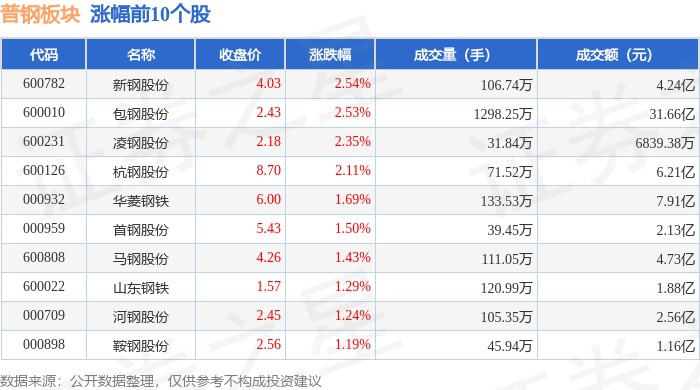
Group 1 - The steel sector saw an increase of 0.68% on January 21, with Xin Steel Co. leading the gains [1] - The Shanghai Composite Index closed at 4116.94, up 0.08%, while the Shenzhen Component Index closed at 14255.12, up 0.7% [1] - Key stocks in the steel sector showed various performance metrics, with Xin Steel Co. closing at 4.03, up 2.54%, and Baosteel Co. at 7.21, down 0.69% [1][2] Group 2 - The steel sector experienced a net inflow of 80.51 million yuan from main funds, while retail funds saw a net inflow of 52.64 million yuan [2] - Major stocks like Baosteel Co. had a significant net outflow from retail investors amounting to 76.84 million yuan, despite a net inflow of 81.51 million yuan from main funds [3] - The trading volume for key stocks varied, with Baosteel Co. recording a transaction amount of 684 million yuan, while Xin Steel Co. had a transaction amount of 424 million yuan [1][2]


普钢板块1月20日涨1.47%,新兴铸管领涨,主力资金净流出1.54亿元
Zheng Xing Xing Ye Ri Bao· 2026-01-20 08:51
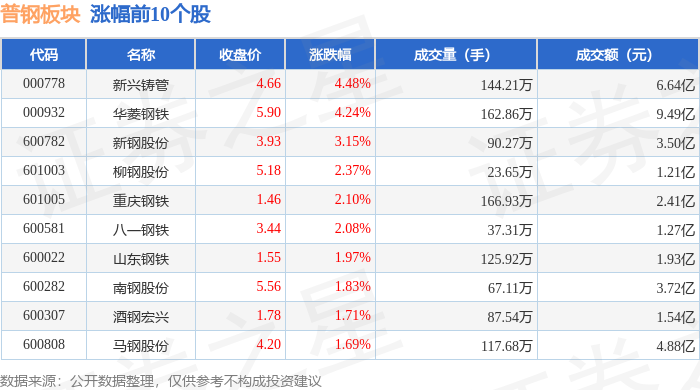
Core Viewpoint - The steel sector experienced a rise of 1.47% on January 20, with Xinxing Casting leading the gains, while the Shanghai Composite Index slightly declined by 0.01% [1]. Group 1: Market Performance - The Shanghai Composite Index closed at 4113.65, down 0.01% [1]. - The Shenzhen Component Index closed at 14155.63, down 0.97% [1]. - Xinxing Casting's stock price increased by 4.48% to 4.66, with a trading volume of 1.4421 million shares and a transaction value of 664 million [1]. Group 2: Individual Stock Performance - Hualing Steel's stock rose by 4.24% to 5.90, with a trading volume of 1.6286 million shares and a transaction value of 949 million [1]. - New Steel's stock increased by 3.15% to 3.93, with a trading volume of 0.9027 million shares and a transaction value of 350 million [1]. - Liugang's stock price rose by 2.37% to 5.18, with a trading volume of 0.2365 million shares and a transaction value of 121 million [1]. Group 3: Fund Flow Analysis - The steel sector saw a net outflow of 154 million from main funds, while retail investors contributed a net inflow of 1.6 billion [2]. - The main funds showed a net outflow of 52.18 million from Chongqing Steel, while retail investors had a net inflow of 2.68 million [3]. - Shandong Steel experienced a net inflow of 15.79 million from main funds, with a net outflow of 1.23 million from retail investors [3].


新钢股份涨2.10%,成交额2.00亿元,主力资金净流入320.09万元
Xin Lang Cai Jing· 2026-01-20 05:48
Core Viewpoint - New Steel Co., Ltd. has shown mixed performance in stock price and financial results, with a notable increase in net profit despite a decline in revenue [2][3]. Group 1: Stock Performance - On January 20, New Steel's stock price increased by 2.10%, reaching 3.89 CNY per share, with a trading volume of 200 million CNY and a turnover rate of 1.65%, resulting in a total market capitalization of 12.386 billion CNY [1]. - Year-to-date, New Steel's stock price has risen by 0.26%, with a decline of 0.51% over the last five trading days, a 1.04% increase over the last 20 days, and a 2.02% decrease over the last 60 days [1]. Group 2: Financial Performance - For the period from January to September 2025, New Steel reported operating revenue of 27.225 billion CNY, a year-on-year decrease of 12.68%, while net profit attributable to shareholders increased by 162.21% to 360 million CNY [2]. - The company has distributed a total of 5.584 billion CNY in dividends since its A-share listing, with 816 million CNY distributed over the past three years [3]. Group 3: Shareholder Structure - As of October 31, 2025, New Steel had 38,200 shareholders, with an average of 82,368 circulating shares per shareholder, showing no change from the previous period [2]. - The second-largest circulating shareholder is Hong Kong Central Clearing Limited, holding 83.8502 million shares, an increase of 49.8782 million shares from the previous period [3]. - New shareholders include Invesco Great Wall Jingsheng Dual Income Bond A (002065) and E Fund CSI Dividend ETF (515180), among others, indicating a shift in the shareholder base [3].
钢铁行业周度更新报告:铁矿库存创历史新高
GUOTAI HAITONG SECURITIES· 2026-01-19 13:25
Investment Rating - The report maintains an "Overweight" rating for the steel industry [5]. Core Insights - Demand is expected to gradually stabilize, while supply-side constraints are anticipated to continue, leading to a potential recovery in the steel industry's fundamentals [3][4]. - The report highlights that despite a long period of micro-profitability in the industry, market-driven supply adjustments have begun, and if supply policies are implemented, the pace of supply contraction may accelerate [3][4]. Summary by Sections Steel Market Overview - The apparent consumption of the five major steel products was 8.2612 million tons, a decrease of 1.77% week-on-week but an increase of 4.33% year-on-year [6]. - The total steel inventory was 12.47 million tons, down 0.55% week-on-week, maintaining a low level [6]. - The average profit margin for rebar was 199.4 CNY/ton, down 15.2 CNY/ton from the previous week [6]. Production and Capacity Utilization - The production of five major steel products was 8.192 million tons, a slight increase of 0.08% week-on-week [6]. - The operating rate of blast furnaces in 247 steel mills was 78.84%, down 0.47 percentage points from the previous week [6][29]. - The capacity utilization rate for these mills was 85.48%, down 0.56 percentage points week-on-week [6][29]. Raw Material Prices - Iron ore spot prices remained unchanged, while futures prices decreased by 0.31% to 812 CNY/ton [48]. - The port inventory of iron ore rose to 165.55 million tons, an increase of 1.72% [52]. - The total shipment volume from major iron ore producers decreased, with Brazil's shipments down 7.37% and Australia's down 2.29% [53][61]. Recommendations - The report recommends focusing on companies with leading technology and product structures, such as Baosteel and Hesteel, as well as those with competitive advantages like CITIC Special Steel and Yongjin Materials [6].




钢铁行业周度更新报告:铁矿库存创历史新高-20260119
GUOTAI HAITONG SECURITIES· 2026-01-19 12:32
Investment Rating - The report maintains an "Overweight" rating for the steel industry [6]. Core Insights - Demand is expected to gradually stabilize, while supply-side constraints are anticipated to continue, leading to a potential recovery in the steel industry's fundamentals [3][4]. - The report highlights that despite a long period of micro-profitability in the industry, market-driven supply adjustments have begun, which could accelerate the industry's upward progress if supply policies are implemented [3][4]. Summary by Sections Steel Market Overview - The apparent consumption of five major steel products was 8.2612 million tons, a decrease of 1.77% week-on-week but an increase of 4.33% year-on-year [6][20]. - Total steel inventory was 12.47 million tons, down 0.55% week-on-week, maintaining a low level [6][12]. - The average profit margin for rebar was 199.4 CNY/ton, down 15.2 CNY/ton from the previous week [6][41]. Production and Capacity Utilization - The operating rate of blast furnaces in 247 steel mills was 78.84%, a decrease of 0.47 percentage points from the previous week [6][29]. - The capacity utilization rate for these mills was 85.48%, down 0.56 percentage points week-on-week [6][29]. - The total steel production was 8.1921 million tons, a slight increase of 0.08% week-on-week [6][40]. Raw Materials - Iron ore inventory at ports reached 165.55 million tons, an increase of 1.72% week-on-week, marking a historical high [6][52]. - The spot price of iron ore remained unchanged, while futures prices decreased slightly [6][48]. - The total shipment volume of the four major iron ore producers decreased, with Brazil's shipments down 7.37% and Australia's down 2.29% [6][53][61]. Investment Recommendations - The report recommends focusing on companies with leading technology and product structures, such as Baosteel and Hualing Steel, as well as low-cost firms like Fangda Special Steel and New Steel [6]. - It also highlights the potential of upstream resource companies like Hebei Resources and Erdos, which may benefit from a recovery in demand [6].
钢铁12月数据跟踪:需求前高后低,材钢比持续扩大
GOLDEN SUN SECURITIES· 2026-01-19 12:24
Investment Rating - The report maintains a "Buy" rating for key steel companies, indicating a positive outlook for their stock performance in the coming months [10]. Core Insights - The steel industry has experienced a fluctuating demand pattern, with a peak in early 2025 followed by a decline, leading to an increase in the material-to-steel ratio, which reached 1.69 in December [2]. - China's apparent steel consumption grew by 2.9% year-on-year in 2025, although December saw a 5.0% decline compared to the previous year [2]. - The net export of steel in 2025 reached 11.296 million tons, a year-on-year increase of 8.7%, driven by strong exports in the automotive and home appliance sectors [3]. - The report highlights a shift in economic drivers from investment to consumption, with fixed asset investment declining by 3.8% year-on-year, while retail sales increased by 3.7% [2]. Summary by Sections Steel Production and Consumption - In December 2025, crude steel production was 68.18 million tons, a 10.3% year-on-year decrease, with an annual total of 960.81 million tons, down 4.4% [6]. - Steel production in December was 115.31 million tons, a 3.8% year-on-year decrease, while the annual total was 1,446.12 million tons, up 3.1% [6]. Export and Import Dynamics - December steel exports were 11.30 million tons, up 16.2% year-on-year, with total exports for the year at 11.902 million tons, a 7.5% increase [6]. - Steel imports in December were 520,000 tons, down 16.3% year-on-year, with total imports for the year at 6.06 million tons, down 11.1% [6]. Economic Context and Policy Implications - The report notes that the Chinese economy is transitioning to a more stable phase, with GDP growth projected at 5% for 2025, reflecting a pattern of high demand followed by a decline [2]. - Recent structural interest rate cuts by the central bank are expected to support credit flow to specific industries, indicating a potential for economic stabilization [8]. - The valuation of the steel sector has improved, moving from absolute undervaluation to a moderately low position, suggesting room for further gains [8]. Recommended Stocks - The report recommends several stocks, including: - Hualing Steel (华菱钢铁) [10] - Nanjing Steel (南钢股份) [10] - Baosteel (宝钢股份) [10] - New Steel (新钢股份) [10] - Jiuli Special Materials (久立特材) [10] - Yongjin Co., Ltd. (甬金股份) [10] - Changbao Steel (常宝股份) [10]


12月数据跟踪:需求前高后低,材钢比持续扩大
GOLDEN SUN SECURITIES· 2026-01-19 12:02
Investment Rating - The report assigns a "Buy" rating for several steel companies, including Xining Steel, Hualing Steel, Nanjing Steel, and Baosteel, indicating a positive outlook for their stock performance in the coming months [10]. Core Insights - The steel industry has experienced a fluctuating demand pattern, with a peak in early 2025 followed by a decline. The material-to-steel ratio has reached a new high of 1.69 in December, with an annual average of 1.51, suggesting a shift in consumption patterns [2]. - China's apparent steel consumption increased by 2.9% year-on-year in 2025, although December saw a decline of 5.0% compared to the previous year. The economic growth rate is projected to be 5% for 2025, with a quarterly breakdown showing a decreasing trend [2]. - The net export of steel reached 11.296 million tons in 2025, a year-on-year increase of 8.7%, driven by strong demand in the automotive and home appliance sectors. Exports to ASEAN countries have significantly increased, despite a decline in exports to the U.S. [3]. Summary by Sections Production and Consumption - In December 2025, crude steel production was 68.18 million tons, a decrease of 10.3% year-on-year, while the total for the year was 960.81 million tons, down 4.4%. Steel production in December was 115.31 million tons, down 3.8% year-on-year, with an annual total of 1,446.12 million tons, up 3.1% [6]. - The apparent consumption of steel in China is expected to be more accurately estimated by using steel production growth rates instead of crude steel production growth rates [2]. Economic Indicators - Fixed asset investment in 2025 is projected to be 48.5186 trillion yuan, a decrease of 3.8% from the previous year, while retail sales of consumer goods are expected to grow by 3.7% [2]. - The report highlights a transition from investment-driven growth to consumption-driven growth as China's economy matures [2]. Market Outlook - The recent structural interest rate cuts by the central bank are expected to support credit growth in specific sectors, indicating a potential for economic stabilization. The steel sector's valuation has improved, moving from absolute undervaluation to a moderately low position, suggesting room for further gains [8]. - Recommended stocks include Hualing Steel, Nanjing Steel, Baosteel, and others, which are expected to benefit from various economic cycles and trends [8].

普钢板块1月19日涨0.82%,南钢股份领涨,主力资金净流出1.79亿元
Zheng Xing Xing Ye Ri Bao· 2026-01-19 08:52
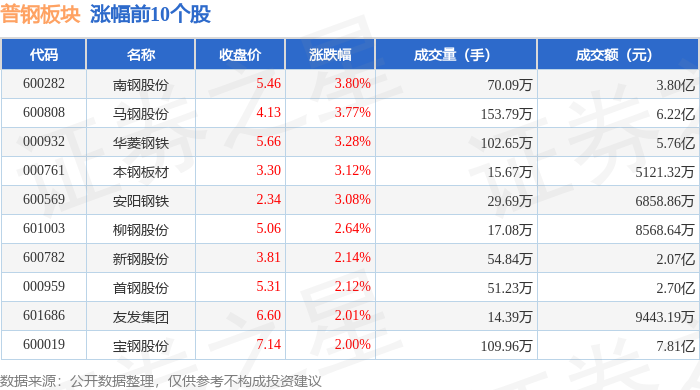
Market Performance - The steel sector saw an increase of 0.82% on January 19, with Nanjing Steel leading the gains [1] - The Shanghai Composite Index closed at 4114.0, up 0.29%, while the Shenzhen Component Index closed at 14294.05, up 0.09% [1] Individual Stock Performance - Nanjing Steel (600282) closed at 5.46, up 3.80% with a trading volume of 700,900 shares and a transaction value of 380 million yuan [1] - Other notable performers included: - Sijiang Steel (600808) at 4.13, up 3.77% with a transaction value of 622 million yuan [1] - Hualing Steel (000932) at 5.66, up 3.28% with a transaction value of 576 million yuan [1] - Benxi Steel (000761) at 3.30, up 3.12% with a transaction value of 51.21 million yuan [1] Capital Flow Analysis - The steel sector experienced a net outflow of 179 million yuan from main funds, while retail investors saw a net inflow of 176 million yuan [2] - Notable capital flows included: - Sijiang Steel had a main fund net inflow of 84.80 million yuan, but a retail net outflow of 76.47 million yuan [3] - Hualing Steel had a main fund net inflow of 40.99 million yuan, with a retail net inflow of 0.78 million yuan [3]


新钢股份涨2.14%,成交额1.67亿元,主力资金净流入843.12万元
Xin Lang Cai Jing· 2026-01-19 06:48
Core Viewpoint - New Steel Co., Ltd. has shown fluctuations in stock performance, with a recent increase of 2.14% in share price, but a year-to-date decline of 1.80% [1] Financial Performance - For the period from January to September 2025, New Steel reported operating revenue of 27.225 billion yuan, a year-on-year decrease of 12.68%, while net profit attributable to shareholders increased by 162.21% to 360 million yuan [2] Shareholder Information - As of October 31, 2025, the number of shareholders for New Steel is 38,200, with an average of 82,368 circulating shares per shareholder, both figures remaining unchanged from the previous period [2] - The company has distributed a total of 5.584 billion yuan in dividends since its A-share listing, with 816 million yuan distributed over the last three years [3] Major Shareholders - As of September 30, 2025, the second-largest circulating shareholder is Hong Kong Central Clearing Limited, holding 83.8502 million shares, an increase of 49.8782 million shares from the previous period [3] - New shareholders include Invesco Great Wall Jing Sheng Dual Income Bond A (002065) and E Fund CSI Dividend ETF (515180), among others, indicating a shift in the shareholder base [3]