
Bank Of Jiangsu(600919)

Search documents
“稳进变”加持优等生,江苏银行三季报彰显硬实力
第一财经· 2025-10-30 10:13
Core Viewpoint - Jiangsu Bank has made significant progress in its high-quality development journey by focusing on a stable risk control system, simultaneous growth in scale and efficiency, and innovative management practices [1] Financial Performance - For the third quarter of 2025, Jiangsu Bank reported operating income of 67.183 billion yuan, a year-on-year increase of 7.83%, and net profit attributable to shareholders of 30.583 billion yuan, up 8.32% year-on-year [3] - The annualized ROE was 15.87% and annualized ROA was 0.96%, with a non-performing loan ratio of 0.84%, marking a historical low [3] - The bank's risk coverage ratio stood at 322.62%, indicating strong risk mitigation capabilities [3] Revenue Composition - Jiangsu Bank achieved net interest income of 49.868 billion yuan, a year-on-year increase of 19.61%, and fee and commission income of 5.421 billion yuan, up 7.88% [4] - The bank's total assets reached 4.93 trillion yuan, with loan balances of 2.47 trillion yuan (up 17.87% year-to-date) and deposit balances of 2.54 trillion yuan (up 20.22% year-to-date) [4] Corporate Lending Growth - As of September, corporate loan balances reached 1.6641 trillion yuan, a year-on-year increase of 26.26%, while corporate deposit balances were 1.4028 trillion yuan, up 20.75% [7] - Jiangsu Bank is committed to enhancing financial services in key areas such as technology, green finance, and inclusive finance [8] Retail Banking Development - Jiangsu Bank's retail assets under management (AUM) surpassed 1.6 trillion yuan, with an increase of nearly 200 billion yuan, leading among city commercial banks [11] - The bank's subsidiary, Su Yin Wealth Management, has assets exceeding 800 billion yuan, maintaining its position as the top wealth management subsidiary among city commercial banks [11] Asset Quality and Risk Management - Jiangsu Bank's non-performing loan ratio was 0.84%, down 0.05 percentage points from the beginning of the year, reflecting a consistent improvement in asset quality [13][14] - The bank has implemented reforms in its risk management system, enhancing its risk control capabilities [14] Market Position and Recognition - Jiangsu Bank has gained significant attention in the capital market, with nearly 70 research reports published by analysts this year [16] - The bank ranked 56th in the "Global 1000 Banks" list, improving by 10 positions from the previous year, and was ranked 162nd in the "Fortune" China 500 list [16]


江苏银行(600919) - 江苏银行关于召开2025年第二次临时股东大会的通知
2025-10-30 10:01
证券代码:600919 证券简称:江苏银行 公告编号:2025-037 优先股代码:360026 优先股简称:苏银优 1 江苏银行股份有限公司 关于召开2025年第二次临时股东大会的通知 本公司董事会及全体董事保证本公告内容不存在任何虚假记载、误导性陈述 或者重大遗漏,并对其内容的真实性、准确性和完整性承担法律责任。 重要内容提示: (四) 现场会议召开的日期、时间和地点 召开的日期时间:2025 年 11 月 17 日 14 点 30 分 召开地点:南京市秦淮区中华路 26 号江苏银行总部大厦 4 楼大会议室 (五) 网络投票的系统、起止日期和投票时间。 网络投票系统:上海证券交易所股东大会网络投票系统 网络投票起止时间:自2025 年 11 月 17 日 一、 召开会议的基本情况 (一) 股东大会类型和届次 2025年第二次临时股东大会 (二) 股东大会召集人:董事会 (三) 投票方式:本次股东大会所采用的表决方式是现场投票和网络投票 相结合的方式 至2025 年 11 月 17 日 采用上海证券交易所网络投票系统,通过交易系统投票平台的投票时间为股 东大会召开当日的交易时间段,即 9:15-9:25,9 ...
江苏银行(600919) - 江苏银行监事会决议公告
2025-10-30 10:00
证券代码:600919 证券简称:江苏银行 公告编号:2025-036 优先股代码:360026 优先股简称:苏银优 1 江苏银行股份有限公司监事会决议公告 本公司监事会及全体监事保证本公告内容不存在任何虚假记载、 误导性陈述或者重大遗漏,并对其内容的真实性、准确性和完整性承 担个别及连带责任。 二、关于江苏银行股份有限公司不再设立监事会相关事项的议案 - 1 - 表决结果:同意 9 票,反对 0 票,弃权 0 票。 三、关于修改江苏银行股份有限公司章程的议案 表决结果:同意 9 票,反对 0 票,弃权 0 票。 江苏银行股份有限公司(以下简称"公司")第六届监事会第十 四次会议通知于2025年10月20日以电子邮件方式发出,会议于2025 年 10 月 30 日以现场加视频方式召开。本次会议应参与表决监事 9 名, 实际参与表决监事 9 名。会议符合《公司法》等法律法规及公司章程 的有关规定,表决所形成的决议合法、有效。 会议由季金松监事长主持,审议通过以下议案: 一、关于江苏银行股份有限公司 2025 年第三季度报告的议案 监事会认为: 1.本公司 2025 年第三季度报告的编制和审议程序符合法律、法 规 ...
江苏银行(600919) - 江苏银行董事会决议公告
2025-10-30 09:59
证券代码:600919 证券简称:江苏银行 公告编号:2025-035 优先股代码:360026 优先股简称:苏银优 1 江苏银行股份有限公司董事会决议公告 本公司董事会及全体董事保证本公告内容不存在任何虚假记载、 误导性陈述或者重大遗漏,并对其内容的真实性、准确性和完整性承 担个别及连带责任。 江苏银行股份有限公司(以下简称"公司")第六届董事会第二 十二次会议通知于 2025 年 10 月 20 日以电子邮件方式发出,会议于 2025 年 10 月 30 日在公司以现场和视频方式召开。本次会议应参与 表决董事 15 名,实际参与表决董事 15 名,监事及高级管理人员列席 会议。会议符合《公司法》等法律法规及公司章程的有关规定,表决 所形成的决议合法、有效。 会议由公司董事长葛仁余先生主持,审议通过以下议案: 一、关于江苏银行股份有限公司 2025 年三季度行长工作报告的 议案 表决结果:同意 15 票,反对 0 票,弃权 0 票。 二、关于江苏银行股份有限公司 2025 年第三季度报告的议案 表决结果:同意 15 票,反对 0 票,弃权 0 票。 本议案已经公司董事会审计委员会事前认可。 三、关于江苏银行 ...
江苏银行(600919) - 2025 Q3 - 季度财报
2025-10-30 09:30
Financial Performance - Operating revenue for Q3 2025 reached CNY 22,318,509, an increase of 7.93% compared to the same period last year[5] - Net profit attributable to shareholders for Q3 2025 was CNY 10,344,229, reflecting an 8.84% year-on-year growth[5] - Net profit excluding non-recurring items for Q3 2025 was CNY 10,329,059, up 9.32% from the previous year[5] - The company reported a year-on-year growth of 7.83% in operating income, totaling CNY 67.183 billion[16] - Net profit attributable to shareholders of the parent company was CNY 30.58 billion, representing a 8.3% increase from CNY 28.23 billion in the previous year[33] - The company reported a total comprehensive income of CNY 28.26 billion, down from CNY 32.48 billion year-on-year[34] Assets and Liabilities - Total assets as of the end of Q3 2025 amounted to CNY 4,927,496,856, representing a 24.68% increase from the end of the previous year[5] - Total assets reached CNY 4.93 trillion, an increase of 24.68% compared to the beginning of the year[16] - Total liabilities increased to CNY 4.58 billion from CNY 3.64 billion, reflecting a growth of 25.9%[31] - Total equity attributable to shareholders of the parent company reached CNY 335.09 billion, up from CNY 303.59 billion, marking a 10.4% increase[31] Cash Flow - Net cash flow from operating activities for Q3 2025 surged to CNY 88,909,308, a significant increase of 183.79% year-on-year[5] - Cash flow from operating activities generated a net amount of CNY 401.95 billion, a significant recovery from a negative cash flow of CNY 4.11 billion in the same period last year[36] Loans and Deposits - Total deposits reached CNY 2,543,639,762, marking a 20.22% increase compared to the end of last year[5] - Total loans stood at CNY 2,469,584,220, which is a 17.87% increase from the previous year[5] - Total loans amounted to CNY 2.469 trillion, with 97.88% classified as normal loans[25] Profitability Ratios - The weighted average return on equity (annualized) decreased by 0.64 percentage points to 16.04%[5] - The cost-to-income ratio for the reporting period was 21.50%, compared to 20.17% in the same period last year[28] - Non-performing loan ratio improved to 0.84%, down 0.05 percentage points from the beginning of the year[16] Other Key Metrics - Interest income was CNY 49.868 billion, up 19.61% year-on-year[16] - Net interest income rose to CNY 49.87 billion, up 19.8% from CNY 41.69 billion year-on-year[33] - Basic earnings per share increased to CNY 1.59, compared to CNY 1.50 in the previous year[34] Strategic Developments - The company acquired Ningbo Jiangbei Fumin Village Bank, resulting in the recognition of goodwill for the first time[9] - The company plans to continue expanding its market presence and investing in new technologies to enhance growth prospects[33]
江苏银行:第三季度归母净利润103.44亿元,同比增长8.84%
Xin Lang Cai Jing· 2025-10-30 09:21
Core Viewpoint - Jiangsu Bank reported a year-on-year increase in operating income and net profit for the third quarter of 2025, indicating strong financial performance and growth potential [1] Financial Performance - For Q3 2025, the operating income reached 22.319 billion yuan, representing a year-on-year growth of 7.93% [1] - The net profit attributable to shareholders was 10.344 billion yuan, showing an increase of 8.84% year-on-year [1] - Basic earnings per share for Q3 2025 were 0.55 yuan [1] Year-to-Date Performance - For the first three quarters of 2025, the total operating income amounted to 67.183 billion yuan, with a year-on-year growth of 7.83% [1] - The net profit attributable to shareholders for the first three quarters was 30.583 billion yuan, reflecting an 8.32% year-on-year increase [1] - Basic earnings per share for the first three quarters were 1.59 yuan [1]
城商行板块10月30日涨0.16%,青岛银行领涨,主力资金净流出5851.22万元
Zheng Xing Xing Ye Ri Bao· 2025-10-30 08:40
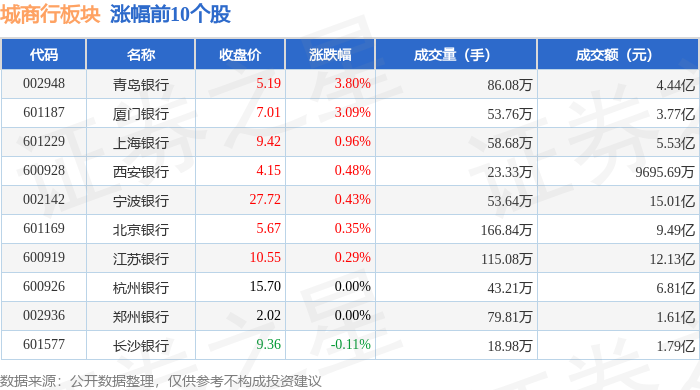
Market Overview - The city commercial bank sector rose by 0.16% on October 30, with Qingdao Bank leading the gains [1] - The Shanghai Composite Index closed at 3986.9, down 0.73%, while the Shenzhen Component Index closed at 13532.13, down 1.16% [1] Individual Stock Performance - Qingdao Bank (002948) closed at 5.19, up 3.80% with a trading volume of 860,800 shares and a turnover of 444 million yuan [1] - Xiamen Bank (601187) closed at 7.01, up 3.09% with a trading volume of 537,600 shares and a turnover of 377 million yuan [1] - Shanghai Bank (601229) closed at 9.42, up 0.96% with a trading volume of 586,800 shares and a turnover of 553 million yuan [1] - Other notable performances include Ningbo Bank (002142) at 27.72, up 0.43%, and Beijing Bank (601169) at 5.67, up 0.35% [1] Capital Flow Analysis - The city commercial bank sector experienced a net outflow of 58.51 million yuan from institutional investors, while retail investors saw a net outflow of 150 million yuan [2] - Conversely, speculative funds recorded a net inflow of 209 million yuan [2] Detailed Capital Flow for Selected Banks - Jiangsu Bank (600919) had a net inflow of 79.4 million yuan from institutional investors, while retail investors experienced a net outflow of 129 million yuan [3] - Qingdao Bank (002948) saw a net inflow of 70.3 million yuan from institutional investors but a net outflow of 31.9 million yuan from speculative funds [3] - Shanghai Bank (601229) had a net inflow of 44.9 million yuan from institutional investors, with retail investors seeing a net outflow of 46.8 million yuan [3]

银行视角十五五规划建议稿解读:金融强国目标不变,兼顾发展与安全
Yin He Zheng Quan· 2025-10-29 12:55
Investment Rating - The report suggests a positive outlook for the banking industry, indicating a shift from homogeneous competition to differentiated development, which opens up new business opportunities [4]. Core Insights - The report emphasizes the goal of building a modern financial system that balances resilience, efficiency, inclusiveness, and security, aligning with the high-quality development needs of the economy [4]. - It highlights the importance of enhancing the central bank's role in macroeconomic regulation and financial stability, with a focus on preventing systemic financial risks [4]. - The report identifies five key areas for financial supply-side structural reform: technology finance, green finance, inclusive finance, pension finance, and digital finance, which are seen as major sources of new business for banks [4]. - It discusses the need for banks to transform their operating models, particularly in technology finance, and to address challenges such as product homogeneity and risk management [4]. - The report notes that regulatory constraints will remain strict, with an emphasis on risk prevention and resolution, particularly in key areas like real estate and local debt [4]. Summary by Sections Central Bank and Macro-Prudential Management - The report advocates for a robust macro-prudential management framework to mitigate systemic risks and enhance the central bank's regulatory capabilities [4]. Financial Supply-Side Structural Reform - The focus is on developing various financial sectors to guide resources to critical areas, fostering new productive forces and expanding credit opportunities [4]. Differentiated Development of Banks - Different types of banks are encouraged to adopt tailored strategies, with state-owned banks focusing on national strategies and regional banks serving local economies [4]. Regulatory Environment - The report anticipates stricter and more efficient regulatory measures, with an emphasis on the application of regulatory technology and accelerated financial legislation [4]. Investment Recommendations - The report recommends specific banks for investment, including Industrial and Commercial Bank of China, Agricultural Bank of China, Postal Savings Bank of China, Jiangsu Bank, Hangzhou Bank, and China Merchants Bank, highlighting their potential for recovery and transformation [4].





公募单季盈利首破2万亿,4000点关口有何调仓伏笔?
Di Yi Cai Jing Zi Xun· 2025-10-29 12:40
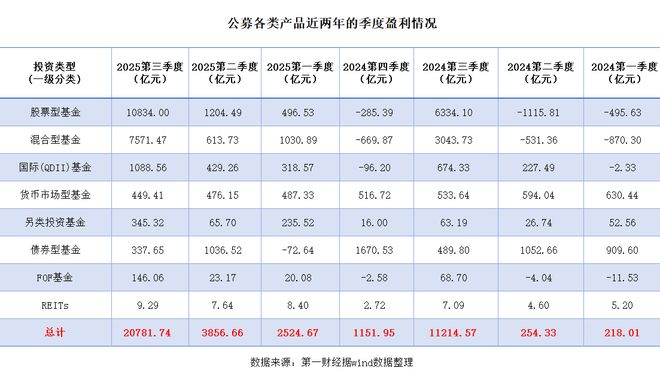
Core Insights - The public fund industry has achieved a record profit of over 2 trillion yuan in Q3, marking a historical peak for a single quarter [2][3] - Active equity products have shown a strong comeback, with the profit gap between active and passive index products narrowing significantly, indicating a more balanced market driving pattern [1][3] Group 1: Fund Performance - In Q3, the total profit of public funds reached 2.08 trillion yuan, a more than fourfold increase from the previous quarter's 385.67 billion yuan and over 80% growth compared to the same period last year [2][3] - The industry has now recorded profits for seven consecutive quarters, with cumulative profits for the year reaching 2.72 trillion yuan, surpassing the previous record of nearly 2 trillion yuan in 2020 [3][4] Group 2: Product Performance - Equity products, which are most correlated with the stock market, contributed significantly to profits, with Q3 profits amounting to 1.84 trillion yuan, accounting for nearly 90% of the industry's total profit [3][4] - Active equity products reported cumulative profits of 1.07 trillion yuan in the first three quarters, a fivefold increase year-on-year, while passive index products made 1.09 trillion yuan, a 140% increase [4] Group 3: Stock Holdings - By the end of Q3, public funds held a total of 3,108 stocks, a decrease of 49 from the previous quarter, indicating a slight increase in holding concentration [6] - Notable changes in major holdings included an increase in the number of funds holding Ningde Times, while Guizhou Moutai saw a decrease in holdings [7][8] Group 4: Market Outlook - The A-share market is experiencing a slow bull trend, with key sectors including the AI industry chain and sectors benefiting from domestic policies expected to drive future market performance [10][11] - Fund managers are optimistic about the market's recovery, with a focus on undervalued stocks and sectors that may benefit from economic improvements [11][12]




银行行业今日跌1.98%,主力资金净流出20.90亿元
Zheng Quan Shi Bao Wang· 2025-10-29 09:03
Market Overview - The Shanghai Composite Index rose by 0.70% on October 29, with 24 out of 31 sectors experiencing gains, led by the power equipment and non-ferrous metals sectors, which increased by 4.79% and 4.28% respectively [1] - The banking and food & beverage sectors were the biggest losers, declining by 1.98% and 0.56% respectively, with the banking sector taking the lead in losses [1] Capital Flow - The net inflow of capital in the two markets was 5.406 billion yuan, with 12 sectors seeing net inflows. The power equipment sector had the highest net inflow of 16.132 billion yuan, followed by the non-ferrous metals sector with 5.997 billion yuan [1] - Conversely, 19 sectors experienced net outflows, with the electronics sector leading with a net outflow of 6.540 billion yuan, followed by the communications sector with 4.736 billion yuan [1] Banking Sector Performance - The banking sector saw a decline of 1.98%, with a net outflow of 2.090 billion yuan. Out of 42 stocks in this sector, only one stock rose while 39 stocks fell [2] - Among the banking stocks, China Bank had the highest net inflow of 299 million yuan, followed by CITIC Bank and Nanjing Bank with net inflows of 111 million yuan and 81.076 million yuan respectively [2] - The stocks with the largest net outflows included China Merchants Bank, Minsheng Bank, and Jiangsu Bank, with net outflows of 773 million yuan, 418 million yuan, and 241 million yuan respectively [2]



