
HZBank(600926)

Search documents
城商行板块12月12日跌0.23%,杭州银行领跌,主力资金净流出908.98万元
Zheng Xing Xing Ye Ri Bao· 2025-12-12 09:12
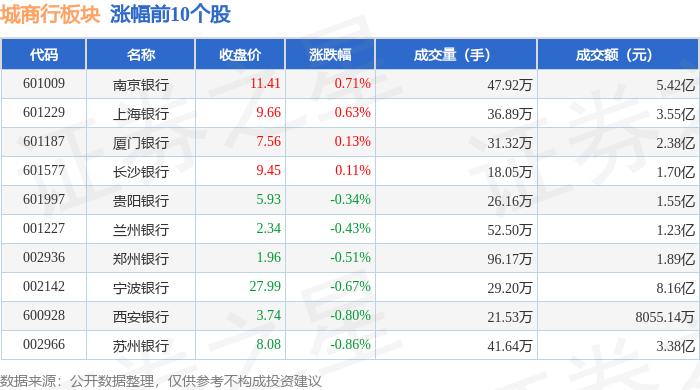
Core Points - The city commercial bank sector experienced a decline of 0.23% on December 12, with Hangzhou Bank leading the drop [1] - The Shanghai Composite Index closed at 3889.35, up 0.41%, while the Shenzhen Component Index closed at 13258.33, up 0.84% [1] Summary by Category Stock Performance - Hangzhou Bank closed at 15.12, down 0.92% with a trading volume of 543,600 shares and a transaction value of 824 million yuan [2] - Qilu Bank closed at 5.63, down 0.71% with a trading volume of 1,165,000 shares and a transaction value of 657 million yuan [2] - Qingdao Bank closed at 4.58, down 0.65% with a trading volume of 370,100 shares and a transaction value of 169 million yuan [2] - Chongqing Bank closed at 10.84, down 0.64% with a trading volume of 118,200 shares and a transaction value of 129 million yuan [2] - Chengdu Bank closed at 16.35, down 0.49% with a trading volume of 390,900 shares and a transaction value of 642 million yuan [2] - Lanzhou Bank closed at 2.32, down 0.43% with a trading volume of 529,700 shares and a transaction value of 123 million yuan [2] - Xiamen Bank closed at 7.56, down 0.26% with a trading volume of 358,000 shares and a transaction value of 270 million yuan [2] - Ningbo Bank closed at 27.72, down 0.25% with a trading volume of 215,400 shares and a transaction value of 596 million yuan [2] - Changsha Bank closed at 9.48, down 0.21% with a trading volume of 321,800 shares and a transaction value of 306 million yuan [2] - Jiangsu Bank closed at 10.39, down 0.19% with a trading volume of 1,989,400 shares and a transaction value of 2.066 billion yuan [2] Capital Flow - The city commercial bank sector saw a net outflow of 9.0898 million yuan from institutional investors, while retail investors contributed a net inflow of 230 million yuan [4] - Speculative funds experienced a net outflow of 2.21 billion yuan [4]



17家上市银行四季度以来获308家机构调研
Zheng Quan Ri Bao· 2025-12-11 16:32
Core Viewpoint - The research interest in A-share listed banks is increasing as the year-end approaches, with a focus on city commercial banks and rural commercial banks, particularly in the Jiangsu, Zhejiang, and Shanghai regions [1][2] Group 1: Research Activity - As of December 11, 17 listed banks have been surveyed by 308 institutions, totaling 312 surveys since the beginning of the fourth quarter [1] - Hangzhou Bank has the highest number of research institutions at 46, followed closely by Ningbo Bank with 45 and Hu Nong Bank with 34 [2] - Ningbo Bank has been surveyed 49 times, significantly more than its peers, while Hangzhou Bank, Hu Nong Bank, and Qingdao Bank have all exceeded 30 surveys [2] Group 2: Key Focus Areas - The main topics of interest for institutions include the trends in net interest margin (NIM) and asset quality [4] - Institutions are particularly focused on banks' strategies for managing liability costs and optimizing interest-earning asset structures [4] - Many banks have reported signs of stabilization in NIM, with optimistic expectations for future trends [4] Group 3: Performance Insights - Hangzhou Bank expects its NIM to decline at a slower rate due to effective management of liability costs, with recent data showing stabilization in NIM from the second to the third quarter [4] - Suzhou Bank has reported a smaller decline in NIM compared to the industry average, supporting growth in net interest income [4] - Several banks, including Ningbo Bank and Jiangsu Bank, anticipate maintaining stable asset quality, with proactive measures to manage risks and optimize credit allocation [6]

为何他们这么早,就敢于押注“杭州六小龙”?
Jin Rong Shi Bao· 2025-12-11 07:53
Core Viewpoint - The article highlights the journey of Yundongchu, a robotics company, from a university lab to becoming a leader in the quadruped robot sector in China, emphasizing the role of financial support in its growth and innovation ecosystem [1][2]. Company Overview - Yundongchu, established in 2017, has achieved an 85% market share in the power inspection sector and over 90% in emergency firefighting, with operations in 34 provinces and 44 countries [1]. - The company faced significant challenges post-B round financing, including long order payment cycles and cash flow issues due to mismatched payment terms with suppliers [2]. Financial Support Mechanism - Hangzhou Bank provided a crucial 5 million yuan credit loan to Yundongchu, which was pivotal for the company's survival during tough times [2]. - The bank's approach involved assessing the company's technology and team reliability, akin to an investor's perspective, to ensure the company's sustainability [2]. Innovative Financing Models - The "Zheke United Loan" model was introduced to address the challenges of traditional bank lending, focusing on shared information, risk-sharing, resource complementarity, and policy coordination among banks [3][4]. - This model allows for higher credit limits for leading companies like Yundongchu, with loan ceilings exceeding 50 million yuan and up to 200 million yuan for star projects [4]. Broader Financial Ecosystem - Since the launch of the "Zheke United Loan," 27 banks in Zhejiang have participated, providing a total of 10.87 billion yuan in loans to 197 enterprises [5]. - The article discusses various regional initiatives across China aimed at enhancing financial support for technology and innovation, including the "Common Growth Plan" in Anhui and "Instrument Loans" in Jiangsu [7][8]. Future Directions - The financial landscape is evolving, with a shift from traditional lending to a more integrated approach that includes diverse financial products and services tailored to the needs of technology enterprises [10][11]. - The role of financial institutions is transforming from mere fund providers to partners in innovation, emphasizing the importance of collaboration between policy, finance, and technology [11].
杭州银行北京分行多措并举推进清廉金融文化建设
Bei Jing Shang Bao· 2025-12-10 11:53
Core Viewpoint - Hangzhou Bank Beijing Branch has implemented a series of integrity culture initiatives since 2025, focusing on building a "clean and honest" environment to support high-quality development [1][8]. Group 1: Integrity Culture Initiatives - The branch has created a "clean square" micro-territory to integrate integrity culture into daily operations, utilizing existing resources to enhance employee engagement [3][4]. - Interactive activities, such as voting on employee-created integrity stories, have been introduced to foster a sense of participation and connection to the integrity culture [3][4]. - The branch has transformed reading corners to include classic literature on integrity and anti-corruption, ensuring comprehensive coverage of integrity education [3]. Group 2: Targeted Integrity Education - The branch conducts tiered integrity education for different employee groups, including collective talks for new leaders and specialized training for new hires [5]. - New employees participate in immersive integrity courses that include case studies and interactive discussions, helping them understand the importance of integrity in their careers [5]. Group 3: Family and Community Engagement - The "Clean Wind and Trust" family letter reading activity extends integrity education into employees' family lives, receiving over 60 heartfelt letters that share personal stories of integrity [6]. - Employees are encouraged to share stories of integrity from their families, fostering a culture of integrity that transcends the workplace [6]. Group 4: Systematic Planning and Quality Improvement - The branch emphasizes systematic planning in its integrity initiatives, integrating disciplinary work into its overall development strategy [7]. - Key disciplinary measures are reinforced during important time periods, with a focus on preventing issues such as gift-giving and misuse of company resources [7]. Group 5: Impact on High-Quality Development - The integrity culture initiatives have begun to yield positive results, with new employees developing correct values and a strong sense of integrity permeating the workplace [8]. - The branch plans to continue enhancing the "clean square" initiative and expand integrity culture outreach to the community, aiming to solidify its role in supporting the financial sector's sustainable development [8].
探寻利率方向(4):从M2看2026年债市流动性
GF SECURITIES· 2025-12-10 11:48
Investment Rating - The report assigns a "Buy" rating for the banking sector, indicating an expectation that stock prices will outperform the market by more than 10% over the next 12 months [40]. Core Insights - The growth of M2 is primarily driven by government and corporate leverage, with government leverage's contribution increasing from 23.9% in 2015 to 45.5% in 2025, while corporate leverage is expected to contribute 63.6% to M2 growth in 2025 [5][14]. - The report highlights a divergence between the social financing (社融) and M2 growth rates, indicating a liquidity accumulation in the financial system when the demand for financing from the real economy is insufficient, which can lead to a decline in bond yields [5][19]. - The expected social financing-M2 differential for 2026 is projected to be 0.56%, with a quarter-on-quarter increase of 33 basis points [32]. Summary by Sections M2 and Liquidity Analysis - M2 includes cash, personal deposits, corporate deposits, non-bank deposits, and deposits from non-deposit financial institutions. The main contributors to M2 growth are government and corporate leverage [5][13]. - The report discusses the relationship between the social financing-M2 differential and bond market performance, noting a shift in correlation since the second half of 2022 [5][19]. Social Financing Projections - For 2026, the report forecasts a total of 16.3 trillion yuan in new loans under the social financing framework, with a growth rate of 8.11% [32][34]. - The report anticipates that the net issuance of government bonds will reach 14.8 trillion yuan in 2026, with a focus on maintaining a proactive fiscal policy [34]. M2 Growth Forecast - The M2 growth rate for 2026 is projected at 7.55%, influenced by factors such as net fiscal deposits, the strengthening of the equity market, and cross-border capital flows [32][36].




城商行板块12月10日跌0.73%,杭州银行领跌,主力资金净流出3.57亿元
Zheng Xing Xing Ye Ri Bao· 2025-12-10 09:10
Market Overview - The city commercial bank sector experienced a decline of 0.73% on December 10, with Hangzhou Bank leading the drop [1] - The Shanghai Composite Index closed at 3900.5, down 0.23%, while the Shenzhen Component Index closed at 13316.42, up 0.29% [1] Individual Stock Performance - Hangzhou Bank's stock price fell by 2.62% to 15.25, with a trading volume of 629,600 shares and a transaction value of 968 million [2] - Other notable declines include Qilu Bank down 2.23% to 5.69 and Chongqing Bank down 2.00% to 10.76 [2] - Conversely, Nanjing Bank and Shanghai Bank saw slight increases of 0.71% and 0.63%, respectively [1] Capital Flow Analysis - The city commercial bank sector saw a net outflow of 357 million from institutional investors, while retail investors contributed a net inflow of 207 million [2] - The capital flow data indicates that Shanghai Bank had a net inflow of 52.73 million from institutional investors, despite a net outflow from retail investors [3] - Hangzhou Bank recorded a net inflow of 10.66 million from institutional investors, but a significant outflow of 35.34 million from retail investors [3]


A股银行股普跌,招商银行跌3%
Ge Long Hui· 2025-12-10 03:53
Group 1 - The A-share market experienced a widespread decline in bank stocks, with China Merchants Bank falling by 3% [1] - Agricultural Bank of China, Qilu Bank, and Hangzhou Bank saw declines of over 2% [1] - Zhangjiagang Bank, Industrial Bank, Changshu Bank, and Bank of Communications each dropped nearly 2% [1]


岁末揽储战升温!部分银行逆势上调存款利率,行业净息差压力犹在
Xin Lang Cai Jing· 2025-12-10 01:15
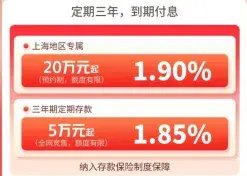
Group 1 - The banking deposit market is experiencing a "polarized" situation, with some banks raising deposit rates while national banks are generally lowering them [1][2] - Hangzhou Bank has increased its 3-year fixed deposit rate for new funds to 1.9% for deposits starting at 200,000 yuan, while Jilin Bank has launched a similar product with a rate 25 basis points higher than its standard rate [3][5] - Despite some banks raising rates, the overall trend in the banking sector is a decline in deposit rates, with many small and medium-sized banks reducing rates significantly since October [1][9] Group 2 - The pressure to attract deposits is particularly acute for smaller banks, which are using rate increases as a strategy to compete with larger banks [7][9] - Many of the high-rate products are region-specific and have conditions such as "new funds" or "specific customers," with minimum deposit amounts ranging from 1,000 yuan to 500,000 yuan [7][9] - The overall trend indicates that while some banks are temporarily raising rates, many are still engaged in a broader trend of lowering rates, particularly for long-term deposits [11][12] Group 3 - The net interest margin for commercial banks is under pressure, with the current average at 1.42%, indicating a need for banks to manage costs and stabilize margins [14][15] - Banks are expected to continue reducing deposit costs, but the pace of rate cuts may slow as rates are already low [16] - The adjustment of deposit products reflects a shift towards more sustainable and refined banking operations, with banks focusing on asset-liability management and differentiated services [16][17]
杭州银行股份有限公司关于优先股停牌的提示性公告
Shang Hai Zheng Quan Bao· 2025-12-09 20:15
登录新浪财经APP 搜索【信披】查看更多考评等级 证券代码:600926 证券简称:杭州银行 公告编号:2025-088 优先股代码:360027 优先股简称:杭银优1 杭州银行股份有限公司 关于优先股停牌的提示性公告 ● 证券停复牌情况:适用 本公司董事会及全体董事保证本公告内容不存在任何虚假记载、误导性陈述或者重大遗漏,并对其内容 的真实性、准确性和完整性承担法律责任。 重要内容提示: 因拟赎回"杭银优1"优先股,杭州银行股份有限公司(以下简称"公司")的相关证券停复牌情况如下: ■ 经公司董事会审议通过,并报国家金融监督管理总局浙江监管局审核无异议,公司拟于2025年12月15日 全额赎回公司于2017年12月15日非公开发行的1亿股优先股(以下简称"本次优先股")。 为保证公平信息披露,维护投资者利益,公司拟申请于2025年12月12日对本次优先股(优先股代码: 360027;优先股简称:杭银优1)停牌,并于2025年12月15日对本次优先股赎回注销。 特此公告。 杭州银行股份有限公司董事会 2025年12月10日 证券代码:600926 证券简称:杭州银行 公告编号:2025-087 优先股代码:3 ...
2025年国家开发银行


Shang Hai Zheng Quan Bao· 2025-12-09 18:53
Core Insights - The awards for financial bond underwriting and market-making have been announced, recognizing various banks and securities firms for their outstanding performance in the industry [1][2][3][4][5][6][7] Group 1: Outstanding Underwriters - The title of "Outstanding Underwriter" was awarded to several banks, including CITIC Bank, Shanghai Pudong Development Bank, and Industrial and Commercial Bank of China [1][2] - A total of 10 banks were recognized as "Excellent Underwriters," highlighting their contributions to the financial bond market [1] Group 2: Excellent Market Makers - The "Excellent Market Maker" category included firms such as Huatai Securities and CITIC Securities, showcasing their role in enhancing market liquidity [2][4] - A diverse range of banks, including Ping An Bank and Industrial Bank, were acknowledged for their market-making capabilities [2][4] Group 3: Special Awards - Special awards were given for various categories, including "Debt Sea Rising Award" and "Green Low Carbon Award," recognizing banks like Agricultural Bank of China and Postal Savings Bank of China for their innovative approaches [3] - The "Technology Innovation Award" was awarded to banks that demonstrated significant advancements in financial technology [3] Group 4: Individual Recognitions - Individual awards were presented to key personnel from various banks, such as CITIC Bank's Sun Wei and China Everbright Bank's Liu Yan, acknowledging their leadership in driving financial bond initiatives [4][5] - The "Outstanding Underwriting Supervisor" category highlighted individuals from major banks, emphasizing the importance of leadership in underwriting processes [5]