CNOOC(600938)

Search documents
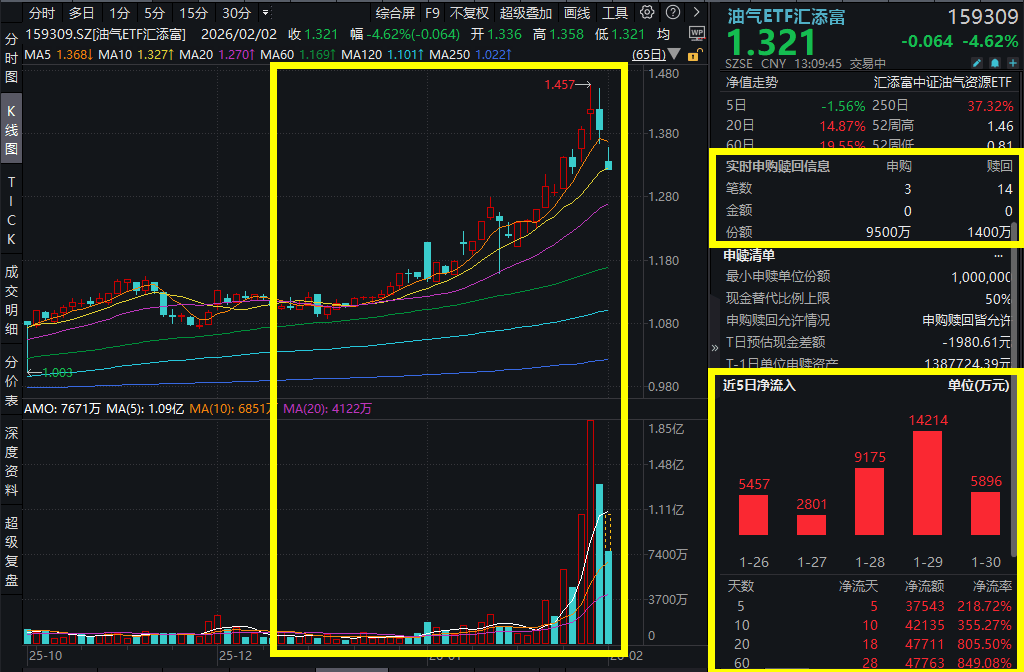
大宗商品集中宣泄,原油跌4.8%!中国海油大跌超4%!油气ETF汇添富(159309)资金逆势涌入超1亿元,连续15日吸金!“OPEC+”3月延续暂停增产
Sou Hu Cai Jing· 2026-02-02 05:45
Core Viewpoint - The A-share market is experiencing volatility and decline, particularly in the oil and gas sector, with significant net inflows into the oil and gas ETF Huatai-PineBridge (159309) despite the downturn [1][3]. Group 1: Market Performance - As of 13:22, the oil and gas ETF Huatai-PineBridge (159309) has dropped over 4%, with a net inflow of more than 106 million yuan during the day, marking a total of over 500 million yuan in inflows over the past 15 days [1]. - Major component stocks of the oil and gas ETF have mostly retreated, with Intercontinental Oil and Gas down over 9%, and China National Offshore Oil Corporation and China Petroleum down over 4% [3]. Group 2: Component Stocks - The top ten component stocks of the oil and gas ETF include: - Jerry Holdings (002353) up 1.71% - CNOOC (601857) down 3.54% - China Petroleum (600028) down 1.54% - Intercontinental Oil and Gas (600759) down 9.91% [4]. Group 3: Geopolitical and Supply Factors - Geopolitical risks have eased, with the U.S. indicating a positive relationship with Venezuela, potentially sharing oil revenues, and ongoing negotiations with Iran [5]. - OPEC+ members have agreed to maintain their production cut policies, with a commitment to market stability and low inventory levels [5]. Group 4: Industry Outlook - The medium to long-term outlook for the oil and gas industry remains positive, with expected exploration and development spending to maintain historical median levels from 2024 to 2030 [7]. - Key variables affecting the market include North American data center construction progress, OPEC+ production policies, and domestic policies on refining capacity [7]. Group 5: ETF Characteristics - The oil and gas ETF Huatai-PineBridge (159309) focuses on the oil and gas industry chain, including exploration, equipment, refining, and sales, emphasizing companies with quality reserves and low-cost advantages [8]. - The ETF has a streamlined sample size of 44 stocks, ensuring high purity with all top ten component stocks being leading oil and gas companies [8].





能源ETF广发(159945)开盘跌5.00%,重仓股中国神华跌0.67%,中国石油跌2.90%
Xin Lang Cai Jing· 2026-02-02 04:18
Group 1 - The Energy ETF Guangfa (159945) opened down 5.00%, trading at 1.253 yuan [1] - Major holdings in the Energy ETF Guangfa include China Shenhua down 0.67%, China Petroleum down 2.90%, China Petrochemical down 1.69%, Shaanxi Coal and Chemical down 1.66%, China National Offshore Oil down 4.70%, and others showing varied performance [1] - The performance benchmark for the Energy ETF Guangfa is the CSI All Share Energy Index, managed by Guangfa Fund Management Co., with a return of 31.88% since its inception on June 25, 2015, and a return of 11.60% over the past month [1]


油气ETF汇添富(159309)开盘跌3.54%,重仓股中国石油跌2.90%,中国海油跌4.70%
Xin Lang Cai Jing· 2026-02-02 04:09
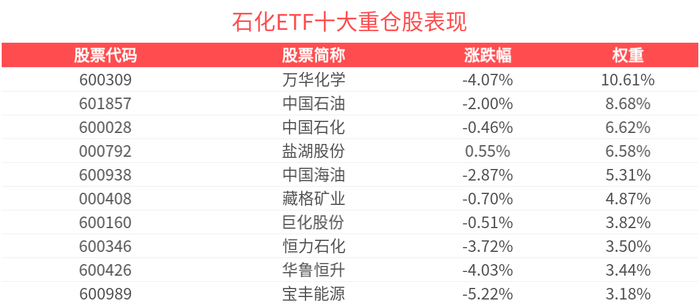
油气ETF汇添富(159309)业绩比较基准为中证油气资源指数收益率,管理人为汇添富基金管理股份有 限公司,基金经理为晏阳,成立(2024-05-31)以来回报为38.77%,近一个月回报为20.14%。 声明:市场有风险,投资需谨慎。本文基于第三方数据库自动发布,不代表新浪财经观点,任何在本文 出现的信息均只作为参考,不构成个人投资建议。如有出入请以实际公告为准。如有疑问,请联系 biz@staff.sina.com.cn。 2月2日,油气ETF汇添富(159309)开盘跌3.54%,报1.336元。油气ETF汇添富(159309)重仓股方 面,中国石油开盘跌2.90%,中国海油跌4.70%,中国石化跌1.69%,杰瑞股份涨6.74%,招商轮船跌 0.53%,广汇能源跌2.32%,中远海能跌0.95%,洲际油气跌9.91%,海油工程跌3.60%,招商南油跌 2.44%。 来源:新浪基金∞工作室 ...
“地缘冲突+极寒天气”推动油价单周涨超7%!油气ETF华泰柏瑞(561570)显著放量,获资金密集关注
Sou Hu Cai Jing· 2026-02-02 04:02
Group 1 - Oil and gas assets have performed well due to geopolitical tensions and extreme weather, with international oil prices significantly rising; WTI crude futures increased by 6.78% and Brent crude futures by 7.30% [1] - A rare winter storm in the U.S. Gulf Coast temporarily reduced crude oil production by approximately 2 million barrels per day, reinforcing expectations of short-term supply tightening and driving oil prices higher [1] - The National Bureau of Statistics reported that as of January 20, 2026, the price of liquefied petroleum gas (LPG) in circulation rose by 1.18% month-on-month, reaching 4482.2 yuan/ton, the highest since late September 2025 [1] Group 2 - The Huatai-PineBridge Oil and Gas ETF (561570) tracks the CSI Oil and Gas Industry Index, which includes 60 fundamentally strong A-share companies across various segments of the oil and gas industry, providing a convenient tool for investors to access the overall opportunities in the sector [2] - The ETF has attracted significant attention with continuous net inflows for six consecutive trading days, accumulating over 86 million yuan, and the average daily trading volume exceeding 33 million yuan, significantly higher than the levels seen in 2025 [2] - The fund manager, Huatai-PineBridge, is one of the first ETF managers in China, with a strong track record, and offers competitive fee structures to help investors minimize costs [2]

政策导向推动供给侧优化,龙头企业竞争优势凸显,石化ETF(159731)连续18天净流入
Xin Lang Cai Jing· 2026-02-02 02:28
Core Viewpoint - The petrochemical industry is experiencing fluctuations in stock performance, with significant policy changes expected to optimize supply-side dynamics and enhance the competitive advantages of leading enterprises [2]. Group 1: Market Performance - As of February 2, 2026, the China Securities Petrochemical Industry Index has decreased by 2.78%, with mixed performance among constituent stocks [1]. - The top-performing stock is Sanmei Co., which increased by 1.75%, while Luxi Chemical led the decline with an 8.18% drop [1]. - The Petrochemical ETF (159731) has fallen by 2.79%, with a latest price of 1.01 yuan and a turnover rate of 6.58% [1]. Group 2: Fund Flows and ETF Performance - The Petrochemical ETF has seen continuous net inflows over the past 18 days, with a peak single-day net inflow of 348 million yuan, totaling 1.351 billion yuan [1]. - As of January 30, 2026, the Petrochemical ETF's net value has increased by 69.05% over the past two years [2]. - The ETF has achieved a maximum monthly return of 15.86% since its inception, with the longest streak of monthly gains lasting 9 months and an average monthly return of 5.59% [2]. Group 3: Policy Impact - Recent government policies aimed at "decarbonization," "environmental protection," and "cancellation of export tax rebates" are expected to suppress low-level redundant construction and disorderly expansion in the chemical industry [2]. - The policies are part of a broader strategy to optimize supply-side dynamics and enhance the competitive advantages of leading enterprises in the petrochemical sector [2]. Group 4: Index Composition - As of January 30, 2026, the top ten weighted stocks in the China Securities Petrochemical Industry Index account for 55.71% of the index, with Wanhua Chemical and China Petroleum being the top two [2].



中国油气行业_ 聚焦深海勘探机遇与长期油价回升-China Oil and Gas Sector _Eyes on opportunities in deep-sea exploration and longer-term oil price recovery
2026-02-02 02:22
Summary of Key Points from the Conference Call Industry Overview - **Industry**: Oil and Gas Sector in China - **Focus**: Opportunities in deep-sea exploration and oil price recovery Core Insights 1. **Deep-Sea Exploration Growth**: The acceleration in the deep-sea exploration permitting framework in the US has attracted investor interest in deep-sea mining and oil & gas exploration. Notably, order intake for FPSOs has significantly increased, driven by deepwater and ultra-deepwater oilfield exploration in South America and Africa [2][2] 2. **Guyana's Oilfields**: The Stabroek oilfield in Guyana, developed by ExxonMobil (45%), Chevron (30%), and CNOOC (25%), is highlighted as a key area of growth. Four additional projects are under construction, with expected production ramp-ups leading to higher returns by 2030 [2][2] 3. **Oil Price Forecasts**: UBS has revised its oil price forecasts, lowering the 2026 estimate to US$62/bbl due to anticipated oversupply of 1.9Mb/d. However, a gradual recovery is expected as supply and demand improve [3][3] 4. **Impact of US Sanctions on Venezuela**: If US sanctions on Venezuela are lifted, production could recover to 1Mb/d, potentially increasing to 1.2-1.3Mb/d. This could exert additional pressure on the oil market in 2026, but the overall supply-demand dynamics are not expected to change significantly [4][4] Company-Specific Insights 1. **PetroChina and CNOOC Price Target Adjustments**: - PetroChina's price target raised to Rmb14.0/HK$11.5 from Rmb12.9/HK$10.3, reflecting a re-rating of the oil and chemical sector [5][5] - CNOOC's price target increased to HK$30.0 from HK$26.5, based on a higher EV/EBITDA multiple [5][5] 2. **Valuation Comparisons**: China's oil majors are trading at lower valuation multiples compared to their overseas peers, with an average 2026E PE/PBV of 11/1.0x versus 13/1.6x for global counterparts. This suggests potential upside for Chinese oil companies [5][5] Additional Insights 1. **Dividend Yield**: The average dividend yield for A+H shares of China's oil majors is projected at 5.2%, which is above the overseas peer average of 4.8% [5][5] 2. **Market Dynamics**: Teapot refineries in China, which typically import Venezuelan crude, may shift to cheaper alternatives like Russian crude, indicating a limited impact from potential Venezuelan oil supply increases [4][4] Conclusion - The oil and gas sector in China is poised for growth, particularly in deep-sea exploration, with favorable long-term price recovery expectations. Companies like PetroChina and CNOOC are well-positioned to benefit from these trends, despite short-term challenges related to oil supply dynamics and geopolitical factors.
石油化工行业周报(2026、1、26—2026、2、1):油价冲高反映地缘风险,中长期或回归基本面逻辑-20260201
Shenwan Hongyuan Securities· 2026-02-01 13:51
Investment Rating - The report maintains a positive outlook on the oil and petrochemical industry, indicating a "Buy" rating due to the current geopolitical risks and potential for price recovery in the medium to long term [1]. Core Insights - The report highlights that the recent surge in oil prices reflects geopolitical risk premiums, particularly due to ongoing tensions between the U.S. and Iran, which significantly impact global oil supply security [4][7]. - It is anticipated that oil prices will exhibit characteristics of being "geopolitically driven with fundamental support" around the Chinese New Year, with potential further increases if conflict expectations materialize [7]. - The medium to long-term outlook suggests a return to fundamental pricing logic as the oil supply-demand balance is expected to loosen, limiting upward price movement without sustained geopolitical conflict [7]. Summary by Sections Upstream Sector - As of January 30, Brent crude oil futures closed at $70.69 per barrel, a 7.30% increase from the previous week, while WTI futures rose by 6.78% to $65.21 per barrel [15]. - U.S. commercial crude oil inventories decreased to 424 million barrels, down 2.296 million barrels week-on-week, which is 3% lower than the five-year average [17]. - The report notes a trend of increasing oil service activity, with drilling day rates remaining stable despite low levels, indicating potential for future increases as global capital expenditures rise [15][35]. Refining Sector - The Singapore refining margin for major products fell to $9.40 per barrel, a decrease of $2.69 from the previous week [54]. - The report indicates that while refining profitability has improved, the current product price differentials remain low, with expectations for gradual improvement as economic recovery progresses [51]. Polyester Sector - The report observes an increase in PTA profitability, with prices rising to 5,271.4 CNY per ton, a 4.66% increase week-on-week [1]. - The overall performance of the polyester industry is deemed average, with a need to monitor demand changes closely [1]. Investment Recommendations - The report recommends focusing on high-quality companies in the polyester sector, such as Tongkun Co. and Wankai New Materials, as well as large refining companies like Hengli Petrochemical and Rongsheng Petrochemical due to expected improvements in cost structures and competitive advantages [1][10]. - It also suggests maintaining a neutral outlook on oil companies, with a focus on those offering high dividend yields, such as China National Petroleum and China National Offshore Oil [10].


石油化工行业周报(2026/1/26—2026/2/1):油价冲高反映地缘风险,中长期或回归基本面逻辑-20260201
Shenwan Hongyuan Securities· 2026-02-01 13:49
Investment Rating - The report maintains a positive outlook on the oil and petrochemical industry, indicating a "Buy" rating due to the current geopolitical risks and potential for price recovery in the medium to long term [1]. Core Insights - The report highlights that the recent surge in oil prices is primarily driven by geopolitical risks, particularly the ongoing tensions between the US and Iran, which have led to Brent crude oil prices exceeding $70 per barrel [1][4]. - It is anticipated that oil prices will exhibit characteristics of being "geopolitically driven with fundamental support" around the Chinese New Year, with potential further increases if conflict expectations materialize [7]. - The medium to long-term outlook suggests a return to fundamental pricing logic, with oil supply and demand expected to be in a loose balance, limiting upward price movement unless geopolitical tensions persist [7]. Summary by Sections Upstream Sector - As of January 30, Brent crude oil futures closed at $70.69 per barrel, reflecting a week-on-week increase of 7.30%, while WTI futures rose by 6.78% to $65.21 per barrel [15]. - US commercial crude oil inventories decreased to 424 million barrels, down by 2.296 million barrels from the previous week, marking a 3% decline compared to the past five years [17]. - The report notes a trend of increasing oil service activity, with drilling day rates remaining stable despite low levels, indicating potential for future increases as global capital expenditures rise [15]. Refining Sector - The report indicates a decline in overseas refined oil crack spreads, with Singapore's refining margin dropping to $9.40 per barrel, down by $2.69 from the previous week [54]. - The report anticipates that refining profitability may improve as oil prices adjust, with expectations of gradual recovery in refining product margins as economic conditions stabilize [51]. Polyester Sector - The report highlights an increase in PTA profitability, with prices rising to 5,271.4 CNY per ton, reflecting a week-on-week increase of 4.66% [1]. - The overall performance of the polyester industry is described as average, with a need to monitor demand changes, but a gradual improvement is expected as new production capacities taper off [1]. Investment Recommendations - The report recommends focusing on high-quality companies in the polyester sector, such as Tongkun Co. and Wankai New Materials, as well as large refining companies like Hengli Petrochemical and Rongsheng Petrochemical, which are expected to benefit from improved cost structures and competitive advantages [1][10]. - It also suggests maintaining a neutral outlook on oil companies, with a preference for those offering higher dividend yields, such as China National Petroleum and China National Offshore Oil Corporation [10].

每经品牌100指数上周涨0.51% 成分股中国海油股价创历史新高
Mei Ri Jing Ji Xin Wen· 2026-02-01 13:06
有券商机构指出,1月制造业PMI(采购经理指数)再度回落到荣枯线以下,反映出有效需求仍不足。A 股流动性支撑延续,临近2026年春节长假,市场交投活跃度依然处于较高水平,短期市场或仍以结构性 震荡为主。 每经记者:刘明涛每经编辑:彭水萍 上周,随着热门板块出现高位震荡,A股主要股指迎来调整,均出现小幅回落,每经品牌100指数在蓝 筹股带动下,周涨幅为0.51%。 有市场人士认为,短期来看,A股市场在交投活跃支撑下,或将延续盘整过程。 "中字头"个股表现出色 上周,A股市场主要指数波动加剧,从周K线来看,截至1月30日收盘,上证指数下跌0.44%,以4117.95 点报收;深证成指下跌1.62%,以14205.89点报收;创业板指和科创50指数周跌幅分别达到0.09%和 2.85%,每经品牌100指数实现小幅反弹,周涨0.51%,以1154.56点报收。 市场热点方面,A股市场板块轮动速度加快,周内半导体、白酒、地产等板块阶段性走高,但行情持续 性仍显不足。经历近期持续上涨后,受国际贵金属价格高位回落影响,上周五有色金属板块大幅回调。 成分股方面,"中字头"个股上周表现出色,中国海油、中国石油以及中国重汽周涨幅 ...
原油周报:伊朗地缘风险升级,油价显著走强-20260201
Xinda Securities· 2026-02-01 13:02
Investment Rating - The report maintains a "Positive" investment rating for the oil processing industry [1]. Core Insights - International oil prices have significantly strengthened due to escalating geopolitical risks in Iran and adverse weather conditions affecting U.S. oil production. As of January 30, 2026, Brent and WTI prices were reported at $69.32 and $65.21 per barrel, respectively, marking increases of 6.53% and 6.78% from the previous week [2][9]. - The oil and petrochemical sector has shown strong performance, with the sector index rising by 7.95% as of January 30, 2026, compared to a slight increase of 0.08% in the broader market index [10]. - The report highlights a notable increase in the number of active offshore drilling platforms, with a total of 376 self-elevating platforms and 134 floating platforms as of January 26, 2026 [26]. Summary by Sections Oil Price Review - Brent crude futures settled at $69.32 per barrel, up $4.25 (+6.53%) from the previous week, while WTI crude futures rose to $65.21 per barrel, an increase of $4.14 (+6.78%) [23]. - The Urals crude price remained stable at $65.49 per barrel, while ESPO crude increased by $4.42 (+8.66%) to $55.46 per barrel [23]. Offshore Drilling Services - The global count of self-elevating drilling platforms remained at 376, while floating platforms increased by one to a total of 134 [26]. U.S. Oil Supply - U.S. crude oil production was reported at 13.696 million barrels per day, a decrease of 36,000 barrels from the previous week. The number of active drilling rigs remained stable at 411 [32]. - The U.S. fracking fleet decreased by 15 units to a total of 148 [32]. U.S. Oil Demand - U.S. refinery crude processing averaged 16.209 million barrels per day, down by 395,000 barrels from the previous week, with a refinery utilization rate of 90.90%, a decline of 2.4 percentage points [40]. U.S. Oil Inventory - Total U.S. crude oil inventories stood at 839 million barrels, a decrease of 1.78 million barrels (-0.21%) from the previous week. Strategic reserves increased by 515,000 barrels (+0.12%), while commercial inventories fell by 2.295 million barrels (-0.54%) [49]. Related Companies - Key companies in the sector include China National Offshore Oil Corporation (CNOOC), China Petroleum & Chemical Corporation (Sinopec), and China National Petroleum Corporation (CNPC) [3].