CHINA MOBILE(600941)

Search documents
2025年中国无线通信系统行业发展历程、产业链、发展现状、重点企业经营情况及趋势研判:5G部署与应用深化发展,驱动无线通信系统规模超万亿元[图]
Chan Ye Xin Xi Wang· 2025-12-16 01:25
Core Insights - The Chinese wireless communication system industry is transitioning from scale construction to a critical phase of quality and efficiency enhancement, focusing on network capability improvement, cost reduction, and deeper integration with industrial manufacturing and smart energy sectors [1][12] - The market size is projected to grow from 1.5 trillion yuan in 2020 to 2.35 trillion yuan in 2024, with a compound annual growth rate (CAGR) of 11.92% [1][12] - The ongoing commercialization of 5G-A and continuous research and development of 6G will further release new technological dividends, solidifying the industry's role as a key infrastructure for the digital economy [1][12] Industry Overview - Wireless communication systems utilize radio waves for information transmission without wired connections, enabling mobile communication, remote control, and sensor networks [3][5] - The industry encompasses various applications, including mobile communications, television broadcasting, satellite navigation, smart homes, and industrial automation [3][5] Industry Development History - The wireless communication industry began with Guglielmo Marconi's invention of radio communication in 1895, evolving through significant milestones such as the introduction of mobile phone services in 1946 and the development of 5G technology [7][8] Industry Chain - The industry chain consists of upstream components like baseband chips and RF chips, midstream production processes, and downstream applications in mobile communication, broadcasting, and automation [8][10] Current Industry Status - The industry is driven by the large-scale deployment of 5G technology, the acceleration of industrial internet penetration, and the expansion of IoT applications, with a total of 475.8 million 5G base stations expected by October 2025 [11][12] - As of October 2025, the number of 5G mobile phone users is projected to exceed 1.184 billion, indicating strong consumer demand for high-speed wireless services [11][12] Key Enterprises - Major players in the industry include China Mobile, China Telecom, and China Unicom, which dominate the market due to their extensive network coverage and user base [13][14] - Companies like Dafeng Technology, Wuhan Fangu, and Sanwei Communication are also significant contributors, focusing on RF devices and network optimization [13][14] Future Trends - The industry is expected to see deeper integration of communication technology with AI and computing, transforming wireless networks into intelligent systems capable of real-time environmental sensing and distributed computing [17][18] - The network architecture will evolve towards a more integrated and elastic model, combining satellite and ground networks for seamless global coverage [18] - The focus will shift from technical capability to value creation, embedding network capabilities into various industries such as industrial internet and smart energy [19]




6G传输系统原型样机发布,八只概念股研发投入高
Zheng Quan Shi Bao· 2025-12-16 00:42
Group 1 - China Mobile officially released the "China Mobile 6G Transmission Technology White Paper" and the "China Mobile 6G Transmission System Prototype 1.0" at the 2025 China Information and Communication Conference, outlining its vision, architecture design, and key technology directions for 6G transmission networks [1] - The prototype successfully validated three core capabilities: intelligent connection driven by business perception, distributed dynamic channel control for high dynamic business scenarios, and multi-dimensional channel collaborative transmission to meet latency coordination requirements [1] - The release of the prototype marks a significant step from theoretical research to system validation, laying a crucial foundation for future technological iterations and industry collaboration [1] Group 2 - The three major telecom operators in China are accelerating 6G technology research, with China Telecom proposing a "6G Universal Intelligent Network" and leading the first 6G billing standard project, while China Unicom focuses on spectrum research and international standard formulation [2] - China has conducted 6G technology trials for four consecutive years, with over 300 key technology reserves formed, and the 6G market in China is expected to reach 1.3 trillion yuan by 2030, becoming the largest 6G market globally [2] - The 6G industry is entering a golden development period with national strategies and local policies working in synergy, as various regions release supportive policies for technology research, standard formulation, and application scenarios [2] Group 3 - Tianfeng Securities predicts that 6G will integrate air, space, and sea, along with AI technologies, creating an intelligent ubiquitous network, with significant growth in terminal connections and data traffic expected by 2040 [3] - There are 34 A-share 6G concept stocks, with an average increase of 8.15% since December, and notable gains from companies like Zhenlei Technology and Tongyu Communication [3] - Eight 6G concept stocks have R&D expenses exceeding 10% of their revenue in the first three quarters of this year, with Zhenlei Technology, Zhenyou Technology, and Haige Communication leading in R&D investment ratios [3] Group 4 - Zhenlei Technology reported a revenue of 302 million yuan in the first three quarters, a year-on-year increase of 65.76%, and a net profit of 101 million yuan, up 598.09%, driven by R&D innovation [4] - The company is a core chip supplier for 6G satellite internet and has established significant partnerships with leading research institutions and enterprises [4] - Since the second half of the year, 6G concept stocks have attracted significant institutional attention, with 12 stocks receiving over 10 institutional surveys, including Yiyuan Communication and Tongyu Communication [4]



下半年以来获机构调研数量居前的6G概念股一览
Xin Lang Cai Jing· 2025-12-15 23:12
Core Viewpoint - China Mobile officially released the "China Mobile 6G Transmission Technology White Paper" and the "China Mobile 6G Transmission System Prototype 1.0" at the 2025 China Information and Communication Conference, indicating a significant step towards 6G technology development [1] Group 1: Market Performance - There are 34 6G concept stocks in the A-share market, which have seen an average increase of 8.15% since December [1] - Notable performers include Zhenlei Technology, Tongyu Communication, and Zhenyou Technology, with cumulative increases of 61.18%, 34.61%, and 33.65% respectively [1] Group 2: R&D Investment - Eight 6G concept stocks have R&D expenses exceeding 10% of their operating income in the first three quarters of this year [1] - Leading companies in R&D investment include Zhenlei Technology, Zhenyou Technology, and Haige Communication, with R&D expense ratios of 32.12%, 23.81%, and 21.85% respectively [1] Group 3: Institutional Attention - Since the second half of the year, 6G concept stocks have attracted significant institutional attention, with 12 stocks receiving research from 10 or more institutions [1] - The companies with the highest number of institutional research engagements are Yiyuan Communication, Tongyu Communication, and Jingwang Electronics, with 267, 191, and 98 institutions respectively [1]


四川移动:数智力量让服务更透明更温暖更安全
Si Chuan Ri Bao· 2025-12-15 22:10
Core Viewpoint - Sichuan Mobile is transforming its service model from passive response to proactive protection, focusing on transparency, safety, and care for special groups, thereby enhancing customer experience and satisfaction [4][9]. Group 1: Service Transparency and Safety - Sichuan Mobile has implemented a "service account" system that provides customers with clear details on fees and consumption, ensuring they have control over their expenses [5]. - The company has launched a "harassment and fraud prevention" service that has protected over 41 million customers by effectively blocking unwanted calls [6]. - Advanced technology is utilized to enhance security, including AI monitoring systems during major examinations to ensure fairness and integrity [6]. Group 2: Online and Offline Service Integration - Sichuan Mobile is promoting a seamless integration of online and offline services, allowing customers to access services proactively rather than having to seek them out [7]. - The "video customer service" feature enables remote assistance for troubleshooting, making complex processes simpler for users [7]. - The "online appointment" feature in the mobile app allows users to reserve service times and check queue statuses, significantly improving convenience [8]. Group 3: Special Group Care - The company has established a "special group response mechanism" to assist elderly and rural customers, providing services such as door-to-door SIM card replacement and fraud prevention education [9]. - Sichuan Mobile has initiated programs to protect vulnerable populations, including the installation of fire alarms for elderly individuals and distributing safety wristbands for children [10][11]. - The company is committed to bridging the digital divide for the elderly by offering tailored services and support, ensuring they can enjoy a secure and connected life [10]. Group 4: Community Engagement and Social Responsibility - Sichuan Mobile has engaged in community initiatives, such as providing technology education to rural schools, thereby fostering a sense of security and opportunity for children [11]. - The company emphasizes the importance of safety for both the elderly and children, creating a multi-layered protective network through community collaboration [10][11]. - Sichuan Mobile aims to enhance the overall sense of security and well-being for all customers, regardless of age or location, through its comprehensive service offerings [11].

6G传输系统原型样机发布 八只概念股研发投入高
Zheng Quan Shi Bao· 2025-12-15 18:27
Core Insights - China Mobile has officially released the "China Mobile 6G Transmission Technology White Paper" and the "China Mobile 6G Transmission System Prototype 1.0," outlining its vision, architecture, and key technology directions for 6G networks [1][2] - The prototype marks a transition from theoretical research to system validation, laying a crucial foundation for future technological iterations and industry collaboration [2] - The Chinese government and local policies are increasingly supporting the development of the 6G industry, with a projected market size of 1.3 trillion yuan by 2030, making it the largest 6G market globally [2] Industry Developments - Major telecom operators in China, including China Telecom and China Unicom, are accelerating their 6G technology research, focusing on areas such as semantic communication and low-orbit satellite testing [2][3] - The 6G industry is entering a golden development period, supported by national strategies and local policies aimed at fostering future industries [2] Market Performance - A total of 34 A-share stocks are categorized as 6G concept stocks, with an average increase of 8.15% since December, highlighting investor interest [3] - Companies like Zhenlei Technology and Tongyu Communication have seen significant stock price increases, with Zhenlei Technology rising by 61.18% [3] Financial Metrics - Zhenlei Technology reported a revenue of 302 million yuan for the first three quarters of the year, a year-on-year increase of 65.76%, and a net profit of 101 million yuan, up 598.09% [3] - Eight 6G concept stocks have invested over 10% of their revenue in R&D, indicating a strong commitment to innovation [3] Institutional Attention - Since the second half of the year, 12 6G concept stocks have attracted significant institutional attention, with companies like Yiyuan Communication and Tongyu Communication receiving extensive research coverage [4] - Yiyuan Communication is actively involved in standardization and cutting-edge research, contributing to the development of 5G standards and focusing on key technologies for 6G [4]


5300亿!中国移动2025全年采购额,寒风凛凛
Xin Lang Cai Jing· 2025-12-15 13:34
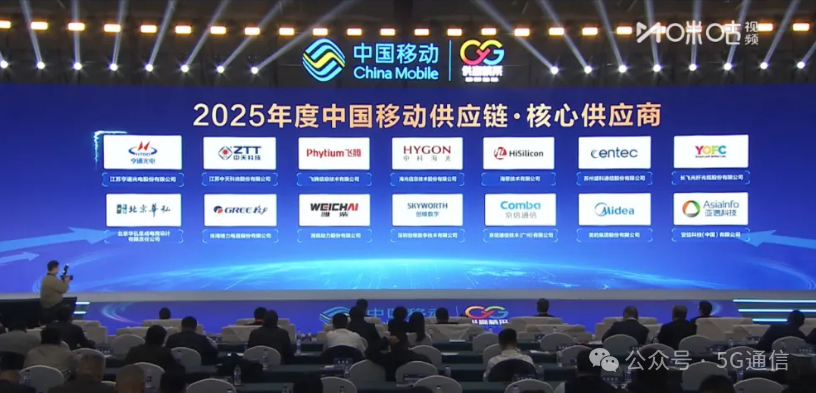
Core Insights - China Mobile disclosed an annual procurement exceeding 530 billion yuan, with over 17,000 signed suppliers, indicating a shrinking market [1][20] - The capital expenditure (CAPEX) trend shows a decline from 92 billion yuan in H1 2022 to 58.4 billion yuan in H1 2025, a decrease of over 30% [4][22] - The CAPEX for H1 2025 is projected to account for 51.8% of the total investment by the three major operators [4][9] Procurement Scale - Annual procurement amount exceeds 530 billion yuan, with over 17,000 suppliers [1][20] - The supplier classification includes 10 strategic suppliers, 14 core suppliers, and 299 excellent (A-level) suppliers [1][20] CAPEX Trends - CAPEX is expected to decrease from 151.2 billion yuan in 2024 to 138.5 billion yuan in 2025, a decline of 8.5% [4][22] - Despite the overall decline, CAPEX remains a significant portion of the three operators' total investment [4][22] Supplier Classification - The core suppliers list includes notable companies such as Haiguang Information, HiSilicon, and Feiteng, indicating a push towards a self-controlled supply chain [5][23] - Strategic suppliers like FiberHome are recognized for their deep collaboration with China Mobile, emphasizing future technological advancements [5][24] Investment Logic - China Mobile plans to invest 37.3 billion yuan in computing power, representing 25% of its capital expenditure, with no upper limit on investment based on market demand [6][25] - The focus on computing power investment reflects its importance as a core competitive weapon for the future [6][25] Domestic Supply Chain Acceleration - The supplier classification highlights a clear trend towards domestic suppliers, with many core suppliers being key players in the domestic innovation industry [7][25] - The domestic AI chip's procurement success indicates strong support for local manufacturing [6][27] Industry Restructuring - The classification system aims to reshape the entire industry chain, focusing on technology, security, and efficiency [11][28] - Companies in the "strategic" tier will collaborate with China Mobile on cutting-edge technologies like 6G and AI [11][29] Future Game Rules - The emphasis on specialization means companies with technical advantages in niche areas will be favored [12][30] - Stricter domestic requirements will continue to strengthen, favoring local suppliers [13][30] - Innovation capabilities will become a critical criterion for companies aiming for the "strategic" tier [14][30] Survival Guide for Suppliers - Suppliers aiming for a larger share in the existing market should strive to meet the standards of core suppliers [15][31] - Those looking to capitalize on new market opportunities should focus on becoming strategic suppliers in emerging technologies [16][31] - Enhancing domestic capabilities will be essential for suppliers seeking international support [17][31]
【明日主题前瞻】中国移动发布6G传输技术白皮书与原型样机
Xin Lang Cai Jing· 2025-12-15 12:01
Group 1: 6G Technology Development - China Mobile has released a white paper and prototype for 6G transmission technology, predicting that by 2040, the number of 6G terminal connections will reach 1.216 billion, growing over 30 times from 2022 [1] - Dongguan Securities reports that the consensus on 6G standards is increasing, with key architectural decisions expected to be made in a relatively short time frame as the industry approaches a period of technological iteration and policy benefits in 2025 [1] Group 2: Commercial Space Industry - SpaceX's internal stock pricing has reached $421 per share, valuing the company at $800 billion, potentially leading to the largest IPO in history [3] - The commercial space industry is at a critical turning point, with supportive policies and technological breakthroughs driving growth, particularly in satellite manufacturing and launch services [3] - Companies like Xunwei Communication and Tongyu Communication are actively developing technologies for satellite communication and have established partnerships with SpaceX [4] Group 3: Quantum Computing Advancements - Google is collaborating with the UK National Quantum Computing Centre to explore applications for its Willow quantum processor, with predictions that quantum computing will mainstream within two years and replace GPUs by 2030 [5] - Companies like Shaanxi Huada and Guoshield Quantum are making strides in quantum computing technologies, with products aimed at the quantum computing market [6] Group 4: AI in Healthcare - The Zhejiang Provincial Government has awarded a contract worth approximately 206 million yuan to Alipay for the development of a medical AI innovation service platform, addressing common industry challenges [7] - The AI healthcare market in China is projected to grow from 2 billion yuan in 2019 to 64 billion yuan in 2023, with a compound annual growth rate of 43.1% expected through 2033 [7] - Companies like RunDa Medical and Kangzhong Medical are actively developing AI solutions for healthcare, enhancing operational efficiency and expanding their product offerings [8] Group 5: Nuclear Fusion Industry - The nuclear fusion sector is experiencing a surge in project bids, with significant funding and interest from major tech companies like Google and Microsoft, indicating a strategic shift towards fusion energy [9] - Companies such as Sichuan Electronic and Xuguang Electronic are engaging in various nuclear fusion projects, establishing technical collaborations to advance the industry [10] Group 6: Photovoltaic Industry Developments - The establishment of a "polysilicon production capacity integration acquisition platform" by the China Photovoltaic Industry Association marks a significant step in the industry, aiming to improve supply chain efficiency [11] - Companies like Tongrun Equipment and Tuori New Energy are leveraging their strengths in the photovoltaic sector, focusing on the entire value chain from silicon purification to solar power plant operations [11]
中国移动与埃斯顿酷卓签署战略合作协议
Zheng Quan Shi Bao Wang· 2025-12-15 11:05
Core Viewpoint - China Mobile and Estun Kuozhu have signed a strategic cooperation agreement to enhance smart manufacturing through embodied intelligence, data value mining, and technological innovation [1] Group 1: Strategic Cooperation - The partnership will focus on the integration of 5G/5G-A and even 6G networks with embodied robots to overcome technical bottlenecks in remote control and multi-machine collaboration [1] - The collaboration aims to improve the intelligence level and response efficiency of industrial automation systems through the low-latency characteristics of mobile communication [1] Group 2: Customized Solutions - Both companies will leverage their strengths to develop customized robotic solutions for sectors such as communication infrastructure inspection and healthcare [1] - The initiative seeks to advance embodied intelligence from mere operational capabilities to thinking and collaborative abilities [1]
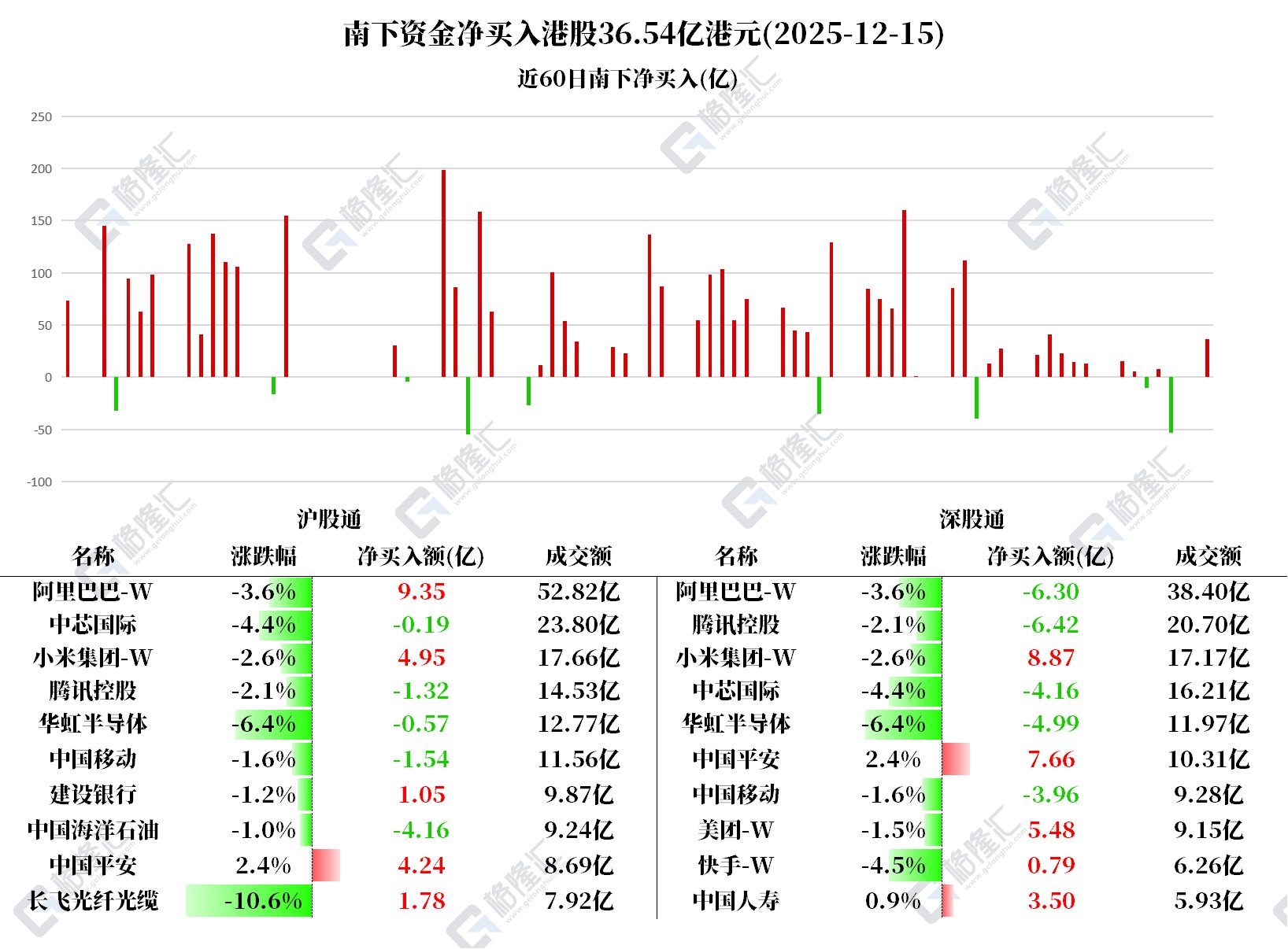
南向资金丨小米集团获净买入13.82亿港元



Di Yi Cai Jing· 2025-12-15 10:03
Core Viewpoint - Southbound funds recorded a net purchase of 36.54 billion HKD, with Xiaomi Group-W, China Ping An, and Meituan-W leading the net purchases at 13.82 billion HKD, 11.90 billion HKD, and 5.48 billion HKD respectively [1] Group 1 - Xiaomi Group-W received a net purchase of 13.82 billion HKD [1] - China Ping An saw a net purchase of 11.90 billion HKD [1] - Meituan-W had a net purchase of 5.48 billion HKD [1] Group 2 - Tencent Holdings experienced a net sell of 7.74 billion HKD [1] - Hua Hong Semiconductor faced a net sell of 5.55 billion HKD [1] - China Mobile recorded a net sell of 5.50 billion HKD [1]
图解丨南下资金净买入小米、中国平安
Ge Long Hui A P P· 2025-12-15 09:52
Group 1 - Southbound funds net bought Hong Kong stocks worth 36.54 billion HKD today [1] - Notable net purchases include Xiaomi Group-W (13.82 billion HKD), China Ping An (11.9 billion HKD), and Meituan-W (5.47 billion HKD) [1] - Continuous net buying trends observed for Xiaomi (12 days, total 121.5043 billion HKD) and Meituan (4 days, total 46.2952 billion HKD) [1] Group 2 - Significant net selling includes Tencent Holdings (7.74 billion HKD), Hua Hong Semiconductor (5.55 billion HKD), and China Mobile (5.5 billion HKD) [1] - Continuous net selling trends noted for SMIC (5 days, total 19.8564 billion HKD) and Tencent (4 days, total 24.9089 billion HKD) [1] - Other companies with net selling include China National Offshore Oil (4.16 billion HKD) and Hua Hong Semiconductor (15.4751 billion HKD) [1] Group 3 - Alibaba-W experienced a decline of 3.6% with a net buy of 9.35 million HKD [1] - SMIC saw a drop of 4.4% with a net sell of 0.19 million HKD [1] - China Ping An increased by 2.4% with a net buy of 4.24 million HKD [1]