
NJBK(601009)

Search documents
南京银行:大股东紫金集团及其控股子公司增持12347.2万股
Zheng Quan Shi Bao Wang· 2026-01-12 14:27
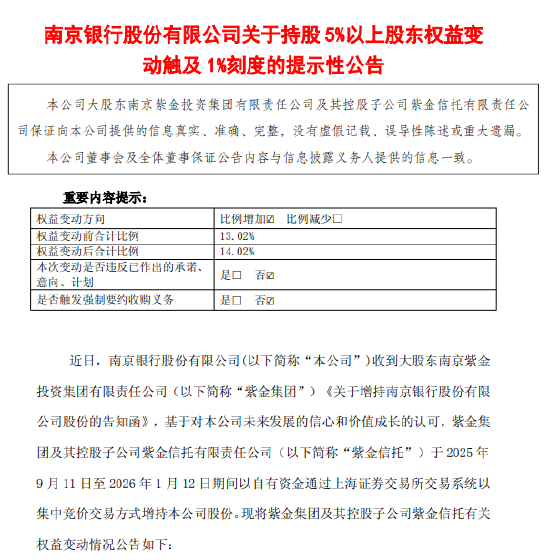
人民财讯1月12日电,南京银行(601009)1月12日公告称,该行收到大股东南京紫金投资集团有限责任 公司(简称"紫金集团")《关于增持南京银行股份有限公司股份的告知函》,基于对该公司未来发展的信 心和价值成长的认可,紫金集团及其控股子公司紫金信托有限责任公司(简称"紫金信托")于2025年9月 11日至2026年1月12日期间以集中竞价交易方式增持该行股份合计12347.2万股,占该行总股本的1%。 紫金集团及其控股子公司紫金信托合计持股比例由13.02%增加至14.02%。 ...

南京银行获大股东紫金集团增持
Xin Lang Cai Jing· 2026-01-12 10:44
| 权益受动方向 | 比例增加☑ 比例减少□ | | --- | --- | | 权益变动前合计比例 | 13.02% | | 权益变动后合计比例 | 14.02% | | 本次变动是否违反己作出的承诺、 | 是□ 合团 | | 意向、计划 | | | 是否触发强制要约收购义务 | 是口 合材 | 1月12日金融一线消息,南京银行今日发布公告称,近日,该行收到大股东南京紫金投资集团有限责任 公司(以下简称"紫金集团")《关于增持南京银行股份有限公司股份的告知函》,基于对该公司未来发 展的信心和价值成长的认可,紫金集团及其控股子公司紫金信托有限责任公司(以下简称"紫金信托") 于 2025 年9 月 11 日至 2026 年 1 月 12 日期间以自有资金通过上海证券交易所交易系统以集中竞价交易 方式增持该行股份。 公告指出,紫金集团及其控股子公司紫金信托于 2025 年 9 月 11 日至 2026 年 1 月 12日期间,以自有资 金通过上海证券交易所交易系统以集中竞价交易方式合计增持南京银行股份123472060股,占公司总股 本的1.00%。紫金集团及其控股子公司紫金信托合计持股比例由13.02%增加至 ...

南京银行:紫金集团及其控股子公司紫金信托增持1.23亿股公司股份
Ge Long Hui· 2026-01-12 10:36
格隆汇1月12日丨南京银行(601009.SH)公布,紫金集团及其控股子公司紫金信托于2025年9月11日至 2026年1月12日期间,以自有资金通过上海证券交易所交易系统以集中竞价交易方式合计增持本公司股 份1.23亿股,占本公司总股本的1.00%。紫金集团及其控股子公司紫金信托合计持股比例由13.02%增加 至14.02%,触及1%整数倍。 ...
南京银行(601009.SH):紫金集团及其控股子公司紫金信托增持1.23亿股公司股份
Ge Long Hui A P P· 2026-01-12 10:33
Core Viewpoint - Nanjing Bank (601009.SH) announced that Zijin Group and its subsidiary Zijin Trust will increase their shareholding in the bank by 123 million shares, representing 1.00% of the total share capital, from September 11, 2025, to January 12, 2026 [1] Group 1 - Zijin Group and Zijin Trust's combined shareholding will rise from 13.02% to 14.02%, reaching a 1% integer threshold [1]
南京银行(601009) - 南京银行股份有限公司关于持股5%以上股东权益变动触及1%刻度的提示性公告
2026-01-12 10:31
证券代码:601009 证券简称:南京银行 公告编号:2026-002 优先股简称:南银优 2 优先股代码:360024 南京银行股份有限公司关于持股 5%以上股东权益变 动触及 1%刻度的提示性公告 1.身份类别 | | □控股股东/实际控制人及其一致行动人 ☑其他 5%以上大股东及其一致行动人 | | --- | --- | | 投资者及其一致行动人的身份 | □合并口径第一大股东及其一致行动人(仅适用于无控 | | | 股股东、实际控制人) | | | □其他______________(请注明) | 重要内容提示: 权益变动方向 比例增加☑ 比例减少□ 权益变动前合计比例 13.02% 权益变动后合计比例 14.02% 本次变动是否违反已作出的承诺、 意向、计划 是□ 否☑ 是否触发强制要约收购义务 是□ 否☑ 注:本表格填写主体为直接持有本公司股份、且发生直接持股变动的股东,即信息披露 义务人。 二、 权益变动触及 1%刻度的基本情况 紫金集团及其控股子公司紫金信托于 2025 年 9 月 11 日至 2026 年 1 月 12 日期间,以自有资金通过上海证券交易所交易系统以集中竞价交易方式合计增持 ...
渝农商行南京银行翻绿 垫底银行板块
Zhong Guo Jing Ji Wang· 2026-01-12 08:22
今日,银行板块涨幅为0.31%,渝农商行、南京银行股价垫底银行板块。 (责任编辑:徐自立) 中国经济网北京1月12日讯 渝农商行(601077.SH)今日股价收报6.51元,跌幅0.91%。南京银行 (601009.SH)今日收报10.75元,跌幅0.74%。 ...

银行业周度追踪2026年第1周:如何理解银行股开年调整?-20260112
Changjiang Securities· 2026-01-12 04:41
Investment Rating - The investment rating for the banking sector is "Positive" and is maintained [12]. Core Insights - In the first week of 2026, the banking sector continued to adjust, with a cumulative decline of 1.9% in the banking index, significantly underperforming the CSI 300 and ChiNext indices by -4.7% and -5.8% respectively. Despite this, the fundamental expectations for the sector remain unchanged, and the market's risk appetite has notably increased [2][6][19]. - The main banks are expected to maintain stable growth in performance throughout 2026. Following recent adjustments, the PB-ROE valuation attractiveness of bank stocks has further increased, suggesting a favorable timing for allocation [2][6][19]. Summary by Sections Market Performance - The banking sector's performance in the first week of 2026 showed a cumulative decline of 1.9%, with significant negative excess returns compared to the CSI 300 and ChiNext indices [6][19]. - Individual stocks such as Chongqing Rural Commercial Bank saw price recovery after management uncertainties were resolved, while stable performers like Hangzhou Bank led the city commercial bank sector [2][6][19]. Fundamental Analysis - The banking sector's performance has been influenced by structural concerns, particularly regarding real estate and retail asset quality. Despite these concerns, overall performance remains stable with steady growth [8][37]. - The LTV (Loan-to-Value) ratios for major banks are stable at 40%-50%, providing a safety margin despite rising asset quality pressures in mortgage loans [8][37]. Trading Dynamics - The increase in market risk appetite has continued to suppress bank stock valuations. Historically, January has seen excess returns for bank stocks, but this year, the rapid recovery in market sentiment has led to underperformance [9][38]. - The report recommends focusing on high-quality city commercial banks such as Hangzhou Bank, Nanjing Bank, and Jiangsu Bank, as well as dividend-oriented assets like Bank of Communications and China Merchants Bank [9][38]. Convertible Bonds - The prices of convertible bonds linked to bank stocks have generally followed the sector's adjustment, with the distance to mandatory conversion prices widening. The report highlights potential trading opportunities in convertible bonds for banks like Changshu Bank and Shanghai Bank, which have stable fundamental performance expectations [7][32].



银行行业2025年度业绩前瞻:利息收入有望回正
ZHESHANG SECURITIES· 2026-01-11 15:27
Investment Rating - The industry investment rating is "Positive" [3][17] Core Insights - Interest income is expected to return to positive growth, supported by an improvement in net interest margins in Q4 2025, which will offset other non-interest impacts [1] - For the full year 2025, listed banks are projected to see a net profit growth rate of 1.8% and revenue growth of 1.2%, both showing a quarter-on-quarter improvement [1] - Quality city commercial banks are expected to lead the sector, with revenue and profit growth rates projected between 5-10% for 2025 [1] Summary by Relevant Sections Industry Outlook - The overall outlook for 2025 indicates an improvement in net profit and revenue growth for listed banks, primarily due to the alleviation of margin pressures and increased provisions [1] - The asset scale of listed banks is expected to grow by 9.0% year-on-year, reflecting a slowdown compared to previous quarters due to weak credit demand [1] Key Drivers - **Margin Stabilization**: Q4 2025 is expected to see a 2 basis point improvement in net interest margin to 1.32%, driven by a larger decline in funding costs compared to asset yields [1] - **Non-Interest Income**: Non-interest income is projected to grow by 3.2% year-on-year, a decrease from earlier quarters, with a slight positive trend in commission income [1] - **Credit Quality**: The credit cost ratio is expected to decline to 0.67%, indicating a stable improvement in non-performing loans, particularly in retail lending [1] Investment Recommendations - The report suggests that banks with new growth drivers are likely to see significant value recovery, recommending major state-owned banks and select city commercial banks as key investment targets [1][2]


过渡期收官在即,银行业首席合规官密集就位
Mei Ri Jing Ji Xin Wen· 2026-01-11 12:29
Core Insights - The banking industry is undergoing a restructuring wave in risk and compliance systems due to tightening regulatory rules and a complex risk environment [1][2] - A surge in appointments for Chief Risk Officers (CROs) and Chief Compliance Officers (CCOs) is expected by the end of 2025 and early 2026, with over 20 banks and branches already approved for relevant positions since the beginning of 2025 [1][2] Regulatory Changes - The "Measures for Compliance Management of Financial Institutions" requires financial institutions to establish a CCO at their headquarters, who will be classified as a senior management position [2] - The transitional period for compliance with this regulation is set to expire one year after its implementation on March 1, 2025 [2] Appointment Trends - A variety of banks, including Ping An Bank, Industrial Bank, and Minsheng Bank, have announced the appointment of CCOs as the transitional deadline approaches [2] - The trend shows a mix of large, medium, and small institutions moving forward with these appointments [2] Governance Models - Two governance models are emerging: "one person holding multiple roles" and "independent separation" for CCOs and CROs [3] - The "one person holding multiple roles" model is prevalent among smaller banks, allowing for unified decision-making in risk and compliance management [3] - The "independent separation" model is more common in larger banks, emphasizing specialized development and independent oversight in risk management [3][4] Talent Acquisition Challenges - The establishment of CCO and CRO positions presents new challenges for talent acquisition, with a preference for candidates possessing a combination of frontline business experience, cross-regional vision, and professional qualifications [6] - Some banks are adopting market-based recruitment strategies for CCOs, breaking traditional selection models [6] Compensation Trends - The compensation for CCOs is rising, with annual total income expected to be no less than the average for senior management positions [6] - Reports indicate that the reference monthly salary for these positions can reach between 100,000 to 130,000 yuan [6] Compliance Management Evolution - Effective compliance management is evolving from a "cost center" to a "value guardian," playing a crucial role in mitigating credit, market, and liquidity risks [7] - The compliance governance system is expected to become more institutionalized and refined, with clearer responsibilities and a growing demand for composite compliance talent [7][8] Core Competencies for CCOs - The core competencies for CCOs are identified as business insight, regulatory interpretation, execution capability, and cross-departmental collaboration [8] - These competencies are essential for CCOs to effectively support governance and create compliance value [8]



过渡期收官在即,银行业首席合规官密集就位,如何推进从“被动遵循”到“主动治理”?
Mei Ri Jing Ji Xin Wen· 2026-01-09 10:51
Core Viewpoint - The tightening of regulatory rules and the complexity of the risk environment are driving a restructuring wave in the banking industry's risk and compliance systems [1][7]. Group 1: Appointment Trends - A surge in appointments for Chief Risk Officers (CROs) and Chief Compliance Officers (CCOs) is expected from late 2025 to early 2026, with nearly 10 banks increasing related personnel configurations in the past month [1][7]. - Since the beginning of 2025, over 20 banks and branches have had relevant qualifications approved by regulators [1][7]. - The trend is influenced by the impending expiration of a one-year transition period set by the "Financial Institutions Compliance Management Measures," which requires financial institutions to establish a CCO at their headquarters [1][7]. Group 2: Governance Models - The banking sector exhibits two governance models for CCOs and CROs: "one person holding both positions" and "independent separation" [2][9]. - The "one person holding both positions" model is prevalent, particularly in smaller banks, allowing for unified decision-making in risk and compliance management [2][9]. - Conversely, the "independent separation" model is more common in larger banks, enhancing professional checks and balances within the risk control system [3][10]. Group 3: Talent Acquisition and Challenges - The demand for composite talents is rising, with banks favoring candidates with extensive experience in finance or legal compliance [11][12]. - Some banks are adopting market-based recruitment methods for CCOs, breaking traditional selection models [11]. - Salary levels for CCO positions are increasing, with some banks offering monthly salaries between 100,000 to 130,000 yuan [11]. Group 4: Compliance Management Evolution - Effective compliance management is evolving from a "cost center" to a "value guardian," playing a crucial role in mitigating credit, market, and liquidity risks [12][13]. - The future of compliance governance in the banking industry is expected to become more institutionalized and refined, with clearer responsibilities and a focus on composite compliance talents [12][13]. - The core competencies for CCOs are expected to include deep business insight, precise regulatory interpretation, efficient execution, and strong cross-departmental collaboration [13].
