NJBK(601009)

Search documents
过渡期收官在即,银行业首席合规官密集就位,如何推进从“被动遵循”到“主动治理”?
Mei Ri Jing Ji Xin Wen· 2026-01-09 10:51
Core Viewpoint - The tightening of regulatory rules and the complexity of the risk environment are driving a restructuring wave in the banking industry's risk and compliance systems [1][7]. Group 1: Appointment Trends - A surge in appointments for Chief Risk Officers (CROs) and Chief Compliance Officers (CCOs) is expected from late 2025 to early 2026, with nearly 10 banks increasing related personnel configurations in the past month [1][7]. - Since the beginning of 2025, over 20 banks and branches have had relevant qualifications approved by regulators [1][7]. - The trend is influenced by the impending expiration of a one-year transition period set by the "Financial Institutions Compliance Management Measures," which requires financial institutions to establish a CCO at their headquarters [1][7]. Group 2: Governance Models - The banking sector exhibits two governance models for CCOs and CROs: "one person holding both positions" and "independent separation" [2][9]. - The "one person holding both positions" model is prevalent, particularly in smaller banks, allowing for unified decision-making in risk and compliance management [2][9]. - Conversely, the "independent separation" model is more common in larger banks, enhancing professional checks and balances within the risk control system [3][10]. Group 3: Talent Acquisition and Challenges - The demand for composite talents is rising, with banks favoring candidates with extensive experience in finance or legal compliance [11][12]. - Some banks are adopting market-based recruitment methods for CCOs, breaking traditional selection models [11]. - Salary levels for CCO positions are increasing, with some banks offering monthly salaries between 100,000 to 130,000 yuan [11]. Group 4: Compliance Management Evolution - Effective compliance management is evolving from a "cost center" to a "value guardian," playing a crucial role in mitigating credit, market, and liquidity risks [12][13]. - The future of compliance governance in the banking industry is expected to become more institutionalized and refined, with clearer responsibilities and a focus on composite compliance talents [12][13]. - The core competencies for CCOs are expected to include deep business insight, precise regulatory interpretation, efficient execution, and strong cross-departmental collaboration [13].





多家银行推出资产提升活动,奖励达标客户
Mei Ri Jing Ji Xin Wen· 2026-01-09 00:29
Group 1 - Several banks, including Jiangsu Bank, Agricultural Bank, Construction Bank, and Nanjing Bank, have launched asset enhancement activities to encourage customers to increase their bank assets [1] - Jiangsu Bank announced that customers who increase their average monthly assets in the first three months of the year compared to the end of the previous year will receive related rewards [1] - The trend of banks initiating asset enhancement programs indicates a competitive environment in the banking sector aimed at attracting and retaining customers [1]





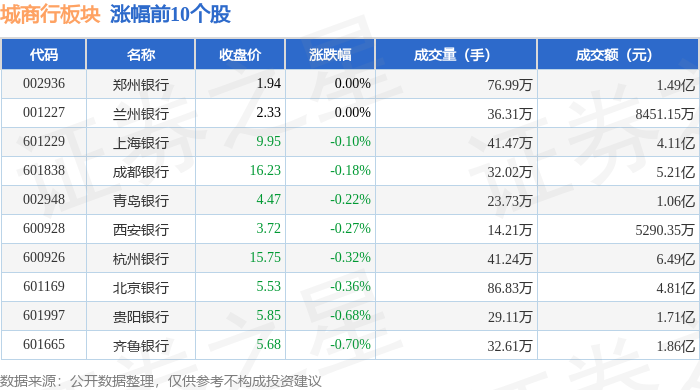
城商行板块1月8日跌0.89%,重庆银行领跌,主力资金净流入673.97万元
Zheng Xing Xing Ye Ri Bao· 2026-01-08 08:56
Market Overview - The city commercial bank sector experienced a decline of 0.89% on January 8, with Chongqing Bank leading the drop [1] - The Shanghai Composite Index closed at 4082.98, down 0.07%, while the Shenzhen Component Index closed at 13959.48, down 0.51% [1] Individual Stock Performance - Zhengzhou Bank closed at 1.94 with no change, while Lanzhou Bank also remained unchanged at 2.33 [1] - Shanghai Bank closed at 9.95, down 0.10%, and Chengdu Bank closed at 16.23, down 0.18% [1] - Chongqing Bank saw a significant decline of 2.70%, closing at 10.45, with a trading volume of 99,000 shares [2] Trading Volume and Turnover - The trading volume for Zhengzhou Bank was 769,900 shares with a turnover of 149 million yuan, while Lanzhou Bank had a trading volume of 363,100 shares and a turnover of 84.51 million yuan [1] - The highest turnover was recorded for Nanjing Bank at 1.342 billion yuan with a trading volume of 1,217,000 shares [2] Capital Flow Analysis - The city commercial bank sector saw a net inflow of 6.7397 million yuan from institutional investors, while retail investors experienced a net outflow of 70.5351 million yuan [2] - Chengdu Bank had a net inflow of 87.0825 million yuan from institutional investors, but a net outflow of 46.0321 million yuan from retail investors [3] Summary of Capital Flows - Institutional investors showed a positive net flow for several banks, including Hangzhou Bank with 77.8301 million yuan and Qingdao Bank with 8.4480 million yuan [3] - Conversely, Chongqing Bank had a negative net flow of 535,600 yuan from institutional investors, indicating a lack of confidence [3]

早部署、快投放、重质量 银行开年信贷“加速跑”
Shang Hai Zheng Quan Bao· 2026-01-07 17:51
Core Insights - The banking sector has entered a "full bow" state at the beginning of the year, with a noticeable acceleration in credit issuance, emphasizing "early deployment, rapid disbursement, and quality" [1] - There is a shift from a "scale-first" approach to a focus on the rhythm, structure, and strategy of credit issuance, aiming to optimize credit structure and upgrade service models for long-term development [1] Group 1: Credit Issuance Trends - Banks are prioritizing early loan disbursement to support enterprises' operational needs, with a focus on completing project funding before the Spring Festival [2] - A significant portion of annual credit issuance typically occurs in the first quarter, with frontline credit personnel recognizing the importance of "early disbursement, early returns" [2][3] - A head of a major joint-stock bank noted that achieving 50% to 60% of the annual loan target in the first quarter is crucial to meeting overall goals [3] Group 2: Structural Adjustments in Credit Supply - In response to narrowing net interest margins, banks are recalibrating their credit issuance direction, emphasizing quality and structural optimization over sheer volume [4] - Agricultural Bank of China plans to focus on high-quality credit issuance, targeting key areas aligned with national strategies, with a goal of adding over 60 billion yuan in loans in 2026 [4] - Zhejiang Commercial Bank aims to increase lending in green, technology, manufacturing, agricultural, and private enterprise sectors [4] Group 3: Innovative Approaches to Credit - The People's Bank of China is enhancing the financial policy framework to improve service evaluation and professionalization in financial services [5] - Banks are adjusting their credit structures to address interest margin pressures, with a focus on supporting technology startups despite their limited short-term profitability [5] - Mechanisms such as "pre-approval" processes are being implemented to expedite loan disbursement, exemplified by Ningbo Bank's rapid funding for technology enterprises [5] Group 4: Shift in Business Strategy - Banks are moving away from traditional interest rate competition, focusing instead on comprehensive service and long-term partnerships with clients [6] - A case study of a small agricultural machinery manufacturer illustrates this shift, where service quality and problem-solving capabilities outweighed the importance of interest rates in client decisions [6] - The transition from "single-point service" to "comprehensive empowerment" is becoming a prevalent strategy among banks, integrating various financial tools to support enterprises [6]

按揭、信用卡、消费贷与经营贷深度:深度银行四大零售资产的风险分析框架
ZHONGTAI SECURITIES· 2026-01-07 11:17
Investment Rating - The report maintains an "Overweight" rating for the banking sector [2] Core Insights - The four categories of retail loans (mortgages, credit cards, consumer loans, and business loans) collectively constitute household liabilities, each with distinct collateral types, duration structures, and policy influences. The report aims to establish a risk framework for these retail assets and assess their impact on banking operations in the future [2][4] - Under stress testing, the non-performing loan (NPL) ratios for mortgages, credit cards, and consumer loans are projected to increase by 11, 12, and 20 basis points respectively in 2026, while the growth in non-performing amounts remains manageable. The overall quality of corporate assets is expected to continue improving, indicating a stable banking sector [2][4] - Retail asset risks are deemed controllable, with policies expected to maintain stability in the near term [2] Summary by Sections Retail Asset Analysis Framework: Collateral Types + Duration Structure + Policy Impact - The overall NPL ratio for retail loans of listed banks is estimated at 1.27% in the first half of 2025, slightly above the corporate NPL ratio of 1.26%, but the increase in NPL ratios is stabilizing. The composition of existing NPLs is 63% corporate and 37% retail, with business loans and mortgages showing higher proportions of both existing and newly added NPLs [2][12] - The report establishes a risk analysis framework for retail assets, highlighting the differences in collateral types, duration structures, and policy impacts among the four categories of retail loans [2][4] Consumer Loans: "High-Risk" Assets - The relationship between consumer loans and consumption trends is closely aligned, with notable deviations occurring during strict property purchase restrictions and regulatory cycles for online loans. The market structure for consumer credit (excluding credit cards and mortgages) shows that listed banks hold over 51.5% of the market, while non-listed banks account for 17% and other players for 31% [2][4] - The risk logic for consumer credit indicates that risk pricing is primarily determined by interest rates, which can be categorized into four tiers based on risk levels. The report estimates that 4.4% of consumer loans fall into the "high-risk" category, with commercial banks' high-risk consumer loans representing only 0.6% of their total consumer loans [2][4] Mortgage Loans: Risk Sources and International Comparisons - The primary sources of mortgage risk include negative cash flow and high loan-to-value (LTV) ratios, with 1.2% of respondents reporting monthly incomes below their mortgage payments. The report anticipates that the current high LTV portion, which constitutes 2.9% of total mortgage balances, will not necessarily lead to increased NPLs [2][4] - International comparisons indicate that mortgage NPL ratios in most countries remain below 2%, suggesting that the risks in the domestic market are manageable [2][4] Business Loans: High-Risk Assets - The report estimates that approximately 2 trillion yuan of high-risk business loans were outstanding at the end of 2021, with nearly one-third of these high-risk assets already exposed. The peak of risk exposure is expected in 2024 and the first half of 2025, with NPL ratios projected to rise by 18 basis points to 1.96% under stress testing conditions [2][4] Credit Cards: Early NPL Exposure - Credit cards have historically shown early exposure to NPLs, with the NPL ratio at 2.44% in the first half of 2025. The report notes that the net increase in credit card NPLs has significantly decreased, indicating that credit cards are not currently a major pressure point for banks [2][4] Investment Recommendations - The report suggests two main investment lines for bank stocks: focusing on regional banks with strong certainty and advantages, particularly in areas like Jiangsu, Shanghai, Chengdu, Shandong, and Fujian, and recommending large banks with high dividend yields such as Agricultural Bank, Construction Bank, and Industrial and Commercial Bank [2][4]



南京银行跌1.77% 领跌银行板块
Zhong Guo Jing Ji Wang· 2026-01-07 09:01
中国经济网北京1月7日讯 南京银行(601009.SH)今日股价收报11.11元,跌幅1.77%。今日,银行 板块跌0.52%,南京银行为该板块跌幅最大的上市公司。 (责任编辑:徐自立) ...
已有十余家银行聘任首席合规官
Jin Rong Shi Bao· 2026-01-07 02:52
Core Viewpoint - The appointment of Chief Compliance Officers (CCOs) in banks is a response to increasing regulatory demands, aiming to enhance compliance management and integrate it into business processes [1][2]. Group 1: Appointment of Chief Compliance Officers - Zhangjiagang Rural Commercial Bank appointed Wu Kai as its Chief Compliance Officer, marking a trend where over ten banks have made similar appointments [1]. - In December 2025 alone, several banks, including Ping An Bank and Industrial Bank, approved the hiring of CCOs [1]. - The rapid appointment of CCOs aligns with the implementation of the "Financial Institutions Compliance Management Measures," which mandates the establishment of CCO positions at the headquarters of financial institutions [2]. Group 2: Responsibilities and Challenges - CCOs are expected to take on more responsibilities, including the formulation and supervision of compliance policies, ensuring that all business activities adhere to regulatory frameworks [5]. - There is a concern that an increase in executive positions may burden banks, particularly smaller financial institutions [2]. - Many currently appointed CCOs are existing senior executives, which helps mitigate potential operational burdens [3]. Group 3: Recruitment Trends - Some banks, such as Jiangxi Bank and Shangrao Bank, have publicly announced recruitment for CCO positions, indicating a proactive approach to compliance management [4].

金融资产提升活动密集来袭,2026年银行零售AUM战火渐起
Bei Jing Shang Bao· 2026-01-06 13:17
Core Viewpoint - The retail wealth management competition among banks has intensified at the beginning of the new year, with various financial institutions launching promotional activities to enhance asset management scale (AUM) by incentivizing users to optimize their asset allocation [1][3]. Group 1: Retail AUM Competition - Multiple banks, including Agricultural Bank of China and Nanjing Bank, have initiated the "Asset Enhancement Gift" campaign, offering tiered rewards to encourage users to increase their financial assets [3][4]. - Agricultural Bank's campaign allows users to participate in a lottery based on their average financial assets from January 2026 compared to December 2025, with rewards ranging from 5,200 to 2.4 million points based on asset tiers [3][4]. - Nanjing Bank targets premium customers with dual campaigns, rewarding them for asset increases and diversified product holdings, with potential rewards of up to 80,000 points monthly [4]. Group 2: Trends in Wealth Management - The competition in wealth management has shifted from product sales to comprehensive management of customer financial assets, reflecting a transformation in retail banking strategies [5]. - Key trends include a transition from interest margin-driven models to those focused on asset management fees, with AUM becoming a critical measure of retail competitiveness [5]. - The focus has moved from comparing single product yields to evaluating customer-centric asset allocation and lifecycle service capabilities [5]. Group 3: Long-term Service Capability - Retail AUM is a key indicator of a bank's ability to attract and manage individual customer wealth, with several banks reporting growth in retail customer numbers and AUM [7]. - For instance, China Merchants Bank reported a retail customer base of 220 million and an AUM of approximately 16.6 trillion yuan, reflecting an 11.19% increase year-on-year [7]. - Banks are encouraged to shift from product promotion to asset allocation assistance, enhancing their service ecosystems to better meet customer needs [8]. Group 4: Sustainable Growth Mechanisms - To achieve sustainable growth in retail AUM, banks must move beyond short-term promotional strategies and focus on systematic capability development [8]. - Strategies include deepening customer segmentation, enhancing investment research capabilities, and fostering channel collaboration to improve customer engagement [8][9]. - Leveraging data and technology for precise marketing and service delivery is essential for creating a comprehensive operational system that supports long-term customer relationships [8].


939亿增持狂潮!523家A股公司扫货,多家银行股将披露业绩
2 1 Shi Ji Jing Ji Bao Dao· 2026-01-06 10:18
记者丨叶静 编辑丨曾芳 根据同花顺统计,截至1月6日,A股上市银行2025年度报告预约披露时间均出炉,平安银行将成为最早 披露年报的上市银行,预约披露时间为3月21日,这已经是平安银行连续第二年率先披露年报了。 同一日披露年报的还有中信银行。去年银行板块上涨12.05%,虽然表现不如2024年,但42家银行的总 市值突破15万亿元大关,较2024年12月31日收盘时的总市值增加约2.1万亿元。对于2026年的银行行 情,多数机构依然表示看好。 国有大行三月末扎堆披露业绩 继平安银行、中信银行之后,紧接着是渝农商行,该行预约于3月26日披露年报;青岛银行、瑞丰银 行、兴业银行则是3月27日披露年报。厦门银行、苏农银行和江苏银行3家上市银行最晚披露年报,预约 披露时间均为4月30日。 最受关注的国有大行披露日,多是集中在3月末,其中最早的交通银行、建设银行和邮储银行,披露日 同为3月28日,紧接着3月31日,农业银行、工商银行和中国银行选择同日披露年报。 从上市银行整体年报披露节奏来看,3月31日当日有10家银行披露2025年的"成绩单"为最多的一日。进 入4月份,4月23日上市银行年报披露将迎来另一个高峰,当日 ...

939亿增持狂潮!523家A股公司扫货,多家银行股将披露业绩
21世纪经济报道· 2026-01-06 10:10
Core Viewpoint - The banking sector in A-shares is expected to perform well in 2026, driven by stable fundamentals and increased dividend attractiveness, despite a less impressive performance in 2025 compared to previous years [4][9][10]. Group 1: Annual Report Disclosure - Ping An Bank will be the first to disclose its annual report on March 21, followed by CITIC Bank on the same day [1]. - A total of 10 banks will disclose their 2025 annual reports on March 31, marking the highest number of disclosures on a single day [3]. - The total market capitalization of 42 A-share banks exceeded 15 trillion yuan, increasing by approximately 2.1 trillion yuan from the end of 2024 [2][3]. Group 2: Market Performance - The banking sector index rose by 12.05% in 2025, underperforming the CSI 300 index, which increased by 17.66% [3]. - Among the 42 banks, 35 experienced stock price increases, with Agricultural Bank of China leading at a 52.66% rise [3]. - The overall market sentiment towards bank annual reports is positive, with expectations of continued growth in 2026 [4][9]. Group 3: Investment Drivers - The strong performance of the banking sector in 2025 was supported by both funding and fundamental factors, including inflows from passive index funds and insurance [4]. - Significant shareholder buybacks have also contributed to the rise in bank stocks, with 523 companies increasing their holdings, totaling 939.6 billion yuan [6]. - Analysts predict that the demand for high-dividend stocks will remain strong, particularly for state-owned banks known for stable returns [10]. Group 4: Future Outlook - Analysts expect the banking sector to maintain stable performance in 2026, supported by a recovering real economy and high dividend yields [9]. - The issuance of ETFs linked to broad indices and dividend indices is expected to continue, attracting more passive fund inflows into the banking sector [9]. - The differentiation in performance among various banks is anticipated to become a key theme, with larger banks likely to see more consistent revenue growth compared to smaller banks [10]. Group 5: Seasonal Trends - Historical data shows that the banking sector has a high success rate for absolute and excess returns before the Spring Festival, with an average absolute return of 4.4% [11]. - The upcoming Spring Festival in 2026 is expected to see continued strong performance in bank stocks, driven by balanced market styles and robust demand for high-dividend stocks [12]. - Recommendations for stock allocation include a stable base in state-owned banks and a more aggressive approach with quality joint-stock and city commercial banks [12].