
Changshu Bank(601128)

Search documents
常熟银行的前世今生:2025年三季度营收90.52亿行业第三,净利润35.83亿排名居三
Xin Lang Cai Jing· 2025-10-30 14:56
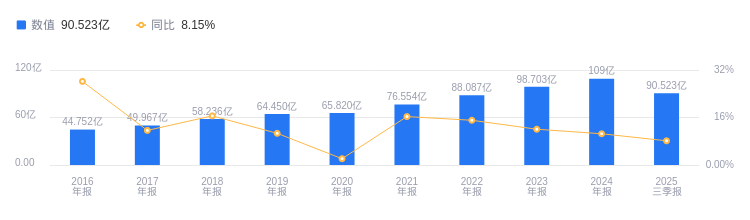
Core Insights - Changshu Bank, established in December 2001 and listed in September 2016, is a leading rural financial institution in China with a strong focus on microfinance and retail banking [1] Group 1: Financial Performance - As of Q3 2025, Changshu Bank reported revenue of 9.052 billion yuan, ranking third among ten industry peers [2] - The bank's net profit for the same period was 3.583 billion yuan, also placing it third in the industry [2] - Revenue growth for the first three quarters of 2025 was 8.15%, while net profit growth was 12.82%, indicating strong performance relative to peers [5][6] Group 2: Business Composition - The bank's revenue composition includes personal business at 3.14 billion yuan (51.80%), corporate business at 1.702 billion yuan (28.08%), and funding business at 1.173 billion yuan (19.34%) [2] - The bank's asset scale is expanding, with improvements in loan growth and retail lending [5] Group 3: Financial Ratios - As of Q3 2025, Changshu Bank's asset-liability ratio was 91.90%, higher than the industry average of 91.45% [3] - The bank's gross profit margin was 45.98%, which, while an increase from the previous year, remains below the industry average of 51.47% [3] Group 4: Shareholder Information - As of September 30, 2025, the number of A-share shareholders increased by 20.12% to 49,600 [5] - The average number of circulating A-shares held per shareholder decreased by 16.75% to 66,900 [5] Group 5: Management and Governance - The chairman of Changshu Bank, Xue Wen, received a salary of 1.8325 million yuan in 2024, reflecting a year-on-year increase of 32,500 yuan [4] - The bank operates without a controlling shareholder or actual controller, indicating a level of governance independence [4]


常熟银行(601128):盈利能力维持高位,资产质量稳健
Tianfeng Securities· 2025-10-30 13:20
Investment Rating - The investment rating for the company is "Buy" with a 6-month outlook maintained [7]. Core Insights - The company has maintained high profitability with a revenue of 9.052 billion yuan for the first three quarters of 2025, representing a year-on-year growth of 8.15% and a net profit attributable to shareholders of 3.357 billion yuan, up 12.82% year-on-year [1][2]. - The net interest margin is expected to stabilize at 2.57%, down 1 basis point from the first half of 2025 [2]. - The asset quality remains robust with a non-performing loan ratio of 0.76% and a loan provision coverage ratio of 463% [4]. Financial Performance Summary - For the first three quarters of 2025, the company achieved a net interest income of 7.068 billion yuan, accounting for 78.08% of total revenue, with a year-on-year increase of 2.39% [2]. - Non-interest income reached 1.984 billion yuan, showing a significant year-on-year growth of 35.24% [2]. - The total interest-earning assets amounted to 3.9 trillion yuan, with a year-on-year growth of 10.97% [3]. - The total interest-bearing liabilities were 3.6 trillion yuan, reflecting an increase of 11.22% year-on-year [3]. Asset and Liability Structure - As of the third quarter of 2025, the composition of interest-earning assets includes loans (63.17%), financial investments (27.17%), interbank lending (2.95%), and deposits with the central bank (6.70%) [3]. - The liability structure shows that deposits account for 87.30% of total interest-bearing liabilities, with a year-on-year growth of 9.69% [3]. Profitability Forecast - The company is projected to achieve a net profit growth of 12.56%, 11.71%, and 11.38% for the years 2025, 2026, and 2027 respectively [5]. - The earnings per share are expected to be 1.29 yuan in 2025, with a price-to-earnings ratio of 5.35 [6].
常熟银行(601128):25Q3单季贷款同比多增,净息差下行趋势逐季放缓
GUOTAI HAITONG SECURITIES· 2025-10-30 11:56
Investment Rating - The investment rating for the company is "Accumulate" with a target price of 8.13 CNY [6][11]. Core Insights - The report highlights that the retail loan growth for the company has shown a continuous upward trend, while the decline in net interest margin and net profit margin is slowing down each quarter. Core revenue growth is accelerating, supported by the progress in the transformation of village banks into branches, which further expands the company's development footprint [2][11]. Financial Summary - The company's projected financials are as follows (in million CNY): - Revenue: 9,870 in 2023, expected to grow to 15,060 by 2027, with a CAGR of 12.1% [4]. - Net profit attributable to the parent company: 3,282 in 2023, expected to reach 5,751 by 2027, reflecting a CAGR of 15.9% [4]. - Book value per share (BVPS): Expected to increase from 8.99 in 2023 to 12.15 by 2027 [4]. - Return on equity (ROE): Projected to rise from 12.8% in 2023 to 13.8% by 2027 [4]. Performance Metrics - The company reported a year-on-year growth in total assets, loans, and deposits of 10.89%, 7.13%, and 9.69% respectively as of Q3 2025, with a significant loan increment of 5.3 billion CNY in the quarter [11]. - The non-performing loan (NPL) ratio remained stable at 0.76%, with a provision coverage ratio of 462.95% [11]. Growth Drivers - The ongoing transformation of village banks into branches is expected to accelerate, with the company having announced the absorption of eight village banks since October 2024, enhancing its market share in Jiangsu province [11]. - The report indicates that the company has successfully optimized its deposit pricing strategy, leading to a slight increase in the proportion of demand deposits [11].
10月30日早间重要公告一览
Xi Niu Cai Jing· 2025-10-30 09:40
Group 1: Company Performance - Anker Innovation reported a revenue of 21.019 billion with a year-on-year growth of 27.79% and a net profit of 1.933 billion, up 31.34% [1] - Hongjing Technology achieved a revenue of 15.510 billion, a staggering growth of 595.49%, and a net profit of 107.5 million, increasing by 448.91% [1][2] - CICC recorded a revenue of 20.761 billion, growing by 54.36%, and a net profit of 6.567 billion, up 129.75% [3] - Tongfeng Electronics reported a revenue of 1.072 billion, with an 11.37% increase, and a net profit of 79.91 million, up 28.88% [4] - Changshu Bank achieved a revenue of 9.052 billion, growing by 8.15%, and a net profit of 3.357 billion, up 12.82% [6] - Jingfeng Mingyuan reported a revenue of 1.117 billion, with a 2.67% increase, and a net profit of 23.33 million, turning from loss to profit [8] - Magmita's revenue was 6.791 billion, growing by 15.05%, but net profit fell by 48.29% to 213 million [9] - Huilong Pharmaceutical reported a revenue of 742 million, down 12.92%, with a net loss of 50.8047 million [10] - Dongwei Semiconductor achieved a revenue of 964 million, growing by 41.60%, and a net profit of 48.55 million, up 58.46% [22] - Spring Autumn Electronics reported a revenue of 3.197 billion, with a 7.21% increase, and a net profit of 231 million, up 63.91% [24] - Jiangnan New Materials achieved a revenue of 7.569 billion, growing by 18.34%, and a net profit of 165 million, up 21.95% [25] - Fuda Alloy reported a revenue of 3.497 billion, with a 30.03% increase, and a net profit of 55.5042 million, up 33.52% [26] - Zhongjin Gold achieved a revenue of 53.976 billion, growing by 17.23%, and a net profit of 3.679 billion, up 39.18% [28] - Shoukai Holdings reported a revenue of 23.186 billion, with a 60.31% increase, but a net loss of 3.105 billion [29] - Nanshan Aluminum achieved a revenue of 26.325 billion, growing by 8.66%, and a net profit of 3.772 billion, up 8.09% [30][32] Group 2: Company Background - Anker Innovation specializes in the research, design, and sales of consumer electronics products, including mobile device peripherals and smart hardware [1] - Hongjing Technology focuses on providing comprehensive solutions in smart living, urban management, and smart parks [2] - CICC is engaged in investment banking, equity sales and trading, proprietary investment and trading, wealth management, and investment management [3] - Tongfeng Electronics specializes in the research, production, and sales of film capacitors and their materials [4][5] - Changshu Bank provides retail banking, corporate banking, financial market services, and village bank services [6][7] - Jingfeng Mingyuan focuses on the research and sales of power management and control driver chips [8][9] - Magmita specializes in the research, production, and sales of smart home control products, power products, and industrial automation products [9] - Huilong Pharmaceutical is involved in the research, production, and sales of innovative and high-quality generic drugs for cancer treatment [10][11] - Dongwei Semiconductor specializes in the research and sales of high-performance power devices [22][23] - Spring Autumn Electronics focuses on the research, design, production, and sales of precision molds and components for consumer electronics [24] - Jiangnan New Materials specializes in the research, production, and sales of copper-based new materials [25][26] - Fuda Alloy focuses on the research, production, and sales of electrical contact materials [26][27] - Zhongjin Gold is involved in geological exploration, mining, and smelting of gold and non-ferrous metals [28][29] - Shoukai Holdings specializes in real estate development, property management, urban renewal, and real estate finance [29][30] - Nanshan Aluminum focuses on the development, production, processing, and sales of aluminum and aluminum alloy products [30][31][32]




常熟银行(601128):信贷量价边际改善
HTSC· 2025-10-30 08:58
Investment Rating - The investment rating for the company is maintained as "Buy" with a target price of RMB 8.53 [1]. Core Insights - The company reported a year-on-year increase in net profit and operating income of 12.8% and 8.2% respectively for the first nine months of 2025, showing improvement compared to the first half of the year [1]. - The company has seen a recovery in credit issuance, with a net interest margin stabilizing and asset quality remaining robust, although there are concerns regarding the trend of non-performing loans in the small and micro-enterprise sector [1][4]. - Significant increases in shareholding by state-owned and insurance capital investors indicate strong long-term investment confidence in the company [4]. Summary by Sections Financial Performance - For the first three quarters of 2025, the annualized ROE and ROA were 15.02% and 1.24%, respectively, reflecting slight increases [1]. - As of September 2025, total assets, loans, and deposits grew by 10.9%, 7.1%, and 9.8% respectively compared to June 2025 [2]. Credit and Interest Income - The company added RMB 5.3 billion in new credit in Q3 2025, with retail, corporate, and bills accounting for 31%, 57%, and 12% of the total respectively [2]. - The net interest margin slightly decreased by 1 basis point to 2.57%, while the yield on interest-earning assets increased by 1 basis point to 4.42% [2]. Non-Interest Income and Capital - Non-interest income growth slowed to 20.0% year-on-year, with a notable increase in middle-income revenue [3]. - The capital adequacy ratio and core tier 1 capital ratio were 13.66% and 11.14% respectively as of September 2025, showing a slight improvement from June 2025 [3]. Asset Quality - The non-performing loan ratio remained stable at 0.76%, while the provision coverage ratio decreased by 27 percentage points to 463% [4]. - The annualized credit cost for Q3 2025 was 0.37%, a decrease of 14 basis points year-on-year [4]. Valuation and Forecast - The company is projected to achieve net profits of RMB 43 billion, RMB 48 billion, and RMB 54 billion for 2025 to 2027, with respective growth rates of 11.7%, 11.7%, and 12.5% [5]. - The target price corresponds to a price-to-book ratio of 0.90 for 2025, reflecting a premium valuation due to the company's mature small and micro-business model and increased dividend capacity [5].
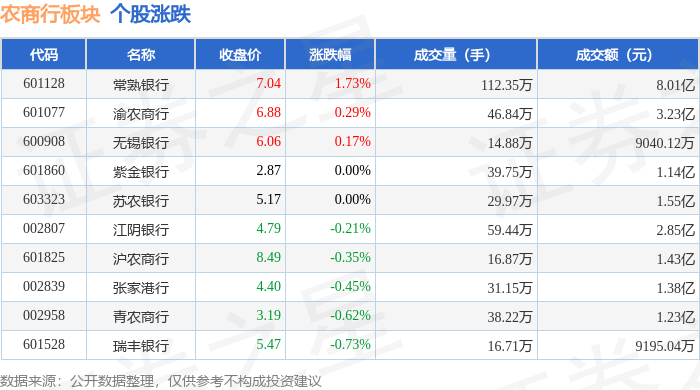
农商行板块10月30日涨0.03%,常熟银行领涨,主力资金净流出2147.47万元
Zheng Xing Xing Ye Ri Bao· 2025-10-30 08:40
Core Insights - The rural commercial bank sector experienced a slight increase of 0.03% on October 30, with Changshu Bank leading the gains [1] - The Shanghai Composite Index closed at 3986.9, down 0.73%, while the Shenzhen Component Index closed at 13532.13, down 1.16% [1] Stock Performance - Changshu Bank (601128) closed at 7.04, up 1.73% with a trading volume of 1,123,500 shares and a transaction value of 800 million yuan [1] - Other notable performances include: - Yunnan Rural Commercial Bank (601077) at 6.88, up 0.29% [1] - Wuxi Bank (600908) at 6.06, up 0.17% [1] - Jiangyin Bank (002807) at 4.79, down 0.21% [1] - Shanghai Rural Commercial Bank (601825) at 8.49, down 0.35% [1] Capital Flow - The rural commercial bank sector saw a net outflow of 21.47 million yuan from institutional investors, while retail investors contributed a net inflow of 18.53 million yuan [1] - Specific capital flows for selected banks include: - Jiangyin Bank (002807) with a net outflow of 29.87 million yuan from institutional investors [2] - Yunnan Rural Commercial Bank (601077) with a net inflow of 19.57 million yuan from institutional investors [2] - Shanghai Rural Commercial Bank (601825) with a significant net outflow of 23.35 million yuan from institutional investors [2]



常熟银行(601128):2025年三季报点评:零售信贷回暖,资产质量边际改善
Huachuang Securities· 2025-10-30 08:35
Investment Rating - The report maintains a "Recommendation" rating for Changshu Bank with a target price of 10.14 CNY [2] Core Views - Changshu Bank's revenue and profit growth remain robust, with a year-on-year revenue increase of 8.15% and a net profit growth of 12.82% for the first three quarters of 2025 [2] - The bank's asset quality shows marginal improvement, with a non-performing loan ratio stable at 0.76% and a provision coverage ratio of 463%, despite a quarter-on-quarter decline of 26.6 percentage points [2] - The bank's credit demand is recovering, with significant growth in both corporate and retail loans, indicating a positive trend in lending activities [2] Financial Performance Summary - For the first three quarters of 2025, Changshu Bank achieved an operating income of 90.52 billion CNY and a net profit attributable to shareholders of 33.57 billion CNY [2] - The average net interest margin for the first three quarters was 2.57%, with a slight decline of 1 basis point from the previous quarter, indicating stability in interest income [2] - Non-interest income has been a drag on revenue growth, with a 22.2% year-on-year decline in other non-interest income in the third quarter due to fluctuations in interest and exchange rates [2] Loan and Asset Quality Summary - As of September 2025, the bank's interest-earning assets grew by 10.4% year-on-year, driven by a 7.1% increase in loan volume [2] - The bank's non-performing loan generation rate improved, with a quarterly annualized rate of 1.0%, down 34 basis points from the previous quarter [2] - The bank's provision for credit losses decreased by 23.8% year-on-year, reflecting improved asset quality and reduced provisioning pressure [2] Future Outlook - The report forecasts net profit growth rates of 13.3%, 11.2%, and 10.4% for 2025, 2026, and 2027, respectively, indicating a stable growth trajectory [2] - The bank's dividend payout ratio has increased to 25.3%, with an expected dividend yield of 4.8% for 2025 [2] - The target price of 10.14 CNY corresponds to a price-to-book ratio of 0.95X for 2026, suggesting potential upside based on historical averages [2]
常熟银行(601128):2025三季报:信贷投放同比多增,不良生成改善
ZHONGTAI SECURITIES· 2025-10-30 08:28
Investment Rating - The report maintains an "Accumulate" rating for the company [4][5]. Core Views - The company has shown a double-digit growth in revenue and profit, with an increase in the dividend payout ratio by 5.5 percentage points [5]. - The bank's credit issuance has increased year-on-year, and the generation of non-performing loans has improved [3][5]. - The bank's business model focuses on a diversified customer structure, maintaining excellent asset quality and leading growth in revenue and profit [5]. Financial Performance Summary - For the first three quarters, the company's revenue increased by 8.2% year-on-year, while net profit rose by 12.8% [5]. - Net interest income grew by 2.4% year-on-year, supported by stable interest margins and a recovery in the growth of interest-earning assets [5]. - Non-interest income saw a significant increase of 35.3% year-on-year, although this was affected by a high base and fluctuations in the bond market [5]. Profitability and Valuation - The company's projected earnings per share (EPS) for 2025 is 1.29 yuan, with a net profit of 4,292 million yuan, reflecting a year-on-year growth of 12.6% [4][16]. - The price-to-earnings (P/E) ratio is expected to decrease from 5.49 in 2024 to 5.36 in 2025, indicating a favorable valuation trend [4][16]. - The projected price-to-book (P/B) ratio is expected to decline from 0.75 in 2024 to 0.73 in 2025, suggesting continued investor confidence [4][16]. Asset Quality - The non-performing loan (NPL) ratio remains stable at 0.76%, with a marginal decrease in the generation of non-performing loans [5][15]. - The provision coverage ratio is reported at 462.94%, indicating a strong buffer against potential loan losses [5][15]. Loan and Deposit Growth - The bank's new loan issuance for the third quarter of 2025 was 5.29 billion yuan, showing a year-on-year increase of 45.43 billion yuan [5][12]. - Total deposits increased by 1.4 billion yuan in the third quarter, with a slight year-on-year decrease of 4.3% [5][12].
常熟银行(601128):规模加速扩张业绩保持高增长
Guotou Securities· 2025-10-30 07:35
Investment Rating - The investment rating for Changshu Bank is "Buy-A" with a 6-month target price of 9.63 CNY, compared to the current stock price of 6.92 CNY [5]. Core Insights - Changshu Bank's performance in the first three quarters of 2025 shows a revenue growth rate of 8.15%, a pre-provision profit growth rate of 10.09%, and a net profit growth rate of 12.82%, maintaining a leading position in the industry [1]. - The bank's asset scale is expanding rapidly, with total assets growing by 10.89% year-on-year as of the end of Q3 2025, and the loan balance increasing by 7.13% year-on-year, marking the first improvement in loan growth since 2024 [1][2]. - Retail loan growth has accelerated, with a year-on-year increase of 2.53% and a significant contribution from personal business loans [2]. - The bank's net interest margin has stabilized, supported by a decrease in funding costs [4][10]. Summary by Sections Financial Performance - In Q3 2025, Changshu Bank's total assets reached a year-on-year growth of 10.89%, with a quarterly increase of 10 billion CNY, primarily driven by loan growth [1]. - The bank's net interest margin for the first three quarters of 2025 was 2.57%, with a slight decline compared to the previous year [10]. - Non-interest income showed a significant increase in fee and commission income, which grew by 250.23% due to agency wealth management services [10]. Asset and Liability Management - The total liabilities of Changshu Bank increased by 10.97% year-on-year, with deposits growing by 9.69%, indicating a strong liability side [3]. - The bank's loan-to-deposit ratio is expected to improve as the cost of liabilities continues to decrease [11]. Future Outlook - The bank is expected to maintain a revenue growth of 9.71% and a profit growth of 13.39% in 2025, with a focus on retail and small micro-businesses [11]. - The strategy includes deepening existing customer relationships and expanding into new markets, particularly in the technology and innovation sectors [11].
常熟银行(601128):业绩领跑,长线资金积极增持
Shenwan Hongyuan Securities· 2025-10-30 06:11
Investment Rating - The report maintains a "Buy" rating for Changshu Bank [1] Core Views - Changshu Bank's performance continues to lead its peers, with a 9M25 revenue of 9.1 billion yuan, up 8.2% year-on-year, and a net profit attributable to shareholders of 3.4 billion yuan, up 12.8% year-on-year [4][9] - The bank's non-performing loan (NPL) ratio remains stable at 0.76%, while the provision coverage ratio decreased by 27 percentage points to 463% [4][9] - Long-term investors, including insurance and state-owned shareholders, have been actively increasing their holdings, reflecting confidence in the bank's growth potential [6][9] Financial Data and Profit Forecast - Revenue and profit forecasts for Changshu Bank are as follows: - Total operating income (million yuan): 2023: 9,870.29, 2024: 10,909.24, 2025E: 11,601.01, 2026E: 12,497.16, 2027E: 13,688.58 [5] - Net profit attributable to shareholders (million yuan): 2023: 3,281.50, 2024: 3,813.26, 2025E: 4,197.26, 2026E: 4,758.90, 2027E: 5,449.21 [5] - The expected year-on-year growth rates for net profit are 19.60% in 2023, 16.20% in 2024, and 10.07% in 2025 [5] Performance Analysis - The bank's net interest income increased by 2.4% year-on-year in 9M25, while non-interest income growth slowed to 35.3% [6][10] - The loan growth rate for 3Q25 was 7.1%, with corporate loans contributing nearly 60% of the new loans [6][8] - The bank's cost-to-income ratio improved, contributing to profit growth [6][10] Credit Quality - The annualized NPL generation rate is estimated at 1.02%, with the majority of new NPLs expected to come from personal business loans [9] - The bank's proactive approach to asset disposal has helped maintain a low NPL ratio [9] Market Position - Changshu Bank's current price-to-book (PB) ratio is 0.65, indicating potential for value appreciation [9] - The bank is expected to continue its high-quality growth trajectory, supported by its strategic focus on small and medium-sized enterprises and retail banking [9]