
SGC(601139)

Search documents
真兰仪表:深圳燃气集团是公司的重要客户之一,公司主要向其提供燃气表、流量计及相关零配件等燃气产品
Mei Ri Jing Ji Xin Wen· 2026-01-14 05:10
Core Viewpoint - The company, Zhenlan Instrument (301303.SZ), confirms its collaboration with Shenzhen Gas Group, indicating that it is a significant customer and that the company will continue to maintain a good partnership with them [1]. Group 1 - The company provides gas meters, flow meters, and related spare parts to Shenzhen Gas Group [1]. - The company emphasizes its commitment to fostering a strong relationship with Shenzhen Gas Group [1].


申万公用环保周报(26/01/05~26/01/09):固体废物综合治理行动计划发布,全球气价普跌-20260112
Shenwan Hongyuan Securities· 2026-01-12 13:25
Investment Rating - The report rates the gaming industry as "high" for investment [1] Core Views - The report emphasizes the importance of the "Solid Waste Comprehensive Treatment Action Plan," which aims for significant improvements in solid waste management by 2030, including a target of 4.5 billion tons of comprehensive utilization of major solid waste and 510 million tons of recycling of key resources [2][5][7] - It highlights the shift in the energy sector towards diversified revenue models for thermal power companies, recommending several key players in the industry [8] - The report discusses the current trends in natural gas pricing, noting a general decline in global gas prices due to mild weather conditions and stable supply [10][29] - It outlines the transition of hydrogen energy towards becoming a "regulator" of the power grid, emphasizing its role in energy storage and management [31][33] Summary by Sections 1. Environmental Protection - The "Solid Waste Comprehensive Treatment Action Plan" was released on January 4, aiming to enhance solid waste management and promote a green economy [5] - By 2030, the plan targets a comprehensive utilization of 4.5 billion tons of major solid waste and 510 million tons of recycling of key resources [2][6] - The focus is on industrial, urban, and agricultural waste, with a comprehensive governance approach to illegal dumping and construction waste [6][7] 2. Natural Gas - As of January 9, the Henry Hub spot price in the U.S. was $2.87/mmBtu, reflecting a weekly decline of 28.24% [10][11] - The report notes that the European gas prices have also decreased, with the TTF spot price at €29.00/MWh, down 1.43% week-on-week [10][16] - The overall gas market is characterized by stable supply and mild weather, leading to lower demand and prices [10][29] 3. Hydrogen Energy - The report discusses the integration of hydrogen energy into the power grid, highlighting its potential for large-scale energy storage and management [31] - It emphasizes the role of hydrogen in addressing renewable energy challenges and improving grid stability [31][33] - The report recommends companies involved in hydrogen production and technology as key investment opportunities [33] 4. Weekly Market Review - The report notes that the electric power equipment, gas, and environmental protection sectors outperformed the Shanghai and Shenzhen 300 index during the week of January 5 to January 9 [34] - It provides insights into the performance of various sectors, indicating a positive trend for certain energy and environmental stocks [36][39] 5. Company and Industry Dynamics - The report highlights the establishment of national zero-carbon parks, which will receive significant support for green energy initiatives [39] - It mentions the successful completion of green power transactions in Gansu, indicating a growing market for renewable energy [40][43] - The report includes updates on major companies' performance and strategic developments in the energy sector [44]



申万公用环保周报:固体废物综合治理行动计划发布,全球气价普跌-20260112
Shenwan Hongyuan Securities· 2026-01-12 10:45
Investment Rating - The report maintains a positive outlook on the industry, indicating a "Look Favorably" investment rating [1]. Core Insights - The report highlights the release of the "Comprehensive Solid Waste Management Action Plan," which aims to enhance solid waste management and promote a circular economy by 2030, targeting a comprehensive utilization of 4.5 billion tons of major solid waste and 510 million tons of recyclable resources annually [2][6][8]. - Global natural gas prices have generally declined, influenced by mild weather conditions, with significant drops in prices across various markets, including a 28.24% decrease in the US Henry Hub spot price [11][12][18]. - The hydrogen energy sector is evolving towards becoming a key regulator in the power grid, with initiatives to integrate clean hydrogen production and utilization into microgrid systems, enhancing energy storage capabilities [35][37]. Summary by Sections 1. Environmental Protection - The "Comprehensive Solid Waste Management Action Plan" aims for significant improvements in solid waste management by 2030, with specific targets for waste recycling and resource utilization [2][6]. - The plan emphasizes the need for a circular economy that does not rely on subsidies, focusing on industrial collaboration and technological innovation to create a sustainable waste management system [7][8]. 2. Natural Gas - Natural gas prices have seen a significant decline, with the US Henry Hub spot price at $2.87/mmBtu, reflecting a 28.24% week-over-week drop [11][12]. - The report notes that the demand for natural gas is expected to remain weak in Northeast Asia, contributing to a slight decrease in LNG prices [11][30]. - Recommendations include focusing on integrated natural gas companies that are expected to benefit from cost reductions and improved profitability [32]. 3. Hydrogen Energy - The report discusses the strategic positioning of hydrogen energy as a flexible load regulator within the power grid, highlighting its potential to enhance energy storage and consumption efficiency [35][37]. - It emphasizes the importance of hydrogen energy in achieving energy security and autonomy, recommending companies involved in hydrogen production [35][37]. 4. Weekly Market Review - The report indicates that the electricity equipment, gas, and environmental protection sectors outperformed the Shanghai and Shenzhen 300 index during the review period [38]. 5. Company and Industry Dynamics - The report outlines significant developments in the renewable energy sector, including the establishment of national zero-carbon parks and the increase in green electricity trading volumes, which are expected to enhance market opportunities for leading companies in the sector [44][48].
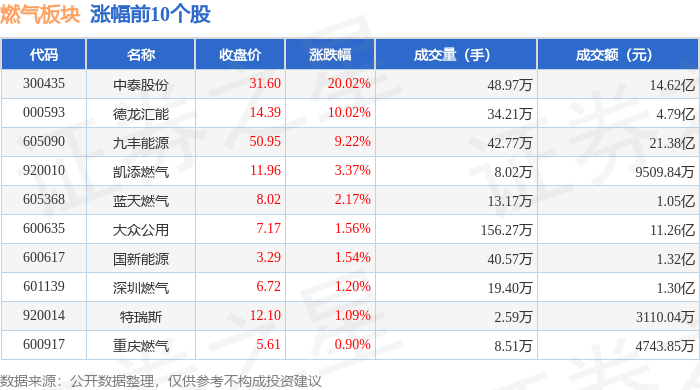
燃气板块1月12日涨2.26%,中泰股份领涨,主力资金净流出9750.18万元
Zheng Xing Xing Ye Ri Bao· 2026-01-12 09:04
Group 1 - The gas sector experienced a rise of 2.26% on January 12, with Zhongtai Co., Ltd. leading the gains [1] - The Shanghai Composite Index closed at 4165.29, up 1.09%, while the Shenzhen Component Index closed at 14366.91, up 1.75% [1] - Zhongtai Co., Ltd. saw a significant increase in its stock price, closing at 31.60 with a rise of 20.02% and a trading volume of 489,700 shares, amounting to a transaction value of 1.462 billion yuan [1] Group 2 - The gas sector had a net outflow of 97.5018 million yuan from institutional funds, while retail investors saw a net inflow of 232 million yuan [2] - The trading data indicates that DeLong Huineng had a net inflow of 75.8922 million yuan from institutional funds, despite a net outflow from retail investors [3] - The overall trend shows that while institutional funds are withdrawing, retail investors are actively buying into the gas sector [2][3]





燃气Ⅱ行业跟踪周报:气温预计回升至正常水平,欧美气价回落-20260112
Soochow Securities· 2026-01-12 08:22
Investment Rating - The report maintains an "Accumulate" rating for the gas industry [1] Core Viewpoints - The temperature is expected to rise to normal levels, leading to a decrease in gas prices in Europe and the US [4][9] - The overall supply of gas is sufficient, with domestic gas prices showing a week-on-week decrease of 1.4% [21] - The report emphasizes the importance of optimizing costs for city gas companies and the ongoing adjustment of pricing mechanisms [50] Price Tracking - As of January 9, 2026, the week-on-week changes in gas prices are as follows: US HH -27.5%, European TTF -5.7%, East Asia JKM -1.4%, China LNG ex-factory -1.4%, and China LNG CIF -4.8% [4][10] - The average daily gas generation in Europe increased by 26.8% week-on-week and 109.7% year-on-year to 1635.8 GWh [16] Supply and Demand Analysis - The US natural gas market price decreased by 27.5% week-on-week due to rising temperatures, with storage levels down by 1190 billion cubic feet to 32560 billion cubic feet [14] - European gas consumption from January to September 2025 was 313.8 billion cubic meters, a year-on-year increase of 4.1% [16] - Domestic gas consumption from January to November 2025 increased by 1.5% year-on-year to 392 billion cubic meters [21] Pricing Progress - Nationwide pricing adjustments are gradually being implemented, with 67% of cities having executed residential pricing adjustments, averaging an increase of 0.22 yuan per cubic meter [34] - The report indicates that there is still a 10% room for price adjustment in city gas companies [34] Investment Recommendations - The report recommends focusing on companies that can optimize costs and benefit from the ongoing pricing adjustments, such as Xin'ao Energy, China Resources Gas, and Kunlun Energy, all with dividend yields around 4.8% [51] - It also highlights the importance of companies with quality long-term contracts and flexible scheduling, such as Jiufeng Energy and Xin'ao Shares [51] - The report suggests paying attention to companies with gas production capabilities, such as Shouhua Gas and New Natural Gas, due to the increasing uncertainty in US gas imports [51]


深圳燃气2025年度业绩快报
Shang Hai Zheng Quan Bao· 2026-01-09 20:24
Financial Performance - The company reported a total operating revenue of 2,979,567 thousand yuan for the year 2025, representing a year-on-year increase of 5.11%, primarily driven by growth in gas resources and comprehensive energy revenue [1] - The net profit attributable to shareholders of the listed company was 140,678 thousand yuan, a decrease of 3.45% compared to the previous year, mainly due to reduced profits from smart service operations [1] - The net profit attributable to shareholders after deducting non-recurring gains and losses was 143,167 thousand yuan, reflecting a year-on-year increase of 1.99% [1] Natural Gas Sales - The total natural gas sales volume reached 6.665 billion cubic meters, an increase of 16.09% compared to the previous year’s 5.741 billion cubic meters [2] - Pipeline natural gas sales amounted to 5.127 billion cubic meters, up 3.06% from 4.975 billion cubic meters in the previous year [2] - Wholesale natural gas sales surged to 1.538 billion cubic meters, marking a significant increase of 100.78% from 0.766 billion cubic meters year-on-year [2] Regional Sales Breakdown - In the Greater Bay Area, natural gas sales were 2.939 billion cubic meters, a growth of 5.42% from 2.788 billion cubic meters in the previous year [2] - Sales to power plants reached 1.532 billion cubic meters, increasing by 8.19% from 1.416 billion cubic meters year-on-year [2] - Other regions recorded sales of 2.188 billion cubic meters, showing a marginal increase of 0.05% compared to 2.187 billion cubic meters in the previous year [2] Gas Transmission - The company’s gas transmission volume was 0.964 billion cubic meters, reflecting a year-on-year increase of 15.45% from 0.835 billion cubic meters [3]
深圳燃气:2025年度业绩快报
Zheng Quan Ri Bao· 2026-01-09 13:42
Group 1 - The core point of the article is that Shenzhen Gas reported its 2025 annual performance, indicating a total operating revenue of 2,979.567 million yuan, which represents a year-on-year increase of 5.11% [2] - The net profit attributable to shareholders of the listed company for 2025 is 140.678 million yuan, showing a year-on-year decrease of 3.45% [2]
1月9日晚间重要公告一览
Xi Niu Cai Jing· 2026-01-09 10:19
Group 1 - China Shipbuilding Defense expects a net profit of 940 million to 1.12 billion yuan for 2025, an increase of 149.61% to 196.88% year-on-year [1] - China First Heavy Industries has only undertaken a small number of related accessory projects and has not generated revenue from them [2] - Huanyu Electronics plans to invest 30 million yuan in a private equity fund focused on AI and emerging industries [3] Group 2 - Zhixiang Jintai's GR1803 injection has been included in the priority review list by the National Medical Products Administration [4] - JianKai Technology's shareholder plans to reduce holdings by up to 3% of the company's shares [5] - Debon Holdings will continue to suspend trading from January 12 due to significant matters being planned [6] Group 3 - South Network Technology's shareholder intends to transfer 847.05 million shares, accounting for 1.50% of the total share capital [7] - Hengrui Medicine has received approval for clinical trials of four drugs [8] - Daotong Technology expects a net profit of 900 million to 930 million yuan for 2025, a year-on-year increase of 40.42% to 45.10% [10] Group 4 - Betta Pharmaceuticals has invested 50 million yuan to acquire a 20% stake in Hangzhou Zhixing Pharmaceutical [11] - Tianyu Biology reported a 10.38% year-on-year decline in cumulative sales revenue for 2025 [12] - Lifang Pharmaceutical's subsidiary has obtained a drug registration certificate for a pain relief product [13] Group 5 - R&F Properties reported a total sales revenue of approximately 14.21 billion yuan for 2025 [14] - Wanfu Biology expects a net profit decline of 87.71% to 91.81% for 2025 [15] - Dazhi expects a negative net profit for 2025 [16] Group 6 - Dongzhu Ecology is negotiating to terminate the acquisition of control over a satellite communication company [17] - Baotai has received a milestone payment of 10 million USD from Hikma Pharmaceuticals [18] - Huace Navigation expects a net profit of 670 million to 690 million yuan for 2025, a year-on-year increase of 14.84% to 18.27% [19] Group 7 - Shenzhen Gas reported a net profit decline of 3.45% for 2025 [20] - Baogang Co. plans to adjust the price of rare earth concentrate for Q1 2026 to 26,834 yuan per ton [21] - Jiuding Investment expects to report a loss for 2025 [22] Group 8 - Shanghai Pharmaceuticals has received a drug registration certificate for a treatment for myasthenia gravis [23] - Hualan Biological plans to acquire a 35% stake in Guangfeng Capsule [24] - Ruina Intelligent plans to invest 169.9 million yuan in a new R&D production base for heat pumps [25] Group 9 - Wantong Development expects to report a loss for 2025 [26] - Xianghe Industrial has completed the purchase of a 5% stake in Hezhixiang Technology [27] - Guangkang Biochemical received a warning letter from the Guangdong Securities Regulatory Commission [28] Group 10 - Xiaoming Co. reported a 37.07% year-on-year decline in chicken product sales revenue for December 2025 [29] - Luokai Co. won a procurement project from State Grid Fujian Power worth approximately 48.2 million yuan [30] - Minhe Co. reported a 65.22% year-on-year increase in the sales of commodity chick seedlings for December 2025 [31] Group 11 - Zhenghai Biological has obtained a registration certificate for calcium silicate bio-ceramic materials [32] - Three Gorges Energy reported a 5.99% year-on-year increase in cumulative total power generation for 2025 [33] - Huisheng Biological expects a net profit of 235 million to 271 million yuan for 2025 [34] Group 12 - Maihe Co. announced the release of the detention measures against its chairman [35] - Wandong's Alzheimer's project has been included in a national major special project for innovative drug development [36] - Kangxin New Materials plans to transfer forest land assets with a book value of 1.203 billion yuan [37] Group 13 - Greenland Holdings expects a net loss of 16 billion to 19 billion yuan for 2025 [39] - Zhongxin Fluorine Materials has obtained a pesticide production license [40]





氪星晚报 |本田在美召回2155辆摩托车;库克透露苹果预计今年换帅,特努斯成库克继任者头号热门人选;闲鱼:2025年二次元、追星与游戏用户总量已突破1.6亿
3 6 Ke· 2026-01-09 10:07
Group 1: Automotive Industry - Foton Motor announced a cumulative sales of 650,053 vehicles in 2025, representing a year-on-year growth of 5.85%, with a production of 659,455 vehicles, up 7.95% from the previous year. Notably, new energy vehicles accounted for 101,200 units sold, marking an impressive growth of 87.21% [1] - The China Passenger Car Association reported that retail sales of new energy passenger vehicles reached 12.809 million units in 2025, reflecting a year-on-year increase of 17.6% [13] Group 2: Pharmaceutical Industry - Betta Pharmaceuticals has invested 50 million yuan to acquire a 20% stake in Hangzhou Zhixing Pharmaceutical, which focuses on high-end inhalation formulations. This investment is expected to enhance the company's new drug development capabilities and expand its strategic layout in disease treatment [2] Group 3: Real Estate Industry - R&F Properties reported a total sales revenue of 14.21 billion yuan for 2025, with a sales area of 1.8736 million square meters [3] Group 4: Technology and Digital Services - Kingsoft Office has signed a strategic cooperation memorandum with FPT, focusing on localizing WPS 365 in the Vietnamese market and enhancing user growth and joint solutions [4] - PhotonPay has completed a multi-million dollar Series B financing round led by IDG Capital, aimed at expanding its global payment network and upgrading its underlying technology infrastructure [8] Group 5: Utilities - Shenzhen Gas reported a total revenue of 29.796 billion yuan for 2025, with a net profit attributable to shareholders of 1.407 billion yuan, reflecting a year-on-year decline of 3.45% [5]



深圳燃气(601139.SH):预计2025年度归母净利润14.07亿元,同比下降3.45%
Ge Long Hui A P P· 2026-01-09 09:06
Core Viewpoint - Shenzhen Gas (601139.SH) reported a revenue of 29.80 billion yuan, a year-on-year increase of 5.11%, primarily driven by growth in gas resources and comprehensive energy revenue [1] Financial Performance - The net profit attributable to shareholders was 1.407 billion yuan, a year-on-year decrease of 3.45%, mainly due to reduced profits from smart service business [1] - The net profit attributable to shareholders after deducting non-recurring gains and losses was 143.17 million yuan, a year-on-year increase of 1.99% [1] Natural Gas Sales - The total natural gas sales volume reached 6.665 billion cubic meters, an increase of 16.09% compared to 5.741 billion cubic meters in the same period last year [1] - Pipeline natural gas sales volume was 5.127 billion cubic meters, up 3.06% from 4.975 billion cubic meters year-on-year [1] - Wholesale natural gas sales volume was 1.538 billion cubic meters, a significant increase of 100.78% from 0.766 billion cubic meters year-on-year [1] Regional Sales Breakdown - In the Greater Bay Area, the sales volume was 2.939 billion cubic meters, a 5.42% increase from 2.788 billion cubic meters year-on-year [1] - Sales volume to power plants was 1.532 billion cubic meters, an increase of 8.19% from 1.416 billion cubic meters year-on-year [1] - Other regions saw a sales volume of 2.188 billion cubic meters, a slight increase of 0.05% from 2.187 billion cubic meters year-on-year [1] Gas Transmission - The gas transmission volume was 0.964 billion cubic meters, a year-on-year increase of 15.45% from 0.835 billion cubic meters [1]