INDUSTRIAL BANK(601166)

Search documents
银行股逆市向上,银行ETF南方(512700)拉升涨超1%,冲击四连阳,银行板块防御属性持续彰显
Xin Lang Cai Jing· 2025-10-23 02:22
Core Viewpoint - The banking sector is showing strong defensive characteristics amid market adjustments, with expectations of seasonal performance improvements due to high dividends and low valuations [2] Group 1: Market Performance - As of October 23, 2025, the Bank ETF Southern (512700) rose by 1.13%, marking a four-day winning streak with a transaction volume of 33.92 million yuan [1] - The CSI Bank Index increased by 1.18%, with notable gains from Postal Savings Bank (up 4.36%), Industrial Bank (up 1.91%), and Agricultural Bank (up 1.85%) [1] - Over the past five trading days, the Bank ETF Southern (512700) experienced net inflows on four occasions [1] Group 2: Interest Rate Policy - Tianfeng Securities suggests that the likelihood of lowering the Loan Prime Rate (LPR) this year is low, as the primary goal of such a move is to stimulate credit demand, which may not be significant in Q4 [1] - The report indicates that the focus will likely shift towards fiscal subsidies and structural monetary policy tools as a form of "indirect interest rate reduction" [1] - The main challenge for banks in asset-liability management is the pressure of asset reallocation [1] Group 3: Investment Outlook - According to Everbright Securities, the banking sector's defensive attributes are highlighted by rising risk aversion due to renewed trade tensions, making it an attractive investment option [2] - Historical data shows that the banking sector has a 70% and 80% probability of generating absolute returns in November-December and January of the following year, respectively [2] - The upcoming Central Economic Work Conference is expected to reinforce policies aimed at stabilizing growth, further supporting the banking stocks' seasonal performance [2] Group 4: Index Composition - The Bank ETF Southern (512700) closely tracks the CSI Bank Index, which categorizes companies into various industry levels for comprehensive performance analysis [2] - The top ten weighted stocks in the index include China Merchants Bank, Industrial Bank, and Agricultural Bank among others [2]




银行ETF指数(512730)涨超1.1%,农行15连阳累涨近25%
Xin Lang Cai Jing· 2025-10-23 02:16
Group 1 - The China Securities Banking Index (399986) has shown a strong increase of 1.17%, with notable gains from Postal Savings Bank (4.19%), Industrial Bank (2.06%), and Minsheng Bank (1.98%) [1] - Agricultural Bank has experienced a significant rally, achieving a 25% increase since September 25, with a total market capitalization approaching 2.9 trillion [1] - According to Everbright Securities, the banking sector's "high dividend, low valuation" characteristics are becoming more prominent, suggesting a potential reallocation opportunity in the sector [1] Group 2 - As of September 30, 2025, the top ten weighted stocks in the China Securities Banking Index account for 64.6% of the index, including major banks such as China Merchants Bank and Industrial Bank [2]


兴业银行济南分行:“链”上发力,为全省现代冶金产业注入金融动能
Qi Lu Wan Bao· 2025-10-23 01:24
Core Viewpoint - Shandong is advancing the transformation and upgrading of its modern metallurgical industry under the "dual carbon" goals, with Industrial Bank's Jinan branch playing a crucial role in providing innovative financial support for high-quality development in this sector [1] Green Empowerment - The steel and aluminum industries are key sectors for low-carbon transformation in Shandong's metallurgical industry, with Industrial Bank's Jinan branch integrating green finance into the entire industrial upgrade process [2] - The bank has launched the first low-carbon transformation loan in the steel industry, addressing local companies' needs for flue gas treatment and providing stable funding for low-carbon circular transformation [2] - A 200 million yuan financial loan for aluminum industry transformation was introduced, linking interest rates to product energy consumption to encourage energy-saving and carbon reduction [2] - The bank's "carbon footprint-linked loan" allows companies to reduce financing costs as their carbon footprint decreases, transforming green transition from a passive requirement to an active pursuit [2] - Industrial Bank received the highest AAA rating from MSCI for the second consecutive year, ranking in the top 3 globally among peers [2] Ecosystem Activation - High-quality development in the metallurgical industry requires both core enterprises to lead and upstream and downstream players to collaborate, with the bank creating a service ecosystem that connects core enterprises and the industrial chain [3] - A comprehensive financial solution was tailored for a large steel group, supporting its new energy initiatives and extending supply chain financial services to alleviate financing difficulties for small and micro enterprises [3] - The bank facilitated 1.2 billion yuan in funding for over 50 small suppliers through reverse factoring, improving procurement efficiency by 40% [3] - Customized support was provided to a metallurgical equipment manufacturer facing cash shortages, with a 10 million yuan credit loan approved and disbursed within the same day [3] Technological Efficiency - The fast-paced production in the metallurgical industry necessitates rapid financial services, which the bank has achieved by restructuring service processes through financial technology [4] - A mechanism for front, middle, and back office collaboration was established to expedite funding approvals, with a case showing a 3-day turnaround from account opening to loan disbursement [4] - The bank's manufacturing loan balance exceeded 61.5 billion yuan, with financing for private enterprises surpassing 70 billion yuan, demonstrating the integration of finance and the real economy [4] Comprehensive Support - The bank is committed to supporting Shandong's modern metallurgical industry by providing a seamless financial service that connects various aspects of the industry, from emissions management to urgent funding needs [5]
多家银行提高积存金门槛 最高上调至1200元
Shang Hai Zheng Quan Bao· 2025-10-23 00:57
Core Viewpoint - The recent increase in the minimum investment threshold for gold accumulation products by banks reflects a response to rising gold prices and aims to guide cautious investment behavior among ordinary investors [1][2][3]. Group 1: Market Changes - The minimum investment threshold for gold accumulation products has risen to a range of 950 to 1200 yuan, compared to 650 yuan earlier this year [1]. - Banks such as Ping An Bank and Industrial Bank have announced adjustments to their gold accumulation product thresholds, with increases of 200 yuan being the largest adjustments this year [1]. - The adjustments are attributed to significant fluctuations in domestic gold prices, prompting banks to align their offerings with market conditions [1][2]. Group 2: Investment Characteristics - Gold accumulation products allow investors to gradually accumulate gold assets through fixed amounts or weights, providing a blend of savings and investment features [2]. - These products are designed to mitigate risks associated with gold price volatility, making them suitable for long-term small-scale investments [2]. Group 3: Expert Insights - Experts suggest that the recent price increases in gold are a result of rapid market changes, and they advise investors to remain vigilant regarding market fluctuations [2][3]. - The market is expected to exhibit characteristics of "easy to rise but difficult to fall" with high volatility, supported by global central bank purchases and geopolitical risks [2]. - The increase in investment thresholds is seen as a measure to encourage prudent investment practices and to protect investors from potential market risks [3].



鹏华恒生科技交易型开放式指数证券投资基金(QDII)基金份额发售公告
Shang Hai Zheng Quan Bao· 2025-10-22 18:15
Core Points - The article discusses the launch of the Penghua Hang Seng Technology Exchange-Traded Fund (QDII), which has been registered with the China Securities Regulatory Commission (CSRC) [1] - The fund aims to raise a maximum of 2 billion RMB, excluding interest and subscription fees, during its subscription period from October 27, 2025, to November 7, 2025 [3][12] - Investors can subscribe through online and offline cash subscription methods, with specific minimum subscription amounts required [13][14] Fund Details - Fund Name: Penghua Hang Seng Technology Exchange-Traded Fund (QDII) [11] - Fund Type: Open-ended, stock-type, QDII fund [11] - Initial Fund Share Value: 1.00 RMB per share [11][6] - Maximum Fundraising Limit: 2 billion RMB [12][29] Subscription Process - Subscription Methods: Online cash subscription and offline cash subscription [20] - Minimum Subscription Amount: 1,000 shares for online subscriptions; 1,000 shares for offline subscriptions through agents; 50,000 shares for offline subscriptions directly through the fund manager [14][28] - Subscription Period: October 27, 2025, to November 7, 2025 [18] Investor Requirements - Eligible Investors: Individual investors, institutional investors, qualified foreign investors, and other investors permitted by laws and regulations [2][15] - Requirement for Shanghai Securities Account: Investors must have a Shanghai Securities Account to subscribe [30][31] Fund Management and Custody - Fund Manager: Penghua Fund Management Co., Ltd. [1] - Fund Custodian: Industrial Bank Co., Ltd. [1] - Offshore Custodian: Citibank N.A. [1] Additional Information - The fund's contract and prospectus will be available on the company's website and the CSRC's electronic disclosure website [13] - The fund management may adjust the subscription arrangements based on various circumstances and will announce any changes [17][18]

最高上调至1200元 多家银行提高积存金门槛
Shang Hai Zheng Quan Bao· 2025-10-22 18:10
Core Viewpoint - The recent increase in the minimum investment threshold for gold accumulation products by several banks reflects a response to rising gold prices and aims to guide cautious investment behavior among ordinary investors [1][2][3] Group 1: Changes in Investment Thresholds - Multiple banks have raised the minimum investment threshold for gold accumulation products, now ranging from 950 to 1200 yuan, compared to 650 yuan earlier this year [1] - Ping An Bank and Industrial Bank have announced adjustments of 200 yuan to their gold accumulation product thresholds, marking the largest increase this year [1] - As of October 24, Ping An Bank's minimum investment amount for gold accumulation has increased from 900 yuan to 1100 yuan [1] - Industrial Bank has raised its minimum purchase amount from 1000 yuan to 1200 yuan for both regular and fixed-term gold accumulation products [1] Group 2: Market Context and Expert Opinions - The adjustments in minimum thresholds are attributed to the rapid increase in gold prices, with experts advising investors to be aware of market fluctuations and to manage risks effectively [2] - The recent volatility in gold and silver prices has prompted banks and experts to recommend that investors pay close attention to the precious metals market and adjust their asset allocations accordingly [2] - Analysts predict that gold prices will exhibit characteristics of "easy to rise but difficult to fall" with high volatility, supported by global central bank purchases and geopolitical risks, although technical pullback pressures should not be overlooked [2] Group 3: Investment Strategy Recommendations - Experts suggest that ordinary investors should rationally allocate their investments based on their risk tolerance, as the increase in minimum thresholds aims to promote cautious investment and prevent impulsive buying [3] - Banks are enhancing risk control measures and providing warnings to protect investors and maintain market stability, emphasizing that rational investment is more important than chasing market trends in a volatile environment [3]
兴业银行济南分行:“链”上发力,为全省现代冶金产业注入金融动能
Qi Lu Wan Bao· 2025-10-22 16:19
Group 1 - The core viewpoint emphasizes Shandong's commitment to modernizing its metallurgy industry under the "dual carbon" goals, with Industrial Bank's Jinan branch playing a crucial role in providing innovative financial support for high-quality development [1][2] - The steel and aluminum sectors are identified as key areas for low-carbon transformation, with the bank introducing tailored financial products such as low-carbon transition loans and carbon footprint-linked loans to facilitate this shift [1][3] - The bank's initiatives have led to a significant increase in financing for the metallurgy industry, with manufacturing loans exceeding 61.5 billion yuan and support for private enterprises surpassing 70 billion yuan [4] Group 2 - The bank has shifted from "single-point support" to creating an "ecosystem activation" model, ensuring that financial resources are effectively distributed across the entire supply chain [3] - Customized financial solutions have been developed for both large enterprises and small suppliers, enhancing overall efficiency and addressing funding challenges within the industry [3][4] - The integration of financial technology has streamlined service processes, allowing for rapid response to urgent funding needs, exemplified by a case where a metal processing company received funding in just three days [4]
兴业银行助力复星高科发行全球首单民营企业玉兰债
Jiang Nan Shi Bao· 2025-10-22 13:07
Core Viewpoint - The issuance of the first global "Yulan Bond" by Shanghai Fosun High Technology Group Co., Ltd. marks a significant innovation in financing for private enterprises in China, facilitated by Industrial Bank as the underwriter and cornerstone investor [1] Group 1: Financial Product Overview - The "Yulan Bond" is a new financial product launched by the Shanghai Clearing House and the European Clearing Bank, designed to support Chinese enterprises in raising funds in international markets through interconnected domestic and foreign financial infrastructures [1] - The issuance scale of the "Yulan Bond" is 1 billion yuan, with a maturity of 3 years [1] - Since its launch, the "Yulan Bond" has been utilized by various issuers, including banks, securities firms, and non-financial enterprises, and is available in multiple currencies such as USD and EUR [1] Group 2: Impact on Private Enterprises - The issuance of the first "Yulan Bond" for a private enterprise expands the service boundaries of this financial product and broadens financing channels for private companies, effectively reducing their financing costs [1] - The private economy is recognized as a driving force for advancing China's modernization [1] Group 3: Industrial Bank's Role - Industrial Bank has been actively addressing the financing challenges faced by private enterprises by combining its strengths and financial innovations, contributing to the high-quality development of the private economy [1] - As of September 2025, Industrial Bank's loans to the private economy exceeded 1.75 trillion yuan, and in the first three quarters of 2025, it underwrote nearly 30 billion yuan in debt financing tools for private enterprises, with over half being sci-tech bonds [1]
金信智能中国2025跑输大盘20%:“智能主题”基金却重仓银行,三季度踏空行情
Feng Huang Wang Cai Jing· 2025-10-22 12:58
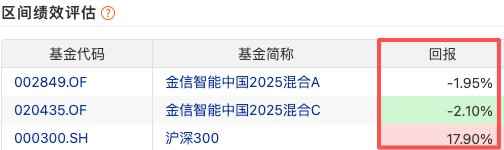
Core Viewpoint - The phenomenon of investment style drift is evident in the third-quarter report of the Jinxin Fund's Intelligent China 2025 Flexible Allocation Mixed Fund, which, despite its stated investment goal of focusing on intelligent enterprises, has heavily invested in traditional financial stocks, leading to poor performance and significant underperformance compared to peers [1][10]. Fund Performance - Jinxin Intelligent China 2025 Mixed Fund reported returns of -1.95% for Class A and -2.10% for Class C in the third quarter, while the benchmark return was 12.19%, and the CSI 300 index rose by 17.90%, indicating a nearly 20% underperformance against the index [2][3]. - Year-to-date performance as of October 21 shows Class A with a return of 14.90%, ranking 1417 out of 2303 similar products, and a six-month return of 11.87%, lagging the CSI 300 by nearly 10 percentage points [4][5]. Investment Strategy and Holdings - The fund's investment objective is to focus on enterprises providing intelligent production, design, and services, including sectors like smart machinery and smart healthcare [6]. - However, the top ten holdings for the third quarter were entirely traditional financial stocks, including major banks such as Industrial and Commercial Bank of China and China Construction Bank, indicating a significant deviation from its stated investment strategy [8][10]. Investor Sentiment - Investors have expressed concerns regarding the fund's strategy, questioning the rationale behind its heavy allocation to traditional financial stocks instead of intelligent enterprises, leading to skepticism about the fund's alignment with its stated goals [11][13]. Regulatory and Market Implications - The drift in investment style raises compliance concerns, as frequent style changes can mislead investors regarding the product's risk profile, potentially leading to greater scrutiny and pressure on the fund's future performance [14].



金信智能中国2025跑输大盘20%:“智能主题”基金却重仓银行,三季度踏空行情
凤凰网财经· 2025-10-22 12:48
Core Viewpoint - The article highlights the phenomenon of style drift in public funds, specifically focusing on the Jin Xin Fund's "Intelligent China 2025" mixed fund, which has deviated from its stated investment goal of focusing on intelligent enterprises by heavily investing in traditional financial stocks, resulting in poor performance compared to the market [3][4][11]. Group 1: Fund Performance - Jin Xin Intelligent China 2025 mixed fund reported a negative return of -1.95% and -2.10% for its A and C shares respectively in Q3, significantly underperforming the benchmark return of 12.19% and the CSI 300 index which rose by 17.90%, leading to a performance gap of nearly 20% [4][5]. - Year-to-date performance as of October 21 shows the fund's A shares with a return of 14.90%, ranking 1417 out of 2303 similar products, indicating a mid-to-low tier performance [6][7]. - The fund's total management scale decreased by 25.7% from 7.59 billion to 5.64 billion yuan in Q3 [6]. Group 2: Investment Strategy and Holdings - The fund's stated investment objective is to focus on enterprises providing intelligent production, design, and services, including sectors like smart machines and smart healthcare [8]. - However, the top ten holdings in Q3 were entirely traditional financial stocks, including major banks like ICBC and Ping An Bank, indicating a significant deviation from its stated investment strategy [9][10]. - The fund's historical trend shows a consistent increase in bank stock holdings since 2017, with at least 8 out of the top 10 holdings being bank stocks since 2018, demonstrating a long-standing style drift [11]. Group 3: Investor Sentiment and Concerns - Investors have expressed concerns regarding the fund's management and investment strategy, questioning the rationale behind the heavy allocation to traditional financial stocks despite the fund's focus on intelligent enterprises [12][15]. - The fund managers acknowledged the market volatility in Q3 but maintained that their strategy focused on the financial services sector's intelligence, which contrasts sharply with their actual stock selections [14][15]. - The article notes that frequent style shifts can lead to confusion among investors regarding the fund's positioning, potentially misleading them about the risk profile of the product [15].