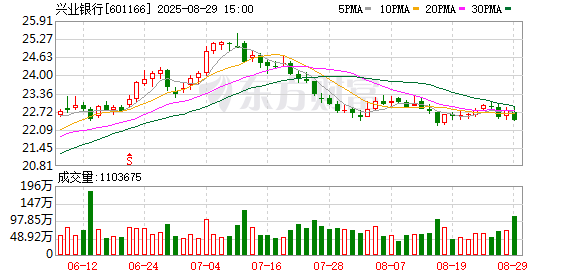
INDUSTRIAL BANK(601166)

Search documents
大家人寿上半年增持兴业银行,公司回应:挖掘优质战略标的并长期持有
Xin Lang Cai Jing· 2025-08-31 13:24
Group 1 - The core point of the article highlights that Dajia Life Insurance Co., Ltd. increased its stake in Industrial Bank during the reporting period, acquiring 540 million shares, bringing its total holdings to 650 million shares, which accounts for over 3% of the bank's shares [1] - As of the end of 2024, Dajia Life had not yet entered the top ten shareholders of Industrial Bank, but by the first quarter of 2025, it had made it into the top ten with consistent shareholding numbers [1] - A representative from Dajia Insurance stated the company's strategy is to identify quality strategic targets, including Industrial Bank, for long-term holding to leverage the advantages of long-term institutional investment [1]

13家银行个人存款同比仍增11.9万亿,定期化趋势未显著缓解
Di Yi Cai Jing· 2025-08-31 12:40
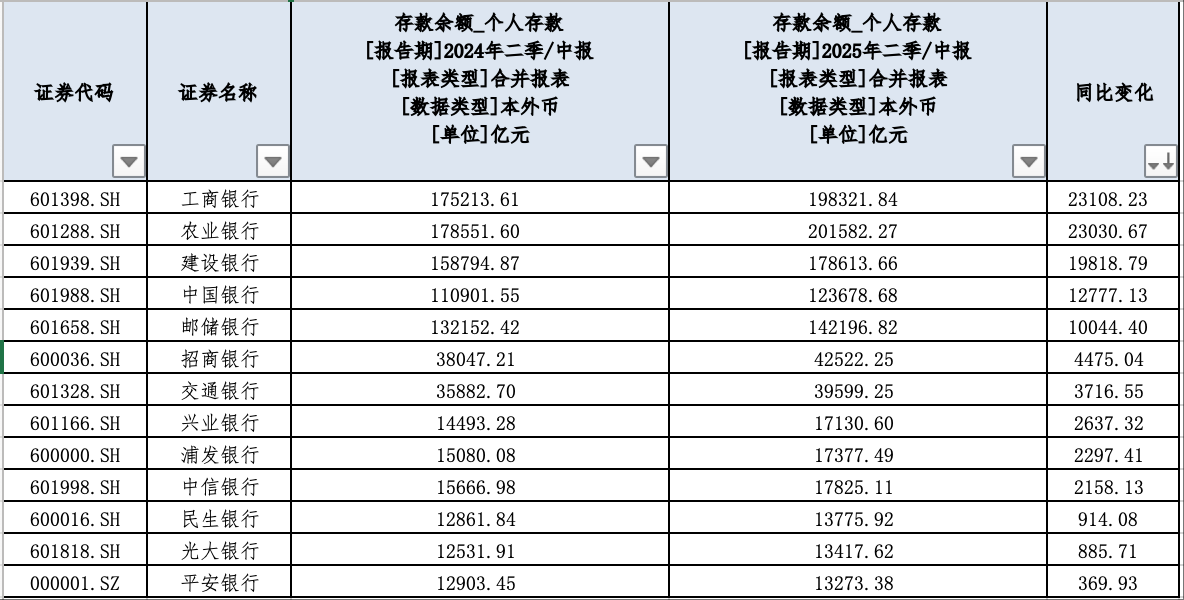
Core Viewpoint - The continuous decline in deposit rates, coupled with the concentration of fixed deposits maturing, is expected to significantly improve the cost of liabilities for banks [1][8]. Group 1: Deposit Trends - Recent reports indicate a trend of residents moving deposits from banks to other financial products such as funds and wealth management products [2][3]. - As of mid-2025, the total personal deposit balance of 13 major commercial banks reached 112.07 trillion yuan, an increase of 11.9 trillion yuan year-on-year [4][5]. - The average cost of deposits for these banks in the first half of 2025 was 1.61%, a decrease of 34 basis points compared to the same period in 2024 [12]. Group 2: Wealth Management Business Growth - The shift of deposits to wealth management products has led to significant growth in banks' wealth management income, with Agricultural Bank's wealth management income increasing by 62.3% [6]. - The total scale of bank wealth management products reached 30.67 trillion yuan by the end of June, with an estimated increase of about 2 trillion yuan by the end of July [6]. Group 3: Interest Margin and Cost of Liabilities - Despite the reduction in deposit costs, banks are still facing pressure on net interest margins, which have decreased to 1.42% as of the second quarter of 2025 [15][16]. - The average net interest margin for the 13 banks was 1.5%, down from 1.62% year-on-year [15]. - The decline in net interest margins is attributed to factors such as the reduction in the Loan Prime Rate (LPR) and adjustments in existing mortgage rates [17][18]. Group 4: Future Outlook - Analysts predict that the concentration of maturing fixed deposits will lead to a significant reduction in the cost of liabilities for banks in the coming years, with expected decreases of 17 to 24 basis points across different types of banks [11]. - The trend of increasing fixed deposits is expected to continue, with the proportion of fixed deposits among total deposits rising to approximately 59.7% in the first half of 2025 [9][10].







兴业银行北京分行举行第二批科技支行揭牌仪式
Zheng Quan Ri Bao Zhi Sheng· 2025-08-31 10:41
(编辑 张昕) 在揭牌仪式上,兴业银行北京分行党委委员张楠表示:"兴业银行高度重视科技金融发展,不仅在资源 配置和考核机制上给予差异化倾斜,而且大力践行总行'商行+投行'战略部署,为科技企业提供从股权 到债权、传统贷款到资本市场融资的全生命周期金融支持。未来,分行将通过'融资+融智',联动产业 资本与财务投资人,打造科技支行特色服务生态,赋能科创企业成长壮大,推动区域产业升级。" 此次第二批科技支行的揭牌,标志着兴业银行北京分行在加速落实总行科技金融领域战略部署上迈出坚 实步伐。未来,兴业银行北京分行将以科技支行为抓手,构建覆盖企业全生命周期的金融服务体系,不 断为首都科技企业的自主创新和区域产业的转型升级注入强劲动力。 本报讯 (记者吕东)为持续助力首都高质量发展、推动科技金融高标准建设,2025年8月28日至29日, 兴业银行北京分行第二批3家科技支行在京揭牌。 此次揭牌的三家科技支行分别为西城支行营业部、月坛支行、大兴支行。至此,兴业银行北京分行科技 支行总数已达7家,覆盖核心城区及重点产业聚集区,为科技企业提供更具针对性和专业化的全方位金 融服务。 ...
个人消费贷贴息明日开闸,贷30万元最多可享贴息3000元
Mei Ri Jing Ji Xin Wen· 2025-08-31 08:23
Core Viewpoint - The personal consumption loan interest subsidy policy will officially start on September 1, 2025, allowing residents to benefit from interest subsidies on eligible loans used for consumption [1][2]. Group 1: Policy Implementation - The subsidy period is from September 1, 2025, to August 31, 2026, covering personal consumption loans issued by various financial institutions [1]. - The subsidy applies to loans used for specific consumption categories, including household vehicles, education, cultural tourism, and health care, with a maximum subsidy of 3,000 yuan for eligible loans [2][5]. Group 2: Subsidy Standards - The annual subsidy rate is set at 1% of the actual loan principal used for consumption, with a cap of 50% of the loan contract interest rate [2]. - Each borrower can receive a total subsidy of up to 3,000 yuan, corresponding to a cumulative consumption amount of 300,000 yuan, with a specific limit of 1,000 yuan for loans under 50,000 yuan [2]. Group 3: Bank Promotions and Preparations - Multiple banks, including Bank of China, China Construction Bank, and others, have begun promotional activities for their consumption loan products, utilizing social media and mobile banking platforms [3][5][6]. - Banks are optimizing their customer service channels to provide information about the subsidy, including dedicated sections in mobile banking apps and enhanced intelligent customer service responses [7][8]. Group 4: Application Process - The application process for the subsidy will be similar to standard loan applications, with banks able to automatically identify eligible transactions for subsidy processing [10]. - Customers must sign a supplementary agreement to authorize banks to access their transaction information for subsidy eligibility [10]. Group 5: Customer Eligibility and Funding - The subsidy is available to both new and existing customers, provided their loans meet the eligibility criteria during the subsidy period [11]. - Subsidy funds will be deducted directly from the interest charged on the loans, simplifying the process for customers [12].


又一险资长期投资银行!透露最新业绩详情
券商中国· 2025-08-31 07:39
Core Viewpoint - The article highlights the strategic investment by Dajia Insurance in Industrial Bank, emphasizing the long-term holding perspective and the potential for collaboration between the two entities [1][3][4]. Group 1: Investment Strategy - Dajia Insurance has maintained a 3.09% stake in Industrial Bank, consistent with its position in the previous quarter [1]. - The approval of Dajia Insurance's executive to serve on the board of Industrial Bank allows for the investment to be accounted for as a long-term equity investment, reducing the impact of stock market volatility [3]. - Dajia Insurance aims to leverage its long-term institutional advantages to hold Industrial Bank as a key investment, responding to policies encouraging long-term capital market participation [2][3]. Group 2: Financial Performance - Dajia Insurance reported a comprehensive investment return of 5.5% for the first half of the year, continuing an upward trend observed in 2024 [5]. - The company has increased its allocation to fixed-income assets, which now constitute 64% of its portfolio, up by approximately 3.3 percentage points from the previous year [5]. - In equity investments, Dajia Insurance achieved a comprehensive return of 9.3%, indicating a strong performance relative to industry standards [7]. Group 3: Investment Focus - The company is focusing on high-dividend and high-return bank stocks, which align with the needs of insurance capital [4]. - Dajia Insurance is exploring investments in technology, green energy, and digital economy sectors, enhancing its asset allocation strategy [7]. - The firm has successfully exited overseas financial assets, capitalizing on favorable market conditions to achieve significant disposal profits [7].

个人消费贷贴息明日开闸!多家银行启动预热,五大热点答疑
Mei Ri Jing Ji Xin Wen· 2025-08-31 05:45
Core Viewpoint - The personal consumption loan interest subsidy policy will officially start on September 1, 2025, allowing residents to benefit from interest subsidies on eligible loans used for consumption [1][2]. Summary by Sections Policy Implementation - The subsidy policy will be in effect from September 1, 2025, to August 31, 2026, covering personal consumption loans issued by various banks, excluding credit card transactions [1][2]. - The subsidy applies to loans used for specific consumption categories, including household vehicles, education, healthcare, and electronics, with a maximum subsidy of 3,000 yuan for eligible loans [2][5]. Subsidy Standards - The annual subsidy rate is set at 1% of the eligible loan principal, capped at 50% of the loan contract interest rate [2]. - Each borrower can receive a total subsidy of up to 3,000 yuan, corresponding to a total consumption amount of 300,000 yuan, with a specific cap of 1,000 yuan for loans under 50,000 yuan [2]. Bank Promotions - Multiple banks, including China Bank, Construction Bank, and others, have begun promotional activities for their consumption loan products, utilizing social media and mobile banking platforms for outreach [2][5][6]. - Banks are offering various loan products that qualify for the subsidy, such as "E-loan" and "Quick Loan" from China Bank, and "iCar Loan" from Shanghai Pudong Development Bank [5][6][7]. Application Process - The application process for the subsidy is designed to be straightforward, with banks automatically identifying eligible transactions through their systems [9]. - Customers may need to sign a supplementary agreement to authorize banks to access their transaction information for subsidy eligibility [9]. Customer Eligibility - The subsidy is available to both new and existing customers, including those who applied for loans before the policy's implementation date, provided they meet the eligibility criteria [10]. - The subsidy will be applied directly to the interest payments, reducing the amount owed by the borrower [11]. Channels for Application - Customers are encouraged to apply for the subsidy through official channels such as bank branches and mobile banking apps, with no third-party intermediaries involved [12]. - No fees will be charged for processing the subsidy applications [12].


银行高管思辨“反内卷”: 在规范市场中提高客服硬实力
Zheng Quan Shi Bao· 2025-08-30 16:46
Core Viewpoint - The banking industry is shifting towards a "de-involution" approach to combat irrational price competition, which is seen as detrimental to long-term growth and stability [1][2][4]. Group 1: Industry Perspectives - The 2024 Central Economic Work Conference and the 2025 Government Work Report emphasize the need to address "involutionary" competition in the banking sector [1]. - The Central Financial Committee's recent meeting highlighted the importance of regulating low-price, disorderly competition among enterprises [1]. - Bank executives, including Ping An Bank's president, have warned that prolonged unprofitable competition poses a significant risk to the industry [1]. Group 2: Impact on Banking Operations - The "de-involution" policy is expected to stabilize net interest margins in the banking sector, as indicated by multiple bank leaders [2]. - There has been a noticeable reduction in malicious competition in loan pricing over the past two months, which helps alleviate downward pressure on asset yields [2]. - Banks are encouraged to enhance their service capabilities and customer experience as competition shifts from price to meeting customer needs [2]. Group 3: Strategic Shifts - Banks like Huaxia Bank and Zhejiang Commercial Bank are focusing on transitioning from price-based competition to differentiated, comprehensive services [4]. - The emphasis is on providing value-driven services centered around customer needs, rather than engaging in price wars [4]. - The industry consensus on "de-involution" is becoming a practical action rather than just a slogan, as discussed in recent earnings presentations [3].



260万银行人,半年平均薪酬“曝光”,5家月薪超4.5万
Zhong Guo Ji Jin Bao· 2025-08-30 12:41
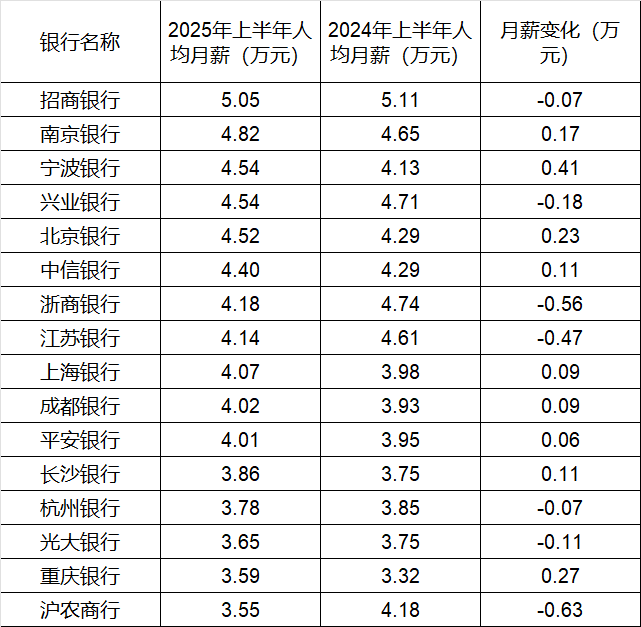
Core Insights - The average salary for bank employees in the first half of 2025 has slightly increased compared to the same period in 2024, with an average salary of 18.1 million yuan and an average monthly salary of 3.02 million yuan, reflecting a rise of approximately 1,300 yuan [2][4] - The salary trends show a balanced distribution, with about half of the banks increasing salaries while the other half decreased them [1][2] Salary Overview - The average monthly salary for major banks such as China Merchants Bank, Nanjing Bank, Ningbo Bank, Industrial Bank, and Beijing Bank exceeded 45,000 yuan in the first half of 2025 [1][2] - Specific monthly salaries for leading banks are as follows: China Merchants Bank at 50,500 yuan, Nanjing Bank at 48,200 yuan, and both Ningbo Bank and Industrial Bank at 45,400 yuan [2][3] Salary Changes - The salary changes for various banks from the first half of 2024 to the first half of 2025 are as follows: - China Merchants Bank: decreased by 700 yuan - Nanjing Bank: increased by 1,700 yuan - Ningbo Bank: increased by 4,100 yuan - Industrial Bank: decreased by 1,800 yuan - Beijing Bank: increased by 2,300 yuan [3] Employment and Compensation Strategy - The six major state-owned banks employ approximately 1.84 million people, accounting for over 70% of the total workforce in the banking sector [5] - State-owned banks are focusing on salary policies that favor grassroots employees, with initiatives to enhance compensation for those in county-level positions [5]




260万银行人,半年平均薪酬“曝光”,5家月薪超4.5万
中国基金报· 2025-08-30 12:39
Core Viewpoint - The average salary of bank employees in China has slightly increased in the first half of 2025 compared to the same period in 2024, with a notable number of banks experiencing salary increases while others saw declines [2][4]. Salary Overview - The average salary for 2.6 million bank employees in the first half of 2025 is approximately 181,000 yuan, translating to an average monthly salary of 30,200 yuan, which is an increase of about 1,300 yuan from the previous year [5]. - The average salary for the first half of 2024 was lower, with a decrease of over 5,000 yuan compared to the first half of 2023 [4]. Leading Banks in Salary - Joint-stock banks and city commercial banks lead in average salary levels, with several banks reporting average monthly salaries exceeding 45,000 yuan in the first half of 2025 [3]. - Specific banks with high average monthly salaries include: - China Merchants Bank: 50,500 yuan - Nanjing Bank: 48,200 yuan - Ningbo Bank: 45,400 yuan - Industrial Bank: 45,400 yuan - Beijing Bank: 45,200 yuan [5][6]. State-Owned Banks Salary Comparison - Among the six major state-owned banks, the average monthly salaries are significantly lower, with: - Bank of China: 28,200 yuan - Bank of Communications: 27,500 yuan - Industrial and Commercial Bank of China: 26,300 yuan - China Construction Bank: 26,200 yuan - Agricultural Bank of China: 25,200 yuan - Postal Savings Bank: 24,900 yuan [7][8]. Salary Policy Trends - Major state-owned banks are focusing on salary policies that favor grassroots employees, aiming to enhance talent development in county-level branches and improve employee engagement [10][11].


兴业银行业绩会:宁可让利不让风险 反内卷下价格战终结
Di Yi Cai Jing· 2025-08-30 10:00
"上个月,我们召开半年度全行工作会,进行了自我检视。总体来看,价值银行建设初显成效,但还有 一些薄弱环节需要正视与改进。比如,负债成本仍偏高,是稳息差的主要矛盾;重点区域贷款占比还偏 低,是稳投放的主要方向;资管财富类中收还不稳定,是提中收的关键。"8月29日,在兴业银行 (601166.SH)2025年中期业绩说明会上,兴业银行副董事长、行长陈信健说。 今年上半年,我国经济总体保持较强韧性,同时发展模式在深刻调整,银行业经营面临诸多挑战,包括 增速放缓、息差收窄、中收承压、市场波动等。面对这些挑战,各家银行积极应对。 陈信健表示,兴业银行继续锚定价值银行目标,坚持提升"战略执行、客户服务、投资交易、全面风 控、管理推动"五大能力,较好平衡"扩面与挖潜、负债与资产、表内与表外、风险管控与短期逐利"四 组关系,经营业绩符合预期。 银行业净息差正处于筑底阶段 盈利能力是商业银行持续经营、抵御风险、服务经济和回报股东的核心基础,是经营的最终结果,也是 战略执行能力的最好体现。 上半年,兴业银行主要盈利指标有所修复,实现营业收入1104.58亿元,同比下降2.29%,降幅较一季度 收窄1.29个百分点;实现净利润43 ...