
INDUSTRIAL BANK(601166)

Search documents
兴业银行业绩会:宁可让利不让风险,反内卷下价格战终结
Di Yi Cai Jing· 2025-08-30 09:55
Core Viewpoint - The bank aims to establish itself as a value bank, focusing on improving strategic execution, customer service, investment trading, comprehensive risk control, and management promotion while addressing challenges such as high liability costs and low loan ratios in key areas [1][2]. Financial Performance - In the first half of the year, the bank's operating income was CNY 110.46 billion, a year-on-year decrease of 2.29%, while net profit reached CNY 43.14 billion, a slight increase of 0.21% [2]. - The bank's net interest margin was 1.75%, down 11 basis points year-on-year and 7 basis points from the beginning of the year, indicating a trend of narrowing [2][3]. Cost Management - The bank achieved a 30 basis point reduction in the interest rate on general deposits year-on-year, with a significant 54 basis point decrease in the interest rate on interbank deposits [3]. - The bank expects to save CNY 1.54 billion in interest expenses by re-pricing CNY 270 billion of 3-5 year fixed deposits that are maturing [3]. Asset Quality - As of the end of the first half, the bank's non-performing loan ratio was 1.08%, stable compared to the first quarter, with a focus loan ratio of 1.66%, down 0.05 percentage points from the beginning of the year [5]. - The bank has made significant progress in risk mitigation in key areas such as real estate and local government financing platforms, with new non-performing loans peaking [6]. Market Environment - The banking industry is currently experiencing a bottoming phase in net interest margins, with signs of improvement as high-interest deposits mature [3][4]. - The "anti-involution" policies initiated in various regions aim to prevent unhealthy competition in the banking sector, which may lead to increased loan default risks in the short term but could improve the overall market structure in the long term [8][9]. Strategic Focus - The bank is committed to enhancing its professional service capabilities and optimizing product design and business processes to adapt to the changing competitive landscape [9].

兴业银行擦亮福农优品“金色招牌”
Zheng Quan Ri Bao Zhi Sheng· 2025-08-30 09:15
Group 1 - The event "Farming Products from Hometown" aims to promote rural revitalization through digital initiatives and live streaming, highlighting local agricultural resources [1] - The establishment of the Fujian E-commerce Alliance for Agriculture aims to enhance the visibility of local products and connect them with a broader market [1] - The event showcased various agricultural products, including hybrid rice seeds, which are significant to the local economy, with one in ten hybrid rice seeds in China originating from Jianing [1] Group 2 - The seed production industry faces challenges such as long production cycles, high investment, and risks, necessitating financial support for various stages including facility construction and seed development [2] - Financial support of 3.5 million yuan was provided to a local enterprise to alleviate concerns regarding production expansion, facilitated by the "Rural Revitalization Loan" product [2] - The "Jinfu Cloud Platform" allows rural enterprises to apply for credit loans, addressing the financing difficulties faced by farmers and agricultural enterprises [2] Group 3 - The importance of not only producing quality agricultural products but also ensuring effective sales strategies was emphasized, with the establishment of the e-commerce alliance being a positive development [3] - In August 2023, the establishment of a financial special commissioner system by Industrial Bank aims to enhance financial services for small and micro enterprises, with a team of over 1,800 professionals [3] - The initiative includes outreach activities to connect with local businesses and communities, ensuring the dissemination of financial policies and tailored services [3]
谈“息差管控”“反内卷”“可转债转股”,兴业银行业绩发布会高管回应这些话题!
Zhong Guo Ji Jin Bao· 2025-08-30 09:11
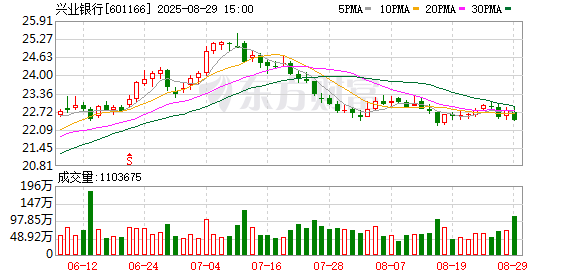
Core Viewpoint - Industrial Bank reported a turnaround in net profit, achieving positive growth after a previous decline, and demonstrated effective management of interest margins [2][3]. Financial Performance - As of June 30, 2025, Industrial Bank's total assets reached 10.61 trillion yuan, a 1.01% increase from the end of the previous year [2]. - The bank's revenue for the first half of the year was 110.46 billion yuan, a year-on-year decrease of 2.29%, with the decline rate narrowing by 1.29 percentage points compared to the first quarter [2]. - Net profit was 43.14 billion yuan, reflecting a year-on-year growth of 0.21%, marking a recovery from negative growth in the first quarter [2]. Interest Margin Management - The net interest margin for the first half of the year was 1.75%, down 7 basis points from 2024, which is within the expected range for joint-stock banks [3]. - Interest income was 73.7 billion yuan, showing a slight decline of 1.5% year-on-year, consistent with industry trends [3]. - The bank anticipates that the decline in net interest margin will be controlled within the initially projected 10 basis points for the year [3]. Asset Quality - The non-performing loan (NPL) ratio stood at 1.08%, unchanged from the first quarter, with a provision coverage ratio of 228.54% [2]. - New non-performing loans in the real estate sector decreased by 45.72% year-on-year, while credit card NPLs fell by 7.5% [5]. - The bank expects a decrease in the overall scale of new non-performing loans for the year compared to the previous year [5]. Loan Structure and Strategy - Retail deposits grew by 148.3 billion yuan, reaching 1.72 trillion yuan, positioning the bank as the second-largest among joint-stock banks [6]. - Corporate loans (excluding bills) increased by 227.1 billion yuan, with significant growth in green, technology, and manufacturing loans [6]. - The bank is focusing on reducing exposure to real estate and local government financing platforms, with respective loan balances decreasing by 21.15 billion yuan and 28.90 billion yuan [6]. Market Outlook and Policy Impact - The "anti-involution" policy is expected to provide both opportunities and challenges for the banking sector, potentially alleviating downward pressure on asset yields [7]. - The bank aims to achieve a new loan target of 300 billion yuan for corporate finance and improve retail loan performance while managing risks [7]. Convertible Bonds - The bank is optimistic about the conversion of its convertible bonds, with a remaining balance of 41.35 billion yuan, following a full conversion by the Fujian Provincial Finance Department [9]. - The current stock price is above the conversion price, indicating potential for further valuation recovery [9].

谈“息差管控”“反内卷”“可转债转股”,兴业银行业绩发布会高管回应这些话题!
中国基金报· 2025-08-30 09:05
Core Viewpoint - The core viewpoint of the article is that Industrial Bank has successfully turned its net profit from negative to positive in the first half of 2025, demonstrating effective management of net interest margin and overall operational performance that outperformed the market expectations [2][4]. Financial Performance - As of June 30, 2025, Industrial Bank's total assets reached 10.61 trillion yuan, an increase of 1.01% compared to the end of the previous year [2]. - The bank reported revenue of 1104.58 billion yuan, a year-on-year decrease of 2.29%, with the decline rate narrowing by 1.29 percentage points compared to the first quarter [2]. - Net profit for the first half of the year was 431.41 billion yuan, showing a year-on-year growth of 0.21%, marking a turnaround from negative growth in the first quarter [2]. Asset Quality - The non-performing loan (NPL) ratio stood at 1.08%, unchanged from the first quarter, while the provision coverage ratio was 228.54% [3]. - The bank has seen a significant reduction in new non-performing loans in key sectors: new non-performing loans in real estate decreased by 45.72% year-on-year, and credit card non-performing loans fell by 7.5% [9]. Net Interest Margin Management - The net interest margin for the first half of 2025 was 1.75%, down 7 basis points from 2024, which is within the expected range for joint-stock banks [5]. - The bank anticipates that the decline in net interest margin will be controlled within the initially projected 10 basis points for the year, with a narrowing of the decline in net interest income expected in the second half [6]. Loan Structure and Strategy - Industrial Bank's retail deposits grew by 148.3 billion yuan in the first half, reaching 1.72 trillion yuan, positioning it as the second-largest among joint-stock banks [10]. - Corporate loans (excluding bills) increased by 227.1 billion yuan, with notable growth in green, technology, and manufacturing loans [10]. - The bank is focusing on risk management and aims to achieve a target of 300 billion yuan in new corporate loans for the year [11]. Policy Impact - The "anti-involution" policy is seen as both an opportunity and a challenge for the banking sector, potentially alleviating downward pressure on asset yields while also leading to a more competitive environment focused on meeting customer needs [12]. - The policy is expected to drive financial resources towards high-end manufacturing and green economy sectors, optimizing the bank's asset and client structure [12]. Convertible Bonds - Industrial Bank is optimistic about the conversion of its convertible bonds, with a significant portion already converted by a major shareholder, reflecting confidence in the bank's long-term development [14]. - The current stock price is above the conversion price, indicating potential for further valuation recovery [14].
上海大消息!20多家银行宣布:调整
Zhong Guo Ji Jin Bao· 2025-08-30 01:53
Core Viewpoint - Shanghai's new housing policy has led to a reduction in mortgage rates for existing loans and a minimum rate of 3.09% for new second-home loans, aligning them with first-home rates [1][3]. Group 1: New Mortgage Rates - The new policy eliminates the distinction between first and second home mortgage rates in Shanghai, with the specific rate determined by the market rate pricing mechanism and individual bank conditions [2][10]. - The minimum mortgage rate for new second-home loans in Shanghai is set at 3.09%, which is consistent with the first-home loan rate [3][2]. Group 2: Existing Mortgage Adjustments - Existing mortgage rates can be adjusted for eligible borrowers, particularly if their current rate exceeds the national average by more than 30 basis points [4][11]. - For example, a second-home loan with a current rate of 3.45% could potentially be reduced to 3.36% [6][4]. - The adjustment process will not incur any fees and will begin on September 1, 2025 [7][14]. Group 3: Implementation and Communication - Banks in Shanghai, including major institutions like ICBC and Bank of China, have issued announcements regarding the new mortgage rate adjustments [1][9]. - Borrowers can check their eligibility for rate adjustments through their respective banks starting September 1, 2025 [12][13].





银行高管思辨“反内卷”:在规范市场中提高客服硬实力
Zheng Quan Shi Bao· 2025-08-29 19:49
Core Viewpoint - The banking industry has reached a consensus on "anti-involution," transitioning from a slogan to actionable measures, as highlighted in recent semi-annual performance briefings [1]. Group 1: Industry Consensus and Policy - The 2024 Central Economic Work Conference and the 2025 Government Work Report have called for a "comprehensive rectification of 'involutionary' competition" [1]. - The sixth meeting of the Central Financial Committee emphasized the need to "legally and reasonably govern low-price and disorderly competition" [1]. Group 2: Impact on Banking Operations - Ping An Bank's president, Ji Guangheng, stated that competition that does not cover costs is detrimental and poses a potentially disruptive risk to the industry [1]. - Hangzhou Bank's vice president, Zhang Jianfu, noted that irrational price wars negatively affect normal banking development, leading to situations where business growth does not translate into revenue or profit [1]. - The long-term impact of such competition could weaken banks' ability to serve the real economy and accumulate risks that affect macroeconomic development [1]. Group 3: Benefits of "Anti-Involution" - Ping An Bank's vice president, Xiang Youzhi, believes that "anti-involution" will create a fairer and more vibrant market, enhance the effective allocation of financial resources, and maximize the interests of financial entities and society [1]. - The policy is expected to promote long-term, high-quality development in the financial industry and protect the legitimate rights of financial customers [1]. Group 4: Stabilization of Net Interest Margin - Citic Bank's president, Lu Wei, indicated that "anti-involution" policies and neutral monetary policies will help stabilize the banking industry's net interest margin [2]. - Zhang Jianfu echoed this sentiment, suggesting that combating irrational pricing will contribute to stabilizing bank interest margins [2]. Group 5: Addressing Malicious Competition - Industrial Bank's financial planning department general manager, Lin Shu, noted that "anti-involution" helps regulate malicious and disorderly competition in loan pricing, alleviating downward pressure on bank asset returns [2]. - However, Lin also pointed out potential inconsistencies in the implementation of "anti-involution" policies across different regions and banks [2]. Group 6: Focus on Customer Needs - As price competition diminishes, banks will need to compete based on their ability to meet customer needs, emphasizing the importance of enhancing professional service capabilities and optimizing business processes [2]. - Huaxia Bank's president, Qu Gang, stated the importance of adhering to regulatory and self-discipline requirements, shifting focus from price competition to value-based services centered around customer needs [2]. - Zhejiang Merchants Bank's president, Chen Haiqiang, mentioned the shift from price-based competition to differentiated comprehensive services, focusing on the entire customer lifecycle [2].



42家上市银行半年盈利1.1万亿六大国有行将分红超2000亿元
Zheng Quan Shi Bao· 2025-08-29 19:49
Core Viewpoint - The banking sector demonstrated stability and resilience in the first half of 2025, achieving a revenue of over 2.9 trillion yuan and a net profit of 1.1 trillion yuan, while focusing on supporting the real economy and preparing for digital transformation [1] Group 1: Financial Performance - A total of 42 A-share listed banks reported a revenue exceeding 2.9 trillion yuan, with a year-on-year growth of over 1% [1] - The net profit attributable to shareholders reached 1.1 trillion yuan, reflecting a year-on-year increase of 0.8% [1] - The six major state-owned banks collectively achieved a revenue of 1.8 trillion yuan and a net profit of 682.52 billion yuan in the first half of 2025 [3] Group 2: Asset and Liability Management - The total asset scale of the six major banks reached approximately 214 trillion yuan, an increase of about 7% compared to the end of the previous year [3] - The total asset scale of nine listed joint-stock banks was approximately 72 trillion yuan, growing by 2.37% [3] - The Industrial and Commercial Bank of China (ICBC) reported an asset scale of 52 trillion yuan, leading the industry in customer loans and deposits [3] Group 3: Dividend Distribution - The six major state-owned banks announced a total cash dividend exceeding 204.65 billion yuan for the first half of 2025 [2][4] Group 4: Digital Transformation - The application of artificial intelligence (AI) has become a key driver for the banks' transformation, with various banks launching AI initiatives and projects [5] - ICBC has initiated the "AI+" action, while Agricultural Bank of China is advancing its "AI+" applications [5] - By the end of June, ICBC had implemented over 100 AI application scenarios across key business areas [5] Group 5: Credit Growth and Focus on Real Economy - The total loan balance of 42 A-share listed banks reached approximately 180 trillion yuan, with a year-on-year growth of about 6% [6] - State-owned banks are the main contributors to credit issuance, with a loan balance exceeding 120 trillion yuan, growing by 6.59% [6] - Agricultural Bank of China reported a loan and advance total of 26.73 trillion yuan, with significant growth in manufacturing, green loans, and inclusive loans [7]



兴业银行: 兴业银行2025年中期审阅报告
Zheng Quan Zhi Xing· 2025-08-29 17:25
Core Viewpoint - The report presents the interim financial statements of Industrial Bank Co., Ltd. for the six months ending June 30, 2025, highlighting the bank's financial performance and compliance with accounting standards [2][3]. Company Overview - Industrial Bank Co., Ltd. was established on July 20, 1988, as a joint-stock commercial bank approved by the People's Bank of China. It went public on February 5, 2007, with the stock code [2]. - The bank's operations include accepting public deposits, issuing loans, conducting domestic and international settlements, and providing various financial services [2]. Financial Reporting Basis - The interim financial statements are prepared in accordance with the Accounting Standards for Business Enterprises No. 32, reflecting the financial position and performance of the bank and its subsidiaries as of June 30, 2025 [2][3]. Compliance with Accounting Standards - The financial statements comply with the requirements set forth by the China Securities Regulatory Commission regarding the disclosure of financial statements and notes [2][3]. Consolidation Scope - The report includes the financial data of the bank and its subsidiaries, detailing their respective ownership percentages and capital contributions [2][4]. Key Financial Metrics - As of June 30, 2025, the bank reported cash and cash equivalents of RMB 5,321 million, with a statutory reserve deposit of RMB 307,884 million [6][7]. - The bank's total loans and advances amounted to RMB 5,777,965 million, with a provision for loan losses of RMB 143,707 million [12][13]. Derivative Financial Instruments - The bank engages in derivative financial instruments for risk management, with nominal amounts for interest rate derivatives at RMB 9,564,996 million and fair value losses of RMB 31,039 million [8][9]. - The total nominal amount of derivatives is RMB 13,526,619 million, with a fair value of RMB 60,126 million [8][9]. Fair Value Hedge - The bank utilizes fair value hedges to mitigate risks associated with market interest rate fluctuations, with specific instruments such as interest rate swaps and futures contracts [11][12].
兴业银行: 兴业银行第九届监事会第八次会议决议公告
Zheng Quan Zhi Xing· 2025-08-29 17:25
Group 1 - The core viewpoint of the announcement is the resolutions made during the 8th meeting of the 9th Supervisory Board of Industrial Bank Co., Ltd., which includes the approval of the revised articles of association and the review of the 2025 semi-annual report [2][3] - The meeting was held on August 27, 2025, in Fuzhou, with all five supervisors present, including one attending via video [2] - The resolutions passed include the approval of the semi-annual report, the formulation of the 2025 recovery plan, and the rectification report regarding consumer rights protection evaluation for the year 2024 [3] Group 2 - The semi-annual report was confirmed to comply with legal, regulatory, and internal management requirements, accurately reflecting the company's operational and financial status [3] - The first resolution regarding the revision of the articles of association will be submitted for approval at the first extraordinary shareholders' meeting of 2025 [3] - All resolutions received unanimous support from the supervisors, with no votes against or abstentions [2][3]
兴业银行: 兴业银行2025年半年度报告
Zheng Quan Zhi Xing· 2025-08-29 17:15
Core Viewpoint - The company emphasizes its commitment to high-quality development and strategic transformation, focusing on integrating various financial services and enhancing its competitive advantages in green finance, wealth management, and investment banking [1][3][14]. Financial Performance - For the first half of 2025, the company reported operating income of 110.46 billion RMB, a decrease of 2.29% compared to the same period in 2024 [10]. - Net profit attributable to shareholders was 43.14 billion RMB, showing a slight increase of 0.21% year-on-year [10][16]. - Total assets reached 10.61 trillion RMB, reflecting a growth of 1.01% from the end of 2024 [10][15]. Strategic Initiatives - The company is actively pursuing a "1234" strategic framework, focusing on "light assets, light capital, and high efficiency" to enhance its banking capabilities [6][19]. - It aims to strengthen its position in five new sectors: technology finance, inclusive finance, energy finance, automotive finance, and park finance [2][6]. - The company is committed to building a "value bank" by improving five core capabilities: strategic execution, customer service, investment trading, comprehensive risk control, and management promotion [14][19]. Risk Management - The company has implemented reforms in its risk management system to enhance its ability to identify and mitigate risks [17]. - As of June 30, 2025, the non-performing loan ratio was 1.08%, indicating stability in asset quality [11][17]. - The provision coverage ratio stood at 228.54%, ensuring a robust buffer against potential loan losses [11][18]. Market Position - The company ranked 14th globally in the "Banker" magazine's 2025 list of the top 1000 banks by Tier 1 capital [4]. - It maintains a leading position in green finance, with green loan balances reaching 1.08 trillion RMB, a growth of 15.61% from the previous year [18]. - The company has successfully expanded its customer base, with corporate clients increasing by 4.26% and retail clients by 1.63% compared to the previous year [17].