INDUSTRIAL BANK(601166)

Search documents
兴业银行(601166) - 兴业银行股份有限公司董事会议事规则
2025-12-29 12:02
1 第一章 总 则 第二章 董事会构成与职权 第三章 会议召集 第四章 议事与表决 第五章 会议记录 第六章 附 则 第一章 总 则 兴业银行股份有限公司董事会议事规则 (2025 年修订) 目 录 第一节 一般议事规定 第二节 特别议事规定 第一条 为规范兴业银行股份有限公司(以下简称本行) 董事会运作,保障董事会依法独立、规范、有效地行使职权, 根据《中华人民共和国公司法》《中华人民共和国商业银行 法》《银行保险机构公司治理准则》《上市公司章程指引》 《上市公司治理准则》等法律、行政法规、规章及《兴业银 行股份有限公司章程》(以下简称"本行章程")的规定, 特制定本规则。 第二条 董事会是本行决策机构,遵照有关法律、行政 法规、规章及本行章程的规定履行职责。 第二章 董事会构成与职权 第三条 本行董事会由十三至十九名董事组成,其中独 立董事人数原则上不低于董事会成员总数的三分之一;设董 事长一名,可根据需要设副董事长一名。董事长和副董事长 由本行董事担任,由全体董事的过半数选举产生和解任。董 事会成员的结构应符合法律、行政法规、规章和有关监管机 关的规定。 第四条 本行董事会行使下列职权: (一)召集股东 ...
兴业银行(601166) - 兴业银行股份有限公司股东会议事规则
2025-12-29 12:02
兴业银行股份有限公司股东会议事规则 (2025 年修订) 目 录 第一章 总 则 第二章 股东会的职权 第三章 股东会的召集 第四章 独立董事、董事会审计与关联交易控制委员会、 股东提议召开的临时股东会 第五章 提案 第六章 议事和表决 第一节 一般议事规定 第二节 特别议事规定 第七章 会议记录和决议 第八章 其他规定 第九章 附 则 1 第一章 总 则 第一条 为规范兴业银行股份有限公司(以下简称本行) 股东会的组织和行为,保证股东会依法、规范、高效地运作, 确保股东有效地行使职权,保障股东的合法权益,根据《中 华人民共和国公司法》《中华人民共和国证券法》《中华人 民共和国商业银行法》《银行保险机构公司治理准则》《上 市公司章程指引》《上市公司股东会规则》等法律、行政法 规、规章及《兴业银行股份有限公司章程》(以下简称"本 行章程")的规定,特制定本规则。 (七)对本行增加或者减少注册资本作出决议; 第二条 股东会由本行全体股东组成。股东会是本行的 权力机构,依法行使法律、行政法规、规章及本行章程规定 的各项职权,不得干涉股东对自身权利的处分。 第二章 股东会的职权 第三条 本行股东会依法行使下列职权: ...
兴业银行(601166) - 兴业银行股份有限公司章程
2025-12-29 12:02
兴业银行股份有限公司章程 [2025 年 9 月 17 日经兴业银行股份有限公司 2025 年第一次临时 股东会审议通过,2025 年 12 月 26 日经国家金融监督管理总局 (金复〔2025〕762 号)核准生效] — 1— 目 录 第六章 董事和董事会 — 2 — 第一章 总 则 第二章 经营宗旨和范围 第三章 股 份 第一节 股份发行 第二节 股份增减和回购 第三节 股份转让 第四节 优先股的特别规定 第四章 党组织 第五章 股东和股东会 第一节 股东 第二节 控股股东、实际控制人 第三节 股东会的一般规定 第四节 股东会的召集 第五节 股东会的提案和通知 第六节 股东会的召开 第七节 股东会的表决和决议 第一节 董事的一般规定 第二节 独立董事 第三节 董事会 第四节 董事会秘书 第七章 行长和高级管理层 第二节 解散和清算 — 3— 第八章 财务会计制度、利润分配和审计 第一节 财务会计制度 第二节 内部审计 第三节 会计师事务所的聘任 第九章 通知和公告 第一节 通知 第二节 公告 第十章 合并、分立、增资、减资、解散和清算 第一节 合并、分立、增资和减资 第十一章 修改章程 第十二章 附 则 ...
兴业银行(601166) - 兴业银行关于公司章程修订获核准及不再设置监事会的公告
2025-12-29 12:01
本公司董事会及全体董事保证本公告内容不存在任何虚假记载、误导性陈述 或者重大遗漏,并对其内容的真实性、准确性和完整性承担法律责任。 兴业银行股份有限公司(以下简称本公司)于 2025 年 9 月 17 日召开的 2025 年第一次临时股东会审议通过了《关于修订章程的议案》《关于修订〈股东会议 事规则〉的议案》《关于修订〈董事会议事规则〉的议案》和《关于不再设置监 事会的议案》。 公告编号:临 2025-068 A股代码:601166 A股简称:兴业银行 可转债代码:113052 可转债简称:兴业转债 兴业银行股份有限公司 关于公司章程修订获核准及不再设置监事会的公告 今日,本公司收到《国家金融监督管理总局关于兴业银行修改公司章程的批 复》(金复〔2025〕762 号),本公司修订后的公司章程已于 2025 年 12 月 26 日获国家金融监督管理总局核准并生效。公司章程全文详见上海证券交易所网站 (www.sse.com.cn)和本公司网站(www.cib.com.cn)。修订后的《兴业银行股 份有限公司股东会议事规则》和《兴业银行股份有限公司董事会议事规则》同步 生效。 自公司章程核准之日起,本公司不再设置 ...
跨境支付(CIPS)概念涨1.57%,主力资金净流入这些股
Zheng Quan Shi Bao Wang· 2025-12-29 09:32
Group 1 - The cross-border payment (CIPS) concept increased by 1.57%, ranking 7th among concept sectors, with 51 stocks rising, including Cuivi Co. and *ST Rendong hitting the daily limit [1] - Leading gainers in the CIPS sector included Lakala, *ST Tianyu, and Sifang Precision, with increases of 12.57%, 11.40%, and 6.30% respectively [1] - The sector saw a net inflow of 2.446 billion yuan from main funds, with 46 stocks receiving net inflows, and 11 stocks exceeding 100 million yuan in net inflow [1] Group 2 - The top stocks by net inflow included Cuivi Co. with 368 million yuan, followed by Lakala, Industrial Bank, and China Merchants Bank with 361 million yuan, 256 million yuan, and 243 million yuan respectively [1] - The net inflow ratios for major banks included China Construction Bank at 16.86%, Industrial Bank at 15.97%, and Cuivi Co. at 15.55% [2] - The trading volume and turnover rates for leading stocks in the CIPS sector were significant, with Cuivi Co. at a turnover rate of 24.01% and Lakala at 17.11% [2]




银行业周度追踪2025年第51周:央行金融稳定报告有哪些要点?-20251229



Changjiang Securities· 2025-12-29 09:14
Investment Rating - The report suggests a focus on undervalued, high-dividend banks, particularly large city commercial banks and state-owned banks [2][19]. Core Insights - The banking sector experienced a decline of 0.9% this week, with negative excess returns influenced by a rebound in market risk appetite, leading to continued outflows of active funds from the sector [2][9]. - The People's Bank of China released a financial stability report indicating a decrease in the number of high-risk rated financial institutions, with the number of red zone (high-risk) institutions dropping from 357 to 312 [6][40]. - The report highlights that the asset scale of red zone banks accounts for only 2.1% of the total, indicating overall stability in the banking sector [6][40]. - The report emphasizes that major banks maintain stable capital levels under various GDP slowdown scenarios, with capital adequacy ratios remaining above regulatory requirements [7][43]. Summary by Sections Market Performance - The banking index has shown a cumulative decline of 0.9%, underperforming compared to the CSI 300 and ChiNext indices by 2.8% and 4.8% respectively [9][19]. - Active funds have been flowing out of the banking sector, with net outflows of approximately 1 billion yuan over the past week [21]. Financial Stability Report Highlights - The financial stability report indicates a reduction in the number of participating financial institutions due to mergers and restructuring, with a total of 3529 institutions evaluated in 2025, down from 3936 in 2023 [6][40]. - The report notes that the distribution of ratings for village and town banks has decreased to the 3-D level, reflecting some tail risks in the industry [6][40]. Capital Stability Under Stress Tests - Stress tests for 23 major banks indicate that under light, moderate, and severe scenarios, the capital adequacy ratio could decrease by 5.81, 6.43, and 7.33 percentage points respectively, but remains compliant with regulatory standards [7][43][44]. - The report highlights that systemically important banks can maintain a capital adequacy ratio above 12% even under the most severe stress scenarios [50]. Convertible Bond Opportunities - The report identifies potential strong redemption opportunities in convertible bonds of banks, particularly for banks like Changshu Bank, Shanghai Bank, and Chongqing Bank, which are approaching their strong redemption prices [8][31]. Dividend Yield Analysis - As of December 26, the average dividend yield for the six major state-owned banks' A-shares has decreased to 3.96%, while the H-shares yield stands at 5.24%, with a discount rate of 24% compared to A-shares [25][29].
银行ETF南方(512700.SH)涨0.75%,兴业银行涨1.28%
Jin Rong Jie· 2025-12-29 07:11
Group 1 - The core viewpoint of the articles indicates that the banking sector is expected to experience a systematic valuation recovery by 2026, shifting the investment logic from pure dividend defense to a dual drive of "dividend + growth" [1] - The banking stocks are characterized by high dividends and low valuations, which continue to attract stable funds in the context of declining risk-free interest rates [1] - Factors such as stabilized interest margins, a rebound in regional credit demand, and growth in non-interest income are anticipated to drive the performance elasticity of quality banks, leading to a potential shift in valuation logic from Price-to-Book (PB) to Price-to-Earnings (PE) [1] Group 2 - The Southern Bank ETF (512700.SH) is highlighted as an effective tool for capturing opportunities in the banking sector, benefiting from the dividends of state-owned banks, the growth elasticity of quality joint-stock banks, and regional policy dividends [1] - The article notes that as of 14:44, the Southern Bank ETF rose by 0.75%, and Industrial Bank increased by 1.28% [1]
香港金管局:人民币业务资金安排额度翻倍至1000亿元 参与银行扩至40家
Zhi Tong Cai Jing· 2025-12-29 05:53
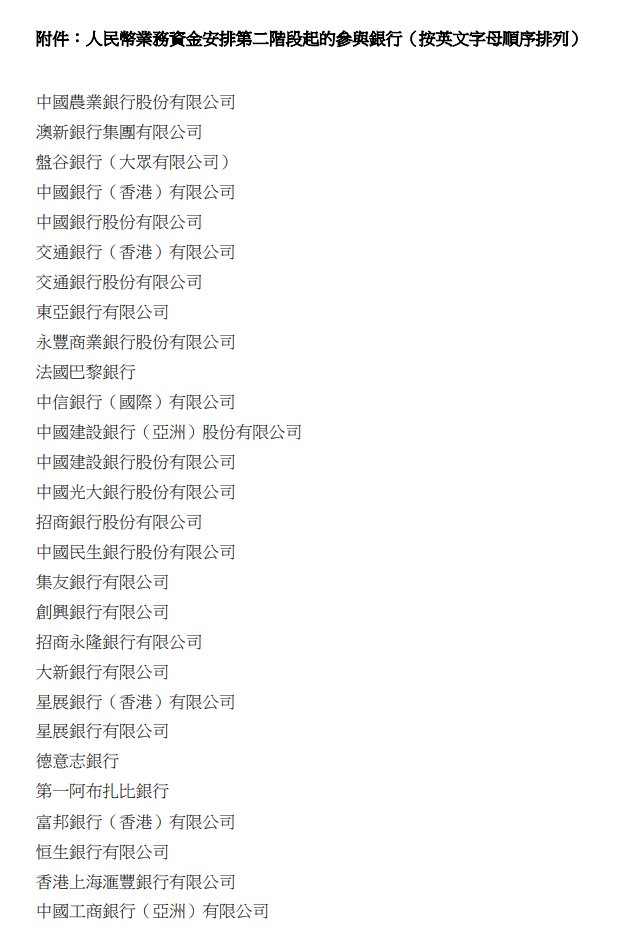
12月29日,香港金管局公布,自人民币业务资金安排第二阶段起,参与银行名单已扩大至40家,分配给 参与银行的总额度由前阶段的500亿元人民币增加至1,000亿元人民币。如香港金管局于9月26日所公 布,人民币业务资金安排由第二阶段起,进一步扩大所涵盖的合资格人民币资金用途范围至人民币资本 支出,及营运资金定期贷款。对此优化安排,银行业界反应正面。 中國農業銀行股份有限公司 澳新銀行集團有限公司 盤谷銀行(大眾有限公司) 中國銀行(香港)有限公司 中國銀行股份有限公司 交通銀行(香港)有限公司 交通銀行股份有限公司 東亞銀行有限公司 永豐商業銀行股份有限公司 法國巴黎銀行 中信銀行(國際)有限公司 中國建設銀行(亞洲)股份有限公司 中國建設銀行股份有限公司 中國光大銀行股份有限公司 招商銀行股份有限公司 中國民生銀行股份有限公司 集友銀行有限公司 創興銀行有限公司 招商永隆銀行有限公司 大新銀行有限公司 星展銀行(香港)有限公司 星展銀行有限公司 德意志銀行 第一阿布扎比銀行 富邦銀行(香港)有限公司 恒生銀行有限公司 香港上海滙豐銀行有限公司 中國工商銀行(亞洲)有限公司 中國工商銀行股份有限公司 興業銀行股 ...






《养老金融发展白皮书(2025)》发布:机构深耕细作时代来临
2 1 Shi Ji Jing Ji Bao Dao· 2025-12-29 04:16
Core Insights - The aging population in China is becoming a significant challenge, with projections indicating that by the end of 2024, 22.0% of the population will be over 60 years old, and 15.6% will be over 65 years old, marking an increase from 2019 [1] - The government is actively implementing policies to enhance the pension finance system, aiming to create a robust framework for pension financial services and products [2][3] Policy Developments - In December 2024, a joint guideline was issued by the People's Bank of China and nine other departments to support the development of the silver economy through targeted financial products for different age groups [2] - The National Financial Supervision Administration released an implementation plan in March 2025 to establish a diverse commercial pension finance system [2] Research Findings - A recent white paper by Industrial Bank highlights that nearly 80% of respondents are willing to allocate up to 30% of their monthly income for retirement savings, with a preference for bank deposits and wealth management products [3][8] - The white paper also indicates a significant urban-rural divide in pension account participation, with urban residents showing higher account opening and contribution rates compared to rural residents [6] Future Trends - The white paper predicts a "six-fold" trend in pension finance development, including systematic management of pension funds, diversification of pension products, personalized financial services, age-appropriate online and offline services, diversified financing methods for the pension industry, and the integration of smart technologies in the silver economy [19][20][21] Consumer Behavior - The ideal monthly retirement expenditure for respondents is between 3,000 to 5,000 yuan, with higher expectations in first-tier cities [12] - The demand for diverse pension financial products is characterized by a preference for safety, rational return expectations, and sensitivity to liquidity [8][12] International Insights - The white paper draws on international experiences, particularly from Japan, suggesting that China can enhance participation in personal pension systems through optimized tax policies and targeted subsidies for low-income groups [14][16] - The analysis indicates that as life expectancy increases, the demand for institutional care in China is likely to rise, similar to trends observed in Japan [16][17]
超越金融:银行如何织就“养老金融+养老服务”的生态网?
2 1 Shi Ji Jing Ji Bao Dao· 2025-12-29 04:16
Core Insights - The article discusses the emergence of a significant "silver economy" in China due to rapid population aging, highlighting the need for innovative financial services tailored to the elderly [1][3] - It emphasizes the shift from traditional financial services focused on account management to a more comprehensive approach that integrates financial products with various aspects of elderly care and lifestyle [5][6] Financial Policy and Market Trends - Since 2022, there has been a surge in pension finance policies, with the central financial work conference prioritizing "pension finance" as a new growth area for commercial banks [3][4] - The demand for pension financial services is evolving, requiring banks to extend their services beyond mere financial management to encompass a full range of elder care needs [3][5] Service Innovation and Integration - Banks are encouraged to create a comprehensive ecosystem that combines financial products with real-life services, addressing the diverse needs of elderly clients [5][6] - Leading banks, such as Industrial Bank, are already exploring innovative service models that integrate various elder care services, including healthcare and social activities, into their offerings [6][10] Challenges in Implementation - The article outlines several challenges banks face in establishing a cohesive pension finance ecosystem, including organizational structure, data sharing, and the need for specialized talent [8][9] - A shift from decentralized management to a more centralized and professional approach is recommended to enhance service delivery [8] Talent Development and Education - The lack of professionals who understand finance, elder care, and customer needs is identified as a significant barrier to improving pension financial services [9] - Industrial Bank is initiating a talent development program to train over 2,100 pension financial planners, focusing on practical experience and collaboration with industry experts [9] Community Engagement and Financial Literacy - Enhancing financial literacy among the elderly is crucial for the acceptance of innovative financial products and services [9] - Industrial Bank has conducted numerous public lectures and established educational bases to promote financial knowledge among the elderly, receiving positive feedback from the community [9][10]