
INDUSTRIAL BANK(601166)

Search documents
兴业银行涨2.02%,成交额13.21亿元,主力资金净流入779.79万元
Xin Lang Cai Jing· 2025-11-14 03:09
Group 1 - The core viewpoint of the news is that Industrial Bank's stock has shown a positive trend, with a 19.94% increase in price year-to-date and a recent rise of 2.55% over the last five trading days [1] - As of November 14, the stock price reached 21.71 CNY per share, with a market capitalization of 459.446 billion CNY and a trading volume of 1.321 billion CNY [1] - The net inflow of main funds was 7.7979 million CNY, with significant buying and selling activity from large orders [1] Group 2 - As of September 30, the number of shareholders increased by 13.93% to 217,900, while the average circulating shares per person decreased by 12.22% to 97,121 shares [2] - For the period from January to September 2025, Industrial Bank reported a net profit of 63.083 billion CNY, reflecting a year-on-year growth of 0.12% [2] - The bank has distributed a total of 216.103 billion CNY in dividends since its A-share listing, with 68.718 billion CNY distributed over the past three years [2]

银行股集体上涨,中证A500红利低波ETF(561680)红盘向上
Xin Lang Cai Jing· 2025-11-14 03:07
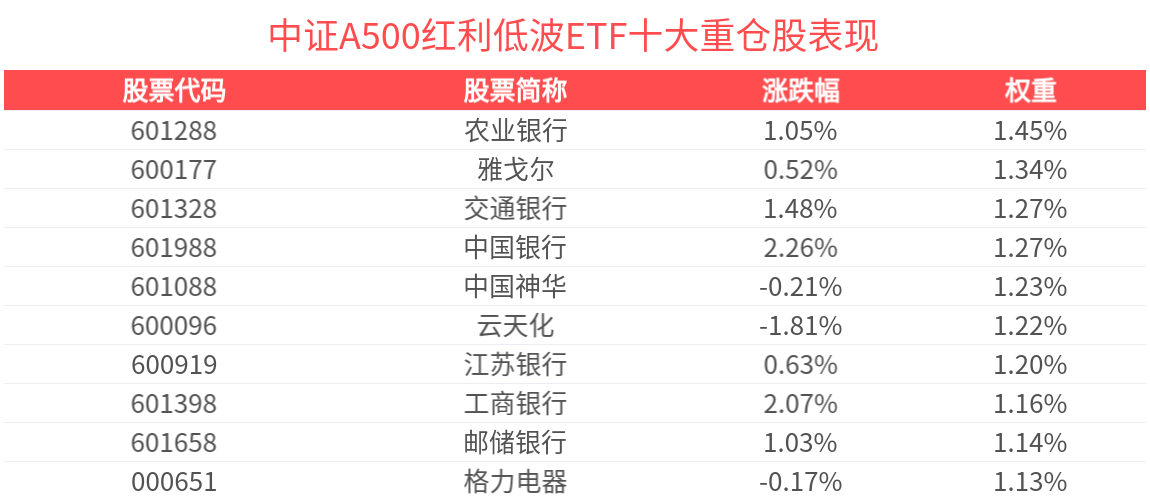
Core Insights - The China A500 Dividend Low Volatility Index (932422) has shown a slight increase of 0.14% as of November 14, 2025, with notable gains in major banks such as Bank of China (601988) up by 2.26% and Industrial and Commercial Bank of China (601398) up by 2.07% [1] Investment Environment - The National Bureau of Statistics emphasizes the need to focus on high-quality development, optimize investment structure, and enhance the investment environment to stimulate private investment and promote healthy investment growth [1] - According to Zhongtai Securities, the investment logic for bank stocks is shifting from "pro-cyclical" to "weak-cyclical," making high-dividend bank stocks more attractive during economic stagnation [1] - With the M1 growth rate declining, major financial data has entered a downward cycle, attributed to weaker fiscal expansion and the fading of low base effects [1] ETF Performance - The China A500 Dividend Low Volatility ETF (561680) has a turnover rate of 1.8% and a transaction volume of 3.36 million yuan as of November 14, 2025 [2] - Since its inception, the ETF has recorded a maximum monthly return of 3.37% and an average monthly return rate of 3.37%, with a monthly profit probability of 78.57% [2] - The maximum drawdown since inception is 3.42%, with a recovery period of 30 days [2] Index Composition - As of October 31, 2025, the top ten weighted stocks in the China A500 Dividend Low Volatility Index account for 31.82% of the index, including Agricultural Bank of China (601288) and China Shenhua Energy (601088) [3] - The top ten stocks include major banks and companies, indicating a strong representation of the financial sector within the index [3][5]






银行研思录25:银行股息率排名与中期分红进度梳理-20251114
CMS· 2025-11-14 03:02
Investment Rating - The report does not explicitly state an investment rating for the banking sector, but it provides detailed insights into dividend yields and distribution processes, which can inform investment decisions. Core Insights - The report outlines the latest dividend yields and mid-term dividend processes for A and H shares of listed banks, emphasizing the importance of accurately calculating dynamic dividend yields to avoid discrepancies across periods [1][2]. - It details the two processes for mid-term dividends following the 2023 revision of the regulatory guidelines, highlighting the conventional and simplified processes for implementing mid-term dividends [2]. - The report provides a comprehensive overview of key dates related to dividend distribution for both A and H shares, including the importance of purchasing shares before the ex-dividend date to qualify for dividends [3][4]. Summary by Sections Dynamic Dividend Yield Calculation - A simplified yet accurate method for calculating dynamic dividend yield is introduced, defined as "rolling 12-month EPS * cash dividend rate / share price," which helps avoid issues related to overlapping or missing annual and mid-term dividends [1]. - The report calculates the cash dividend rate using a standardized approach across different banks, resulting in a clear comparison of dividend yields as of November 13, 2025 [1]. Mid-Term Dividend Processes - The report explains the two processes for mid-term dividends: the conventional process requiring shareholder approval and a simplified process allowing for quicker implementation [2]. - The simplified process is designed to enhance flexibility for companies in distributing mid-term dividends, thereby improving shareholder returns [2]. Dividend Distribution Key Dates - For A shares, investors must purchase shares before the ex-dividend date to receive dividends on the same day, while H shares typically see a delay of about one month for dividend payments [3][4]. - The report outlines the differences in the dividend distribution timeline between A and H shares, emphasizing the need for investors to be aware of these timelines to maximize their returns [3][4]. Mid-Term Dividend Progress - As of November 13, 2025, 31 A-share banks have confirmed mid-term dividends, while 11 H-share banks have also confirmed their dividend distributions [9][11]. - The report categorizes banks based on their dividend status, detailing those that have implemented dividends, those that are pending, and those that have opted not to distribute dividends [9][10][11]. - It highlights that the end of 2025 and early 2026 is expected to be a peak period for mid-term dividend distributions, suggesting potential investment opportunities for dividend-seeking investors [11].






兴业银行成立金融资产投资公司,注册资本100亿
Zheng Quan Shi Bao Wang· 2025-11-14 02:01
人民财讯11月14日电,企查查APP显示,近日,兴银金融资产投资有限公司成立,注册资本100亿元, 经营范围包含:非银行金融业务。企查查股权穿透显示,该公司由兴业银行(601166)全资持股。 ...
沪深300ESGETF南方(560180)开盘跌0.50%
Xin Lang Cai Jing· 2025-11-14 01:43
Core Viewpoint - The article discusses the performance of the Hu-Shen 300 ESG ETF managed by Southern Fund Management, highlighting its recent market movements and returns since inception [1]. Group 1: Fund Performance - The Hu-Shen 300 ESG ETF (560180) opened at 1.188 yuan, experiencing a decline of 0.50% [1]. - Since its inception on April 13, 2023, the fund has achieved a return of 19.48%, with a monthly return of 2.79% [1]. Group 2: Major Holdings Performance - Key stocks in the fund's portfolio include: - Ningde Times: down 2.07% - Kweichow Moutai: down 0.03% - China Merchants Bank: up 0.07% - Zhongji Xuchuang: down 3.29% - Yangtze Power: unchanged - Midea Group: down 0.13% - BYD: down 0.83% - Industrial Bank: up 0.05% - Industrial and Commercial Bank of China: up 0.24% - Heng Rui Pharmaceutical: down 0.17% [1].





这些银行,悄悄发力理财代销
3 6 Ke· 2025-11-14 01:09
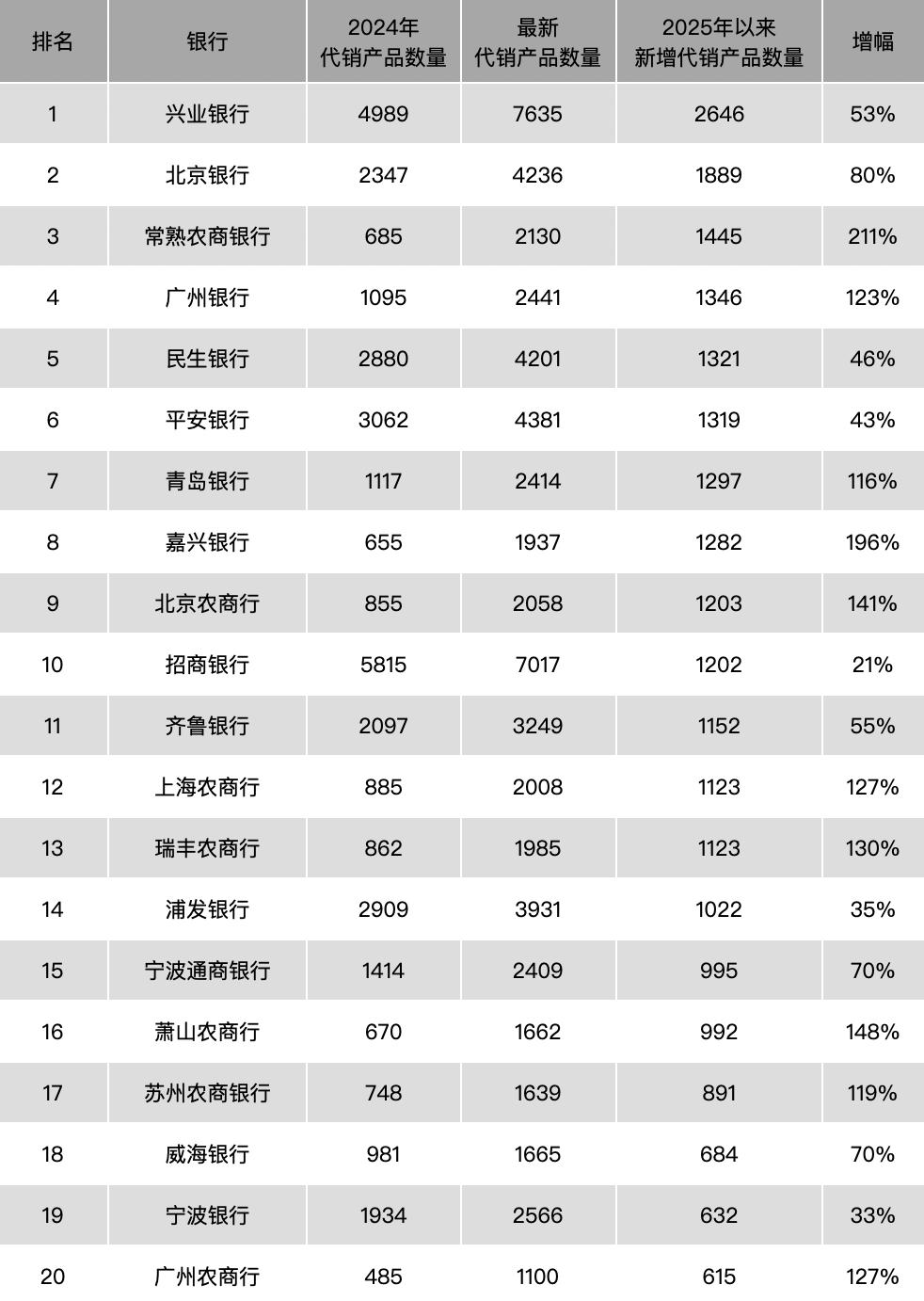
Core Insights - The banking wealth management distribution market has seen significant growth since 2025, with many banks rapidly increasing the number of wealth management products they distribute [2][3]. Distribution Growth - From the top 20 banks by incremental growth, at least 14 banks have added over 1,000 new wealth management products, with 10 banks doubling their product offerings compared to the end of last year, and some even exceeding a 200% increase [3][4]. - Notable banks include: - Industrial Bank: 7,635 products, a 53% increase [4] - Beijing Bank: 4,236 products, an 80% increase [4] - Changshu Rural Commercial Bank: 2,130 products, a 211% increase [4]. Performance Metrics - The wealth management distribution revenue for major banks has also increased significantly: - China Merchants Bank reported a wealth management distribution income of 7.014 billion yuan, an 18.14% year-on-year increase [8]. - Beijing Bank's distribution scale has exceeded last year's total, with a fee income growth of over 10% [8]. - Changshu Rural Commercial Bank's commission income grew over 57% in the third quarter, attributed to increased fees from agency wealth management services [8]. Market Dynamics - The wealth management distribution market has reached a new high, surpassing 32 trillion yuan, with 139 million investors holding wealth management products, a 12.7% year-on-year increase [10]. - The average annualized yield for cash management products is 1.33%, while fixed-income products yield 2.42%, indicating a competitive advantage over traditional savings [11]. Regulatory Changes - The implementation of the "Commercial Bank Agency Sales Business Management Measures" on October 1 has clarified standards and processes for distribution business [16]. - The market is witnessing a shift as many banks, especially smaller ones, are aggressively entering the wealth management distribution space to capture market opportunities amid narrowing interest margins [9][10]. Future Trends - The demand for retirement wealth management products is expected to grow, especially following the recent expansion of pilot programs for retirement financial products across the country [24][27]. - The market is preparing for increased competition as banks look to enhance their service capabilities and product offerings in response to evolving customer needs [23][24].


金价波动下风险防控提级 银行密集调整积存金业务
Shen Zhen Shang Bao· 2025-11-13 23:07
Core Viewpoint - International gold prices have rebounded significantly, surpassing $4200 per ounce, leading to major adjustments in gold accumulation services by banks [1] Group 1: Bank Adjustments - China Construction Bank has announced a revision to its gold accumulation business rules to protect investor rights, with the new rules effective from November 15 [1] - The revised rules include adjustments to trading quotes based on international and domestic gold price trends, trading positions, market liquidity, and RMB exchange rates [2] - At least 12 banks have adjusted their gold accumulation services since October, focusing on increasing minimum investment amounts, revising trading rules, and optimizing pricing mechanisms [2] Group 2: Minimum Investment Thresholds - The highest minimum investment threshold for gold accumulation is now set at 1500 yuan by Citic Bank, up from 1000 yuan [3] - China Construction Bank and Industrial Bank have set their minimum investment amounts at 1200 yuan, marking the fourth adjustment for Construction Bank this year [3] - Several banks have shifted from fixed minimum thresholds to a floating mechanism, with China Communications Bank being the first to implement a model that adjusts based on real-time gold prices [3]



银行调整积存金业务规则 消费者购金热情不减
Zhong Guo Zheng Quan Bao· 2025-11-13 22:20
Core Viewpoint - Gold prices have entered an upward trend, with spot gold prices exceeding $4200 per ounce and a year-to-date increase of over 60%, prompting banks to adjust their gold accumulation business rules to manage risks more prudently [1][3]. Group 1: Bank Adjustments - Citic Bank announced an increase in the minimum investment amount for its gold accumulation plan from 1000 yuan to 1500 yuan, effective November 15 [2]. - Industrial and Commercial Bank of China raised the minimum investment for its gold accumulation business from 850 yuan to 1000 yuan starting October 13 [2]. - Xingye Bank adjusted its minimum purchase amount for gold accumulation from 1000 yuan to 1200 yuan on October 21 [2]. - Construction Bank implemented a "large redemption" rule, where if total customer redemption requests exceed 20% of the bank's total gold accumulation balance, it may refuse excess redemption requests [2]. Group 2: Market Participation - Investors have shown strong interest in gold accumulation products due to the rising gold prices, with many inquiries focused on fees and the process for redeeming physical gold [4]. - A recent announcement from the Ministry of Finance and the State Administration of Taxation clarified tax policies on gold transactions, distinguishing between on-exchange and off-exchange transactions, which affects the cost of holding and trading gold [4]. Group 3: Investment Strategies - Experts suggest that investors should recognize the correlation between the recent rise in gold prices and the weakening of the US dollar, and should monitor dollar trends and related factors [5]. - Despite the long-term support for gold prices from safe-haven demand and central bank purchases, short-term volatility is expected due to crowded long positions in the market [5]. - Investors are advised to diversify their asset allocation to mitigate risks and avoid concentrating solely on the gold market [5].
银行调整积存金业务规则消费者购金热情不减
Zhong Guo Zheng Quan Bao· 2025-11-13 20:02
Core Viewpoint - The recent surge in gold prices, exceeding $4200 per ounce with a year-to-date increase of over 60%, has prompted banks to adjust their gold accumulation business rules, reflecting a cautious risk management approach in the industry [1][2]. Bank Adjustments to Gold Accumulation Business - On November 11, China CITIC Bank announced an increase in the minimum investment amount for its gold accumulation plan from 1000 yuan to 1500 yuan, effective November 15 [1]. - This adjustment follows similar moves by other banks, such as Industrial and Commercial Bank of China raising its minimum investment from 850 yuan to 1000 yuan on October 13, and Industrial Bank increasing its minimum purchase amount from 1000 yuan to 1200 yuan on October 21 [1]. Redemption Rules and Risk Management - China Construction Bank introduced a "large redemption" rule on November 11, stating that if total net redemption requests exceed 20% of the bank's total gold accumulation balance, it may refuse the excess requests [2]. - Continuous large redemptions over two trading days may lead to a suspension of redemption transactions, aimed at filtering clients with stronger risk tolerance and mitigating liquidity risks during market volatility [2]. Investor Participation and Market Trends - As of November 13, banks reported a significant interest in gold accumulation products, with many clients inquiring about fees and the process for redeeming physical gold [2]. - The recent tax policy changes regarding gold transactions have made gold investment products, such as gold accumulation accounts and ETFs, more attractive due to their convenience and transparency [3]. Asset Allocation Recommendations - Experts suggest that investors should recognize the correlation between the recent rise in gold prices and the weakening of the US dollar, and monitor related factors [3]. - While long-term support for gold prices exists, short-term volatility is expected, and investors are advised to diversify their asset allocation to mitigate risks associated with concentrated investments in gold [3][4].
全面升级!兴业银行发布《养老金融发展白皮书(2025)》
Zhong Jin Zai Xian· 2025-11-13 12:52
Core Insights - The core viewpoint of the news is the release of the "Pension Finance Development White Paper (2025)" by Industrial Bank, which analyzes the challenges posed by China's aging population and provides a framework for the development of pension finance to support the national strategy for addressing aging and promoting high-quality development of the silver economy [1][2]. Group 1: Population Aging and Policy Context - China's aging population is a significant challenge, with projections indicating that by the end of 2024, 22.0% of the population will be aged 60 and above, and 15.6% will be aged 65 and above [1]. - Since 2024, various financial policies have been introduced to support the pension finance sector, guiding the future development of pension finance, pension industry finance, and pension service finance [1]. Group 2: White Paper Structure and Findings - The white paper is structured around five core chapters: policy tracking, resident demand, practical exploration, international comparison, and trend forecasting [3]. - The policy tracking chapter analyzes the positive impacts of recent pension finance policies on the development of the sector [3]. - The resident demand chapter includes a survey on residents' awareness of pension finance, asset reserves, and consumption preferences, aiming to provide data support for financial institutions [3]. - The practical exploration chapter showcases Industrial Bank's innovative achievements in pension finance across three major areas [3]. - The international comparison chapter focuses on the experiences of major economies in pension finance, particularly the role of policy incentives in promoting personal pensions [3]. - The trend forecasting chapter offers forward-looking suggestions on the future direction of pension finance in China, covering aspects such as pension fund management and product diversification [3]. Group 3: Industrial Bank's Role and Achievements - Industrial Bank has been a pioneer in the pension finance sector, launching the first pension financial service plan in 2012 and has since focused on the coordinated development of three major areas of pension finance [4]. - As of September, the bank has opened over 7.51 million personal pension accounts, ranking among the industry leaders [4]. - The bank has established 85 senior service demonstration outlets and has served over 29 million clients aged 50 and above, with total financial assets reaching 1.13 trillion yuan [4]. - In the pension industry finance sector, the bank has increased the supply of differentiated financial products and has provided nearly 1.4 billion yuan in new loans for the pension industry in the first three quarters of 2025 [4]. Group 4: Future Focus and Collaboration - The release of the white paper is seen as an opportunity for the bank to focus on the diverse pension needs of the public and to enhance resource investment in the pension finance sector [5]. - The bank aims to leverage its professional advantages to support the development of pension finance and collaborate with various sectors to promote high-quality development of the silver economy [5].