INDUSTRIAL BANK(601166)

Search documents
基本面选股组合月报:AEG估值潜力组合今年实现6.46%超额收益-20251113
Minsheng Securities· 2025-11-13 10:53
Quantitative Models and Construction Methods Models and Construction Methods 1. Model Name: Competitive Advantage Portfolio - **Model Construction Idea**: This model incorporates the competitive environment and strategic factors of enterprises into the stock selection logic, providing a value quantification perspective different from traditional factor investing[12] - **Model Construction Process**: The framework identifies four types of industries: "Barrier Shield", "Intense Competition", "Steady Progress", and "Seeking Breakthrough". The strategy focuses on identifying "dominant" companies in the "Barrier Shield" industries and "cooperative win-win" companies in industries without clear leaders. For non-"Barrier Shield" industries, the strategy targets "efficient operation" companies that perform well even in competitive environments[12][13] - **Model Evaluation**: This model has been effective in identifying companies with significant management competitive advantages and maintaining market leadership positions[12] 2. Model Name: Margin of Safety Portfolio - **Model Construction Idea**: The core of competitive advantage lies in creating entry barriers for enterprises, ensuring their unique position and sustainable profitability in the market[17] - **Model Construction Process**: The model calculates the intrinsic value of a company based on its profitability value, selecting the top 50 stocks with the highest margin of safety from a pool of stocks with comprehensive competitive advantages. The portfolio is weighted by dividend yield to maximize the margin of safety[17][19] - **Model Evaluation**: This model effectively identifies companies with significant intrinsic value gaps, providing a reliable reflection of the actual value of enterprises[17] 3. Model Name: Dividend Low Volatility Adjusted Portfolio - **Model Construction Idea**: The model aims to avoid the "high dividend trap" by considering the sustainability of company earnings and long-term value, rather than solely chasing high dividend yields[23] - **Model Construction Process**: The model predicts dividend yields and excludes stocks with extreme price performance or abnormal debt ratios, optimizing the dividend strategy[23] - **Model Evaluation**: This model effectively balances dividend yield and company stability, avoiding the pitfalls of high dividend traps[23] 4. Model Name: AEG Valuation Potential Portfolio - **Model Construction Idea**: The model focuses on the abnormal earnings growth (AEG) to determine the value of investments based on expected total returns, including dividend reinvestment[27] - **Model Construction Process**: The model selects the top 100 stocks using the AEG_EP factor, then narrows down to the top 50 stocks with high dividend reinvestment/P ratios[31] - **Model Evaluation**: This model targets companies with growth potential not yet fully recognized by the market, providing significant investment opportunities[27][31] 5. Model Name: Cash Cow Portfolio - **Model Construction Idea**: The model introduces free cash flow (FCF) and cash flow return on investment (CFOR) as key analysis dimensions to evaluate the profitability and cash generation efficiency of enterprises[35] - **Model Construction Process**: The CFOR system dissects cash flow return rates, revealing how companies convert operating cash flows into net profits, and evaluates the stability of free cash profit ratios and operating asset return rates[35][36] - **Model Evaluation**: This model provides a comprehensive assessment of a company's operational performance and financial stability[35] 6. Model Name: Distress Reversal Portfolio - **Model Construction Idea**: The model captures short-term valuation fluctuations to gain from valuation improvements, complementing the long-term effectiveness of prosperity investment[42] - **Model Construction Process**: The model uses inventory cycles to depict distress reversals, considering accelerated recovery and undervaluation, and constructs a top 50 portfolio based on valuation improvements[42] - **Model Evaluation**: This model effectively captures valuation-driven returns, providing continuous gains even when prosperity investment strategies fail[42] Model Backtest Results Competitive Advantage Portfolio - **Annualized Return**: 20.60%[16] - **Sharpe Ratio**: 0.97[16] - **IR**: 0.12[16] - **Max Drawdown**: -19.32%[16] - **Calmar Ratio**: 1.07[16] Margin of Safety Portfolio - **Annualized Return**: 23.45%[22] - **Sharpe Ratio**: 1.17[22] - **IR**: 0.16[22] - **Max Drawdown**: -16.89%[22] - **Calmar Ratio**: 1.39[22] Dividend Low Volatility Adjusted Portfolio - **Annualized Return**: 17.23%[24] - **Sharpe Ratio**: 1.01[24] - **IR**: 0.16[24] - **Max Drawdown**: -21.61%[24] - **Calmar Ratio**: 0.80[24] AEG Valuation Potential Portfolio - **Annualized Return**: 25.13%[33] - **Sharpe Ratio**: 1.14[33] - **IR**: 0.15[33] - **Max Drawdown**: -24.02%[33] - **Calmar Ratio**: 1.05[33] Cash Cow Portfolio - **Annualized Return**: 14.11%[40] - **Sharpe Ratio**: 0.71[40] - **IR**: 0.10[40] - **Max Drawdown**: -19.80%[40] - **Calmar Ratio**: 0.71[40] Distress Reversal Portfolio - **Annualized Return**: 25.02%[44] - **Sharpe Ratio**: 1.01[44] - **IR**: 0.15[44] - **Max Drawdown**: -33.73%[44] - **Calmar Ratio**: 0.74[44]




股份制银行板块11月13日涨0.04%,招商银行领涨,主力资金净流入5684.08万元
Zheng Xing Xing Ye Ri Bao· 2025-11-13 08:45
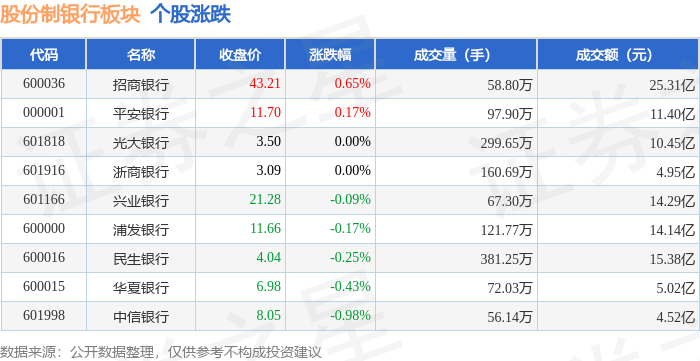
Core Insights - The banking sector saw a slight increase of 0.04% on November 13, with China Merchants Bank leading the gains [1] - The Shanghai Composite Index closed at 4029.5, up 0.73%, while the Shenzhen Component Index closed at 13476.52, up 1.78% [1] Banking Sector Performance - China Merchants Bank (600036) closed at 43.21, with a rise of 0.65% and a trading volume of 588,000 shares, amounting to a transaction value of 2.531 billion [1] - Ping An Bank (000001) closed at 11.70, up 0.17%, with a trading volume of 979,000 shares and a transaction value of 1.14 billion [1] - Other banks like Everbright Bank (601818) and Zhejiang Commercial Bank (601916) remained flat, while Industrial Bank (601166), Shanghai Pudong Development Bank (600000), and Minsheng Bank (600016) experienced slight declines [1] Capital Flow Analysis - The banking sector saw a net inflow of 56.84 million from institutional investors, while retail investors experienced a net outflow of 72.83 million [1] - Industrial Bank (601166) had a significant net outflow of 78.00 million from retail investors, despite a net inflow of 12.90 million from institutional investors [1] - China Merchants Bank had a net inflow of 24.99 million from institutional investors, with retail investors contributing a net inflow of 15.79 million [1]




重庆多家银行违规遭处罚 涉事银行拒绝回应整改措施
Xin Lang Cai Jing· 2025-11-13 02:31
Core Insights - The banking sector in Chongqing is facing increased regulatory scrutiny, with multiple banks receiving fines for various violations, indicating a trend of heightened enforcement in the industry [1][8]. Regulatory Actions - Industrial Bank's Chongqing branch was fined 4.2 million yuan for serious violations, including inadequate loan "three checks," poor credit management, and evasion of recording regulations [3][4]. - Chongqing Bank was fined 2.2 million yuan for similar issues, including inadequate loan "three checks" and imprudent investment practices [5][9]. - Hengfeng Bank's Chongqing branch was fined 2.6 million yuan for covering up bad loans and failing to manage investments properly [1]. Violations and Consequences - The violations at Industrial Bank included multiple serious issues such as inadequate loan checks, misclassification of assets, and poor management of non-standard investment businesses [3][4]. - Several individuals associated with these violations received warnings or fines, highlighting accountability within the institutions [3][5]. Industry Trends - In the third quarter of 2025, banks received a total of 1,448 fines amounting to 829 million yuan, representing an 84.63% year-on-year increase, with credit business violations being a significant concern [8]. - The trend of violations has shifted from real estate to other areas, including the repayment of bad loans and investment in stocks and funds [8]. Financial Health of Chongqing Bank - As of July 2023, Chongqing Bank's total assets reached 1,008.7 billion yuan, but the bank's risk management shortcomings have been exposed by repeated fines [7]. - The bank's non-performing loan ratio stood at 1.17% as of mid-2025, with declines in key capital adequacy ratios compared to the end of 2024 [7]. Expert Opinions - Experts attribute the frequent violations to a combination of factors, including banks prioritizing short-term performance over risk management and a lack of compliance systems in rapidly expanding new business areas [10]. - The increased regulatory penalties serve as a warning about management vulnerabilities and signal a normalization of stringent regulatory oversight in the banking sector [10].
多家银行上调积存金起点
2 1 Shi Ji Jing Ji Bao Dao· 2025-11-13 00:24
Core Viewpoint - The international gold price has returned to $4100 per ounce, prompting banks to raise the minimum investment threshold for gold accumulation, with some banks adjusting the starting point to a historical high of 1500 yuan [1][3]. Summary by Sections Bank Adjustments - Several banks have raised their gold accumulation thresholds, with notable changes including: - ICBC from 850 yuan to 1000 yuan - Bank of China from 850 yuan to 950 yuan - Ningbo Bank from 900 yuan to 1000 yuan - Ping An Bank from 900 yuan to 1100 yuan - Industrial Bank from 1000 yuan to 1200 yuan - CITIC Bank from 1000 yuan to 1500 yuan - Agricultural Bank and Bank of Communications have switched to a "floating with gold price" mechanism [2][3]. Investment Mechanism Changes - Some banks, like Agricultural Bank and Bank of Communications, have implemented a "floating with gold price" mechanism to avoid frequent adjustments, allowing the minimum investment amount to vary with market prices [4][5]. - This approach aims to provide flexibility for investors and better align with market dynamics [4]. Market Analysis - The gold price has seen significant volatility, with a rise of over 60% this year, peaking above $4300 per ounce before experiencing a sharp decline [6][7]. - Analysts have differing views on future gold prices, with predictions ranging from $3650 to $5000 per ounce by the end of 2026, influenced by various economic factors [7][8]. - The outlook remains optimistic for gold due to factors such as a weakening dollar and inflation risks, which could sustain investment demand [7][8]. Risk Awareness - In response to the volatile gold market, banks and regulatory bodies have increased risk awareness efforts, advising investors to recognize the inherent risks in precious metal investments [5].



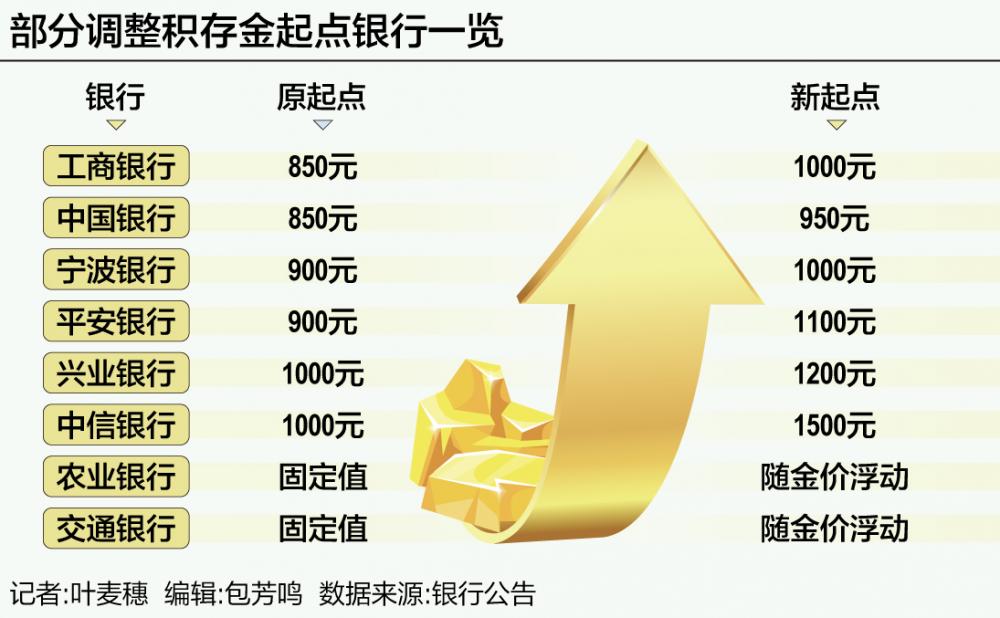
银行再度上调积存金起投门槛
Zheng Quan Ri Bao Zhi Sheng· 2025-11-12 16:43
Core Insights - International gold prices have significantly rebounded, surpassing the $4100 per ounce mark, prompting banks to adjust their gold accumulation business rules and increase minimum investment thresholds [1][2][3] Group 1: Changes in Investment Thresholds - Multiple banks have raised the minimum investment amount for gold accumulation plans, with some banks increasing the threshold to 1500 RMB, up from 1000 RMB [2][3] - The adjustments in minimum investment amounts have been frequent throughout the year, particularly accelerating in the third quarter, with banks like China Construction Bank and others raising the threshold from 600 RMB to 1000 RMB or more [3][4] Group 2: Regulatory Compliance and Risk Management - The increase in minimum investment thresholds is primarily driven by the need to mitigate potential risks associated with gold market volatility and to ensure compliance with regulatory requirements [1][4] - According to industry experts, the adjustments serve as a risk warning to investors, encouraging them to be cautious and avoid irrational investment behaviors [4][5] Group 3: Investment Strategies and Recommendations - Investors are advised to adopt a rational approach to gold asset allocation, focusing on long-term value preservation rather than short-term speculation [5][6] - It is recommended that investors utilize a periodic investment strategy to mitigate the impact of market volatility, while also considering their financial situation and risk tolerance when determining the proportion of gold in their overall asset allocation [6]
时代万恒:关于公司股东部分股份解除质押的公告

Zheng Quan Ri Bao Zhi Sheng· 2025-11-12 13:12
Core Viewpoint - The company, Times Wan Heng, announced the release of 20,000,000 shares previously pledged to Industrial Bank, indicating a positive development in its financial management and shareholder equity [1] Group 1 - The announcement was made on November 12, 2025, regarding the release of the pledged shares [1] - The shares were pledged to Industrial Bank and the release was confirmed by the China Securities Depository and Clearing Corporation Limited, Shanghai Branch [1] - The specific announcement number for this transaction is 临2019-075, indicating a formal record of the pledge and its release [1]
戴志锋:3Q25货币政策执行报告点评
Xin Lang Cai Jing· 2025-11-12 11:59
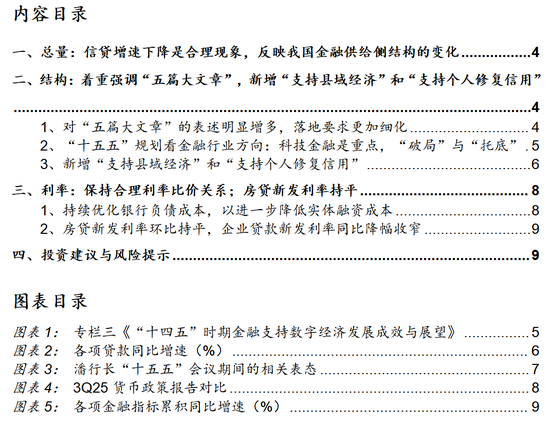
Summary of Key Points Overall Credit Growth - The decline in credit growth is a reasonable phenomenon, reflecting changes in China's financial supply-side structure. The focus should be on social financing scale and money supply as more comprehensive indicators compared to bank loans [1][8]. - Factors contributing to the decline include local special bonds replacing financing platform loans, the reform of small and medium-sized banks, and the trend of long-term economic structural evolution [9][12]. - Since last year, local governments have issued 4 trillion yuan in special refinancing bonds, with approximately 60-70% used to repay bank loans [10]. - In 2024, financial institutions are expected to write off about 1.3 trillion yuan in loans, with over 1 trillion yuan already written off in the first nine months of this year [11]. - The decline in real estate loans and the low credit dependence of light asset industries make it difficult to fill the gap left by real estate [12]. Structural Emphasis - The monetary policy report emphasizes the "Five Major Articles," with increased focus on supporting county economies and personal credit repair [2][18]. - The "14th Five-Year Plan" highlights technology finance as a key area, with policies aimed at breaking through economic growth ceilings and stabilizing macroeconomic environments [16]. - New measures include improving financial support mechanisms for county economic development and implementing policies for personal credit repair, which will not display certain default information in credit systems for individuals who have repaid loans [18][19]. Interest Rates - Maintaining a reasonable interest rate relationship is crucial, with new mortgage rates remaining stable [3][21]. - Continuous optimization of bank liability costs is necessary to lower financing costs for the real economy. The report notes that loan rates are decreasing faster than deposit rates, which compresses banks' net interest margins [21]. - As of September 2025, new loan rates for general loans, personal housing loans, and corporate loans are 3.67%, 3.06%, and 3.14%, respectively, with year-on-year declines of 48 basis points, 25 basis points, and 37 basis points [22]. Investment Recommendations - The banking sector is transitioning from a "pro-cyclical" to a "weak cyclical" phase, with a focus on the stability and sustainability of the sector [4]. - Two main investment lines are suggested: regional banks with strong certainty and high dividend stability, particularly in areas like Jiangsu, Shanghai, and Fujian [4].


部分金饰价突破1310元/克 有银行提高定投门槛至1500元
2 1 Shi Ji Jing Ji Bao Dao· 2025-11-12 09:41
Group 1 - The domestic gold jewelry prices have significantly increased, with most brands surpassing 1300 RMB per gram, and some top brands exceeding 1310 RMB per gram, reaching new highs [2] - As of November 12, 2023, the international gold market continues to rise, with London gold priced at 4116.931 USD per ounce, reflecting a year-to-date increase of 56.89%, while COMEX gold is at 4119.6 USD per ounce, also up 56.09% for the year [2] - The domestic gold price in Shanghai is reported at 945.76 RMB per gram, with a year-to-date increase of 51.13%, indicating a clear upward trend in both domestic and international gold prices [2] Group 2 - Several banks have raised the minimum investment thresholds for gold accumulation products, with Citic Bank increasing its minimum from 1000 RMB to 1500 RMB effective November 15, 2025 [3] - China Construction Bank announced a revision to its gold accumulation business, raising the minimum investment amount from 1000 RMB to 1200 RMB, effective November 15, 2023 [3] - Other banks, including Ningbo Bank, Industrial and Commercial Bank of China, and Bank of China, have also adjusted their minimum investment amounts for gold accumulation products in recent weeks, reflecting a broader trend in the banking sector [4]

时代万恒:控股股东时代万恒控股集团解除质押2000.00万股股
2 1 Shi Ji Jing Ji Bao Dao· 2025-11-12 08:56
Core Viewpoint - The company, Times Wan Heng, announced the release of 20,000,000 shares from pledge, which represents 13.97% of the shares held by its controlling shareholder and 6.80% of the total share capital [1] Summary by Relevant Sections - **Pledge Release Details** - The controlling shareholder, Times Wan Heng Holdings Group, has completed the release of 20,000,000 shares pledged to Industrial Bank [1] - The release was confirmed by the China Securities Depository and Clearing Corporation Limited, Shanghai Branch [1] - **Current Pledge Status** - After the release, the total number of shares pledged by Times Wan Heng Holdings Group is 117,735,043 shares [1] - This represents 82.26% of the shares held by the controlling shareholder and 40.00% of the company's total share capital [1]
股份制银行板块11月12日涨0.04%,光大银行领涨,主力资金净流入6.81亿元
Zheng Xing Xing Ye Ri Bao· 2025-11-12 08:49
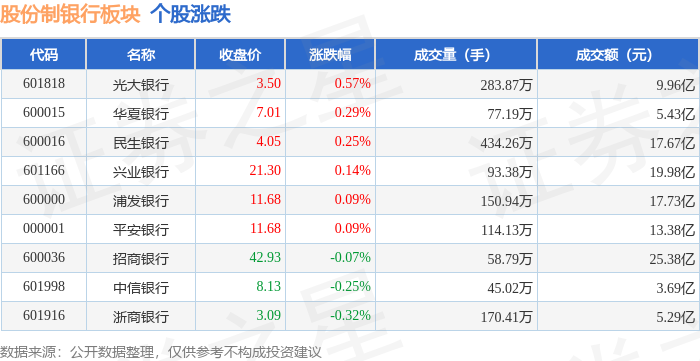
Market Overview - On November 12, the share price of the joint-stock bank sector increased by 0.04% compared to the previous trading day, with Everbright Bank leading the gains [1] - The Shanghai Composite Index closed at 4000.14, down 0.07%, while the Shenzhen Component Index closed at 13240.62, down 0.36% [1] Individual Bank Performance - Everbright Bank (601818) closed at 3.50, up 0.57% with a trading volume of 2.83 million shares and a transaction value of 996 million [1] - Huaxia Bank (600015) closed at 7.01, up 0.29% with a trading volume of 771,900 shares and a transaction value of 543 million [1] - Minsheng Bank (600016) closed at 4.05, up 0.25% with a trading volume of 4.34 million shares and a transaction value of 1.767 billion [1] - Industrial Bank (601166) closed at 21.30, up 0.14% with a trading volume of 933,800 shares and a transaction value of 1.998 billion [1] - Shanghai Pudong Development Bank (600000) and Ping An Bank (000001) both closed at 11.68, up 0.09% with transaction values of 1.773 billion and 1.338 billion respectively [1] - China Merchants Bank (600036) closed at 42.93, down 0.07% with a transaction value of 2.538 billion [1] - CITIC Bank (601998) closed at 8.13, down 0.25% with a transaction value of 369 million [1] - Zhejiang Commercial Bank (601916) closed at 3.09, down 0.32% with a transaction value of 529 million [1] Fund Flow Analysis - The joint-stock bank sector saw a net inflow of 681 million from main funds, while retail funds experienced a net outflow of 360 million [1] - The main fund inflow and outflow for individual banks showed varied results, with China Merchants Bank experiencing a main fund inflow of 2.86 billion, while retail funds saw a net outflow of 910 million [2] - Industrial Bank had a main fund inflow of 168 million and a retail fund outflow of 1.17 billion [2] - Everbright Bank had a main fund inflow of 65 million, with retail funds seeing a net outflow of 4.64 million [2]