INDUSTRIAL BANK(601166)

Search documents
银行再度上调积存金起投门槛
Zheng Quan Ri Bao Zhi Sheng· 2025-11-12 16:43
Core Insights - International gold prices have significantly rebounded, surpassing the $4100 per ounce mark, prompting banks to adjust their gold accumulation business rules and increase minimum investment thresholds [1][2][3] Group 1: Changes in Investment Thresholds - Multiple banks have raised the minimum investment amount for gold accumulation plans, with some banks increasing the threshold to 1500 RMB, up from 1000 RMB [2][3] - The adjustments in minimum investment amounts have been frequent throughout the year, particularly accelerating in the third quarter, with banks like China Construction Bank and others raising the threshold from 600 RMB to 1000 RMB or more [3][4] Group 2: Regulatory Compliance and Risk Management - The increase in minimum investment thresholds is primarily driven by the need to mitigate potential risks associated with gold market volatility and to ensure compliance with regulatory requirements [1][4] - According to industry experts, the adjustments serve as a risk warning to investors, encouraging them to be cautious and avoid irrational investment behaviors [4][5] Group 3: Investment Strategies and Recommendations - Investors are advised to adopt a rational approach to gold asset allocation, focusing on long-term value preservation rather than short-term speculation [5][6] - It is recommended that investors utilize a periodic investment strategy to mitigate the impact of market volatility, while also considering their financial situation and risk tolerance when determining the proportion of gold in their overall asset allocation [6]



时代万恒:关于公司股东部分股份解除质押的公告

Zheng Quan Ri Bao Zhi Sheng· 2025-11-12 13:12
Core Viewpoint - The company, Times Wan Heng, announced the release of 20,000,000 shares previously pledged to Industrial Bank, indicating a positive development in its financial management and shareholder equity [1] Group 1 - The announcement was made on November 12, 2025, regarding the release of the pledged shares [1] - The shares were pledged to Industrial Bank and the release was confirmed by the China Securities Depository and Clearing Corporation Limited, Shanghai Branch [1] - The specific announcement number for this transaction is 临2019-075, indicating a formal record of the pledge and its release [1]
戴志锋:3Q25货币政策执行报告点评
Xin Lang Cai Jing· 2025-11-12 11:59
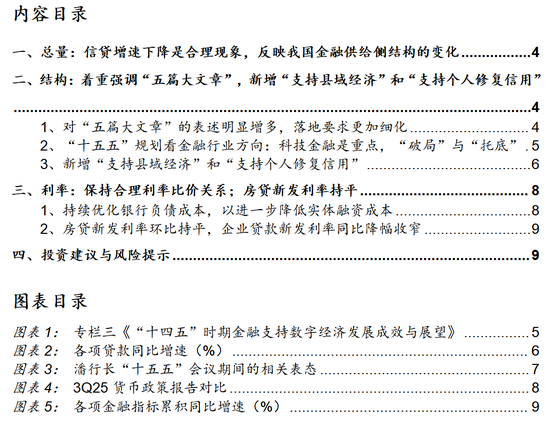
Summary of Key Points Overall Credit Growth - The decline in credit growth is a reasonable phenomenon, reflecting changes in China's financial supply-side structure. The focus should be on social financing scale and money supply as more comprehensive indicators compared to bank loans [1][8]. - Factors contributing to the decline include local special bonds replacing financing platform loans, the reform of small and medium-sized banks, and the trend of long-term economic structural evolution [9][12]. - Since last year, local governments have issued 4 trillion yuan in special refinancing bonds, with approximately 60-70% used to repay bank loans [10]. - In 2024, financial institutions are expected to write off about 1.3 trillion yuan in loans, with over 1 trillion yuan already written off in the first nine months of this year [11]. - The decline in real estate loans and the low credit dependence of light asset industries make it difficult to fill the gap left by real estate [12]. Structural Emphasis - The monetary policy report emphasizes the "Five Major Articles," with increased focus on supporting county economies and personal credit repair [2][18]. - The "14th Five-Year Plan" highlights technology finance as a key area, with policies aimed at breaking through economic growth ceilings and stabilizing macroeconomic environments [16]. - New measures include improving financial support mechanisms for county economic development and implementing policies for personal credit repair, which will not display certain default information in credit systems for individuals who have repaid loans [18][19]. Interest Rates - Maintaining a reasonable interest rate relationship is crucial, with new mortgage rates remaining stable [3][21]. - Continuous optimization of bank liability costs is necessary to lower financing costs for the real economy. The report notes that loan rates are decreasing faster than deposit rates, which compresses banks' net interest margins [21]. - As of September 2025, new loan rates for general loans, personal housing loans, and corporate loans are 3.67%, 3.06%, and 3.14%, respectively, with year-on-year declines of 48 basis points, 25 basis points, and 37 basis points [22]. Investment Recommendations - The banking sector is transitioning from a "pro-cyclical" to a "weak cyclical" phase, with a focus on the stability and sustainability of the sector [4]. - Two main investment lines are suggested: regional banks with strong certainty and high dividend stability, particularly in areas like Jiangsu, Shanghai, and Fujian [4].



部分金饰价突破1310元/克 有银行提高定投门槛至1500元
2 1 Shi Ji Jing Ji Bao Dao· 2025-11-12 09:41
Group 1 - The domestic gold jewelry prices have significantly increased, with most brands surpassing 1300 RMB per gram, and some top brands exceeding 1310 RMB per gram, reaching new highs [2] - As of November 12, 2023, the international gold market continues to rise, with London gold priced at 4116.931 USD per ounce, reflecting a year-to-date increase of 56.89%, while COMEX gold is at 4119.6 USD per ounce, also up 56.09% for the year [2] - The domestic gold price in Shanghai is reported at 945.76 RMB per gram, with a year-to-date increase of 51.13%, indicating a clear upward trend in both domestic and international gold prices [2] Group 2 - Several banks have raised the minimum investment thresholds for gold accumulation products, with Citic Bank increasing its minimum from 1000 RMB to 1500 RMB effective November 15, 2025 [3] - China Construction Bank announced a revision to its gold accumulation business, raising the minimum investment amount from 1000 RMB to 1200 RMB, effective November 15, 2023 [3] - Other banks, including Ningbo Bank, Industrial and Commercial Bank of China, and Bank of China, have also adjusted their minimum investment amounts for gold accumulation products in recent weeks, reflecting a broader trend in the banking sector [4]



时代万恒:控股股东时代万恒控股集团解除质押2000.00万股股
2 1 Shi Ji Jing Ji Bao Dao· 2025-11-12 08:56
Core Viewpoint - The company, Times Wan Heng, announced the release of 20,000,000 shares from pledge, which represents 13.97% of the shares held by its controlling shareholder and 6.80% of the total share capital [1] Summary by Relevant Sections - **Pledge Release Details** - The controlling shareholder, Times Wan Heng Holdings Group, has completed the release of 20,000,000 shares pledged to Industrial Bank [1] - The release was confirmed by the China Securities Depository and Clearing Corporation Limited, Shanghai Branch [1] - **Current Pledge Status** - After the release, the total number of shares pledged by Times Wan Heng Holdings Group is 117,735,043 shares [1] - This represents 82.26% of the shares held by the controlling shareholder and 40.00% of the company's total share capital [1]
股份制银行板块11月12日涨0.04%,光大银行领涨,主力资金净流入6.81亿元
Zheng Xing Xing Ye Ri Bao· 2025-11-12 08:49
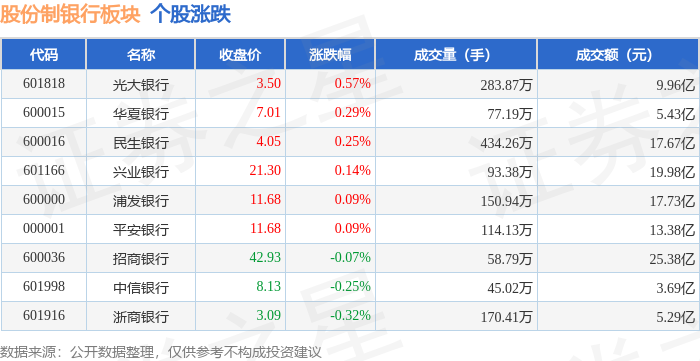
Market Overview - On November 12, the share price of the joint-stock bank sector increased by 0.04% compared to the previous trading day, with Everbright Bank leading the gains [1] - The Shanghai Composite Index closed at 4000.14, down 0.07%, while the Shenzhen Component Index closed at 13240.62, down 0.36% [1] Individual Bank Performance - Everbright Bank (601818) closed at 3.50, up 0.57% with a trading volume of 2.83 million shares and a transaction value of 996 million [1] - Huaxia Bank (600015) closed at 7.01, up 0.29% with a trading volume of 771,900 shares and a transaction value of 543 million [1] - Minsheng Bank (600016) closed at 4.05, up 0.25% with a trading volume of 4.34 million shares and a transaction value of 1.767 billion [1] - Industrial Bank (601166) closed at 21.30, up 0.14% with a trading volume of 933,800 shares and a transaction value of 1.998 billion [1] - Shanghai Pudong Development Bank (600000) and Ping An Bank (000001) both closed at 11.68, up 0.09% with transaction values of 1.773 billion and 1.338 billion respectively [1] - China Merchants Bank (600036) closed at 42.93, down 0.07% with a transaction value of 2.538 billion [1] - CITIC Bank (601998) closed at 8.13, down 0.25% with a transaction value of 369 million [1] - Zhejiang Commercial Bank (601916) closed at 3.09, down 0.32% with a transaction value of 529 million [1] Fund Flow Analysis - The joint-stock bank sector saw a net inflow of 681 million from main funds, while retail funds experienced a net outflow of 360 million [1] - The main fund inflow and outflow for individual banks showed varied results, with China Merchants Bank experiencing a main fund inflow of 2.86 billion, while retail funds saw a net outflow of 910 million [2] - Industrial Bank had a main fund inflow of 168 million and a retail fund outflow of 1.17 billion [2] - Everbright Bank had a main fund inflow of 65 million, with retail funds seeing a net outflow of 4.64 million [2]



专业赋能跨境业务 服务链接全球资源 ——兴业银行上海分行积极服务进博盛会
Sou Hu Cai Jing· 2025-11-12 08:33
Group 1 - The 8th China International Import Expo (CIIE) is held from November 5 to 10 in Shanghai, serving as a significant platform for global enterprises to integrate with the Chinese market [1] - The expo showcases global goods and technologies while providing a platform for financial institutions to deepen international cooperation and support global trade enterprises [1] - Industrial Bank's Shanghai branch actively participates in the expo, focusing on financial technology and business innovation, offering a range of digital and intelligent international business products [1] Group 2 - Industrial Bank's Shanghai branch leverages the Shanghai Free Trade Zone to explore various products that cater to the cross-border financing needs of high-quality foreign enterprises [2] - The bank successfully provided a comprehensive cross-border financing solution to a leading shipping company, enhancing its financing cost and settlement convenience [2] - This achievement marks a significant step for the bank in the cross-border financing sector, demonstrating its strengthened capability to serve global enterprises [2] Group 3 - In the digital era, the evolution of currency and payment systems is inevitable, and Industrial Bank's Shanghai branch is implementing a cross-chain payment system using digital RMB [3] - The bank's "Xingyin Chain" connects to the digital RMB blockchain service platform, enabling rapid cross-border fund transfers and significantly improving settlement efficiency [3] - Many foreign enterprises along the Belt and Road Initiative expressed great interest in the bank's cross-border and cross-chain digital currency payment solutions during the expo [3] Group 4 - Industrial Bank's Shanghai branch emphasizes the development of international business, showcasing its international settlement system and diverse cross-border financing products at the expo [3] - The bank aims to enhance the internationalization of the RMB and create an efficient and secure cross-border payment system [3] - The branch is committed to deepening its professional capabilities to contribute to the prosperity of the global economy and trade [3]
兴业银行昆明分行科技金融精准滴灌云南科创企业
Xin Hua Wang· 2025-11-12 07:08
Group 1 - The core viewpoint of the news is that Industrial Bank's Kunming branch successfully executed a 100 million yuan stock pledge financing for a listed company's actual controller, providing strong support for the company's core business development and injecting "financial vitality" into Yunnan's characteristic sci-tech industry [1][2] - The financing solution was tailored to meet the specific needs of the client, moving away from conventional financial service models and establishing a dedicated service team to address financing pain points [1] - The bank implemented a three-tiered linkage mechanism to streamline the business approval and processing workflow, facilitating the rapid execution of the financing deal [1] Group 2 - Industrial Bank's Kunming branch has been actively engaged in the Yunnan technology finance sector, exploring effective paths for financial support of the sci-tech industry [2] - The successful execution of this financing business serves as a practical example of how financial services can support characteristic sci-tech enterprises, providing replicable and promotable operational experience [2] - The bank plans to further deepen its capital market business and optimize its sci-tech financial service system to provide better and more precise comprehensive financial services for various market entities in the sci-tech sector [2]
已有7家银行私银客户超10万户
2 1 Shi Ji Jing Ji Bao Dao· 2025-11-12 05:45
Core Insights - The private banking sector has seen significant growth in the first three quarters of this year, with seven listed banks reporting over 100,000 private banking clients as of September 30, 2023, indicating a rising demand for wealth management services among high-net-worth individuals [2][4][5] Group 1: Growth in Private Banking Clients - Multiple banks reported a client growth rate exceeding 10%, with Minsheng Bank, Beijing Bank, and Nanjing Bank showing increases over 15% [4] - Minsheng Bank had the fastest growth, reaching 73,409 private banking clients, an increase of 18.21% from the end of last year [5] - Beijing Bank reported 20,586 private banking clients, up 17.9%, and an asset under management (AUM) of 224 billion yuan, a 14.39% increase [5][6] Group 2: Market Position of Major Banks - State-owned banks continue to dominate the private banking market, with Agricultural Bank of China leading at 279,000 clients, followed by China Construction Bank and Bank of China [6] - China Merchants Bank and Ping An Bank have also joined the "100,000 club," with Ping An Bank reaching 103,300 clients, marking its first entry into this category [6][7] Group 3: Challenges and Opportunities in Wealth Management - The growth in private banking clients is attributed to the expanding base of high-net-worth individuals and the upgrading of banking services [9] - The Hu Run Wealth Report indicates that the total wealth of China's 6 million affluent families has reached 150 trillion yuan, with ultra-high-net-worth families holding 87 trillion yuan, an increase from 56% to 58% of total wealth [9] - The private banking sector is facing challenges such as economic shifts, declining risk-free returns, and reduced investor confidence, necessitating a transformation in wealth management services [10][11]



已有7家银行私银客户超10万户
21世纪经济报道· 2025-11-12 05:38
Core Insights - The private banking business has seen significant growth in the first three quarters of this year, with seven listed banks surpassing 100,000 private banking clients as of September 30, 2023, driven by the increasing number of high-net-worth individuals and evolving wealth management needs [1][3][6] Growth of Private Banking Clients - Several banks reported a client growth rate exceeding 10%, with Minsheng Bank, Beijing Bank, and Nanjing Bank showing increases over 15%. Minsheng Bank led with an 18.21% growth, reaching 73,409 clients [3][6] - Beijing Bank's private banking clients grew by 17.9% to 20,586, with total assets under management (AUM) increasing by 14.39% to 224 billion yuan [3][6] - Nanjing Bank also reported a 15.43% increase in private banking clients [3] Dominance of State-Owned Banks - State-owned banks continue to lead in absolute numbers, with Agricultural Bank of China having 279,000 clients, followed by China Construction Bank with 265,500 clients [4] - China Merchants Bank and Ping An Bank have also joined the "100,000 club," with Ping An Bank reaching 103,300 clients, marking its first time surpassing this threshold [4][6] Market Dynamics and Competition - The private banking market is characterized by a competitive landscape where state-owned banks leverage their scale, while joint-stock banks focus on differentiated services and operational efficiency [7] - The growth of high-net-worth individuals is expected to drive competition towards service quality and asset allocation capabilities [7] Challenges in Wealth Management - The wealth management sector faces three main challenges: economic growth slowdown, declining risk-free returns, and reduced investor confidence [10][11] - Banks are urged to upgrade their wealth management services to meet clients' real needs and utilize various financial tools for comprehensive solutions [11] Changing Client Demographics - The core client base for private banking is shifting from traditional business owners to new economy groups, with a notable increase in demand for comprehensive wealth management services [9] - Banks are redefining their target clients based on their strengths, with some focusing on family wealth transfer and others on retirement financial management [9]