BOB(601169)

Search documents
城商行板块1月7日涨0%,杭州银行领涨,主力资金净流出1.7亿元
Zheng Xing Xing Ye Ri Bao· 2026-01-07 08:58
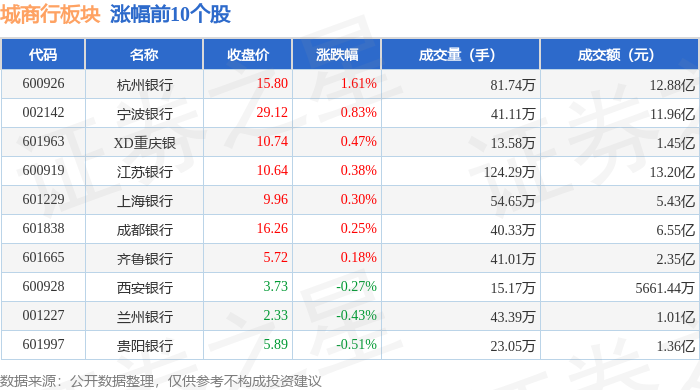
Market Performance - The city commercial bank sector experienced a slight increase of 0.0% on January 7, with Hangzhou Bank leading the gains [1] - The Shanghai Composite Index closed at 4085.77, up 0.05%, while the Shenzhen Component Index closed at 14030.56, up 0.06% [1] Individual Stock Performance - Hangzhou Bank (600926) closed at 15.80, with a rise of 1.61% and a trading volume of 817,400 shares [1] - Ningbo Bank (002142) closed at 29.12, up 0.83%, with a trading volume of 411,100 shares [1] - Other notable performances include Jiangsu Bank (601963) at 10.64 (+0.38%) and Shanghai Bank (601229) at 9.96 (+0.30%) [1] Capital Flow Analysis - The city commercial bank sector saw a net outflow of 170 million yuan from institutional investors, while retail investors contributed a net inflow of 188 million yuan [2] - The overall capital flow indicates a mixed sentiment, with institutional investors withdrawing funds while retail investors increased their positions [2] Detailed Capital Flow by Bank - Jiangsu Bank had a net inflow of 123 million yuan from institutional investors, while retail investors saw a net outflow of 27 million yuan [3] - Hangzhou Bank experienced a net inflow of 84 million yuan from institutional investors, but retail investors had a significant outflow of 132 million yuan [3] - Chengdu Bank recorded a net inflow of 55 million yuan from institutional investors, with retail investors also experiencing a net outflow [3]





2025年银行CIO盘点:建行、中行CIO离任,多家中小银行行外引进CIO
Xin Lang Cai Jing· 2026-01-07 03:33
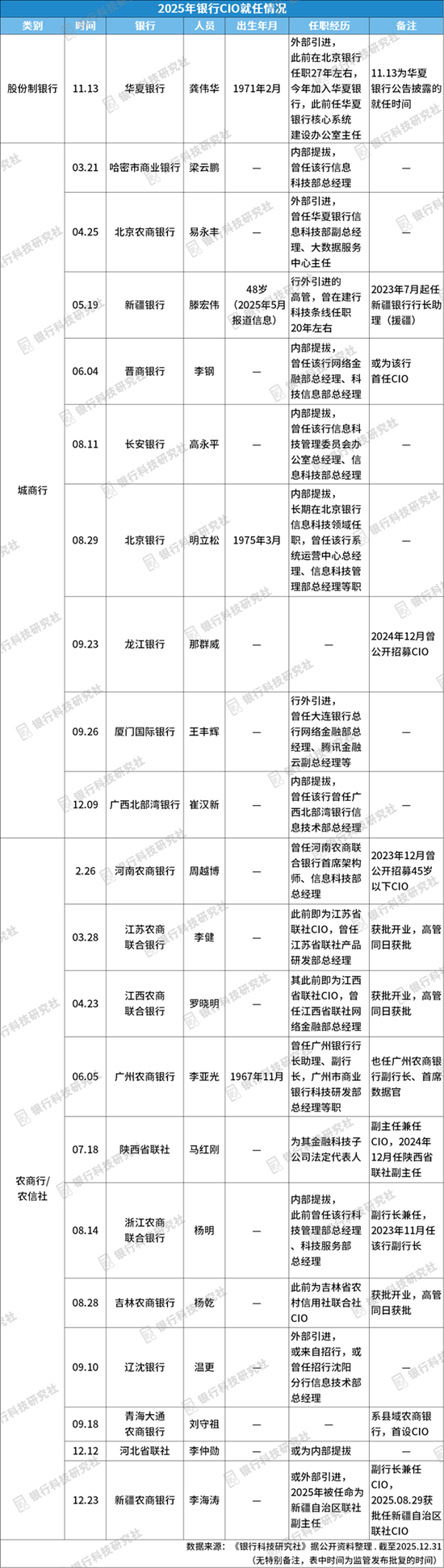
Core Insights - The digital transformation is crucial for the banking industry, with a significant focus on the restructuring of digital talent, particularly the Chief Information Officers (CIOs) [1][2] Group 1: Changes in CIO Positions - In 2025, several major banks experienced changes in their technology leadership, with the CIOs of China Construction Bank (CCB) and Bank of China (BOC) resigning [2][4] - CCB's former CIO, Jin Panshi, resigned due to age reasons after serving for four years [2][3] - BOC's former CIO, Meng Qian, also resigned for age reasons after a 38-year tenure, during which she held multiple senior positions [4][6] - The Industrial and Commercial Bank of China (ICBC) also saw its technology leader, CTO Lv Zhongtao, leave at the end of 2025 [7][8] Group 2: New Appointments and Trends - In 2025, 21 new CIOs were appointed, primarily in small and medium-sized banks, with many being external hires [10][11] - Notable new CIOs include Gong Weihua at Huaxia Bank and Wang Fenghui at Xiamen International Bank, both of whom were brought in from outside the banking sector [11][12] - The trend indicates a shift towards external recruitment for CIO positions, with 48% of the new appointments being external hires [16] Group 3: Recruitment Trends in Smaller Banks - Many small and medium-sized banks have publicly announced CIO recruitment in 2025, including Xiamen International Bank and Zhengzhou Bank [18][19] - Recruitment criteria often include age limits and specific experience requirements, such as a minimum of six years in information technology and four years in senior management roles [18][20] - The trend reflects a growing emphasis on digital leadership within smaller banks, as they seek to enhance their technological capabilities [18][19]
2025年A股银行板块涨幅放缓 个股分化显著 机构看好2026年上市银行营收利润增速改善
Xin Lang Cai Jing· 2026-01-06 23:23
Core Viewpoint - The A-share banking sector is expected to achieve a market value breakthrough in 2025, but the overall growth rate is slowing and underperforming compared to the broader market, with significant individual stock differentiation [1][7]. Market Performance - As of December 31, 2025, the Wind Banking Index reached 7180.68 points, with an annual growth of 12.04%, lower than the previous year's 43.56%. The total market value of the sector at year-end was 15.71 trillion yuan, an increase of over 15% from the beginning of the year, having briefly surpassed 16 trillion yuan [1][7]. - The banking sector exhibited a clear phase differentiation throughout the year, with a mild increase in Q1, a significant rise in Q2, a deep correction in Q3, and a recovery in Q4 [2][8]. Individual Stock Performance - In 2025, 35 out of 42 A-share listed banks saw their stock prices rise, accounting for over 83%. Among the six banks with over 20% growth, Agricultural Bank led with a 52.66% increase, followed by Xiamen Bank, Shanghai Pudong Development Bank, Chongqing Bank, Industrial and Commercial Bank, and Ningbo Bank with growth rates ranging from 20.68% to 35.78% [3][9]. - Conversely, seven banks experienced declines, with Huaxia Bank at the bottom with a 9.82% drop, and Zhengzhou Bank, Beijing Bank, and China Everbright Bank all declining by over 5% [3][9]. Future Outlook - Multiple brokerage firms predict an improvement in revenue and profit growth for listed banks in 2026, with expected revenue growth rates of +2.5% and +3.6% for 2026 and 2027, respectively, and net profit growth rates of +1.9% and +2.6% [4][10]. - The improvement in revenue and profit growth is attributed to several factors, including a reduction in net interest margin pressure, a shift towards quality in credit issuance, and a stabilization in fee income growth [4][10]. Investment Strategy - In light of the different characteristics of new inflows, the equity market in 2025 is characterized by increased stable return strategy products, enhanced structural trends, and greater individual stock volatility. For 2026, it is recommended to prioritize stable stocks and adopt a bottom-fishing strategy, while also considering elastic stocks for rotation trading [6][12].




城农商行2025年收罚单超千张、罚没金额8.75亿元,信贷与反洗钱成违规“重灾区”
Xin Lang Cai Jing· 2026-01-06 11:17
Core Viewpoint - In 2025, a total of 6,521 fines were issued to 1,097 banking institutions in China, with a total penalty amount of 2.641 billion yuan, indicating a continued trend of stricter regulatory oversight in the financial sector [2][12]. Group 1: Penalty Statistics - Agricultural commercial banks received the highest number of fines, totaling 738, with Shenzhen Rural Commercial Bank receiving the largest fine among them [2][12]. - City commercial banks were issued 276 fines, with Shanghai Bank leading in the amount of fines [2][12]. - The total number of fines for both agricultural and city commercial banks accounted for 15.55% of the total fines, amounting to 875 million yuan [2][12]. Group 2: Reasons for Penalties - The top three reasons for penalties included violations in credit business (1,209 fines), inadequate internal control systems (752 fines), and violations of anti-money laundering regulations (697 fines) [2][12]. - Other reasons for penalties included violations in payment settlement, data reporting and governance, and inadequate employee behavior management [2][12]. Group 3: Major Fines in City Commercial Banks - Among 80 city commercial banks, Shanghai Bank, Beijing Bank, and Chongqing Three Gorges Bank had the highest penalty amounts, with fines of 37.31 million yuan, 35.40 million yuan, and 14.49 million yuan respectively [3][13]. - Shanghai Bank was penalized for multiple violations, including account management and anti-money laundering regulations, resulting in a total fine of 28.748 million yuan [4][14]. - Beijing Bank faced penalties for similar violations, with a total fine of 25.2685 million yuan [5][15]. Group 4: Major Fines in Agricultural Commercial Banks - In the agricultural commercial bank sector, Shenzhen Rural Commercial Bank, Chongqing Rural Commercial Bank, and Beijing Rural Commercial Bank received the largest fines, amounting to 12.84 million yuan, 11.65 million yuan, and 10.87 million yuan respectively [6][16]. - Shenzhen Rural Commercial Bank was fined for failing to comply with customer identity verification regulations and other violations, leading to a fine of 12.844 million yuan [7][17]. - Other banks, such as Foshan Rural Commercial Bank, also faced significant penalties for various violations, with fines reaching up to 8.8 million yuan [8][18]. Group 5: Regulatory Implications - The increasing number of fines highlights the need for city and agricultural commercial banks to strengthen internal management and compliance awareness to avoid future violations [9][19]. - Regulatory authorities are demonstrating a firm commitment to enhancing financial safety through stringent oversight [9][19].
城商行板块1月6日涨0.63%,宁波银行领涨,主力资金净流入3.84亿元
Zheng Xing Xing Ye Ri Bao· 2026-01-06 09:00
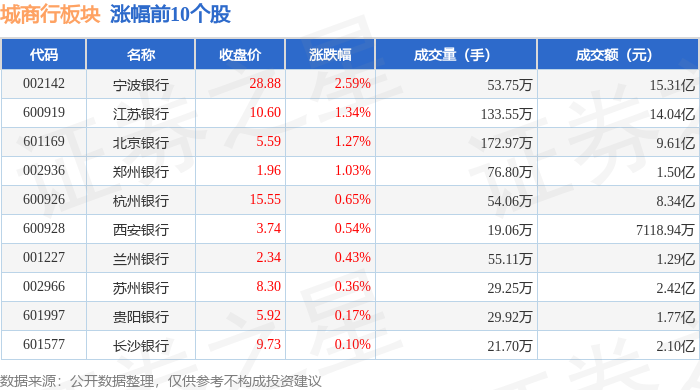
证券之星消息,1月6日城商行板块较上一交易日上涨0.63%,宁波银行领涨。当日上证指数报收于 4083.67,上涨1.5%。深证成指报收于14022.55,上涨1.4%。城商行板块个股涨跌见下表: 以上内容为证券之星据公开信息整理,由AI算法生成(网信算备310104345710301240019号),不构成投资建议。 | 代码 | 名称 | 收盘价 | 涨跌幅 | 成交量(手) | 成交额(元) | | --- | --- | --- | --- | --- | --- | | 002142 | 宁波银行 | 28.88 | 2.59% | 53.75万 | 15.31亿 | | 616009 | 江苏银行 | 10.60 | 1.34% | 133.55万 | 14.04亿 | | 601169 | 北京银行 | 5.59 | 1.27% | 172.97万 | 9.61亿 | | 002936 | 郑州银行 | 1.96 | 1.03% | 76.80万 | 1.50亿 | | 600926 | 杭州银行 | 15.55 | 0.65% | 54.06万 | 8.34亿 | | 600928 | 西安银 ...
彭博绿金2026值得关注榜成功发布
Sou Hu Wang· 2026-01-06 04:57
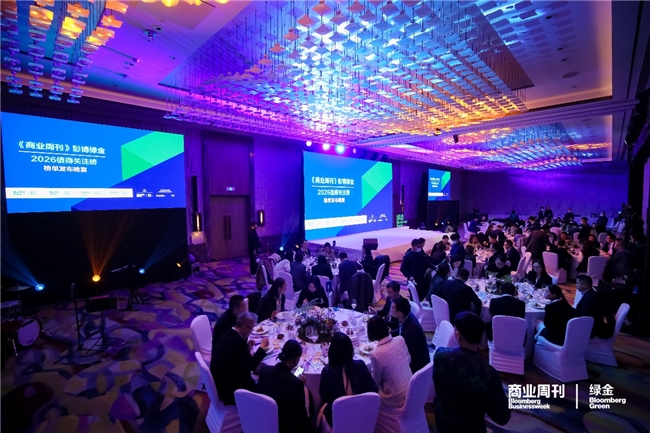
Core Insights - The 2026 Bloomberg Green Finance Awards ceremony was successfully held at the MGM Hotel in Shanghai, emphasizing the importance of aligning with China's "dual carbon" goals and the evolving global business landscape [2] - The event introduced two new evaluation systems: the "Green Finance List" and the "ESG Potential Enterprises" list, alongside existing categories for "ESG Leading Enterprises" and "Outstanding ESG Projects" [2] Green Finance List - The Green Finance List focuses on the green development and innovation within China's financial sector, developed in collaboration with the Central University of Finance and Economics [3] - It aims to respond to national green finance policies and promote the green transformation of financial institutions and enterprises [3] ESG Potential Enterprises - The ESG Potential Enterprises list is based on Bloomberg's proprietary analysis of corporate data, utilizing a comprehensive ESG matrix covering four dimensions, 16 core issues, and 41 sub-issues [4] - The matrix addresses nine major themes, including climate action, energy and ecological management, product safety, employee health, and social responsibility, to identify companies with long-term value and industry leadership potential [4] Complete Lists Released - The ESG Leading Enterprises include CHINT Group Co., Ltd., Tingyi Holding Corp. (Master Kong), Trina Solar Co., Ltd., and several others [5][6][7] - Outstanding ESG Projects feature initiatives from Beijing Fuping Social Venture Capital Co., Ltd., Envision Energy, LONGi Green Energy Technology Co., Ltd., and others [7][8] Green Financial Institutions - The Green Financial Institutions recognized include Bank of China (Hong Kong) Limited, Guotai Junan International Holdings Limited, Industrial Bank Co., Ltd., and others [9][10] Innovation Drivers - The ESG Innovation Drivers include organizations such as the Alliance for Water Stewardship, Climate Bonds Initiative, and Shanghai Advanced Institute of Finance [10] ESG Advocates - The ESG Advocates list features companies like Hydrowell (Taicang) Energy Technologies Co., Ltd., Ningbo Joyson Electronics Corp., and Skyworth Group Limited [11] Future Outlook - Bloomberg Green Finance aims to collaborate with more practitioners to explore core trends and future pathways for sustainable development, accumulating cross-disciplinary wisdom and solutions [13]



城商行板块1月5日涨0.26%,杭州银行领涨,主力资金净流入3.8亿元
Zheng Xing Xing Ye Ri Bao· 2026-01-05 09:09
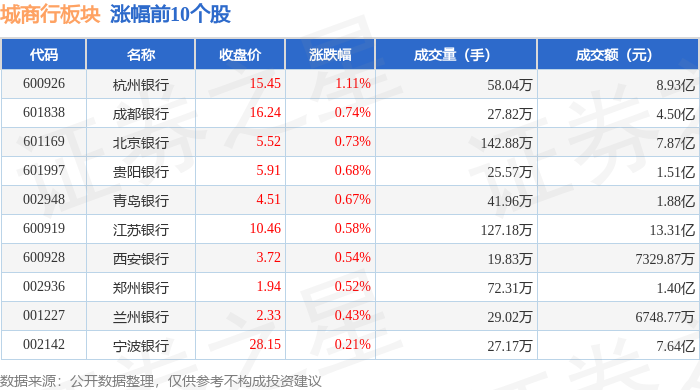
Market Overview - The city commercial bank sector increased by 0.26% on January 5, with Hangzhou Bank leading the gains [1] - The Shanghai Composite Index closed at 4023.42, up by 1.38%, while the Shenzhen Component Index closed at 13828.63, up by 2.24% [1] Individual Bank Performance - Hangzhou Bank (600926) closed at 15.45, with a rise of 1.11% and a trading volume of 580,400 shares, amounting to a transaction value of 893 million yuan [1] - Chengdu Bank (601838) closed at 16.24, up by 0.74%, with a trading volume of 278,200 shares and a transaction value of 450 million yuan [1] - Beijing Bank (601169) closed at 5.52, increasing by 0.73%, with a trading volume of 1,428,800 shares and a transaction value of 787 million yuan [1] - Guizhou Bank (601997) closed at 5.91, up by 0.68%, with a trading volume of 255,700 shares and a transaction value of 151 million yuan [1] - Qindao Bank (002948) closed at 4.51, increasing by 0.67%, with a trading volume of 419,600 shares and a transaction value of 188 million yuan [1] - Jiangsu Bank (616009) closed at 10.46, up by 0.58%, with a trading volume of 1,271,800 shares and a transaction value of 1.331 billion yuan [1] - Xian Bank (600928) closed at 3.72, increasing by 0.54%, with a trading volume of 198,300 shares and a transaction value of 73.3 million yuan [1] - Zhengzhou Bank (002936) closed at 1.94, up by 0.52%, with a trading volume of 723,100 shares and a transaction value of 140 million yuan [1] - Lanzhou Bank (001227) closed at 2.33, increasing by 0.43%, with a trading volume of 290,200 shares and a transaction value of 67.5 million yuan [1] - Ningbo Bank (002142) closed at 28.15, up by 0.21%, with a trading volume of 271,700 shares and a transaction value of 764 million yuan [1] Capital Flow Analysis - The city commercial bank sector saw a net inflow of 380 million yuan from main funds, while retail funds experienced a net outflow of 134 million yuan [2] - The main funds' net inflow and outflow for individual banks include: - Jiangsu Bank (600919) had a net inflow of 10.4 million yuan, with a 7.78% share of main funds [3] - Shanghai Bank (601229) had a net inflow of 87.04 million yuan, with a 13.64% share of main funds [3] - Hangzhou Bank (600926) had a net inflow of 79.04 million yuan, with an 8.86% share of main funds [3] - Nanjing Bank (600000) had a net inflow of 67.86 million yuan, with a 9.68% share of main funds [3] - Ningbo Bank (002142) had a net inflow of 58.14 million yuan, with a 7.61% share of main funds [3] - Qilu Bank (601665) had a net inflow of 57.72 million yuan, with a 14.60% share of main funds [3] - Qingdao Bank (002948) had a net inflow of 22.18 million yuan, with an 11.82% share of main funds [3] - Suzhou Bank (002966) had a net inflow of 6.29 million yuan, with a 2.71% share of main funds [3] - Xiamen Bank (601187) had a net inflow of 520,450 yuan, with a 5.25% share of main funds [3] - Xian Bank (600928) had a net inflow of 287,550 yuan, with a 3.92% share of main funds [3]
优先股隐退永续债上位!银行业资本补充进入密集冲刺期,年利息至少省3%
Xin Lang Cai Jing· 2026-01-04 05:31
Core Viewpoint - The Chinese banking industry is undergoing a significant transformation, with banks redeeming high-cost preferred shares and issuing perpetual bonds as a more cost-effective financing alternative, driven by declining social financing costs and regulatory changes [2][4][11]. Group 1: Redemption of Preferred Shares - By the end of 2025, a total of 9 banks announced the redemption of preferred shares, amounting to 111.8 billion RMB in domestic preferred shares and 5.72 billion USD in foreign preferred shares [4]. - In December 2025 alone, five banks, including Changsha Bank and Beijing Bank, redeemed a total of 45.8 billion RMB in preferred shares [3]. - The redemption of preferred shares is facilitated by their lack of maturity dates but includes redemption clauses, allowing banks to manage capital flexibly [4]. Group 2: Issuance of Perpetual Bonds - As of December 31, 2025, Chinese commercial banks issued 69 perpetual bonds, raising a total of 821.8 billion RMB, marking a historical high in both issuance quantity and scale [5]. - The interest rates for newly issued perpetual bonds generally ranged from 2.0% to 2.9%, the lowest in nearly three years, with a significant issuance peak occurring in the second half of 2025 [5][6]. - The issuance of perpetual bonds is seen as a response to the urgent need for capital replenishment, especially among small and medium-sized banks facing declining capital adequacy ratios [2][6]. Group 3: Cost Savings and Financial Efficiency - By replacing preferred shares with perpetual bonds, banks can save at least 3% annually on interest expenses, significantly reducing their financing costs [8][10]. - For instance, the interest rate on newly issued perpetual bonds is substantially lower than that of previously issued preferred shares, with examples showing potential annual savings of 12.8 million RMB for banks like Industrial Bank [10]. - The transition from preferred shares to perpetual bonds is viewed as a strategic move to optimize capital structure and reduce interest payment burdens, aligning with regulatory requirements [8][10]. Group 4: Regulatory Environment and Market Dynamics - The shift towards perpetual bonds is influenced by regulatory changes that favor capital instruments with loss absorption capabilities, making traditional preferred shares less attractive [11]. - The approval process for issuing perpetual bonds is simpler and faster compared to preferred shares, which require dual regulatory approvals, thus enhancing their appeal to banks [11]. - The current low-interest-rate environment is expected to persist, allowing banks to lock in low financing costs for the next 5 to 10 years, effectively mitigating the pressure from narrowing net interest margins [10].



近30笔千万级罚单!2025年银行业罚单大盘点
证券时报· 2026-01-03 05:27
Core Viewpoint - In 2025, the Chinese banking industry is undergoing significant regulatory scrutiny characterized by "strict regulation, strong accountability, and zero tolerance," leading to a notable increase in both the quantity and severity of penalties imposed on banks [1]. Group 1: Regulatory Environment - The number of penalties exceeding 10 million yuan in the banking sector reached nearly 30, affecting various types of institutions including state-owned banks, policy banks, joint-stock banks, city commercial banks, private banks, and bank-affiliated wealth management subsidiaries [2]. - Regulatory focus has expanded beyond traditional areas like credit management to include corporate governance, related party transactions, anti-money laundering, data security, and wealth management business oversight [2][4]. Group 2: Major Penalties - Major state-owned banks such as Bank of China, Industrial and Commercial Bank of China, and Agricultural Bank of China received substantial fines, with Bank of China facing a fine of 97.9 million yuan for issues related to corporate governance and asset quality management [4]. - In December 2025, China Communications Bank was fined 68.07 million yuan for violating multiple regulations, including account management and anti-money laundering obligations [4][5]. Group 3: Compliance and Risk Management - The penalties highlight a trend of inadequate compliance and risk management across various banking operations, including loan management, interbank transactions, and wealth management [7][10]. - The regulatory environment has intensified scrutiny on compliance with anti-money laundering regulations, with significant fines imposed for failures in customer identity verification and transaction reporting [8][9]. Group 4: Emerging Business Areas - New banking business models, such as wealth management subsidiaries and direct banks, are also facing strict regulatory penalties, indicating that the regulatory environment is not limited to traditional banking practices [13]. - For instance, Jiaoyun Wealth Management was fined 17.5 million yuan for non-compliance in product information disclosure and post-investment management [13]. Group 5: Double Penalty System - The implementation of a "double penalty system" has become prevalent, where not only institutions are fined but also individual responsible parties face penalties, enhancing accountability within financial institutions [15]. - This system links the career prospects of involved personnel directly to the compliance performance of their institutions, thereby increasing regulatory pressure [15]. Group 6: Future Outlook - The ongoing trend of strict regulation and accountability is expected to continue, prompting banks to improve their internal governance structures and compliance management systems [16]. - The adjustments in business processes and increased technological investments are anticipated to have a profound impact on the operational models and competitive landscape of the banking industry [16].


重拳出击!近30笔千万级罚单!2025年银行业罚单大盘点
券商中国· 2026-01-03 03:33
Core Viewpoint - In 2025, the Chinese banking industry is undergoing significant regulatory scrutiny characterized by "strict regulation, strong accountability, and zero tolerance," leading to a notable increase in both the quantity and amount of penalties imposed on various banking institutions [1]. Regulatory Penalties Overview - The number of penalties exceeding ten million yuan has reached nearly 30, affecting a wide range of institutions including state-owned banks, policy banks, joint-stock banks, city commercial banks, private banks, and bank-affiliated wealth management subsidiaries [1]. - Penalties are not limited to traditional areas like credit management but also extend to corporate governance, related party transactions, anti-money laundering, data security, and wealth management [2]. Corporate Governance and Compliance - Major state-owned banks such as Bank of China, Industrial and Commercial Bank of China, and Agricultural Bank of China have received substantial fines for issues related to corporate governance and business management [3]. - The largest penalty of the year was imposed on Bank of China, amounting to 97.9 million yuan for various management issues [3]. - Regulatory focus has shifted to deeper issues such as the effectiveness of board responsibilities and the integrity of internal control processes [3]. Compliance and Anti-Money Laundering - There has been an intensified crackdown on compliance, particularly in the anti-money laundering sector, with significant fines imposed on banks for failing to adhere to basic financial management regulations [4]. - For instance, China Merchants Bank was fined 68.07 million yuan for violating 11 regulations related to account management and anti-money laundering [4]. Business Management Issues - The primary reasons for penalties in the banking sector include: - Inadequate management across various business areas such as loans, interbank transactions, and wealth management [6]. - Non-compliance with anti-money laundering responsibilities, including failure to identify customers and report suspicious transactions [7]. - Violations in foreign exchange and investment operations, including illegal currency transactions and improper investment disclosures [8]. - Insufficient implementation of regulatory requirements, leading to non-compliance in data reporting and employee management [9]. Emerging Business Areas - New banking business models, including wealth management subsidiaries and direct banks, have also faced penalties, indicating strict regulatory oversight in these emerging sectors [11]. - For example, a wealth management subsidiary was fined 17.5 million yuan for non-compliance in product information disclosure and post-investment management [12]. Double Penalty System - The implementation of a "double penalty system" has become a significant aspect of regulatory actions, where both institutions and responsible individuals face penalties [13]. - This system aims to link the career prospects of involved personnel directly to the compliance performance of their institutions, thereby enhancing accountability [14]. Summary of Penalties - A detailed overview of penalties reveals that various banks have faced significant fines for a range of compliance failures, with amounts often exceeding ten million yuan [15][16].