
BOB(601169)

Search documents
城商行板块12月31日跌0.33%,厦门银行领跌,主力资金净流入2.01亿元
Zheng Xing Xing Ye Ri Bao· 2025-12-31 09:07
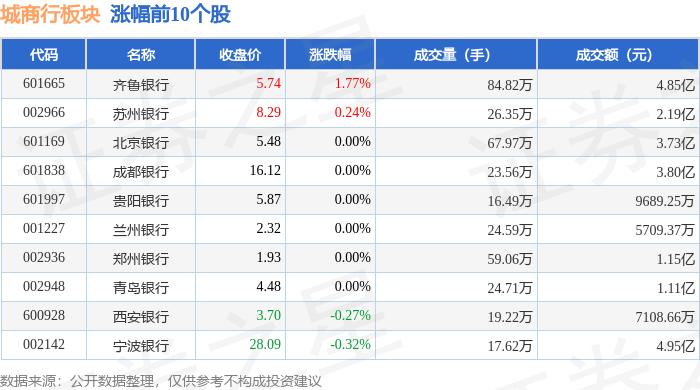
Market Overview - The city commercial bank sector experienced a decline of 0.33% on December 31, with Xiamen Bank leading the drop [1] - The Shanghai Composite Index closed at 3968.84, up 0.09%, while the Shenzhen Component Index closed at 13525.02, down 0.58% [1] Individual Bank Performance - Qilu Bank closed at 5.74, up 1.77% with a trading volume of 848,200 shares and a transaction value of 485 million [1] - Suzhou Bank closed at 8.29, up 0.24% with a trading volume of 263,500 shares and a transaction value of 219 million [1] - Xiamen Bank closed at 7.34, down 1.08% with a trading volume of 133,200 shares and a transaction value of 97.8 million [2] - Nanjing Bank closed at 11.43, down 0.78% with a trading volume of 235,600 shares and a transaction value of 270 million [2] Capital Flow Analysis - The city commercial bank sector saw a net inflow of 201 million from institutional investors, while retail investors experienced a net outflow of 9.56 million [2] - The capital flow for individual banks shows that Shanghai Bank had a net inflow of 48.9 million from institutional investors, while Hangzhou Bank had a net outflow of 50.55 million [3] - Suzhou Bank recorded a net inflow of 30.66 million from institutional investors, while retail investors had a net outflow of 27.1 million [3]



北京银行全面推动人工智能与业务深度融合
Xin Jing Bao· 2025-12-31 07:42
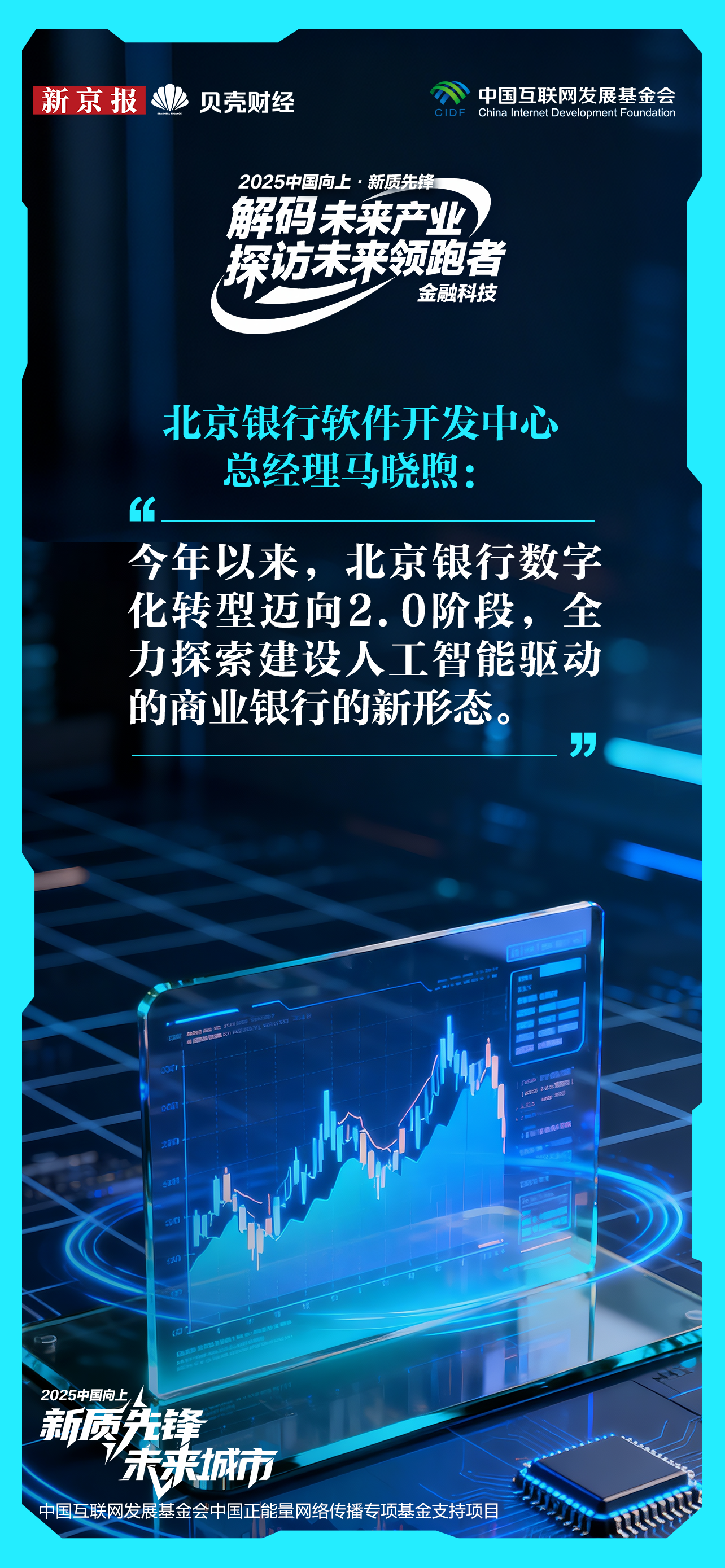
新 京 报 《》 贝壳财经 t x 友展县余会 hina Internet Development Foundation 2025中国向上 得专 EVIV t 主要 频 金融科技 北京银行软件开发中心 总经理马晓煦: 今年以来,北京银行数字 化转型迈向2.0阶段,全 力探索建设人工智能驱动 的商业银行的新形态。 "十五五"规划建议明确指出全面实施"人工智能(AI)+"行动。北京银行(601169)在2025年2月也提出"All in AI"战 略,全面推动人工智能与业务的深度融合,希望以人工智能为动力,让AI赋能全面数字化经营,为高质量发展注 入强劲动能。 (中国互联网发展基金会中国正能量网络传播专项基金支持) ...

打卡北京小巨人|北京银行全面推动人工智能与业务深度融合
Bei Ke Cai Jing· 2025-12-31 07:34
t 今年以来,北京银行数字 化转型迈向2.0阶段,全 力探索建设人工智能驱动 的商业银行的新形态。 サ 新 京 报 《》贝壳财经 围百联网友展 China Internet Development 2025中国向上·新质朱缝 在相未来产业 时走变频频者 金融科技 北京银行软件开发中心 总经理马晓煦: "十五五"规划建议明确指出全面实施"人工智能(AI)+"行动。北京银行在2025年2月也提出"All in AI"战略,全面推动人工智能与业务的深度融合,希望以 人工智能为动力,让AI赋能全面数字化经营,为高质量发展注入强劲动能。 (中国互联网发展基金会中国正能量网络传播专项基金支持) 校对 柳宝庆 ...
北京银行招标结果:北京银行报价引擎系统外汇期权模块外部市场数据采购项目成交结果公告
Sou Hu Cai Jing· 2025-12-31 04:54
Group 1 - The core announcement is regarding the procurement results of the external market data for the foreign exchange options module of the pricing engine system by Beijing Bank [1] - Beijing Bank has invested in a total of 20 enterprises and participated in 8,928 bidding projects [1] - The bank holds 1,488 trademark records, 99 patent records, and 405 copyright records, along with 151 administrative licenses [1] Group 2 - The procurement was awarded to Refinitiv Information Services (China) Co., Ltd. [2] - The winning bid amount for the project is approximately 699,192.96 [2] - The announcement was published on December 28, 2025, and the procurement is located in Beijing [2]
金融供给侧结构性改革的“京行样本”
中国基金报· 2025-12-30 12:57
Core Viewpoint - Beijing Bank has evolved from a small local city commercial bank into a significant financial force supporting urban development and industrial upgrading, exemplifying the "Beijing Model" of financial supply-side structural reform [1][3]. Group 1: Historical Development - Beijing Bank was established 30 years ago as the "Beijing Urban Cooperative Bank" in a small building, and has since transformed its operations with advanced technology and efficient service delivery [1]. - The bank was proactive in supporting technological innovation, establishing its first branch in Zhongguancun in 1999, and later creating the first bank-affiliated incubator in China in 2015 [4][6]. Group 2: Support for Innovation - Beijing Bank has built a comprehensive service system for technology enterprises, launching the "Jingxin Navigation" brand and forming specialized teams to provide tailored financial solutions [7]. - The bank has provided over 50 million yuan in comprehensive financial support to companies like Nine Chapters Cloud Extreme, showcasing its commitment to nurturing innovation [6]. Group 3: Inclusive Finance - The bank has implemented a "social security card service station" to provide convenient services to residents, achieving a card issuance time of 3 minutes [11]. - It has also supported small and micro enterprises by offering customized loan solutions, such as a 1.4 million yuan credit loan to a meat processing company in need [12][13]. Group 4: Digital Transformation - Beijing Bank is advancing its digital transformation through the "Digital Jing Bank" strategy, focusing on building a unified data platform and enhancing operational efficiency [15]. - The bank has developed the "Tong E Loan" platform for small enterprises, facilitating quick loan approvals and enhancing customer experience [15][16]. Group 5: Community Engagement - The bank has introduced a "Smart Cashier System" in the New Fa Market, improving operational efficiency for merchants and providing them with financial support for business expansion [18]. - Beijing Bank's initiatives in children's financial education, such as the "Children's Friendly Bank" program, aim to foster financial literacy from a young age [8][9]. Group 6: Future Outlook - The bank aims to continue its differentiated development path, contributing to the construction of a financial power and the revitalization of the nation through precise financial supply and intelligent capabilities [19].
金融供给侧结构性改革的“京行样本”
新浪财经· 2025-12-30 10:28
Core Viewpoint - Beijing Bank has evolved from a small local city commercial bank into a significant financial force supporting urban development and industrial upgrading, exemplifying the "Beijing Model" of financial supply-side structural reform [5][7]. Group 1: Innovation Roots - Beijing Bank established its first branch in Zhongguancun, a hub for technology innovation, in 1999, embedding financial services in the heart of China's tech landscape [9]. - The bank has consistently supported technology enterprises, providing over 50 million yuan in comprehensive financial support to companies like Nine Chapters Cloud Extreme, showcasing its commitment to precision and responsiveness in serving innovators [12]. - Beijing Bank has developed a service system covering the entire lifecycle of tech enterprises, launching the "Jingxin Navigation" brand and tailoring differentiated service plans for high R&D investment firms [12][13]. Group 2: Inclusive Finance - The bank has implemented a "social security card service station" to provide convenient services to residents, achieving a card issuance time of just three minutes [17][18]. - Beijing Bank has supported small and micro enterprises by offering tailored financial solutions, such as a "no repayment renewal loan" for a meat processing company, demonstrating its role in enhancing economic resilience [18]. - The bank's efforts in inclusive finance reflect its understanding of local needs and its ability to deliver equitable financial services to all segments of society [18]. Group 3: Intelligent Engine - Beijing Bank is advancing its digital transformation through the "Digital Jing Bank" initiative, focusing on building a unified data foundation and operational systems to enhance efficiency and responsiveness [21][22]. - The bank has created a one-stop financing platform for small and micro enterprises, facilitating over 30,000 loan applications in a year, showcasing its commitment to digital solutions [22]. - The implementation of smart cash register systems at New Agricultural Products Market illustrates how the bank integrates digital solutions into everyday business operations, enhancing efficiency for merchants [23]. Group 4: Future Outlook - Over its 30-year history, Beijing Bank has demonstrated a unique sensitivity and innovative spirit, ensuring that financial resources circulate effectively within the city [24]. - The bank aims to contribute to the construction of a strong financial nation and the rejuvenation of the nation by providing more precise financial supply and intelligent capabilities [24].

“80后”博士获批华夏银行首席风险官,年内高管接连换新
Nan Fang Du Shi Bao· 2025-12-30 09:27
Core Viewpoint - Huaxia Bank has undergone significant management restructuring, including the appointment of Fang Yi as the new Chief Risk Officer, following the resignation of Liu Xiaoli, indicating a strategic shift in leadership and risk management focus [2][5][6]. Management Changes - Fang Yi has been officially approved as the Chief Risk Officer, effective from December 22, 2025, after Liu Xiaoli's resignation on October 22, 2025, due to work changes [2][5][7]. - Liu Xiaoli has transitioned to the newly established position of Chief Operating Officer, which is critical for executing the CEO's strategic vision [8]. - The Chief Financial Officer role has been filled by Liu Yue, who has a long tenure at Huaxia Bank and has been promoted internally [8]. Broader Restructuring Context - 2025 has been marked as a year of significant personnel adjustments for Huaxia Bank, starting with the unexpected resignation of former Chairman Li Minji in January [9]. - The management team has expanded to include five key executives, all with backgrounds from Beijing Bank, indicating a concentrated influence from that institution [9][10]. - The new management team is expected to address performance challenges and enhance internal control and compliance systems [10].


金融供给侧结构性改革的“京行样本”
Xin Lang Cai Jing· 2025-12-30 08:58
Core Viewpoint - Beijing Bank has evolved from a small local city commercial bank into a significant financial force supporting urban development and industrial upgrading over the past thirty years, exemplifying the "Beijing model" of financial supply-side structural reform [1][32]. Group 1: Historical Development - Beijing Bank was established thirty years ago as the "Beijing Urban Cooperative Bank" in a small building, serving the local community [1][17]. - The bank has transitioned to a modern financial institution utilizing intelligent systems for efficient data processing and service delivery [1][17]. Group 2: Innovation and Technology - In 1999, Beijing Bank established a branch in Zhongguancun, embedding financial services in China's technology innovation hub [4][19]. - The bank launched the "京心领航" technology finance brand and created a specialized team to support the entire lifecycle of technology enterprises [7][23]. - Beijing Bank has developed a comprehensive digital transformation strategy, including a unified data platform and AI-driven banking services [13][29]. Group 3: Financial Inclusion and Community Support - The bank has implemented over 1,000 mobile service stations to provide social security card services, achieving a three-minute card issuance capability across its network [10][26]. - Beijing Bank has supported over 20 million residents in Beijing with convenient medical insurance settlement services since 2001 [10][26]. - The bank has tailored financial solutions for small and micro enterprises, providing timely loans to support their operational needs [11][27]. Group 4: Educational and Talent Development - Beijing Bank has initiated programs like the "京萤计划" to promote financial literacy among children, establishing a "child-friendly bank" concept [8][24]. - The bank has developed talent financial products such as "英才贷" to support researchers and entrepreneurs, reinforcing the link between finance and innovation [7][24]. Group 5: Future Outlook - Beijing Bank aims to enhance its service precision and intelligence, contributing to the construction of a strong financial nation and the revitalization of the nation [32].
北京银行业已实现对辖内上万家专精特新企业金融服务的全覆盖
Bei Ke Cai Jing· 2025-12-30 05:05
Core Insights - Specialized and innovative enterprises represent high-quality small and medium-sized enterprises, playing a crucial role in promoting new industrialization and developing new productive forces. As of the end of Q3 2025, there are 10,482 recognized specialized and innovative enterprises in Beijing [1] Group 1: Financial Coverage and Support - By the end of Q3 2025, all specialized and innovative enterprises in Beijing have opened accounts in local banks, achieving full financial service coverage, with a financing coverage rate of nearly 80% [1] - The Beijing Financial Regulatory Bureau has collaborated with relevant departments to dynamically update the list of specialized and innovative enterprises and promote precise matching by banking institutions [1] Group 2: Loan Composition and Trends - As of the end of Q3 2025, the proportion of credit loans among loans to specialized and innovative enterprises in Beijing reached 58.7%, indicating a shift from traditional "heavy collateral" to "heavy credit" in the local technology financial ecosystem [2] Group 3: Financing Costs and Future Directions - The financing costs for specialized and innovative enterprises in Beijing have significantly decreased in 2025. The annualized interest rate for loans issued to these enterprises in the first three quarters of 2025 dropped by 44 basis points compared to the entire previous year, and it is 78 basis points lower than the average interest rate for small and micro enterprises in the same period [3] - The Beijing Financial Regulatory Bureau plans to continuously improve the financial support system for technological innovation, guiding financial resources to more precisely and effectively support specialized and innovative enterprises, thereby contributing to the construction of an international technology innovation center and promoting high-quality development through new productive forces [3]
北京银行今日大宗交易折价成交5980万股,成交额3.17亿元
Xin Lang Cai Jing· 2025-12-29 09:34
Core Insights - Beijing Bank executed a block trade of 59.8 million shares on December 29, with a transaction value of 317 million yuan, accounting for 39.11% of the total trading volume for the day [1] - The transaction price was set at 5.3 yuan per share, representing a discount of 3.99% compared to the market closing price of 5.52 yuan [1]