
Bank Of Shanghai(601229)

Search documents
公益初心关爱“城市守护者”,上海银行网点“变身”避暑港湾
Zhong Guo Jin Rong Xin Xi Wang· 2025-09-08 09:52
Group 1 - Shanghai Bank has launched a "Cool Summer Care" initiative in collaboration with a volunteer service foundation to support outdoor workers during the ongoing high temperatures [1][2] - The initiative includes setting up "Love Relay Stations" at bank branches, providing a place for outdoor workers to rest, hydrate, and cool off [2] - Free iced drinks and cooling supplies such as cooling oil are offered to outdoor workers, making these stations a reliable refuge from the heat [2] Group 2 - The bank's branches have actively engaged with sanitation workers by delivering cooling supplies and financial knowledge, enhancing community support [2][3] - "Love Relay Stations" also distribute service cards detailing branch services and facilities, inviting outdoor workers to utilize amenities like microwaves and refrigerators [2] - Shanghai Bank emphasizes its responsibility as a financial institution by providing consumer rights protection materials and educating workers on anti-fraud measures [3]

A股上市公司及上市银行中报分析:上市公司中报的几点债市信号
Hua Yuan Zheng Quan· 2025-09-07 12:50
1. Report Industry Investment Rating - Currently, the report has a phased and clear bullish view on the bond market [1]. 2. Core Viewpoints of the Report - The revenue growth rate of the entire A-share market and the return on 10-year Treasury bonds are relatively consistent, and the economy may have stabilized at a low level in the first half of 2025, but there is still downward pressure [1][4]. - The loan growth rate continues to decline, the proportion of loans on the asset side of banks tends to decrease, and the financial investment proportion of large banks has increased since early 2023 [1]. - The cost rate of interest-bearing liabilities of listed banks has declined quarter by quarter, and it is expected to further decline in the next few years [1]. - The decline in bank liability costs will support the bond yield to oscillate downward, and it is recommended to increase the allocation of government bonds [1]. 3. Summary by Relevant Catalogues 3.1 From the Semi-annual Report of the Entire A-share Market to See the Economic and Bank Operating Pressures - **From the Performance of the Entire A-share Market to See the Economy** - The revenue growth rate of the entire A-share market can reflect the nominal GDP growth rate to a certain extent, and it is more consistent with the return on 10-year Treasury bonds than the nominal GDP growth rate [5][6]. - In the first half of 2025, the revenue growth rate of the entire A-share market was 0.0%, and the net profit growth rate attributable to the parent was 2.4%. The growth rate of the entire A-share market excluding finance, petroleum, and petrochemicals was under pressure, reflecting the large pressure on real - economy growth [4][10]. - **From the Performance of the Bank Sector to See the Economy** - The performance of the banking industry is closely related to the economy. In the past two years, the performance growth of the banking industry has been significantly under pressure, and the net interest margin of commercial banks has continued to decline [13][16]. - As of the second quarter of 2025, the net interest margin of commercial banks was 1.42%, a record low, and the average net interest margin of various types of listed banks has also decreased significantly [16][18]. - **From the Liabilities of the Entire A-share Market to See the Financing Demand** - Since the first quarter of 2024, the long - term borrowing of the entire A - share market (excluding finance, petroleum, and petrochemicals) has stagnated, reflecting the weak financing demand of market - oriented enterprises [20]. - The social financing growth rate generally leads the nominal GDP growth rate by 1 - 2 quarters, and the social financing growth rate may decline in the next few months [23]. 3.2 What Changes Have Occurred in the Bank's Assets and Liabilities? - **The Loan Growth Rates of Large and Small and Medium - Sized Banks Have Both Declined** - As of the end of July 2025, the balance of RMB loans of financial institutions was 268.5 trillion yuan, with a year - on - year growth rate of 6.9%, the lowest level since the beginning of 2011 [25]. - The growth rate of personal housing loans is under pressure of negative growth, and the loan growth rates of large and small and medium - sized banks have both declined. The proportion of loans of listed banks has tended to decline since the second quarter of 2024 [25][29]. - **The Proportion of Deposits on the Liability Side of Large Banks Has Decreased, and the Proportion of Deposits of Small and Medium - Sized Banks Has Remained Stable** - Since early 2023, the proportion of deposits of the six major banks has decreased from 81.4% in the first quarter of 2023 to 76.0% in the second quarter of 2025, while the average proportion of deposits of listed joint - stock banks has increased [25]. - The large - scale banks' corporate deposit growth has slowed down, and the large - scale banks' dependence on non - bank inter - bank deposits has increased [39][45]. 3.3 Which Banks Had More Financial Investment Growth in the First Half of 2025? - Since early 2023, the proportion of financial investment of large banks has rebounded. As of the end of June 2025, the overall financial investment of A - share listed banks reached 97.4 trillion yuan, accounting for 30.3% of assets [51]. - In the first half of 2025, ICBC and CCB had more financial investment growth, while a small number of joint - stock banks' financial investment decreased. The financial investment increments of large banks, joint - stock banks, and city and rural commercial banks were all significant [55][59]. - As of the end of July 2025, the year - on - year growth rate of the bond investment of the four major banks reached 21.2%, the highest since 2017, and that of small and medium - sized banks was 18.3% [60]. 3.4 How Much Has the Cost of Interest - Bearing Liabilities of Banks Decreased? - In 2025, the decline of the current deposit ratio has slowed down. Since early 2018, the current deposit ratio has dropped significantly, and it is expected to further decline in the future, but the decline rate may slow down [61]. - Since the beginning of 2024, the deposit interest - payment rate has decreased significantly. The overall deposit interest - payment rate of A - share listed banks in the first half of 2025 was 1.65%, a year - on - year decrease of 32BP [65]. - The cost rate of interest - bearing liabilities has declined quarter by quarter. It is expected to further decline in the next few years, and may drop below 1.65% in the fourth quarter of 2025 [67]. 3.5 Investment Suggestions - It is expected that the liability cost of commercial banks will decline year by year in the next five years, which will support the bond yield to oscillate downward, and the return on 10 - year Treasury bonds will follow the decline of bank interest - bearing liabilities [69]. - In the low - interest - rate era, it is recommended to reduce the return expectation of bond investment, and commercial bank self - operation should increase the allocation of government bonds [72][73].






本周聚焦:2025上半年银行确认了多少金融资产处置收益?OCI浮盈有多少?
GOLDEN SUN SECURITIES· 2025-09-07 08:20
Investment Rating - The report maintains an "Increase" rating for the banking sector, indicating a positive outlook for the industry [1]. Core Insights - In the first half of 2025, the contribution of financial asset disposal gains from AC and OCI accounts to revenue reached 5.2%, an increase of 2.9 percentage points compared to 2024 [1][2]. - The investment income growth rate for 42 listed banks was 23.6%, with AC, OCI, and TPL gains showing year-on-year growth rates of 134.7%, 79.0%, and -8.4% respectively [1]. - The report highlights that the increase in disposal gains does not necessarily indicate a significant increase in asset disposal scale, as market conditions and strategies vary among banks [2]. Financial Asset Disposal Gains - The contribution of AC and OCI financial asset disposal gains to revenue was 5.2%, up 2.9 percentage points from 2024, with AC asset disposal gains contributing 2.6% [2]. - Among different types of banks, rural commercial banks had the highest contribution from AC and OCI disposal gains, reaching 11.0%, an increase of 6.2 percentage points from 2024 [2]. - Specific banks such as Jiangyin Bank, Sunong Bank, and Zijin Bank had high disposal gain ratios relative to their revenue, at 28.9%, 26.7%, and 22.7% respectively [2]. OCI Floating Profit Situation - The overall OCI floating profit decreased compared to the end of the previous year, accounting for 12.6% of the estimated profit for 2025 [3]. - Major state-owned banks like CCB and ABC reported significant OCI floating profits, with balances exceeding 30 billion [3]. - The average contribution of OCI floating profits to profits for city and rural commercial banks was notably high, with Ningbo Bank's ratio reaching 35% [3][6]. Sector Trends - The banking sector is expected to benefit from expansionary policies aimed at stabilizing the economy, with a focus on real estate and consumer spending [7]. - The report suggests a focus on banks with improving fundamentals, such as Ningbo Bank, and those with dividend strategies like Jiangsu Bank and Chengdu Bank [7]. - Attention is also drawn to banks with potential convertible bond conversion expectations, including Shanghai Bank and Industrial Bank [7].



上市银行1H25业绩总结:营收利润边际改善,看好板块配置价值有限
Dongxing Securities· 2025-09-05 09:38
Investment Rating - The report maintains a positive outlook on the banking sector's allocation value, suggesting continued investment interest in the sector [4][10]. Core Viewpoints - The performance of listed banks in the first half of 2025 shows a marginal improvement in revenue and profit margins, with year-on-year growth of 1.0% in revenue and 0.8% in net profit attributable to shareholders [4][5]. - The recovery in the bond market during the second quarter has alleviated some of the pressures on bond investment returns, contributing to the overall performance improvement [4][5]. - The report anticipates that the banking sector's revenue and net profit growth will remain around 1% year-on-year for 2025, despite ongoing pressures on the banking fundamentals [4][10]. Summary by Sections Performance Overview - In the first half of 2025, listed banks experienced a year-on-year revenue growth of 1.0% and a net profit growth of 0.8%, with quarter-on-quarter improvements of 2.8 percentage points and 2 percentage points respectively [4][5]. - The growth in interest-earning assets was 9.7% year-on-year, with a stable credit growth of 8% and a significant increase in financial investments by 14.9% [4][11]. - The net interest margin for the first half of 2025 was 1.33%, showing a year-on-year decline of 13 basis points, which is less than the decline seen in the same period last year [4][5]. Non-Interest Income - Non-interest income showed a positive trend, with a year-on-year increase of 10.8% in other non-interest income and a 3.1% increase in fee income [4][5][10]. - The report highlights that the recovery in the capital market has contributed to the improvement in non-interest income [4][10]. Asset Quality - The report notes that while the non-performing loan ratio remains stable, there is an increase in the generation rate of overdue and non-performing loans, particularly in retail banking [4][10]. - The provision coverage ratio remained stable, with an increase in provisioning efforts during the first half of 2025 [4][10]. Future Outlook - The banking sector is expected to face continued pressure in 2025, but signs of a potential turning point are emerging, with improved net interest margins and non-interest income [4][10]. - The report suggests that the demand for bank stocks will increase from long-term funds, driven by favorable policies encouraging investment in the banking sector [4][10].

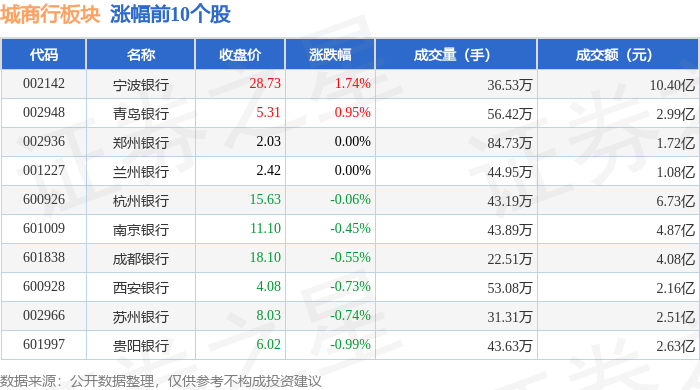
城商行板块9月5日跌0.37%,重庆银行领跌,主力资金净流出2.87亿元
Zheng Xing Xing Ye Ri Bao· 2025-09-05 08:56
Group 1 - The city commercial bank sector experienced a decline of 0.37% on September 5, with Chongqing Bank leading the drop [1] - The Shanghai Composite Index closed at 3812.51, up 1.24%, while the Shenzhen Component Index closed at 12590.56, up 3.89% [1] - Key individual stock performances in the city commercial bank sector included Ningbo Bank rising by 1.74% and Chongqing Bank falling by 1.34% [1][2] Group 2 - The net outflow of main funds from the city commercial bank sector was 287 million yuan, while retail investors saw a net inflow of 141 million yuan [2] - The trading volume for Chongqing Bank was 107,400 shares, with a transaction amount of 103 million yuan [2] - The overall trading activity showed a mixed trend, with some banks experiencing slight declines while others saw minor gains [1][2]



A股银行股普跌,邮储银行、中信银行跌超2%
Ge Long Hui A P P· 2025-09-05 02:52
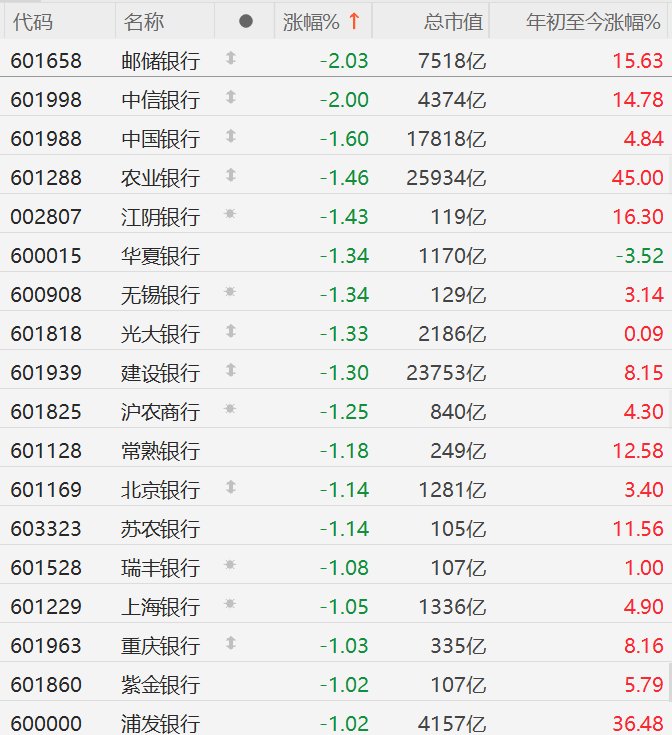
Core Viewpoint - The A-share market experienced a widespread decline in bank stocks, with several major banks seeing significant drops in their share prices [1][2]. Group 1: Stock Performance - Postal Savings Bank of China saw a decrease of 2.03%, with a total market capitalization of 751.8 billion [2]. - CITIC Bank's shares fell by 2.00%, with a market value of 437.4 billion [2]. - Bank of China experienced a decline of 1.60%, with a market capitalization of 1.7818 trillion [2]. - Agricultural Bank of China dropped by 1.46%, holding a market value of 2.5934 trillion [2]. - Other banks such as Everbright Bank, Construction Bank, and Shanghai Pudong Development Bank also reported declines of over 1% [1]. Group 2: Year-to-Date Performance - Agricultural Bank of China has the highest year-to-date increase at 45.00% [2]. - Postal Savings Bank of China and CITIC Bank have year-to-date increases of 15.63% and 14.78%, respectively [2]. - Shanghai Pudong Development Bank has a notable year-to-date increase of 36.48% despite the recent decline [2].


万亿低空经济:银行争相布局
3 6 Ke· 2025-09-05 02:52
Core Viewpoint - The low-altitude economy is gaining significant attention from financial institutions, with banks actively embedding themselves into the industry chain to support its development, projected to reach a market size of 1.5 trillion yuan by 2025 and 3.5 trillion yuan by 2035 [1][19]. Group 1: Bank Involvement in Low-Altitude Economy - Multiple banks have begun to establish a presence in the low-altitude economy, which includes activities below 1,000 meters such as drone logistics, low-altitude tourism, and aircraft manufacturing [2][4]. - Banks are providing various financial support mechanisms, including credit loans, special bonds, and asset-backed plans, to facilitate funding for low-altitude manufacturing, infrastructure, and operations [4][5]. - State-owned banks are focusing on infrastructure projects, exemplified by Postal Savings Bank's rapid credit approval for a precision manufacturing company in the aerospace sector [4][5]. Group 2: Financial Products and Innovations - Policy banks are leveraging long-term funding and policy synergies, with Agricultural Development Bank approving 800 million yuan for a drone demonstration base [5][9]. - Joint-stock banks and city commercial banks emphasize service flexibility and product innovation, such as Everbright Bank's online financial products for low-altitude economy enterprises [5][11]. - Jiangsu Bank has introduced a "Low-Altitude Park Treasure" product to support the development of industrial parks in the low-altitude economy [7]. Group 3: Challenges and Opportunities - The low-altitude economy presents banks with new lending and investment opportunities, but also requires enhanced risk management capabilities due to its complexity [14][16]. - Banks are encouraged to develop innovative financing tools tailored to the characteristics of low-altitude enterprises, such as intellectual property pledges and future revenue rights [9][11]. - The evolving regulatory landscape poses challenges, as banks must navigate uncertainties while capitalizing on the growth potential of the low-altitude economy [17][18]. Group 4: Strategic Collaborations - Banks are advised to engage in partnerships with government industry funds and leading enterprises to create a multi-layered financing system [11][19]. - The integration of online and offline service models is crucial for improving efficiency and customer experience in the low-altitude economy [11][14]. - A focus on comprehensive financial support systems, including equity investments and credit services, is essential for meeting the funding needs of low-altitude startups [11][19].


机构看好板块价值重估,银行ETF指数(512730)上涨近1%,上市银行上半年营收及利润增速双双转正
Xin Lang Cai Jing· 2025-09-04 07:18
Group 1 - The core viewpoint is that the banking sector is experiencing a recovery in revenue and profit growth, with overall operating income and net profit growth rates for listed banks turning positive [1][2] - The banking sector is expected to benefit from a stable low interest rate environment, leading investors to prefer lower-risk and more predictable return assets [1][2] - The banking sector's price-to-book (PB) ratio is considered undervalued, especially given the systemic risk concerns have been alleviated [1][2] Group 2 - Recent market conditions have led to increased long-term investments in banks by institutional investors, such as insurance funds and asset management companies [2] - The banking sector's asset quality is stable, and the pressure on interest margins is manageable, with expectations for interest margins to stabilize in the coming quarters [2] - The banking sector is anticipated to enter a new phase of stable return on equity (ROE), supported by fiscal stability and risk management from the central bank [2] Group 3 - The CSI Bank Index closely tracks the performance of the banking sector, with the top ten weighted stocks accounting for 65% of the index [3] - The top ten stocks in the CSI Bank Index include major banks such as China Merchants Bank, Industrial and Commercial Bank of China, and Agricultural Bank of China [3]


二季度新进重仓股超800只,QFII调仓瞄准这几个方向
第一财经· 2025-09-04 06:21
Core Viewpoint - The article discusses the significant movements of foreign institutional investors (QFII) in the A-share market as of the end of Q2 2025, highlighting their investment strategies and sector preferences [3][4]. Summary by Sections QFII Holdings Overview - As of the end of Q2 2025, QFII held shares in 1,145 A-share companies, with a total market value exceeding 1,400 billion yuan [4]. - In Q2, QFII initiated positions in 813 new stocks, increased holdings in 173 stocks, reduced holdings in 126 stocks, and maintained positions in 33 stocks [5][11]. Sector Distribution and Adjustments - QFII showed notable adjustments in sectors such as machinery, hardware equipment, chemicals, and electrical equipment, while increasing holdings in banking, textiles, and non-ferrous metals [5][12]. - New investments were made in the industrial trade and telecommunications sectors, whereas coal and building materials saw overall reductions [12]. Top QFII Holdings - The top ten QFII holdings by market value include: - Ningbo Bank (361.63 billion yuan) - Nanjing Bank (231.94 billion yuan) - Shengyi Technology (95.50 billion yuan) - Shanghai Bank (45.22 billion yuan) - Zijin Mining (33.83 billion yuan) [9][10]. - The highest number of QFII holdings were in banking stocks, with Nanjing Bank and Ningbo Bank seeing increases in Q2 [7][10]. New Entrants and Market Movements - Among the new QFII heavyweights, the top three by market value were: - Haowei Group (1.45 billion yuan) - Jianghuai Automobile (675 million yuan) - Guai Bao Pet (493 million yuan) [11]. - QFII's new heavyweights included companies like Tianfeng Securities and Shengyi Technology, with significant movements in their stock values [8][11]. Sector Performance - Over 60% of QFII's heavy stocks were concentrated in machinery, hardware equipment, chemicals, electrical equipment, automotive parts, pharmaceuticals, and software services [13]. - The hardware equipment sector had the highest new investment value at 40.79 billion yuan, followed by machinery at 30.07 billion yuan and chemicals at 27.65 billion yuan [14][15].






银行研究框架及25H1业绩综述:营收及利润增速双双转正
GOLDEN SUN SECURITIES· 2025-09-04 06:14
Investment Rating - The report indicates a positive outlook for the banking industry, with overall revenue and net profit growth rates turning positive in the first half of 2025, at 1.0% and 0.8% respectively, showing improvements from the previous quarter [4]. Core Insights - The banking sector's net interest margin for the first half of 2025 is reported at 1.42%, a decrease of 10 basis points compared to the previous year, but the decline is narrowing due to improved cost management on the liability side [5]. - Non-interest income, particularly from fees and commissions, has increased by 3.1% year-on-year, driven by a recovery in wealth management and a more active market environment [5]. - The asset quality remains stable, with a non-performing loan ratio of 1.23% and a provision coverage ratio of 239%, indicating a solid credit environment [5]. Summary by Sections Financial Performance Overview - The overall revenue and net profit growth for listed banks in the first half of 2025 were 1.0% and 0.8%, respectively, with both metrics showing improvement from the first quarter [4][22]. - The total assets of listed banks reached 321.3 trillion yuan, growing by 6.35% year-to-date, with loans and advances totaling 179.4 trillion yuan, accounting for 55.84% of total assets [21][24]. Income Sources - Net interest income decreased by 1.3% year-on-year, but the decline rate has slowed, reflecting better management of funding costs [5]. - Fee and commission income grew by 3.1% year-on-year, benefiting from a recovering market and the gradual impact of regulatory changes [5]. - Other non-interest income saw a significant increase of 10.7%, primarily due to favorable market conditions in the bond market [5]. Asset Quality and Management - The non-performing loan ratio remained stable at 1.23%, with a provision coverage ratio of 239%, indicating a robust asset quality [5]. - The credit cost for the first half of 2025 was 0.81%, a decrease of 5 basis points year-on-year, suggesting manageable credit risks [5]. Loan Growth and Composition - Loan growth was primarily driven by corporate lending, with significant contributions from infrastructure and manufacturing sectors [20]. - Personal loan growth was weaker, with a year-on-year increase of only 3.6%, reflecting a cautious approach to consumer lending amid rising risks [20]. Investment and Market Conditions - The investment asset proportion decreased to 34% as banks adjusted their strategies in response to market volatility [20]. - The overall yield on bonds fluctuated significantly, prompting banks to engage in tactical trading to enhance returns [20].