Bank Of Shanghai(601229)

Search documents
广发景富纯债: 广发景富纯债债券型证券投资基金2025年第2季度报告
Zheng Quan Zhi Xing· 2025-07-18 03:21
Core Viewpoint - The report provides an overview of the performance and management of the Guangfa Jingfu Pure Bond Fund for the second quarter of 2025, highlighting its investment strategy, financial indicators, and compliance with regulations [1][2][8]. Fund Product Overview - Fund Name: Guangfa Jingfu Pure Bond - Fund Code: 007778 - Fund Type: Contractual open-end fund - Total Fund Shares at End of Reporting Period: 1,437,858,026.03 shares - Investment Objective: To achieve investment returns that exceed the performance benchmark while ensuring long-term stable growth of fund assets [2][8]. - Investment Strategy: The fund employs a comprehensive analysis of macroeconomic conditions, interest rate trends, yield curve changes, and credit risk to construct and adjust its fixed-income securities portfolio [2][10]. Financial Indicators and Fund Performance - Reporting Period: April 1, 2025, to June 30, 2025 - Fund's Net Value Growth Rate: 0.97% - Performance Benchmark Return: 1.54% - 1-Year Government Bond Yield: Down 20 basis points to 1.34% - 10-Year Government Bond Yield: Down 15 basis points to 1.69% [10][11]. Investment Portfolio Report - Total Value of Bonds Held: 1,977,819,392.26 RMB, representing 99.99% of total assets - Policy Financial Bonds: 80,944,197.27 RMB, accounting for 5.37% of total assets [13][14]. Fund Management and Compliance - The fund management strictly adheres to the Securities Investment Fund Law and related regulations, ensuring legal and compliant operations throughout the reporting period [8][9]. - The investment decision-making process includes a rigorous investment candidate library and authorization system to maintain control over investment risks [9][10]. Changes in Fund Shares - Initial Fund Shares: 1,398,245,993.52 - Total Subscription Shares During Reporting Period: 39,612,033.45 - Total Redemption Shares During Reporting Period: 0.94 - Final Fund Shares: 1,437,858,026.03 [15][16]. Other Important Information - The fund experienced a situation where a single investor held over 20% of the shares, which may lead to specific risks affecting fund performance and liquidity [16][17].

广发集悦债券A,广发集悦债券C: 广发集悦债券型证券投资基金2025年第2季度报告
Zheng Quan Zhi Xing· 2025-07-18 03:21
Group 1 - The fund aims to achieve long-term stable appreciation of assets through optimized allocation of different asset classes while strictly controlling risks and maintaining asset liquidity [2][3] - The investment strategy includes asset allocation, bond investment, stock investment, asset-backed securities investment, and treasury futures investment, with a focus on macroeconomic factors, valuation, and liquidity [3][4] - The fund's performance benchmark is set as 90% of the China Bond New Comprehensive Wealth Index return plus 5% of the CSI 300 Index return and 5% of the Hong Kong dollar-denominated Hang Seng Index return [3] Group 2 - As of the end of the reporting period, the total fund shares amounted to 418,231,445.63 shares [4] - The fund's A class share net value growth rate for the reporting period was 1.61%, while the C class share net value growth rate was 1.57%, compared to a benchmark return of 1.80% [14] - The fund's investment portfolio primarily consists of bonds (81.64%), with a smaller portion in stocks (14.07%) [15] Group 3 - The fund's investment in Hong Kong stocks is subject to specific risks related to the Hong Kong stock market, including price volatility and exchange rate risks [5] - The fund management adheres to strict compliance with relevant laws and regulations, ensuring the protection of investors' interests [11][12] - The fund's investment decision-making process includes a rigorous internal control system and a fair trading principle to prevent unfair trading practices [12][13]
财经短波 | 建设银行大力发展绿色金融
Ren Min Ri Bao· 2025-07-17 21:52
Group 1: China Construction Bank's Green Finance Development - China Construction Bank's Hubei branch launched the "Green New Pioneer Equity Investment Fund," the first green low-carbon equity investment fund of the group, with a total scale of 1.5 billion yuan [1] - The fund focuses on ecological environmental protection and high-quality development along the Yangtze River Economic Belt, targeting emerging industries in ecological protection, clean energy, and green transportation [1] - The bank plans to leverage its integrated commercial and investment banking advantages to explore the green finance development potential along the Yangtze River Economic Belt through its 13 first-level branches in 11 provinces and cities [1] Group 2: China UnionPay's "Vital Life Card" - China UnionPay launched the "Vital Life Card," a card product tailored for the elderly and those preparing for retirement, in collaboration with commercial banks and industry partners [2] - The card product matrix includes debit and credit cards issued by commercial banks aimed at the elderly, as well as social security cards that meet bank criteria [2] - The initial offering includes 12 benefits across six categories related to high-frequency consumption scenarios such as healthcare, nursing care, retirement communities, daily life, high-end vacations, and high-end medical services [2]


星巴克变瑞幸、贵宾厅取消,银行的“羊毛”不好薅了|巴伦精选
Tai Mei Ti A P P· 2025-07-16 14:08
Group 1 - The core viewpoint of the articles highlights a significant reduction in credit card benefits across various banks, driven by cost pressures and a shift in the banking industry's strategy towards high-value customers [1][3][4] - The changes in benefits have led to customer dissatisfaction, with many users expressing their frustration on social media and even canceling their cards [5][6] - The credit card market is entering a phase of stock competition, with many banks experiencing negative growth in card issuance and a decline in transaction volumes [4][6] Group 2 - Banks are facing cost pressures due to narrowing interest margins, declining transaction amounts, and rising customer acquisition costs, prompting a need for efficiency [3][4] - The reduction in benefits is seen as a short-term cost-cutting measure, but it risks losing high-net-worth customers who are sensitive to service quality [5][6] - To retain high-value clients, banks are encouraged to offer personalized services and higher-yield products, moving away from traditional benefits [6][7] Group 3 - The industry is transitioning towards "data-driven services and scenario-based benefits," with banks innovating through co-branded cards and tailored offerings to enhance customer loyalty [7][8] - By leveraging big data, banks can provide customized products and services, increasing credit card usage frequency and overall customer satisfaction [8]




上海银行顾建忠:商业银行发展科技金融的理论与实践
Zhong Guo Jin Rong Xin Xi Wang· 2025-07-16 10:33
Core Viewpoint - The development of technology finance is crucial for enhancing China's economic quality and addressing structural contradictions in financing, particularly in supporting technological innovation and small and medium-sized enterprises [1][4]. Group 1: Importance of Technology Finance - The Chinese government emphasizes the integration of technology, industry, and finance to foster a virtuous cycle that supports high-quality economic development [1][4]. - Technology finance is essential for improving total factor productivity, especially as China transitions from high-speed growth to high-quality development [2][4]. - The current financial system, primarily dominated by banks, struggles to meet the unique needs of technology enterprises, highlighting the necessity for a more supportive technology finance framework [3][4]. Group 2: Historical Development of Technology Finance - The development of technology finance in China can be categorized into four stages: 1. The embryonic stage (1980-1984) focused on policy-driven technology loans. 2. The initial stage (1985-2005) saw government-led innovations in financial tools. 3. The rapid development stage (2006-2015) established a systematic technology finance framework. 4. The integration development stage (2016-present) involves collaboration among government, financial institutions, and platform enterprises [5][6]. Group 3: Current Trends in Technology Finance - The financial sector is increasingly prioritizing technology finance, with banks establishing specialized departments and enhancing their service capabilities [9]. - There is a growing emphasis on professional talent development within banks to better serve technology enterprises [9]. - Innovative financial products tailored to the needs of technology firms are being developed, focusing on early-stage financing and risk-sharing mechanisms [9][29]. Group 4: Challenges in Technology Finance - The existing financial system faces significant challenges in aligning with the unique characteristics of technology innovation, such as long development cycles and high uncertainty [10][15]. - There is a mismatch between the risk profiles of technology enterprises and traditional banking practices, which often rely on collateral and stable cash flows [13][14]. - The lack of effective risk assessment and pricing mechanisms for technology enterprises hampers the growth of technology finance [13][15]. Group 5: International Experiences and Practices - The U.S. and Germany have developed distinct technology finance systems, with the U.S. favoring direct financing through venture capital and private equity, while Germany relies on indirect financing through policy banks [16][19]. - Successful models from these countries highlight the importance of government support and innovative financing mechanisms in fostering technology finance [22][24]. Group 6: Recommendations for Enhancing Technology Finance - It is recommended that commercial banks adopt a more patient capital approach, focusing on long-term value assessment rather than short-term gains [25][26]. - Establishing a differentiated performance evaluation system that aligns with the characteristics of technology finance is crucial for encouraging banks to support early-stage technology enterprises [27][34]. - Strengthening collaboration between banks and various stakeholders, including government and industry, can enhance the overall ecosystem for technology finance [30][32].

深圳银行集体“打假”指向违规贷款中介!涉事机构称已整改
Nan Fang Du Shi Bao· 2025-07-16 09:47
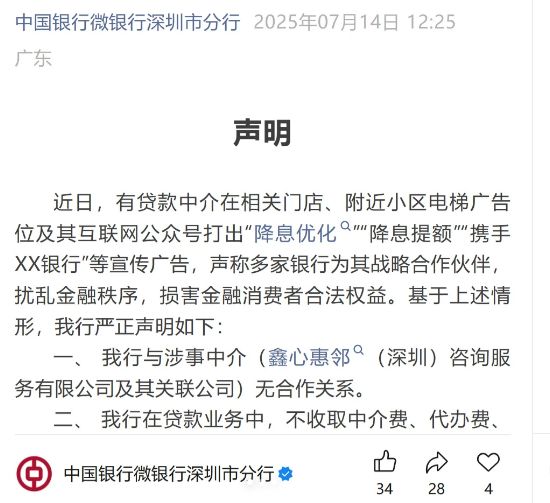
Core Viewpoint - Shenzhen banks have collectively issued statements targeting the misconduct of loan intermediaries, specifically addressing the actions of a consulting service agency named Xin Xin Hui Lin [1][5][17]. Group 1: Bank Responses - Nearly 20 banks in Shenzhen, including major institutions like Bank of China and Agricultural Bank of China, have released statements disavowing any partnership with the intermediary Xin Xin Hui Lin [1][5]. - The Bank of China emphasized that it does not charge intermediary fees or any related costs in its loan business [3]. - Postal Savings Bank of China highlighted that some intermediaries are using false advertisements to claim partnerships with banks, urging the public to be cautious of misleading loan offers [5][7]. Group 2: Intermediary Misconduct - Xin Xin Hui Lin has been accused of falsely advertising itself as a bridge between banks and communities, claiming to improve loan approval rates while charging various fees [7][9]. - The agency reportedly displayed logos of over 20 banks, misleading customers into believing it had strategic partnerships with these institutions [9][12]. - The actual control of Xin Xin Hui Lin is held by Gui Yaolin, who has registered multiple companies under the "Hui Lin" name, indicating a potential pattern of misconduct [12][14]. Group 3: Regulatory Response - The collective statements from banks were reportedly made in response to requests from Shenzhen's financial regulatory authorities, aiming to protect consumer rights and clarify the situation [5][7]. - The intermediary acknowledged its mistakes in using bank logos and stated it has undertaken corrective measures, asserting that it does not have any partnerships with financial institutions [17].

“红包雨”来了!30余家上市行年度分红“到账”,哪家出手最阔绰?
Xin Lang Cai Jing· 2025-07-16 00:40
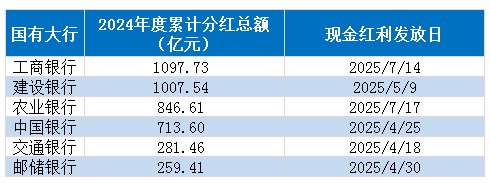
Core Viewpoint - A-share listed banks are experiencing a peak in dividend distribution for the 2024 fiscal year, with over thirty banks having completed their annual dividends and several others announcing dividend implementation plans [1][3][4]. Group 1: 2024 Annual Dividends - The Industrial and Commercial Bank of China (ICBC) leads with a total cash dividend of approximately 109.77 billion yuan for the previous year [3][4]. - The six major state-owned banks have collectively distributed over 420 billion yuan in dividends for 2024, with ICBC, China Construction Bank, Agricultural Bank of China, and Bank of China being the top contributors [4][6]. - Other banks such as China CITIC Bank and Beijing Bank have also announced significant cash dividends, with CITIC Bank distributing around 19.46 billion yuan [4][5]. Group 2: 2025 Mid-Year Dividend Plans - Several banks, including China Merchants Bank and Hangzhou Bank, have initiated plans for mid-year dividends in 2025, aiming to enhance investor returns [1][8][10]. - The focus on mid-year dividends is seen as a strategy to improve liquidity and provide more consistent cash flow to investors, which may support long-term stock price appreciation [10]. - Banks like Su Nong Bank and Changsha Bank have expressed intentions to implement mid-year dividend plans based on their financial performance and regulatory requirements [8][9]. Group 3: Stock Performance and Market Trends - The banking sector has shown strong performance in the A-share market, with several banks achieving significant stock price increases in the first half of the year [12][13]. - The overall dividend yield of the banking sector remains attractive, particularly in a low-interest-rate environment, making it appealing for long-term investors [10][13]. - Some banks have faced challenges in executing share buyback plans due to stock price fluctuations, indicating a cautious approach to capital management [11][14].



外资银行加码大湾区,桑坦德将“借力”城商行落子深圳
news flash· 2025-07-15 03:53
Group 1 - Santander Bank has officially received approval to establish a branch in Shenzhen, marking its third entry into mainland China [1] - Previously, Santander Bank had set up branches in Shanghai and Beijing but had not registered as a legal entity in mainland China, which limited its operations [1] - The bank has historically partnered with local commercial banks such as Shanghai Bank and Beijing Bank to expand its presence in the Chinese market [1] Group 2 - The Shenzhen branch will continue the bank's localization strategy, leveraging the global network of its parent company to serve domestic enterprises looking to expand internationally [1] - A partnership with a leading local commercial bank in Shenzhen will be a key component of this strategy, as both institutions have overlapping operational areas but different business focuses, creating a natural complementarity [1]

中证上海国企指数上涨0.07%,前十大权重包含浦发银行等
Sou Hu Cai Jing· 2025-07-14 14:15
据了解,中证上海国企指数以上海市(含区县)国资控股以及重要参股的上市公司证券为待选样本,结 合盈利能力、成长能力、股东回报水平等进行选样,以反映基本面情况较好的上海国资国企相关上市公 司证券的整体表现。该指数以2012年12月31日为基日,以1000.0点为基点。 金融界7月14日消息,A股三大指数收盘涨跌不一,中证上海国企指数 (上海国企,950096)上涨0.07%, 报1398.01点,成交额247.42亿元。 数据统计显示,中证上海国企指数近一个月上涨3.22%,近三个月上涨8.05%,年至今下跌1.62%。 从指数持仓来看,中证上海国企指数十大权重分别为:中国太保(8.41%)、国泰海通(6.06%)、上 海机场(5.68%)、浦发银行(5.05%)、上海电气(3.85%)、上海银行(3.79%)、上汽集团 (3.28%)、东方证券(3.15%)、华域汽车(3.02%)、申能股份(2.98%)。 从中证上海国企指数持仓的市场板块来看,上海证券交易所占比100.00%。 从中证上海国企指数持仓样本的行业来看,金融占比29.11%、工业占比23.07%、可选消费占比 11.80%、房地产占比10.14% ...




上证上海改革发展主题指数上涨0.51%,前十大权重包含上海电气等
Jin Rong Jie· 2025-07-14 14:11
Group 1 - The Shanghai Reform and Development Theme Index closed at 2523.18 points, with a trading volume of 29.016 billion yuan, reflecting a 0.51% increase [1] - Over the past month, the index has risen by 3.32%, and by 8.67% over the last three months, while it has decreased by 0.07% year-to-date [1] - The index primarily selects stocks from companies listed on the Shanghai Stock Exchange, focusing on themes such as the "Belt and Road" initiative, "Four Centers," and Free Trade Zone development [1] Group 2 - The top ten weighted stocks in the index include SAIC Motor (8.68%), Shanghai Port Group (7.73%), and Pudong Development Bank (7.62%) [1] - The index's holdings are entirely composed of stocks from the Shanghai Stock Exchange, with the industrial sector representing 29.98%, financial sector 22.30%, and consumer discretionary 18.22% [2] - The index samples are adjusted quarterly, with changes implemented on the next trading day following the second Friday of March, June, September, and December [2]