AGRICULTURAL BANK OF CHINA(601288)

Search documents
多家银行,合计被罚超2亿元!回应来了
Zhong Guo Ji Jin Bao· 2025-11-01 06:53
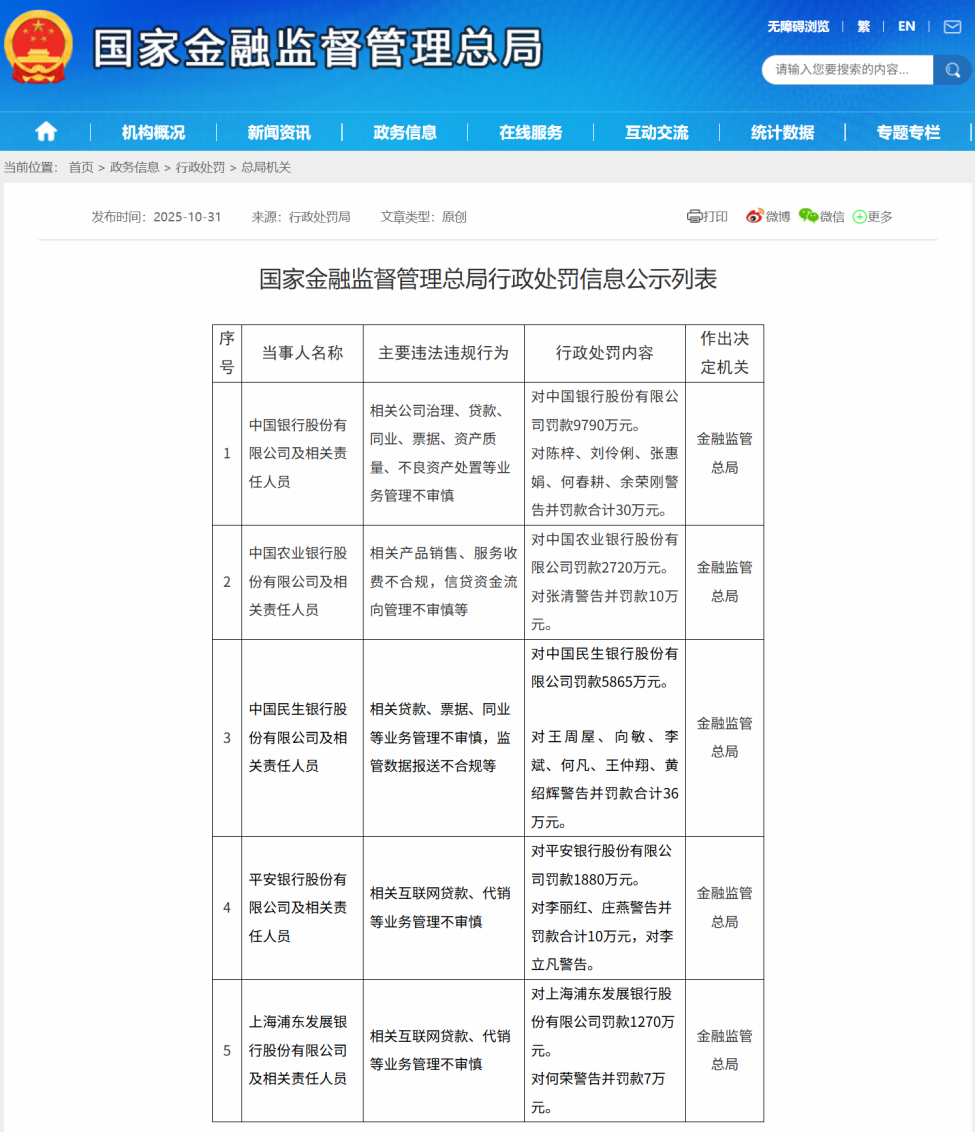
Core Viewpoint - Five banks in China received significant fines totaling over 215 million yuan due to various regulatory violations, highlighting ongoing issues in risk management and compliance within the banking sector [1][4]. Group 1: Fines and Violations - China Bank was fined 97.9 million yuan for imprudent management in areas such as corporate governance, loans, and asset quality, with five responsible personnel receiving warnings and fines totaling 300,000 yuan [2][3]. - Agricultural Bank was fined 27.2 million yuan for non-compliance in product sales and service fees, with one responsible person receiving a warning and a fine of 100,000 yuan [2][4]. - China Minsheng Bank faced a fine of 58.65 million yuan for imprudent management in loans and data reporting, with six responsible personnel receiving warnings and fines totaling 360,000 yuan [2][4]. - Ping An Bank and Shanghai Pudong Development Bank were both fined for imprudent management in internet loans and agency sales, with Ping An Bank fined 18.8 million yuan and Shanghai Pudong Development Bank fined 12.7 million yuan [2][5]. Group 2: Responses and Remedial Actions - China Bank emphasized its commitment to rectifying issues identified during a 2023 risk management inspection and has reportedly completed most of the necessary corrections [4]. - Agricultural Bank stated that the fine was a follow-up to previous inspections and that it has addressed most issues promptly, adhering to a principle of comprehensive remediation [4]. - Minsheng Bank acknowledged previous fines and has taken steps to address regulatory concerns, indicating a proactive approach to compliance [5].




多家银行,合计被罚超2亿元!回应来了
中国基金报· 2025-11-01 06:48
Summary of Key Points Core Viewpoint - Five banks in China received significant fines totaling over 215 million yuan, highlighting ongoing regulatory scrutiny in the banking sector [2]. Group 1: Regulatory Actions and Penalties - China Bank was fined 97.9 million yuan for imprudent management in areas such as corporate governance, loans, and asset quality, with five responsible individuals receiving warnings and fines totaling 300,000 yuan [3][4]. - Agricultural Bank faced a penalty of 27.2 million yuan due to non-compliance in product sales and service fees, with one individual fined 100,000 yuan [5]. - China Minsheng Bank was fined 58.65 million yuan for imprudent management in loans and data reporting, with six individuals receiving warnings and fines totaling 360,000 yuan [5]. - Ping An Bank and Shanghai Pudong Development Bank were both fined for imprudent management in internet loans and related services, with Ping An Bank fined 18.8 million yuan and Shanghai Pudong Development Bank fined 12.7 million yuan [6]. Group 2: Responses from Banks - China Bank emphasized its commitment to rectifying issues identified during regulatory inspections and improving risk management and internal controls [4]. - Agricultural Bank stated that it has addressed most issues raised by regulators and is focused on systematic rectification [5]. - China Minsheng Bank acknowledged previous penalties and has taken steps to address regulatory concerns [5].
险资现身713家A股公司前十大流通股股东,银行股仍为“心头好”
Huan Qiu Wang· 2025-11-01 02:43
Core Insights - The latest investment layout of insurance funds in A-share listed companies has been revealed as the 2025 Q3 reports are disclosed, showing active participation and allocation in the capital market [1][2] Group 1: Investment Activity - As of the end of Q3, insurance institutions were among the top ten circulating shareholders in 713 A-share listed companies, indicating a strong presence in the market [1] - In Q3, insurance institutions entered 203 new stocks and increased holdings in 185 stocks, with 112 stocks remaining unchanged, reflecting active portfolio adjustments [1] Group 2: Stock Preferences - Excluding internal holdings, the top ten stocks held by insurance institutions at the end of Q3 were predominantly bank stocks, with eight out of ten being banks, highlighting a preference for undervalued, high-dividend assets [1] - The only non-bank stocks in the top ten were China Unicom, Beijing-Shanghai High-Speed Railway, and Gemdale Group, further emphasizing the central role of financial stocks in insurance fund allocations [1] Group 3: Notable Increases - The stocks with the largest increases in holdings by insurance funds in Q3 included Postal Savings Bank, Nanjing Bank, Hunan Steel, Changshu Bank, and China National Foreign Trade Transportation Group, with Postal Savings Bank seeing the largest increase, reflecting market confidence in state-owned banks' stable operations and dividend capabilities [1] Group 4: New Entrants - Among the 203 new heavy positions taken by insurance institutions in Q3, the top five stocks were Agricultural Bank, Industrial and Commercial Bank, Joy City, Zijin Mining, and Quzhou Development, indicating a shift towards resource stocks amid rising global inflation expectations and strong commodity prices [2] - The high proportion of bank stocks in the portfolio and continued increases suggest insurance funds' preference for high-dividend, low-valuation assets, while the entry of resource and real estate stocks may be based on expectations of valuation recovery and favorable policy environments [2]




非息收入补位,六大行单季日赚42亿元
Hua Xia Shi Bao· 2025-10-31 15:58
Core Viewpoint - The six major state-owned banks in China reported stable growth in operating performance for the first three quarters of 2025, achieving a total operating income of approximately 2.73 trillion yuan and a net profit attributable to shareholders of 1.07 trillion yuan, despite pressures to reduce costs for the real economy [3][4]. Group 1: Financial Performance - The six major banks collectively achieved a net profit of over 389.8 billion yuan in the third quarter, averaging over 4.2 billion yuan in daily profit [3]. - All six banks reported positive year-on-year growth in both operating income and net profit for the first three quarters [3][4]. - The Industrial and Commercial Bank of China (ICBC) led with a net profit of 269.9 billion yuan, followed by China Construction Bank (CCB) and Agricultural Bank of China (ABC) with net profits of 258.4 billion yuan and 220.9 billion yuan, respectively [4][6]. Group 2: Profit Growth Disparities - The net profit growth rates varied significantly among the banks, with ABC leading at 3.03%, while CCB, ICBC, and Postal Savings Bank of China (PSBC) had growth rates below 1% [5][7]. - China Bank's net profit growth in the third quarter was 5.09%, attributed to improved asset quality and reduced tax rates [7]. Group 3: Revenue Trends - All six banks achieved positive revenue growth, with ICBC, ABC, CCB, and China Bank showing growth rates of 2.17%, 1.97%, 0.82%, and 2.69%, respectively [8]. - China Bank experienced the fastest revenue growth, driven by strong non-interest income, while CCB faced significant pressure leading to the lowest growth rate [8]. Group 4: Net Interest Margin - The net interest margin (NIM) for the six banks continued to decline, with PSBC having the highest NIM at 1.68%, followed by CCB and ABC at 1.36% and 1.30%, respectively [10][11]. - The decline in NIM is a significant challenge for the banking sector, impacting interest income and overall revenue [9][10]. Group 5: Non-Interest Income - Non-interest income has become a crucial supplement to profitability, with ABC and PSBC achieving double-digit growth in fee and commission income [12]. - Investment income for five of the six banks showed positive growth, effectively offsetting the pressure from declining NIM [12].


险资现身713家A股公司前十大流通股股东名单
Zheng Quan Ri Bao· 2025-10-31 15:52
Group 1 - As of the end of Q3 2023, insurance institutions were among the top ten shareholders in 713 A-share listed companies, with significant movements in their stock holdings [1] - In Q3, insurance institutions entered 203 new stocks, increased holdings in 185 stocks, and maintained positions in 112 stocks, indicating active portfolio management [1] - The top ten stocks held by insurance institutions included major banks and companies, reflecting a continued preference for bank stocks due to their high dividends and low volatility [1] Group 2 - Insurance stocks generally exhibit characteristics of high dividends, low valuations, and large market capitalizations, often being industry leaders with strong cash flows [2] - The net profit of the five major listed insurance companies reached 426.04 billion yuan, a year-on-year increase of 33.5%, driven by a favorable equity market [2] - There is an expectation for insurance institutions to continue increasing their allocation to equity assets, particularly in strategic emerging industries and high-end manufacturing sectors [2][3] Group 3 - The trend for insurance institutions is to steadily increase the total amount of equity assets while optimizing the structure of their investments [3] - The need to enhance long-term investment returns in a declining interest rate environment drives the shift towards equity assets [3] - Regulatory encouragement for long-term capital to enter the market supports the ongoing strategy of focusing on high dividend stocks and sectors aligned with national strategic development [3]
六大行三季报业绩:工行挣得最多,农行增速最快,建行派息最高
2 1 Shi Ji Jing Ji Bao Dao· 2025-10-31 15:22
Core Insights - The six major state-owned banks in China reported double growth in revenue and net profit for the first three quarters of the year, achieving a total profit of 1.07 trillion yuan [2] - China Bank had the fastest revenue growth, while Industrial and Agricultural Banks led in total net profit and year-on-year growth [2] - The net interest margin showed a downward trend across all banks, indicating a potential challenge in profitability [3] Revenue Summary - The revenue figures for the six banks are as follows: Industrial Bank 640.03 billion yuan, Agricultural Bank 550.88 billion yuan, Construction Bank 573.70 billion yuan, China Bank 491.20 billion yuan, Postal Savings Bank 265.08 billion yuan, and Transportation Bank 199.65 billion yuan, with year-on-year growth rates of 2.17%, 1.97%, 0.82%, 2.69%, 1.82%, and 1.80% respectively [2] Net Profit Summary - The net profit figures for the banks are: Industrial Bank 269.91 billion yuan, Agricultural Bank 220.86 billion yuan, Construction Bank 257.36 billion yuan, China Bank 177.66 billion yuan, Postal Savings Bank 76.56 billion yuan, and Transportation Bank 69.99 billion yuan, with year-on-year growth rates of 0.33%, 3.03%, 0.62%, 1.08%, 0.98%, and 1.90% respectively [2] Asset Quality - The non-performing loan ratios for the banks as of September 30 are: Industrial Bank 1.33%, Agricultural Bank 1.27%, Construction Bank 1.32%, China Bank 1.24%, Postal Savings Bank 0.94%, and Transportation Bank 1.26%, all showing improvement compared to the end of the previous year [3] Dividend Distribution - The proposed dividend distributions per 10 shares are: Industrial Bank 1.414 yuan, Agricultural Bank 1.195 yuan, Construction Bank 1.858 yuan, China Bank 1.094 yuan, Postal Savings Bank 1.230 yuan, and Transportation Bank 1.563 yuan, totaling 204.66 billion yuan, with Construction Bank having the highest payout [3] Market Performance - The stock prices of the four major banks have seen varying degrees of increase this year, with Agricultural Bank up 57.72%, Industrial Bank 18.05%, Construction Bank 10.06%, and China Bank 7.12%, leading to Agricultural Bank ranking second in global bank market capitalization [3] Analyst Outlook - Morgan Stanley's report suggests that profits for major Chinese banks are expected to remain stable, with dividend yields around 6%-7%, indicating that large state-owned banks are considered safe investment choices [4]
合计被罚超2亿元!5家银行领千万级罚单
Zhong Guo Zheng Quan Bao - Zhong Zheng Wang· 2025-10-31 15:14
Core Points - Five banks in China, including Bank of China, Minsheng Bank, Agricultural Bank of China, Ping An Bank, and Shanghai Pudong Development Bank, were fined a total of 215.25 million yuan for various violations [1][4] - The violations involved multiple business areas such as non-performing asset disposal, product sales, loan management, and regulatory data reporting [1][4] Summary by Bank - **Bank of China**: Fined 97.9 million yuan for issues related to corporate governance, loans, interbank transactions, bills, asset quality, and non-performing asset disposal. Five responsible personnel received warnings and fines totaling 300,000 yuan [2][4] - **Agricultural Bank of China**: Fined 27.2 million yuan for non-compliance in product sales, service charges, and imprudent management of credit fund flows. One responsible personnel, Zhang Qing, received a warning and a fine of 100,000 yuan [4] - **Minsheng Bank**: Fined 58.65 million yuan for imprudent management of loans, bills, interbank transactions, and non-compliance in regulatory data reporting. Six responsible personnel received warnings and fines totaling 360,000 yuan [3][4] - **Ping An Bank**: Fined 18.8 million yuan for imprudent management of internet loans and agency sales. Two responsible personnel received warnings and fines totaling 100,000 yuan, and one received a warning [4] - **Shanghai Pudong Development Bank**: Fined 12.7 million yuan for imprudent management of internet loans and agency sales. One responsible personnel, He Rong, received a warning and a fine of 70,000 yuan [4] Regulatory Context - The China Banking and Insurance Regulatory Commission emphasized its focus on key issues affecting financial stability, key individuals causing major financial risks, and key behaviors disrupting market order during the "14th Five-Year Plan" period [4]
涉贷款、票据等业务违规 5家银行领2.15亿元罚单
Mei Ri Jing Ji Xin Wen· 2025-10-31 15:02
Summary of Key Points Core Viewpoint - Five major Chinese banks, including Bank of China, Agricultural Bank of China, Minsheng Bank, Ping An Bank, and Shanghai Pudong Development Bank, received fines totaling over 215 million yuan due to imprudent business management practices across various sectors such as loans, interbank transactions, bills, and sales [1][2]. Group 1: Penalties and Amounts - Bank of China was fined 97.9 million yuan for issues related to corporate governance, loans, interbank transactions, bills, asset quality, and non-performing asset disposal [1]. - Agricultural Bank of China faced a penalty of 27.2 million yuan for non-compliance in product sales, service charges, and imprudent management of credit fund flows [1]. - Minsheng Bank was fined 58.65 million yuan for multiple violations including imprudent management of loans, bills, interbank transactions, and non-compliance in regulatory data reporting [1]. - Ping An Bank received a fine of 18.8 million yuan for imprudent management in internet loans and agency sales [2]. - Shanghai Pudong Development Bank was fined 12.7 million yuan for similar issues in internet loan management [2]. Group 2: Responsible Personnel - In total, five responsible personnel from Bank of China were warned and fined a combined 300,000 yuan [1]. - One responsible personnel from Agricultural Bank of China was warned and fined 100,000 yuan [1]. - Six personnel from Minsheng Bank received warnings and were fined a total of 360,000 yuan [1]. - Three personnel from Ping An Bank were warned, with two receiving fines totaling 100,000 yuan [2]. - One personnel from Shanghai Pudong Development Bank was warned and fined 70,000 yuan [2].
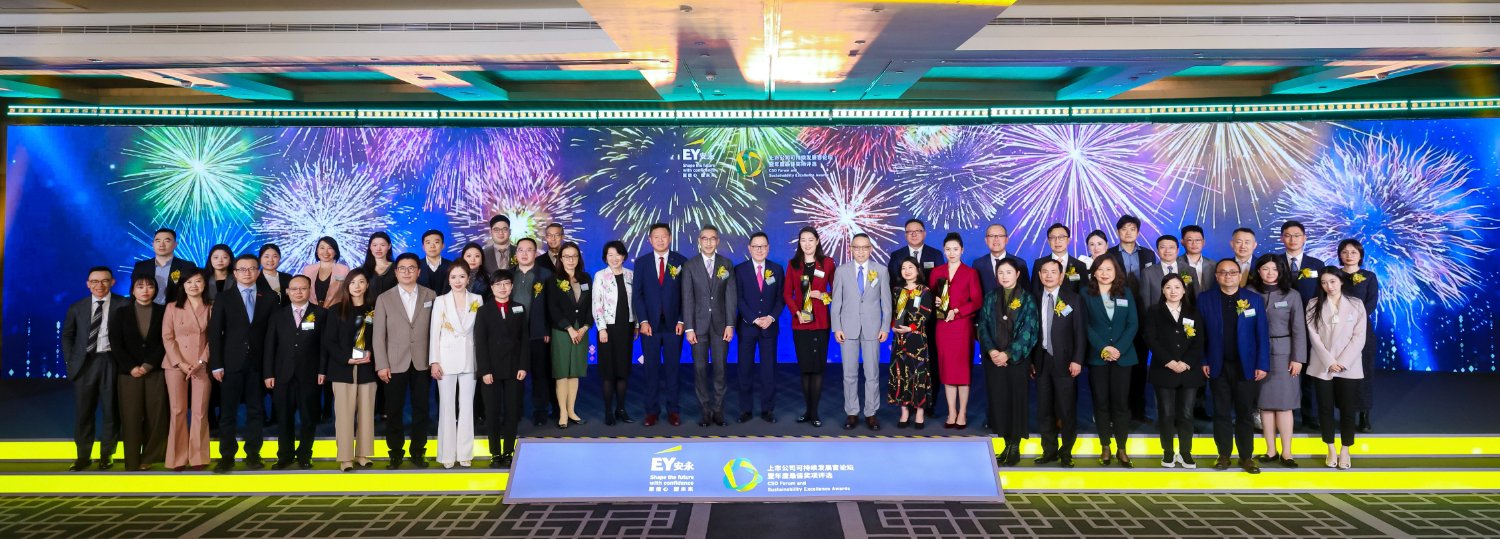
以数为擎,向绿而行,企业可持续发展迎“智”变——第四届上市公司可持续发展官论坛暨年度最佳奖项评选结果隆重揭晓
Zhong Guo Jin Rong Xin Xi Wang· 2025-10-31 14:58
Core Insights - The integration of "digital intelligence" and "green" initiatives is advancing corporate ESG (Environmental, Social, and Governance) practices from conceptual advocacy to systematic and intelligent implementation [1][3] - The fourth annual forum on sustainable development for listed companies, themed "Digital Intelligence and Green Movement Leading New Journey," was held in Beijing, revealing the winners of the "Ernst & Young Sustainable Development Annual Best Awards 2025" [1][3] - The awards highlighted the innovative practices of Chinese companies in the ESG and AI integration space, showcasing their contributions to building a modern industrial system and achieving high-quality development [1][3] Group 1: Event Overview - The forum featured 2 special awards, 12 outstanding companies, 2 distinguished individuals, 16 excellent cases, and 1 special contribution award for technological innovation in ESG development [1][3] - The focus of this year's awards was on the role of digitalization as an innovative driving force, emphasizing zero-carbon technology and AI's role in enhancing productivity [1][3] Group 2: Industry Trends - Ernst & Young's China Chairman noted that 2023 is a pivotal year for global sustainable development, marking the 10th anniversary of the Paris Agreement and the 20th anniversary of the "Green Mountains and Clear Water are Gold and Silver Mountains" concept [3] - The rapid advancement of AI technology is accelerating the digital and green transformation of Chinese enterprises, positioning them as key players in sustainable development [3][4] Group 3: AI and ESG Integration - Companies are encouraged to integrate ESG into their core strategies and leverage technology to transform sustainable development into a quantifiable and operational value system [4][5] - Ernst & Young has introduced AI-driven solutions, including the DeepSeek model and the METIS AI platform, to support enterprises in their green transformation efforts [4][5] Group 4: Award Evaluation and Criteria - The evaluation framework for the awards includes nine dimensions, focusing on technological innovation, low-carbon benefits, and social responsibility [5] - This year, an AI assessment component was introduced to enhance the evaluation process, utilizing a comprehensive ESG information database [5] Group 5: Future Outlook - Ernst & Young aims to deepen its professional service capabilities, helping companies embed sustainable development into their strategic core and operational processes [6]





230股本月股价创新高 27股获机构净买入
Zheng Quan Shi Bao Wang· 2025-10-31 14:57
Market Performance - The Shanghai Composite Index increased by 1.85% this month, with 230 stocks reaching historical highs [1] - Among the tradable A-shares, 3,051 stocks rose, accounting for 56.06%, while 2,364 stocks fell, making up 43.44% [2] Historical Highs - A total of 230 stocks reached historical highs this month, with 114 from the main board, 55 from the ChiNext, 50 from the Sci-Tech Innovation Board, and 11 from the Beijing Stock Exchange [2] - The average increase for stocks that reached historical highs was 10.24%, with the largest increase being 103.60% for Zhendemedical [2] Sector Analysis - The electronics, machinery equipment, and non-ferrous metals sectors had a significant concentration of stocks reaching historical highs, with 58, 34, and 29 stocks respectively [2] - The average closing price of stocks that reached historical highs was 72.30 yuan, with 46 stocks priced over 100 yuan and 53 stocks priced between 50 and 100 yuan [2] Market Capitalization - The average total market capitalization of stocks reaching historical highs was 70.06 billion yuan, with an average circulating market capitalization of 66.39 billion yuan [3] - Major stocks by total market capitalization included Agricultural Bank of China (25,411.84 billion yuan), CATL (17,132.86 billion yuan), and Industrial Fulian (14,297.89 billion yuan) [3] Institutional Activity - 65 stocks that reached historical highs saw institutional involvement, with 27 stocks experiencing net purchases [3] - Sunshine Power received the highest net purchase from institutions at 1.654 billion yuan, followed by Canxin Technology and Kaimete Gas with 613 million yuan and 418 million yuan respectively [3] Notable Stocks - Zhendemedical had a closing price of 95.00 yuan with a monthly increase of 103.60% and a turnover rate of 123.42% [3] - Guoshun Quantum had the highest closing price at 579.80 yuan, with a monthly increase of 65.19% [3]