AGRICULTURAL BANK OF CHINA(601288)

Search documents
因个贷款管理不审慎等,农行浙江省分行被罚880万元
Bei Jing Shang Bao· 2026-01-21 09:48
北京商报讯(记者 宋亦桐)1月21日,据国家金融监督管理总局浙江监管局公布的行政处罚信息公开 表,农业银行浙江省分行因"个人贷款管理不审慎;对公贷款管理不审慎等"违法违规行为,被罚款880 万元;另有多位相关责任人被警告。 ...

银行行业今日净流出资金4.47亿元,农业银行等5股净流出资金超5000万元
Zheng Quan Shi Bao Wang· 2026-01-21 09:21
Market Overview - The Shanghai Composite Index rose by 0.08% on January 21, with 18 out of the 28 sectors experiencing gains. The top-performing sectors were non-ferrous metals and electronics, with increases of 2.79% and 2.62% respectively [1] - The banking and coal sectors were the worst performers, declining by 1.58% and 1.57% respectively, with the banking sector leading the decline [1] Capital Flow - The net inflow of capital in the two markets was 11.983 billion yuan, with 14 sectors seeing net inflows. The electronics sector had the highest net inflow of 16.369 billion yuan, while the non-ferrous metals sector followed with a net inflow of 7.289 billion yuan [1] - Conversely, 17 sectors experienced net outflows, with the power equipment sector seeing the largest outflow of 6.688 billion yuan, followed by the defense and military industry with a net outflow of 2.906 billion yuan [1] Banking Sector Performance - The banking sector saw a decline of 1.58% with a net outflow of 447 million yuan. Out of 42 stocks in this sector, only one stock rose while 41 stocks fell [2] - Among the stocks with net inflows, Hangzhou Bank led with an inflow of 153 million yuan, followed by China Transportation Bank and Jiangsu Bank with inflows of 106 million yuan and 96.849 million yuan respectively [2] - The stocks with the highest net outflows included Agricultural Bank of China, Industrial and Commercial Bank of China, and Bank of China, with outflows of 555.7 million yuan, 227.4 million yuan, and 167.4 million yuan respectively [2] Detailed Banking Sector Data - A detailed table of banking stocks shows various performance metrics, including daily price changes and turnover rates. For instance, Agricultural Bank of China decreased by 2.93% with a turnover rate of 0.17% and a net outflow of 55.707 million yuan [3] - Other notable declines included Industrial and Commercial Bank of China at -2.52% and Bank of China at -2.02%, with respective net outflows of 22.740 million yuan and 16.737 million yuan [3]



国有大型银行板块1月21日跌2.53%,农业银行领跌,主力资金净流出12.7亿元
Zheng Xing Xing Ye Ri Bao· 2026-01-21 08:54
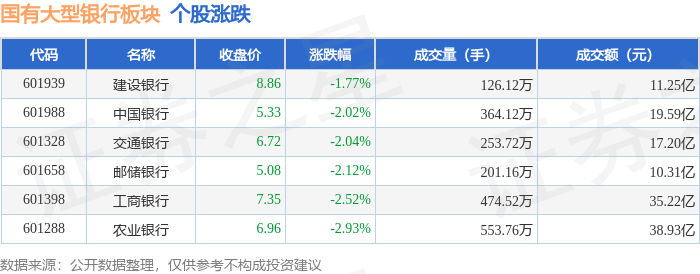
证券之星消息,1月21日国有大型银行板块较上一交易日下跌2.53%,农业银行领跌。当日上证指数报收 于4116.94,上涨0.08%。深证成指报收于14255.12,上涨0.7%。国有大型银行板块个股涨跌见下表: | 代码 | 名称 | 收盘价 | 涨跌幅 | 成交量(手) | 成交额(元) | | --- | --- | --- | --- | --- | --- | | 666109 | 建设银行 | 8.86 | -1.77% | 126.12万 | 11.25 Z | | 601988 | 中国银行 | 5.33 | -2.02% | 364.12万 | 19.59亿 | | 601328 | 交通银行 | 6.72 | -2.04% | 253.72万 | 17.20亿 | | 601658 | 邮储银行 | 5.08 | -2.12% | 201.16万 | 10.31亿 | | 601398 | 工商银行 | 7.35 | -2.52% | 474.52万 | 35.22 亿 | | 601288 | 农业银行 | 6.96 | -2.93% | 553.76万 | 38.93亿 | | 代码 ...



王国彪,被“双开”!
Zhong Guo Ji Jin Bao· 2026-01-21 08:46
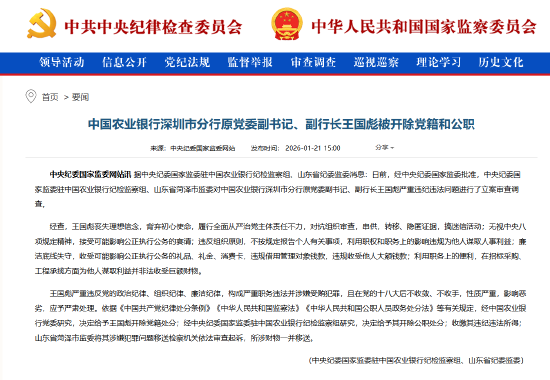
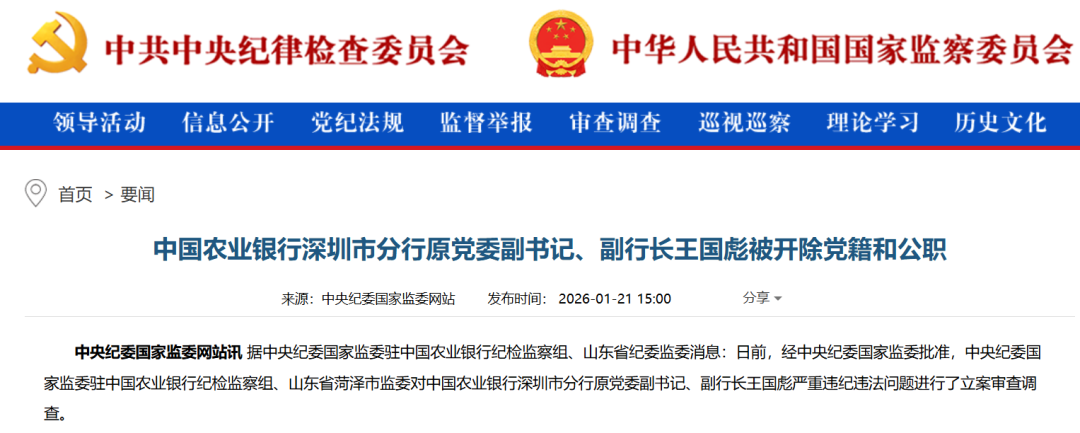
【导读】中国农业银行深圳市分行原党委副书记、副行长王国彪被开除党籍和公职 金融反腐最新消息来了! 1月21日,中央纪委国家监委官网通报:中国农业银行深圳市分行原党委副书记、副行长王国彪被开除党籍和公职。 日前,经中央纪委国家监委批准,中央纪委国家监委驻中国农业银行纪检监察组、山东省菏泽市监委对中国农业银行深圳市分行原党委副书记、副行长王 国彪严重违纪违法问题进行了立案审查调查。 经查,王国彪存在以下问题: 中国基金报记者晨曦 ●丧失理想信念,背弃初心使命,履行全面从严治党主体责任不力,对抗组织审查,串供,转移、隐匿证据,搞迷信活动; ●无视中央八项规定精神,接受可能影响公正执行公务的宴请;违反组织原则,不按规定报告个人有关事项,利用职权和职务上的影响违规为他人谋取人 事利益; ●廉洁底线失守,收受可能影响公正执行公务的礼品、礼金、消费卡,违规借用管理对象钱款,违规收受他人大额钱款; ●利用职务上的便利,在招标采购、工程承揽方面为他人谋取利益并非法收受巨额财物。 通报指出,王国彪严重违反党的政治纪律、组织纪律、廉洁纪律,构成严重职务违法并涉嫌受贿犯罪,且在党的十八大后不收敛、不收手,性质严重,影 响恶劣,应予严 ...
王国彪,被“双开”!
中国基金报· 2026-01-21 08:33
【导读】中国农业银行深圳市分行原党委副书记、副行长王国彪被开除党籍和公职 中国基金报记者 晨曦 金融反腐最新消息来了! 1 月 21 日,中央纪委国家监委官网通报:中国农业银行深圳市分行原党委副书记、副行长王 国彪被开除党籍和公职。 日前,经中央纪委国家监委批准,中央纪委国家监委驻中国农业银行纪检监察组、山东省菏 泽市监委对中国农业银行深圳市分行原党委副书记、副行长王国彪严重违纪违法问题进行了 立案审查调查。 经查,王国彪存在以下问题: ● 丧失理想信念,背弃初心使命,履行全面从严治党主体责任不力,对抗组织审查,串供, 转移、隐匿证据,搞迷信活动; ● 无视中央八项规定精神,接受可能影响公正执行公务的宴请;违反组织原则,不按规定报 告个人有关事项,利用职权和职务上的影响违规为他人谋取人事利益; 通报指出,王国彪严重违反党的政治纪律、组织纪律、廉洁纪律,构成严重职务违法并涉嫌 受贿犯罪,且在党的十八大后不收敛、不收手,性质严重,影响恶劣,应予严肃处理。 依据《中国共产党纪律处分条例》《中华人民共和国监察法》《中华人民共和国公职人员政 务处分法》等有关规定,经中国农业银行党委研究,决定给予王国彪开除党籍处分;经中 ...

并购贷款新规实施20天 四大行率先落地首批项目
2 1 Shi Ji Jing Ji Bao Dao· 2026-01-21 08:23
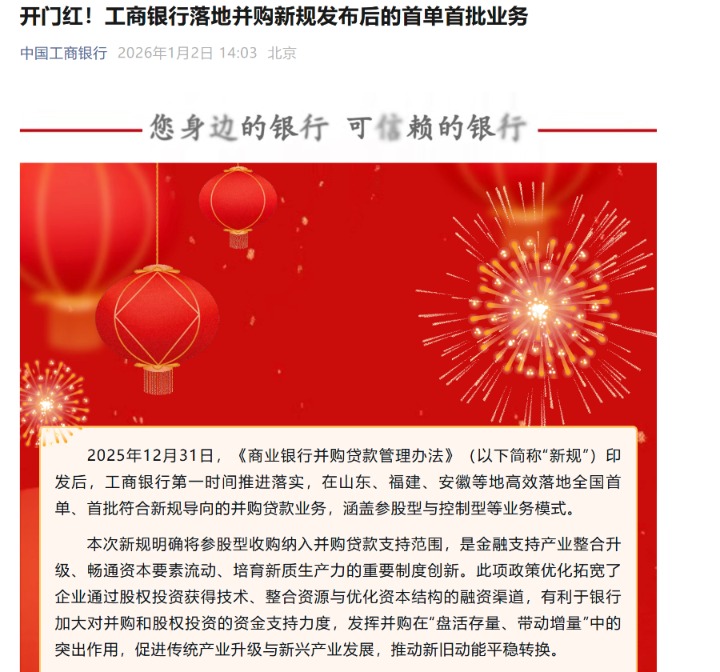
Core Viewpoint - The implementation of the new merger and acquisition loan management regulations by the National Financial Supervision Administration has enabled major state-owned banks to quickly respond and support the real economy through targeted financing solutions, enhancing the effectiveness of financial services in the context of China's economic transformation [1][6]. Group 1: Regulatory Changes - The new regulations, effective from January 1, 2026, introduce several key features, including the inclusion of equity-based merger loans and an increase in the upper limit of controlling merger loans from 60% to 70% of the transaction price [1][6]. - The loan term for controlling merger loans has been extended from seven years to ten years, providing a compliant and efficient financing path for non-controlling strategic investments [1][6]. Group 2: Bank Responses - Major state-owned banks, including ICBC, ABC, BOC, and CCB, have quickly launched equity-based merger loans in various provinces, demonstrating their ability to adapt to regulatory changes and support local economic needs [2][5]. - ICBC's Anhui branch has focused on green industry investments, while ABC and BOC have successfully issued loans to support local enterprises in strategic sectors such as environmental protection and semiconductors [2][5]. Group 3: Market Impact - The new regulations are expected to stimulate the merger and acquisition market by facilitating industry consolidation and transformation, particularly as traditional industries undergo optimization and new industries continue to grow [6][7]. - The financial support for equity investments is seen as a crucial innovation to enhance capital flow, promote resource optimization, and improve the overall efficiency of financial services to the real economy [6][7].
事关消费贷贴息,农行、中行、交行、邮储银行率先响应!
Jin Rong Shi Bao· 2026-01-21 07:52
Core Viewpoint - The Ministry of Finance, the People's Bank of China, and the Financial Regulatory Administration have extended the implementation period of the personal consumption loan interest subsidy policy until the end of 2026, including credit card installment payments in the support scope [1] Group 1: Policy Implementation - The personal consumption loan interest subsidy policy will now be effective from September 1, 2025, to December 31, 2026, with credit card installment subsidies effective from January 1, 2026, to December 31, 2026 [1] - Agricultural Bank of China has announced that customers who have already processed credit card installments between January 1, 2026, and the policy announcement date can apply for subsidies [1] Group 2: Changes in Subsidy Standards - The policy removes the restriction on consumption transactions of 50,000 yuan and above, allowing these transactions to qualify for subsidies regardless of their category [2] - The annual subsidy rate is set at 1%, with a maximum subsidy of 3,000 yuan per borrower for all personal consumption loans and credit card installments combined [2] - The policy eliminates the previous limits on single transaction subsidies and the cumulative subsidy cap for loans below 50,000 yuan [2] Group 3: Application Process and Monitoring - Customers can apply for personal consumption loan subsidies through standard loan processes, and banks will calculate subsidies based on actual consumption [2] - If the system cannot identify the loan usage, customers can provide proof of consumption for manual review [3] - Banks are required to monitor loan usage and fund flow, with strict penalties for fraudulent activities or misuse of funds [3]

超3000只个股上涨
第一财经· 2026-01-21 07:28
1月21日,A股市场冲高回落,截至收盘,沪指涨0.08%,深成指涨0.7%,创业板指涨0.54%,科创综指 涨2.32%。 | 代码 | 名称 | 两日图 | 现价 | 涨跌 | 涨跌幅 | | --- | --- | --- | --- | --- | --- | | 000001 | 上证指数 | the control control concession in the control of the controllers and | 4116.94c | 3.29 | 0.08% | | 399001 | 深证成指 | S | 14255.13c | 99.50 | 0.70% | | 399006 | 创业板指 | In | 3295.52c | 17.54 | 0.54% | | 000680 | 科创综指 | Non m | 1862.69c | 42.21 | 2.32% | 盘面上,半导体、AI算力产业链集体爆发,GPU、先进封装、CPO方向齐上涨。有色金属板块活跃,黄 金股掀涨停潮,锂矿、铜矿涨幅靠前。银行、煤炭、白酒、零售板块走弱。 具体来看,贵金属板块集体爆发,招金黄金、四川黄金、西部 ...






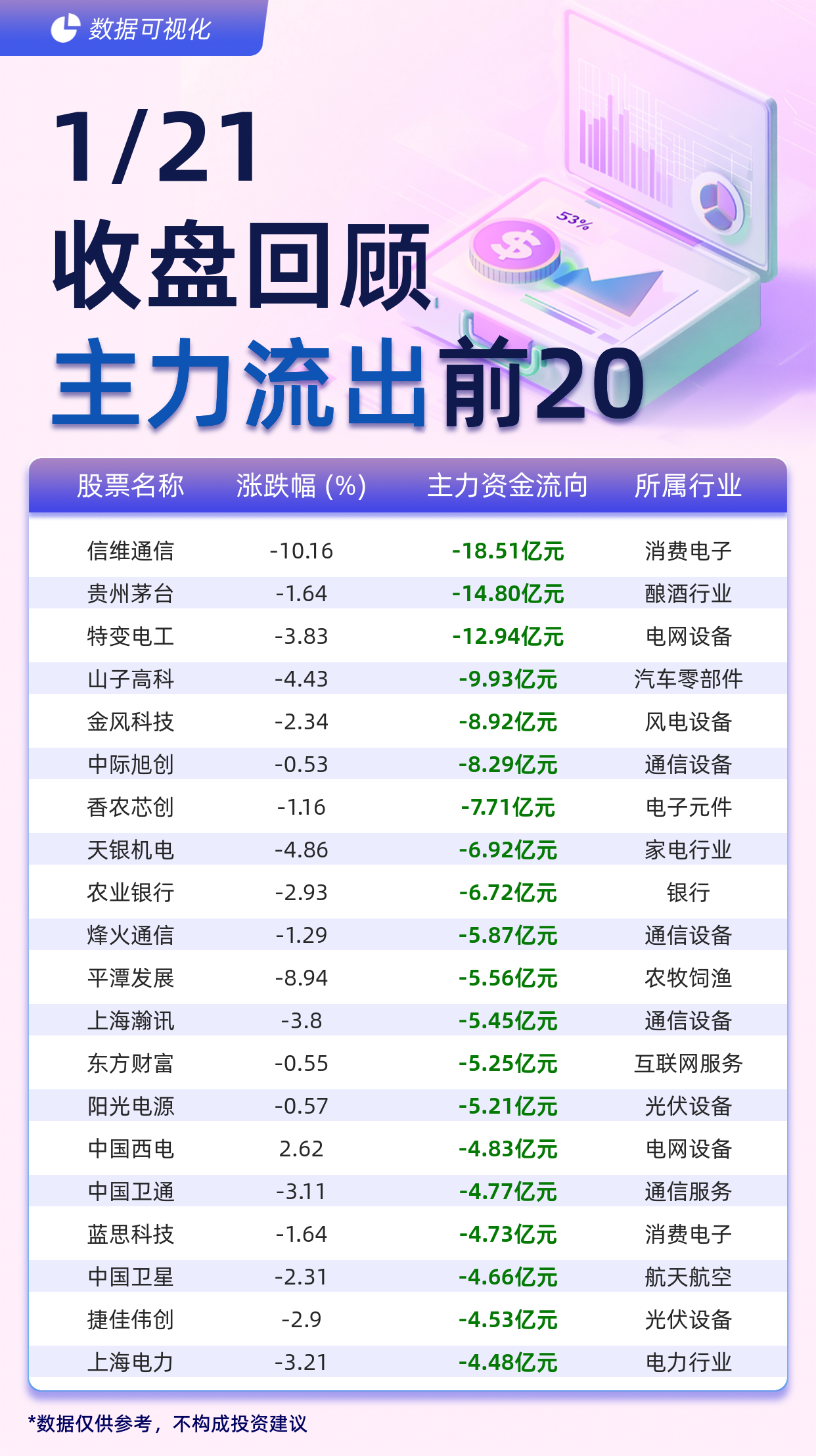
主力个股资金流出前20:信维通信流出18.51亿元、贵州茅台流出14.80亿元
Jin Rong Jie· 2026-01-21 07:11
Core Viewpoint - The data indicates significant outflows of main funds from various stocks, with notable amounts withdrawn from companies across different sectors, suggesting a potential shift in investor sentiment and market dynamics [1][2][3] Group 1: Stock Performance and Fund Outflows - The top stock with the largest fund outflow is XW Communication, with a withdrawal of 1.851 billion yuan and a decline of 10.16% in its stock price [2] - Guizhou Moutai follows with a fund outflow of 1.480 billion yuan and a decrease of 1.64% [2] - TBEA Co., Ltd. experienced a fund outflow of 1.294 billion yuan and a drop of 3.83% [2] - Other notable companies with significant outflows include: - Sanzi Gaoke: -0.993 billion yuan, -4.43% [2] - Goldwind Technology: -0.892 billion yuan, -2.34% [2] - Zhongji Xuchuang: -0.829 billion yuan, -0.53% [2] Group 2: Sector Analysis - The consumer electronics sector is represented by XW Communication and Lens Technology, both experiencing substantial fund outflows [2][3] - The beverage industry, highlighted by Guizhou Moutai, shows a minor decline in stock price despite significant fund outflow [2] - The power equipment sector, including TBEA Co., Ltd. and China Western Power, reflects mixed performance with varying fund outflows [2][3] - The telecommunications sector, represented by companies like Zhongji Xuchuang and Fenghuo Communication, also shows notable fund withdrawals [2][3]



农业银行深圳市分行原党委副书记、副行长王国彪被开除党籍和公职
Xin Lang Cai Jing· 2026-01-21 07:09
1月21日金融一线消息,据中央纪委国家监委驻中国农业银行纪检监察组、山东省纪委监委消息:日 前,经中央纪委国家监委批准,中央纪委国家监委驻中国农业银行纪检监察组、山东省菏泽市监委对中 国农业银行深圳市分行原党委副书记、副行长王国彪严重违纪违法问题进行了立案审查调查。 经查,王国彪丧失理想信念,背弃初心使命,履行全面从严治党主体责任不力,对抗组织审查,串供, 转移、隐匿证据,搞迷信活动;无视中央八项规定精神,接受可能影响公正执行公务的宴请;违反组织 原则,不按规定报告个人有关事项,利用职权和职务上的影响违规为他人谋取人事利益;廉洁底线失 守,收受可能影响公正执行公务的礼品、礼金、消费卡,违规借用管理对象钱款,违规收受他人大额钱 款;利用职务上的便利,在招标采购、工程承揽方面为他人谋取利益并非法收受巨额财物。 王国彪严重违反党的政治纪律、组织纪律、廉洁纪律,构成严重职务违法并涉嫌受贿犯罪,且在党的十 八大后不收敛、不收手,性质严重,影响恶劣,应予严肃处理。依据《中国共产党纪律处分条例》《中 华人民共和国监察法》《中华人民共和国公职人员政务处分法》等有关规定,经中国农业银行党委研 究,决定给予王国彪开除党籍处分;经 ...