AGRICULTURAL BANK OF CHINA(601288)

Search documents
7只股票A股市值超1万亿元 农业银行登顶榜首
Xin Lang Cai Jing· 2025-12-31 07:43
Core Viewpoint - The total market capitalization of A-shares has exceeded 108 trillion yuan, reaching a record high by the end of the year [1] Group 1: Market Capitalization - As of December 31, the total market capitalization of A-shares (excluding other shares) surpassed 108 trillion yuan, marking a historical peak [1] - Seven stocks have a market capitalization exceeding 1 trillion yuan, including Agricultural Bank of China, Industrial and Commercial Bank of China, Kweichow Moutai, China Petroleum, CATL, Bank of China, and Industrial Fulian [1] - Agricultural Bank of China has overtaken Industrial and Commercial Bank of China to become the market capitalization leader among A-shares, with a market value of 2.45 trillion yuan [1]




六大国有行官宣,2026年起数字人民币实名钱包按活期利率计息
Di Yi Cai Jing· 2025-12-31 07:40
Core Insights - The People's Bank of China has announced that starting January 1, 2026, interest will be paid on the balances of real-name digital RMB wallets at the current demand deposit rate of 0.05% [2][3] - Digital RMB wallets are categorized into four types, with only the first three types (real-name wallets) eligible for interest payments, while the fourth type (anonymous wallets) will not earn interest [2] - The digital RMB management service system and related financial infrastructure will officially launch on January 1, 2026, with banks required to comply with self-regulatory agreements on deposit interest rates [3] Group 1 - The current demand deposit rate is set at 0.05% [2] - Six major state-owned banks will implement interest payments on digital RMB real-name wallet balances according to the demand deposit rate [2] - The designated operating institutions for digital RMB currently include 10 banks, comprising six state-owned commercial banks, two joint-stock commercial banks, and two internet banks [2] Group 2 - The new digital RMB management framework will include a measurement framework, management system, operational mechanism, and ecosystem [3] - Banks will be allowed to conduct asset-liability management for digital RMB wallet balances, with deposit insurance providing the same level of security as traditional deposits [4]





农行内蒙古分行:多点发力护航乡村振兴
Zhong Guo Jin Rong Xin Xi Wang· 2025-12-31 07:37
Core Viewpoint - Agricultural Bank of Inner Mongolia Branch is focusing on empowering rural revitalization through financial services, achieving a balance of 149.9 billion yuan in agricultural loans, with an increase of 13.2 billion yuan, demonstrating its commitment to rural development [1] Group 1: Financial Empowerment and Support - The bank integrates financial services into the entire supply chain of key industries such as dairy, beef, sheep, and cashmere in Inner Mongolia, establishing a comprehensive financial support system [2] - A "smart grass feeding" cloud platform was developed in collaboration with Caodu Group, facilitating online transactions and financial services, resulting in 82 transactions worth 3.72 million yuan and the issuance of 2.05 million yuan in government procurement loans [2] - The bank provided 6.468 million yuan in customized financial solutions to a cashmere company in Ordos, helping it achieve recognition as a technology-based SME [2] Group 2: Innovative Financing Solutions - The bank introduced a frozen meat collateral loan of 10 million yuan to support the development of a key agricultural enterprise, enabling production expansion and technology upgrades [3] - The bank's innovative service model includes a five-in-one service system to enhance accessibility to financial services for farmers, including mobile banking and rural service stations [4] - New financial products such as "Grain Farmer e-loan" and "Rural Travel Loan" have been launched, along with support for special groups through "Wealthy People Loan" and "Solid Border Loan" [4]
多家国有行公告:余额按0.05%生息,数字人民币告别无息时代
Xin Lang Cai Jing· 2025-12-31 07:03
数字人民币将正式告别"无息时代"。 2025年12月31日,工商银行、农业银行、交通银行公告,自2026年1月1日起,为数字人民币实名钱包余 额按照活期存款挂牌利率计付利息,计结息规则与活期存款一致。 工商银行关于数字人民 币计付利息的公告 图/银行官网 农业银行关于数字人民 币计付利息的公告 图/银行官网 交通银行关于数字人民 币计付利息的公告 图/银行官网 交通银行公告亦表示,客户开立在交行的数字人民币实名钱包(包含一类、二类、三类个人钱包和单位 钱包)余额,按照交行公布的活期存款挂牌利率计付利息。如客户开立的数字人民币钱包为四类个人钱 包,则钱包内的余额不计付利息。 此次利息计付政策的落地,源于中国人民银行近期出台的《关于进一步加强数字人民币管理服务体系和 相关金融基础设施建设的行动方案》(以下简称《行动方案》)。中国人民银行党委委员、副行长陆磊 在2025年12月29日公开发文表示,经过十年研发试点,数字人民币将从"数字现金时代"迈入"数字存款 货币"时代。《行动方案》将于2026年1月1日起正式实施,届时新一代数字人民币的计量框架、管理体 系、运行机制与生态体系将同步落地,其中重要的亮点就是,数字人 ...
农行内蒙古分行:金融创新服务农牧民增收致富
Zhong Guo Jin Rong Xin Xi Wang· 2025-12-31 06:55
Core Insights - Agricultural Bank of Inner Mongolia has played a crucial role in enhancing the income of farmers and herdsmen through financial services, innovative products, and optimized service models, resulting in a loan balance of 79.2 billion yuan and an annual increase of 14.1 billion yuan as of the end of October this year [1] Group 1: Support for Farmers - The bank has provided targeted financial support to entrepreneurs like Shi Jian, who transformed his livestock business by investing in quality breeding and modern farming techniques, leading to significant economic benefits [2][3] - Shi Jian received a loan of 5 million yuan from Agricultural Bank, which alleviated his financial pressure and supported his business expansion [3] Group 2: Innovation in Traditional Industries - The unique fermented mare's milk product, known as "Cegge," has gained popularity due to its health benefits, leading to the establishment of standardized production facilities by local herders [4] - The bank supported the expansion of a local mare's milk producer, Sai Henqi Mu Ge, with a loan of 500,000 yuan, enabling the upgrade of production equipment and facilities, resulting in annual sales exceeding 2 million yuan and increased income for surrounding herders [4]
金融活水润消费 农行内蒙古分行让汽车市场“热”起来
Zhong Guo Jin Rong Xin Xi Wang· 2025-12-31 06:55
Core Insights - Agricultural Bank of China Inner Mongolia Branch is actively responding to national and regional policies aimed at boosting consumption, focusing on automotive consumption as a key area for growth [1][2] - The bank has developed a new model for consumption stimulation that integrates policy guidance, banking empowerment, and collaboration with car manufacturers, aiming to release consumption potential and support high-quality regional economic development [1][2] Group 1: Financial Performance - As of November 2025, the bank's automotive installment transaction volume reached 1.993 billion yuan, representing a year-on-year increase of 71.99% [1] - The balance of automotive loans exceeded 2.5 billion yuan for the first time, increasing by 1.16 billion yuan since the beginning of the year, with a growth rate of 86.50% [1] Group 2: Strategic Initiatives - The bank has established a comprehensive consumption financial support system by embedding financial services deeply into consumption scenarios, implementing differentiated management strategies for urban and rural areas, and focusing on key areas such as rural automotive sales and new energy subsidies [2] - A strategic partnership with quality automotive dealers has been deepened to enhance collaboration among policies, banks, and car manufacturers, thereby broadening sales channels for car manufacturers and providing convenient financial services for consumers [2] Group 3: Service Innovations - To address consumer pain points such as financial pressure and complicated processes, the bank has innovated in product offerings, service processes, and overall service quality [3] - The introduction of a "two years interest-free + low fee rate" promotional policy, combined with local consumption vouchers, has lowered the barriers to car purchases [3] - The bank has streamlined its service process to allow for online applications, rapid approvals, and immediate disbursements, significantly enhancing operational efficiency [3] Group 4: Regional Collaboration - Under the bank's coordination, various regional branches have tailored their consumption stimulation efforts to local conditions, resulting in a flourishing multi-point development [5] - The Hohhot branch collaborated with over 70 automotive dealers, achieving an automotive installment business transaction amount of 427 million yuan, a year-on-year increase of 49.88% [5] - The Ordos branch's automotive installment loan disbursements reached 276 million yuan, marking a 110% increase year-on-year, serving nearly 1,800 customers [5][6] Group 5: Future Outlook - The Agricultural Bank of China Inner Mongolia Branch plans to continue deepening structural reforms in financial supply, optimizing consumer financial products and services, and expanding cooperation scenarios to further support the recovery of the consumption market [6]
工行、农行、建行、交行、邮储银行发布公告
Xin Jing Bao· 2025-12-31 06:49
新京报贝壳财经记者 姜樊 编辑 陈莉 校对 杨利 本周一(12月29日),人民银行出台的《关于进一步加强数字人民币管理服务体系和相关金融基础设施 建设的行动方案》(以下简称《行动方案》)明确,从明年起,数字人民币钱包余额将计付利息。 明日起,数字人民币实名钱包余额将开始计息。12月31日,工行、农行、建行、交行、邮储银行等国有 银行公布了数字人民币钱包余额计息的规则。 工行、农行、建行、交行、邮储银行均发布公告称,自2026年1月1日起,银行将为客户开立的数字人民 币实名钱包余额按照本行活期存款挂牌利率计付利息,计结息规则与活期存款一致。 值得注意的是,数字人民币钱包分为四类钱包。其中,一类、二类、三类钱包未实名钱包,四类钱包为 非实名钱包。因此四类钱包不属于各家银行计息的"实名钱包"范畴。交行在公告中明确,如客户开立的 数字人民币钱包为四类个人钱包,则钱包内的余额不计付利息。 数字人民币是指人民银行发行的法定数字货币和相关支付体系,采用双层运营架构,由中国人民银行向 数字人民币业务运营机构发行,再由数字人民币业务运营机构兑换给公众。 ...

三大行集体公告数字钱包生息机制,数字人民币告别“无息时代”
2 1 Shi Ji Jing Ji Bao Dao· 2025-12-31 06:42
Core Viewpoint - The digital renminbi will officially end its "interest-free era" as of January 1, 2026, with major banks announcing that interest will be paid on the balances of real-name digital renminbi wallets based on the current deposit rates [1][6][10]. Group 1: Interest Payment Policy - Starting January 1, 2026, the balance in real-name digital renminbi wallets will earn interest according to the People's Bank of China's current deposit interest rate [6][7]. - The interest calculation will follow the same rules as regular savings accounts, with interest credited on the 21st of each quarter [6][10]. - Balances in anonymous wallets will not earn interest, maintaining a distinction between different wallet types [6][10]. Group 2: Transition to Digital Deposit Currency - The implementation of the interest payment policy marks the transition from "digital cash" to "digital deposit currency," indicating a significant evolution in the digital renminbi's role [7][10]. - The digital renminbi will now be considered a liability of commercial banks, allowing it to earn interest and be subject to deposit insurance, similar to traditional bank deposits [10]. - This change enhances the monetary elasticity of the digital renminbi, enabling it to support credit activities and deposit expansion mechanisms [10]. Group 3: Background and Development - The policy change is part of a broader initiative by the People's Bank of China to strengthen the management and service system for digital renminbi [7]. - The digital renminbi has been in development for over ten years, expanding its pilot programs from select cities to entire provinces [8]. - As of November 2025, the digital renminbi has processed 3.48 billion transactions, amounting to 16.7 trillion yuan, indicating significant adoption and usage [9].
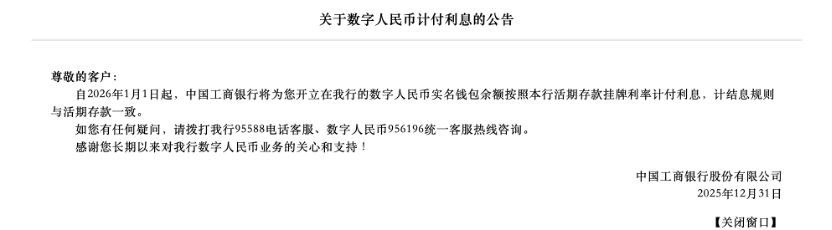
多家银行宣布:2026年起数字人民币钱包余额可计付利息
Sou Hu Cai Jing· 2025-12-31 05:40
Group 1 - The core announcement is that starting from January 1, 2026, major Chinese banks including Agricultural Bank of China, Postal Savings Bank, and others will pay interest on digital RMB wallet balances according to the same rates as regular demand deposits [1][4][8] - The interest calculation rules for digital RMB wallets will align with those of demand deposits, indicating a significant shift in how digital currency is treated [1][8] - This transition marks the evolution of digital RMB from a "digital cash era" to a "digital deposit currency era," following a decade of research and pilot programs [8] Group 2 - The People's Bank of China has introduced a plan to enhance the management and service system for digital RMB, which will officially launch on January 1, 2026 [8] - The new framework will include a measurement system, management structure, operational mechanism, and ecosystem for digital RMB [8]
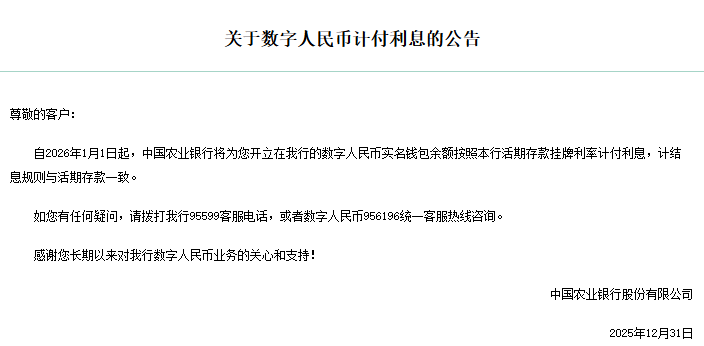
多家银行官宣:2026年1月1日起,为数字人民币实名钱包余额计付利息
Bei Jing Shang Bao· 2025-12-31 05:25
Core Viewpoint - Major Chinese banks including Industrial and Commercial Bank of China, Agricultural Bank of China, Postal Savings Bank of China, Bank of Communications, and China Construction Bank will start paying interest on digital RMB wallet balances at the same rate as current deposit rates from January 1, 2026, marking a significant transition in the digital currency landscape in China [1][4][5] Group 1: Bank Announcements - Industrial and Commercial Bank of China, Agricultural Bank of China, and Postal Savings Bank of China will apply interest to digital RMB wallet balances according to the current deposit rate, with interest calculation rules consistent with those for current deposits [4] - Bank of Communications will also apply the current deposit rate to digital RMB wallet balances, including various types of personal and corporate wallets, while balances in type four wallets will not earn interest [4] - China Construction Bank will revise its customer service agreement to reflect that digital RMB wallet balances will earn interest based on the current deposit rate starting January 1, 2026 [4] Group 2: Digital RMB Framework - The People's Bank of China has introduced a plan to enhance the management and service system for digital RMB, which will officially implement a new measurement framework and operational mechanism on January 1, 2026 [5] - This transition signifies a shift from the "digital cash era" to the "digital deposit currency era" after a decade of research and pilot programs [5]