
BANK COMM(601328)

Search documents
狂赚6900亿元!国有六大行中期业绩亮眼,投资者笑称“躺着赚钱”
Hua Xia Shi Bao· 2025-08-30 09:40
Core Viewpoint - The performance report of China's six major state-owned banks for the first half of 2025 demonstrates their strong profitability and stability, reinforcing their appeal to conservative investors who value safety and consistent returns [1][2]. Group 1: Financial Performance - The six major banks collectively earned over 690 billion yuan in net profit in the first half of 2025, showcasing robust profitability [1]. - Industrial and Commercial Bank of China (ICBC) led with a revenue of 427.09 billion yuan, although its net profit decreased by 1.46% year-on-year to 168.80 billion yuan [3]. - Agricultural Bank of China reported a revenue of 369.90 billion yuan and a net profit increase of 2.5% to 139.94 billion yuan [4]. Group 2: Asset Quality - All six banks reported a year-on-year decline in non-performing loan (NPL) ratios, indicating improved asset quality [5]. - Postal Savings Bank of China had the lowest NPL ratio at 0.92%, while ICBC and China Construction Bank both reported NPL ratios of 1.33% [6]. - The banks maintained high provision coverage ratios, with ICBC at 217.71% and Agricultural Bank at 295% [5][6]. Group 3: Net Interest Margin - The net interest margin (NIM) for the six banks collectively declined, with the range of decrease between 0.08% and 0.21% [7]. - Postal Savings Bank had the highest NIM at 1.7%, while ICBC and Agricultural Bank reported NIMs of 1.3% and 1.32%, respectively [7][9]. - Future expectations indicate that while NIM may continue to decline, the rate of decrease is expected to slow down [10][11]. Group 4: Dividend Distribution - The six banks plan to distribute over 200 billion yuan in dividends, reflecting their status as "cash cows" in the capital market [12]. - The dividend payout ratio for most banks is around 30%, with ICBC proposing a dividend of 1.414 yuan per 10 shares, totaling approximately 50.40 billion yuan [12][13]. - The consistent high dividend payouts enhance the attractiveness of these banks to long-term investors [14][15].



管窥六大行上半年动向:推出中期分红计划,持续发力科技金融
Sou Hu Cai Jing· 2025-08-30 08:58
Core Viewpoint - The six major banks in China reported their mid-year performance, showing stable growth in revenue and net profit, while also announcing mid-term dividend plans amidst challenges such as declining net interest margins. Financial Performance - Industrial and Commercial Bank of China (ICBC) achieved operating income of 427.09 billion RMB, a growth of 1.6%, and net profit of 168.80 billion RMB, with ROA at 0.67% and ROE at 8.82% [1] - Agricultural Bank of China reported operating income of 369.9 billion RMB and net profit of 139.9 billion RMB, with year-on-year growth of 0.8% and 2.5% respectively [1] - Bank of China recorded operating income of 329.00 billion RMB, a year-on-year increase of 3.76%, and net profit of 126.14 billion RMB, with ROA at 0.70% and ROE at 9.11% [1] - China Construction Bank reported operating income of 394.27 billion RMB, a growth of 2.15%, and net profit of 162.64 billion RMB [1] - Bank of Communications achieved operating income of 133.37 billion RMB, a year-on-year increase of 0.77%, and net profit of 46.02 billion RMB, with a growth of 1.61% [2] - Postal Savings Bank reported operating income of 179.45 billion RMB, a growth of 1.50%, and net profit of 49.42 billion RMB, with a year-on-year increase of 1.08% [2] Dividend Plans - ICBC proposed a mid-term cash dividend of 1.414 RMB per 10 shares, totaling approximately 50.40 billion RMB [2] - Agricultural Bank suggested a cash dividend of 1.195 RMB per 10 shares, amounting to 41.82 billion RMB [2] - Bank of China plans to distribute a cash dividend of 1.094 RMB per 10 shares, totaling 35.25 billion RMB [2] - China Construction Bank proposed a cash dividend of 1.858 RMB per 10 shares, amounting to approximately 48.61 billion RMB [2] - Bank of Communications plans to distribute a cash dividend of 1.563 RMB per 10 shares, totaling 13.81 billion RMB [3] - Postal Savings Bank suggested a cash dividend of 1.230 RMB per 10 shares, totaling approximately 14.77 billion RMB [3] Strategies to Address Net Interest Margin Pressure - Bank of China is focusing on increasing asset allocation, optimizing liability structure, and managing foreign currency funds to counteract interest rate pressures [4] - China Construction Bank is adjusting its asset-liability structure and enhancing pricing management to maintain a reasonable net interest margin [4] Focus on Technology Finance - ICBC is enhancing its technology finance service system and has established 28 AIC equity investment funds, with technology loan balances exceeding 6 trillion RMB [6] - Bank of Communications is building a comprehensive financial service system for technology innovation, providing loans to 68,000 enterprises with a balance exceeding 1.5 trillion RMB [6] - China Construction Bank reported a technology loan balance of 5.15 trillion RMB, with a year-on-year increase of 16.81% [7]

交通银行殷久勇:聚焦重点领域 做足项目储备、深挖信贷需求
2 1 Shi Ji Jing Ji Bao Dao· 2025-08-30 07:24
Core Viewpoint - The report highlights that despite a slight decline in credit demand in the real economy, the bank is focusing on enhancing its credit project reserves and supporting key national strategies and sectors [1][3]. Group 1: Financial Performance - In the first half of 2025, the bank achieved a net profit attributable to shareholders of 46.016 billion yuan, a year-on-year increase of 1.61% [1]. - The total assets of the group reached 15.44 trillion yuan, growing by 3.59% compared to the end of the previous year [1]. - The non-performing loan (NPL) ratio stood at 1.28%, a decrease of 0.03 percentage points from the end of the previous year [1][2]. Group 2: Credit Growth and Focus Areas - The total customer loan balance reached 9 trillion yuan, an increase of 443.4 billion yuan, with a growth rate of 5.18% year-on-year [2][3]. - The bank is increasing support for major national strategies and key sectors, with loans in the Yangtze River Delta, Guangdong-Hong Kong-Macau, and Beijing-Tianjin-Hebei regions growing by 5.57% [2]. - Personal consumption loans increased by 18.06%, indicating a strong focus on consumer finance [2]. Group 3: Risk Management and Asset Quality - The bank's NPL ratio improved, but early warning indicators such as the attention loan ratio and overdue loan ratio have slightly increased [5][6]. - The bank disposed of 37.83 billion yuan in NPLs, a year-on-year increase of 27.9%, with significant recoveries from large projects [6]. - The bank is enhancing risk management by optimizing monitoring and collection processes, particularly for overdue loans [7]. Group 4: Interest Margin and Deposit Management - The net interest margin for the bank was 1.21%, showing a decline due to falling asset yields [8][9]. - The bank's deposits grew by 371 billion yuan, with a year-on-year increase of 271 billion yuan, primarily in time deposits [10]. - To manage deposit costs, the bank plans to enhance customer engagement through various services and reduce high-cost deposits [10].

国有六大行,拟中期分红超2000亿元
Zhong Guo Zheng Quan Bao· 2025-08-30 06:14
Core Insights - The six major state-owned banks in China reported a combined net profit of over 680 billion yuan for the first half of 2025, with all banks announcing mid-term dividend plans [1][3] Financial Performance - In the first half of 2025, the six banks achieved total operating income exceeding 1.8 trillion yuan and a combined net profit of 682.5 billion yuan [1] - Individual bank performances include: Industrial and Commercial Bank of China (ICBC) 168.1 billion yuan, Agricultural Bank of China (ABC) 139.5 billion yuan, Bank of China (BOC) 117.6 billion yuan, China Construction Bank (CCB) 162.1 billion yuan, Bank of Communications (BCOM) 46.0 billion yuan, and Postal Savings Bank of China (PSBC) 49.2 billion yuan [1] Dividend Plans - The total proposed mid-term dividends from the six banks exceed 200 billion yuan, with specific proposals including: - ICBC: 1.414 yuan per 10 shares, totaling approximately 50.4 billion yuan [3] - ABC: 1.195 yuan per 10 shares, totaling approximately 41.8 billion yuan [3] - BOC: 1.094 yuan per 10 shares, totaling approximately 35.3 billion yuan [3] - CCB: approximately 48.6 billion yuan [3] - PSBC: 1.230 yuan per 10 shares, totaling approximately 14.8 billion yuan [3] - BCOM: 1.563 yuan per 10 shares, totaling approximately 13.8 billion yuan [4] Strategic Focus - The banks are shifting away from a pure scale-driven approach, focusing on balanced and high-quality development [2] - In a low-interest-rate environment, banks are addressing the challenge of narrowing net interest margins by adapting to interest rate changes and diversifying non-interest income sources [2] - The banks are actively supporting new productive forces through technology finance, green finance, inclusive finance, pension finance, and digital finance [5] - Specific initiatives include: - CCB's comprehensive financial services for technology sectors, with a technology loan balance of 5.15 trillion yuan [5] - ICBC's establishment of an 80 billion yuan technology innovation fund [5] - PSBC's plan to invest 10 billion yuan in establishing an Asset Investment Company (AIC) [5]
六大行中报答卷:营收超1.8万亿 归母净利润“三增三降”
2 1 Shi Ji Jing Ji Bao Dao· 2025-08-30 05:57
Core Viewpoint - The six major banks reported a total operating income of 1.81 trillion yuan for the first half of 2025, with a year-on-year growth rate of 2.05%, while the net profit attributable to shareholders decreased by 0.13% to 682.52 billion yuan, indicating a mixed performance among the banks [1][6]. Group 1: Financial Performance - The operating income of the six major banks showed positive growth, but net profit exhibited a "three increases and three decreases" pattern, with Industrial and Commercial Bank of China (ICBC), China Construction Bank (CCB), and Bank of China (BOC) experiencing declines in net profit of 1.4%, 1.37%, and 0.85% respectively [1][6][7]. - China Bank led in revenue growth with an increase of 3.76% to 329 billion yuan, driven by a significant rise in non-interest income, which grew by 26.43% [6][7]. - ICBC's operating income reached 409.1 billion yuan, marking a 1.8% increase, its best performance in three years [6][7]. Group 2: Asset Growth and Structure - The total assets of the six major banks continued to expand, with a year-on-year growth rate of 8.9% as of June 2025, compared to 7.1% at the end of March [2]. - ICBC maintained its position as the largest bank by total assets, reaching 52.32 trillion yuan, while CCB and Agricultural Bank of China (ABC) also surpassed 40 trillion yuan [2]. - Postal Savings Bank of China (PSBC) saw its total assets exceed 18 trillion yuan, growing by 6.47% year-on-year [2]. Group 3: Loan Growth and Quality - The six major banks collectively increased their loan balances by approximately 7.7 trillion yuan in the first half of 2025, with growth rates for individual banks ranging from 5.18% to 7.72% [4][7]. - The non-performing loan (NPL) ratios remained low, with ICBC and CCB both at 1.33%, while PSBC had the lowest NPL ratio at 0.92% [4][5][9]. Group 4: Net Interest Margin - The net interest margin (NIM) for the six major banks showed a decline, with PSBC at 1.70%, down 21 basis points year-on-year [8][9]. - BOC's NIM was reported at 1.26%, a decrease of 18 basis points, attributed to the ongoing decline in loan prime rates (LPR) and adjustments in mortgage rates [9][10]. - CCB's NIM was 1.40%, while ICBC's was 1.30%, both reflecting a downward trend [9][10].

狂赚6900亿元撒2000亿元分红,国有六大行中期业绩亮眼,投资者笑称“躺着赚钱”
Hua Xia Shi Bao· 2025-08-30 05:42
Core Viewpoint - The performance of China's six major state-owned banks in the first half of 2025 demonstrates their strong profitability and investment value, with a total net profit exceeding 690 billion yuan and a total dividend payout expected to exceed 200 billion yuan, reinforcing their status as "cash cows" in the capital market [2][15]. Group 1: Financial Performance - The six major banks achieved a total net profit of over 690 billion yuan in the first half of 2025, with all banks announcing mid-term dividend plans totaling over 200 billion yuan [2][15]. - Industrial and Commercial Bank of China (ICBC) reported the highest operating income of 427.09 billion yuan, but its net profit decreased by 1.46% year-on-year to 168.80 billion yuan [5][6]. - Agricultural Bank of China (ABC) ranked third in operating income with 369.90 billion yuan and a net profit increase of 2.5% to 139.94 billion yuan [7]. Group 2: Asset Quality - All six banks reported a year-on-year decline in non-performing loan (NPL) ratios, indicating improved asset quality [8][9]. - Postal Savings Bank of China had the lowest NPL ratio at 0.92%, while ICBC and Construction Bank both reported NPL ratios of 1.33% [8][9]. - The provision coverage ratios remained high, with ICBC at 217.71% and ABC at 295%, indicating strong risk mitigation capabilities [8][9]. Group 3: Net Interest Margin - The net interest margin (NIM) for all six banks showed a collective decline, with the range of decrease between 0.08% to 0.21% [10][11]. - Postal Savings Bank led with a NIM of 1.7%, followed by Construction Bank at 1.4% and ABC at 1.32% [10][13]. - The banks' management expressed expectations for a continued decline in NIM, but with a narrowing rate of decrease in the second half of the year [14]. Group 4: Dividend Distribution - The total expected dividend payout from the six banks is over 200 billion yuan, with dividend rates generally around 30% [15][18]. - ICBC plans to distribute approximately 50.40 billion yuan, while ABC intends to distribute about 41.82 billion yuan, both maintaining a 30% payout ratio [15][16]. - The consistent high dividend payout ratios reflect the banks' confidence in their operational stability and aim to attract long-term investors [17][18].


交通银行副行长钱斌答每经:成立数字化经营中心是一项重大改革,从三方面增强零售业务一体化经营能力
Mei Ri Jing Ji Xin Wen· 2025-08-30 04:57
Core Viewpoint - The establishment of the Digital Operations Center by Bank of Communications is a significant reform aimed at enhancing the bank's retail business capabilities through digital empowerment and centralized management [1][3]. Group 1: Digital Operations Center Functions - The Digital Operations Center aims to strengthen direct operations, creating a new growth engine by enhancing online direct management of retail credit business, resulting in a 153% year-on-year net increase in online consumer loan balances in the first half of the year [3]. - It focuses on shared foundational capabilities to accelerate the integration of online and offline development, implementing a marketing model of "online reach, offline follow-up," which led to a net increase of 9.5 billion yuan in personal operating loans [4]. - The center also emphasizes centralized operations, utilizing digital technologies to manage retail asset risks and improve operational efficiency, with the quality of centralized operations showing steady improvement [4]. Group 2: Financial Performance - As of June 30, the total customer loan balance of Bank of Communications reached 9 trillion yuan, an increase of approximately 443.4 billion yuan, reflecting a growth rate of 5.18% [6]. - The bank's net interest margin for the first half of the year was 1.21%, with expectations of further downward pressure, although future conditions may stabilize margins [6]. - The bank's total assets reached 15.44 trillion yuan, a growth of 3.59% compared to the previous year, with operating income of 133.368 billion yuan and net profit attributable to shareholders of 46.016 billion yuan, representing year-on-year growth of 0.77% and 1.61%, respectively [6].
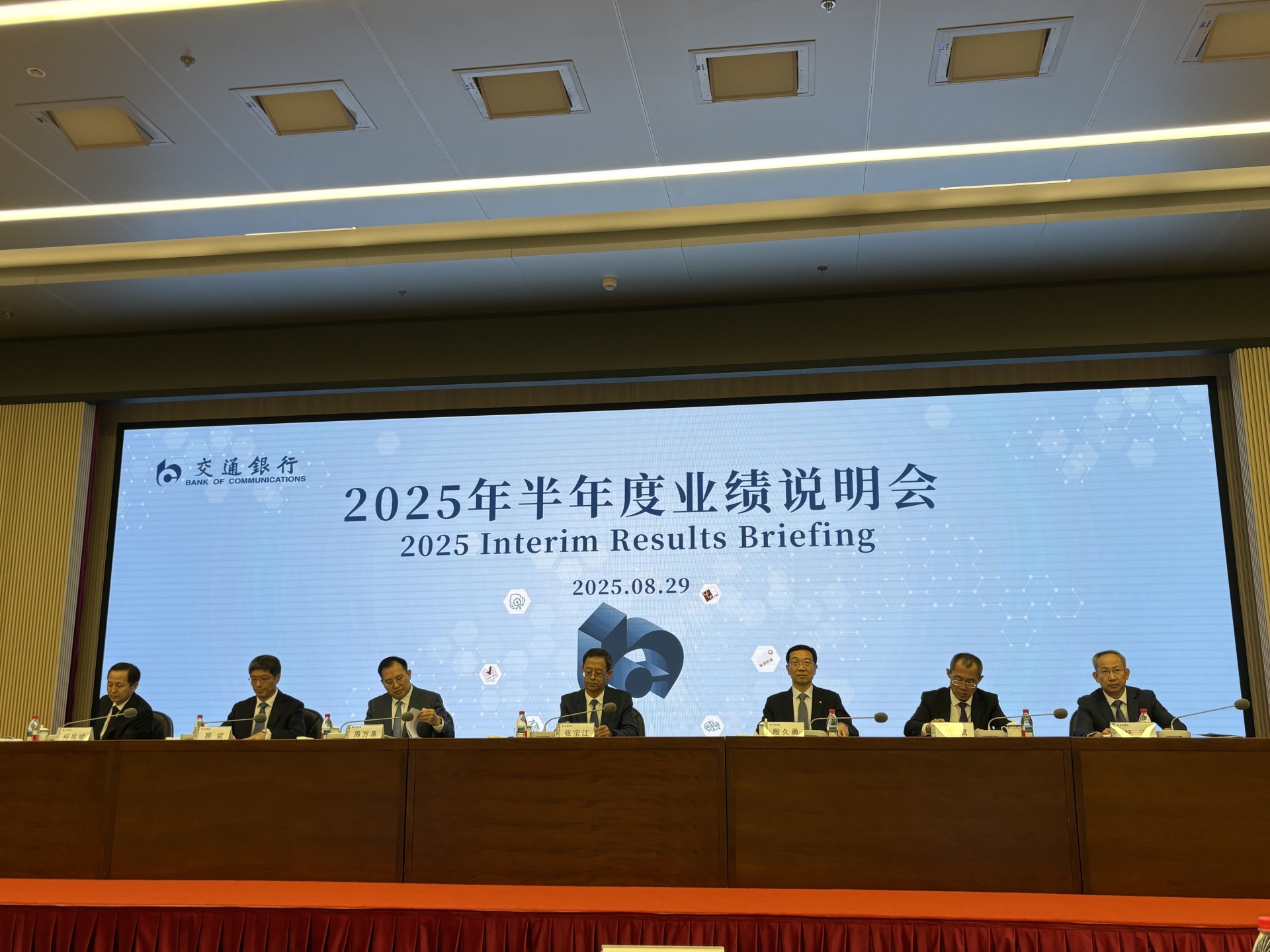
交通银行拟每10股分配现金股利人民币1.563元(含税) 2025年半年度现金分红总额138.11亿元
Jing Ji Guan Cha Wang· 2025-08-30 04:14
若在权益分派股权登记日前公司总股本发生变动,将保持现金分红总额不变,按最新股本调整每股派息 金额,具体调整安排将另行公告。本次利润分配方案符合公司章程及监管规定,已获董事会全票通过, 尚需提交股东大会审议。 经济观察网 交通银行于8月29日董事会审议通过2025年半年度利润分配方案,拟向全体股东每10股派发 现金股利人民币1.563元(含税)。以截至2025年6月30日总股本883.64亿股为基准,预计派现总额约 138.11亿元,约占归属于母公司普通股股东净利润的31.2%。 ...
直击交通银行业绩会:存款降息后理财规模增长!息差降幅预计逐步收窄……管理层回应热点话题
Zheng Quan Ri Bao· 2025-08-30 04:12
Core Viewpoint - The Bank of Communications reported a resilient performance in the first half of 2025, with revenue and net profit showing slight year-on-year growth, while maintaining a stable asset quality and focusing on risk management and support for the real economy [2][3]. Financial Performance - In the first half of 2025, the Bank of Communications achieved revenue of 133.368 billion yuan and a net profit attributable to shareholders of 46.016 billion yuan, representing year-on-year growth of 0.77% and 1.61% respectively [2]. - As of the end of June, the bank's total assets reached 15.44 trillion yuan, with a non-performing loan (NPL) ratio of 1.28%, a decrease of 0.03 percentage points from the end of the previous year [2]. Loan Growth and Strategy - The bank's loan balance approached 9 trillion yuan by the end of June, increasing by 443.4 billion yuan (5.18%) compared to the end of 2024, with a year-on-year increase of 132.7 billion yuan [3]. - The growth in corporate loans was particularly strong, with an increase of 118.8 billion yuan year-on-year, focusing on key sectors such as manufacturing, small and micro enterprises, and private businesses [3]. Credit Demand and Interest Margin - Credit demand weakened in the second quarter compared to the first quarter, leading to a slowdown in corporate loan growth [4]. - The bank expects the decline in interest margins to gradually narrow, as the reduction in deposit rates will positively impact the stability of interest margins over time [4]. Asset Quality Management - The bank has intensified efforts to recover and manage non-performing loans, with a total of 37.8 billion yuan in non-performing loans disposed of in the first half of the year, a year-on-year increase of 27.9% [5]. - The bank is particularly focused on managing asset quality in the real estate sector, retail, and small business loans, with plans to enhance risk management through digital and AI technologies [5]. Wealth Management and Investment Products - Following the reduction in deposit rates in May, there has been a noticeable shift of funds back into wealth management products, with the bank's wealth management product sales reaching 151.692 billion yuan in June, a month-on-month increase of 1.73% [6]. - The bank plans to enhance its wealth management offerings by diversifying product categories, improving customer coverage, and strengthening asset allocation capabilities [6].
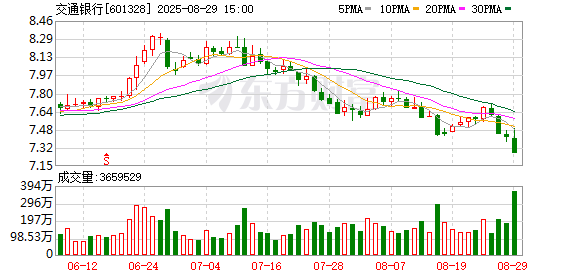
国有六大行上半年归母净利润合计约6825亿元 均计划实施中期现金分红
Zheng Quan Ri Bao· 2025-08-30 02:55
Core Viewpoint - The six major state-owned banks in China have reported stable and balanced operating indicators for the first half of 2025, with overall asset quality showing improvement [1][2]. Group 1: Financial Performance - The total net profit attributable to shareholders of the six banks reached approximately 682.52 billion yuan, with Agricultural Bank, Postal Savings Bank, and Bank of Communications achieving both revenue and net profit growth year-on-year [1][2]. - Industrial and Commercial Bank of China (ICBC) led with a net profit of 168.10 billion yuan, followed by China Construction Bank (CCB) with 162.08 billion yuan, and Agricultural Bank with a net profit of 139.51 billion yuan, marking a year-on-year increase of 2.70% [2]. - All six banks reported year-on-year revenue growth, with China Bank leading at 3.76%, followed by CCB at 2.15%, and ICBC at 1.60% [2]. Group 2: Asset Quality - As of June 2025, five banks reported a decrease in non-performing loan (NPL) ratios compared to the end of 2024, with Postal Savings Bank having the lowest NPL ratio at 0.92% [3]. - The capital adequacy ratios of three banks increased, with ICBC at 19.54%, Bank of Communications at 16.59%, and Postal Savings Bank at 14.57% [3]. Group 3: Dividend Plans - All six major banks plan to implement mid-term cash dividends, with ICBC proposing a distribution of 1.414 yuan per 10 shares, Agricultural Bank 1.195 yuan, and CCB 1.858 yuan per 10 shares [4].