
NCI(601336)

Search documents
新华保险秦泓波:养老服务领域将重点构建全国性“养联体”布局
Bei Jing Shang Bao· 2025-08-29 11:18
Core Viewpoint - The company emphasizes the construction of a comprehensive medical, health, and elderly care system, positioning itself as a stabilizer for society and an economic shock absorber in the fields of elderly finance and inclusive finance [1][2] Group 1: Business Development - In the past two years, the company has accelerated the layout of the medical, health, and elderly care ecosystem, expanding quality cooperative communities and travel institutions, enriching home-based elderly care and health services [1] - As of the first half of 2025, nearly 15,000 customers have obtained rights to enter health and elderly care communities, generating nearly 20 billion yuan in premiums, while an additional 240,000 customers have gained travel rights [1] - The company has integrated high-quality internal and external resources to build a comprehensive health management service system covering disease prevention, medical assistance, and overseas medical services [1] Group 2: Product and Service Innovation - The company has connected nearly 100 high-quality medical resources domestically and internationally as of the first half of 2025 [1] - The launch of the "Worry-Free Medicine" health insurance product has effectively met new health protection and service needs of customers, seizing opportunities from reforms in commercial health insurance and medical insurance payment methods [1] - The company plans to continue enhancing the integration of insurance products and health services, constructing a comprehensive service network known as "Xinhua Health Steward" to provide extensive interconnected services [2]

新华保险:分红政策依据盈利水平、偿付能力等因素,并对比同业分红情况制定
Bei Jing Shang Bao· 2025-08-29 11:18
Group 1 - The core viewpoint of the article is that Xinhua Life Insurance Company will adjust its dividend policy based on regulatory guidelines and various internal and external factors [1] - The company will consider industry conditions, its development stage, operational model, profitability, solvency, and funding needs when formulating its dividend policy [1] - Xinhua Life aims to create long-term sustainable returns for all shareholders while also taking into account shareholder expectations and comparing with peers' dividend situations [1]
新华保险龚兴峰:会把分红险产品作为主流产品来进行对待
Bei Jing Shang Bao· 2025-08-29 10:37
Core Viewpoint - Xinhua Life Insurance Company is focusing on expanding the sales of participating insurance products in a low-interest-rate macro environment, indicating a strategic shift towards enhancing its product offerings and customer wealth management services [1] Group 1: Strategic Initiatives - The company has established a leadership team for the transformation of participating insurance, creating an integrated mechanism for sales promotion and account management [1] - The transformation of participating insurance has shown positive results in the first half of the year, with three main aspects highlighted: defining the role of participating insurance in the customer lifecycle product system, enriching wealth management concepts centered on customer needs, and constructing a sales framework [1] Group 2: Market Positioning - With the expected decrease in the predetermined interest rate, the proportion of participating insurance is anticipated to gradually increase, positioning these products as mainstream offerings [1] - The company plans to deepen the development of participating insurance products, aiming to provide a more competitive product portfolio [1]
新华保险今日大宗交易折价成交7.45万股,成交额481.94万元
Xin Lang Cai Jing· 2025-08-29 09:41
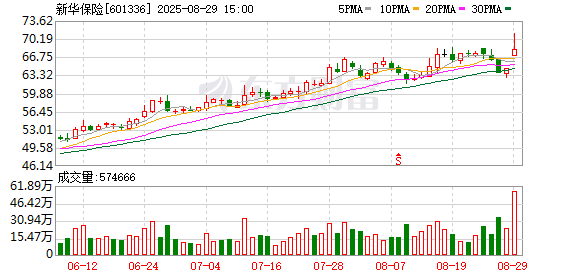
| | | | | | 光大证券股份有限 3.4 shoke 11 .4.20 | 光大证券股份有限 3.14 places 11 .1. m | | --- | --- | --- | --- | --- | --- | --- | | 交易日期 2025-08-29 | 证券简称 新华保险 | 证券代码 601336 | 成交价(元) 成交金额(万元) 成交量( * ) 买入营业部 64.69 481.94 | 7.45 | 公司宁波柳汀街证 | 卖出营业部 公司宁波柳汀街证 | 8月29日,新华保险大宗交易成交7.45万股,成交额481.94万元,占当日总成交额的0.12%,成交价64.69元,较市场收盘价68.24元折价5.2%。 ...


如何行业利差损压力?新华保险副总裁秦泓波:总体思路是“资产负债联动”
Xin Lang Cai Jing· 2025-08-29 09:14
Core Viewpoint - Xinhua Insurance reported strong investment performance in the first half of the year, attributed to deep market insights and effective asset allocation [1] Fixed Income Investment - The company emphasizes two key strategies for fixed income investments: maintaining strategic consistency with a focus on long-term bond matching across cycles, and enhancing trading capabilities through a diversified approach and seizing trading opportunities [1] Equity Investment Strategy - Xinhua Insurance's equity investment strategy focuses on optimizing allocation structures to achieve long-term stable excess returns while controlling volatility, with three main directions: - Emphasizing the value of high-dividend stocks, which provide stable cash flow and net investment returns, especially under declining interest rates [1] - Actively investing in sectors aligned with national strategic priorities, supporting the development of strategic emerging industries and future industries [1] Market Considerations - Regarding market concerns about stake acquisitions, the company will consider macroeconomic conditions, the long-term value of specific targets, and alignment with its strategic needs when making decisions [1]
新华保险杨玉成:“十五五”时期是保险行业发展的重要机遇期,公司已着手启动战略规划工作
Bei Jing Shang Bao· 2025-08-29 08:57
Group 1 - The core viewpoint of the article emphasizes that the "14th Five-Year Plan" period is a significant opportunity for the insurance industry and for Xinhua Insurance to become a leading insurance service group in China [2] - Xinhua Insurance has initiated the "14th Five-Year" strategic planning work, focusing on implementing the "New National Ten Articles" of the insurance industry and aligning with national reform and development [2] - The company aims to enhance its internal driving force for high-quality and high-energy development by fully promoting a customer-centric strategic transformation [2] Group 2 - Xinhua Insurance has defined five core positions: being a proactive participant in reform and development, a guardian of customer service, a responsible steward of patient capital, a persevering forward mover, and a practitioner of insurance philanthropy [2]
新华保险详解银保渠道优势:概括为根、魂、能三个关键词
Bei Jing Shang Bao· 2025-08-29 08:57
Core Viewpoint - The current competitive landscape in the Chinese bancassurance market is intensifying, yet it demonstrates robust development resilience and vitality, with the company leveraging strategic agility and unique resource endowments to drive dual growth in value and scale [2] Group 1: Core Competitiveness of Bancassurance Channel - The term "root" signifies the foundational aspects of the company's bancassurance business, which has been a pioneer in the industry for over 20 years, establishing a nationwide network and a trusted brand image. The company collaborates with 52 banks, including state-owned banks, joint-stock banks, and local commercial banks, maintaining long-term stable partnerships [3] - The term "soul" refers to the company's talented workforce, characterized by strong learning capabilities, quick responsiveness, and high execution efficiency. The team maintains a competitive mindset, innovative spirit, and strategic resilience, earning widespread acclaim in the market [3] - The term "ability" highlights the company's commitment to market-oriented, professional, systematic, and refined reforms, aiming for high-level development and empowering the bancassurance channel to fully benefit from the company's reform and growth [3]
新华保险秦泓波回应权益投资:重点投资高股息和新质生产力方向股票
Bei Jing Shang Bao· 2025-08-29 08:50
Core Viewpoint - Xinhua Insurance emphasizes a strategy focused on optimizing equity investment allocation to achieve long-term stable excess returns while effectively controlling volatility [1] Group 1: Equity Investment Strategy - The company prioritizes high dividend stocks, which are seen as advantageous in a declining interest rate environment, providing stable cash flow and net investment returns [1] - High dividend stocks can also help smooth profit fluctuations under new accounting standards by being included in Other Comprehensive Income (OCI) [1] Group 2: Strategic Alignment - Xinhua Insurance aims to support the development of strategic emerging industries and future industries, aligning with national strategic initiatives [1] - The company plans to leverage its long-term advantages in financial insurance funds to contribute to the "Five Major Articles" of national strategy [1]
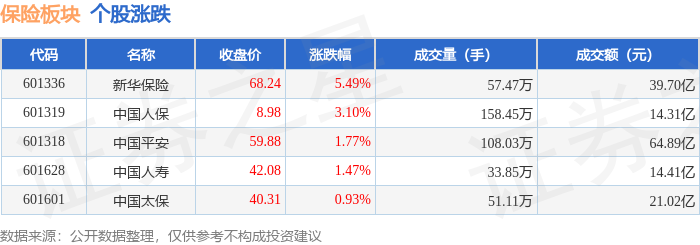
保险板块8月29日涨1.95%,新华保险领涨,主力资金净流入9413.95万元
Zheng Xing Xing Ye Ri Bao· 2025-08-29 08:48
从资金流向上来看,当日保险板块主力资金净流入9413.95万元,游资资金净流出5.07亿元,散户资金净 流入4.13亿元。保险板块个股资金流向见下表: | 代码 | 名称 | 收盘价 | 涨跌幅 | 成交量(手) | 成交额(元) | | --- | --- | --- | --- | --- | --- | | 601336 | 新华保险 | 68.24 | 5.49% | 57.47万 | 39.70 Z | | 601319 | 中国人保 | 8.98 | 3.10% | 158.45万 | 14.31亿 | | 601318 | 中国平安 | 59.88 | 1.77% | 108.03万 | 64.89 Z | | 601628 | 中国人寿 | 42.08 | 1.47% | 33.85万 | 14.41亿 | | 601601 | 中国太保 | 40.31 | 0.93% | 51.11万 | 21.02亿 | 证券之星消息,8月29日保险板块较上一交易日上涨1.95%,新华保险领涨。当日上证指数报收于 3857.93,上涨0.37%。深证成指报收于12696.15,上涨0.99%。保险板块个股 ...




新华保险秦泓波:固收投资做好超长期债券的跨周期匹配
Bei Jing Shang Bao· 2025-08-29 08:25
Core Insights - The core viewpoint of the article emphasizes the strategic focus of Xinhua Life Insurance on fixed income investments, highlighting the importance of long-term bond matching and enhancing trading capabilities to improve overall portfolio returns [1] Group 1: Investment Strategy - Xinhua Life Insurance aims to maintain strategic determination in fixed income investments by focusing on long-term bond cross-cycle matching [1] - The company plans to actively strengthen its trading capabilities in fixed income investments through a combination of various products and strategies, as well as capturing trading opportunities [1] - The goal is to achieve "fixed income plus" to enhance the overall returns of the investment portfolio [1]