
CPIC(601601)

Search documents
中国太保(02601) - 董事名单与其角色和职能
2026-01-26 12:54
| 執 | 行 | 董 | 事、董 | 事 | 長 | 獨立非執行董事 | | --- | --- | --- | --- | --- | --- | --- | | 傅 | 帆 | | | | | 陳 欣 | | | | | | | | 林婷懿 | | 執 | 行 | 董 | 事、總 | 裁 | | 羅婉文 | | 趙永剛 | | | | | | 金弘毅 | | | | | | | | 黃顯榮 | 非 執 行 董 事、副 董 事 長 中國太平洋保險(集團)股份有限公司 CHINA PACIFIC INSURANCE (GROUP) CO., LTD. (於中華人民共和國註冊成立的股份有限公司) (股份代號:02601) 董事名單與其角色和職能 中 國 太 平 洋 保 險(集 團)股 份 有 限 公 司 董 事 會(「董事會」)成 員 載 列 如 下: 周東輝 John Robert DACEY 黃迪南 路巧玲 非執行董事 王他竽 王昱華 陳 然 董事會目前已設立5個 委 員 會。下 表 提 供 各 董 事 會 成 員 在 這 些 委 員 會 中 所 擔 任 的 職 位。 – 1 – | | 委員會 | 審計 ...
“保险+助贷”退潮:融资性信保下一站,谁来接住千亿需求?
Nan Fang Du Shi Bao· 2026-01-26 12:49
Core Viewpoint - The personal financing credit insurance business in China is experiencing a significant decline, with major insurance companies like Sunshine Insurance and Dadi Insurance halting new applications for this type of insurance, raising concerns in the financial market about the future of financing credit insurance [5][6][13]. Group 1: Business Suspension - Multiple insurance companies, including Sunshine Insurance and Dadi Insurance, have officially stopped accepting new applications for personal financing credit insurance as of December 31, 2025, focusing only on servicing existing clients [5][6]. - The suspension of personal financing credit insurance has been anticipated, as Pacific Insurance had already ceased new applications for its core product "Tai Xiang Dai" earlier in 2025 [5][6]. - The personal financing credit insurance business, which once thrived, is now facing a downturn, with the industry premium income dropping from 1,043.96 billion yuan in 2020 to an estimated 40 billion yuan in 2023 [7][12]. Group 2: Industry Challenges - The financing credit insurance business is under pressure due to multiple factors, including regulatory changes, rising costs, and increased risk exposure, leading to a reevaluation of business models [9][10]. - The introduction of new regulations in October 2025 has imposed stricter limits on the overall financing costs, affecting the pricing models of traditional credit insurance products [10][11]. - The risk exposure in personal credit insurance has reportedly decreased by about one-third as of July 2025, with expectations of complete risk clearance by 2026 [6]. Group 3: Market Impact - The halt in personal financing credit insurance will create short-term challenges for consumers, particularly those without collateral, as they will need to seek alternative financing options with higher entry barriers [13]. - The industry is transitioning towards a more sustainable growth model, moving away from aggressive expansion to focus on risk management and quality service [14]. - The long-term outlook suggests a healthier credit market ecosystem, with resources being allocated more effectively to meet the genuine needs of the economy and consumers [14].




中国太保(02601) - 董事任职资格核准
2026-01-26 12:49
香港交易及結算所有限公司及香港聯合交易所有限公司對本公告的內 容 概 不 負 責,對 其 準 確 性 或 完 整 性 亦 不 發 表 任 何 聲 明,並 明 確 表 示,概 不對因本公告全部或任何部分內容而產生或因倚賴該等內容而引致的 任 何 損 失 承 擔 任 何 責 任。 中國太平洋保險(集團)股份有限公司 CHINA PACIFIC INSURANCE (GROUP) CO., LTD. 董事任職資格核准 茲 提 述 中 國 太 平 洋 保 險(集 團)股 份 有 限 公 司(「本公司」))日 期 為2025年7 月31日 的 第 十 屆 董 事 會 第 十 五 次 會 議 決 議 公 告,日 期 為2025年8月12日 的 通 函(「該通函」)及 日 期 為2025年8月29日的臨時股東大會表決結果公告。 除另有指定者外,本公告中所使用的詞彙與該通函所界定者具有相同意義。 本公司於2025年8月29日舉行之臨時股東大會選舉黃顯榮先生為本公司 獨 立 非 執 行 董 事,任 期 至 本 公 司 第 十 屆 董 事 會 屆 滿。其 任 職 資 格 須 待 監 管 機 構 核 准 後 方 可 生 效。 本公 ...
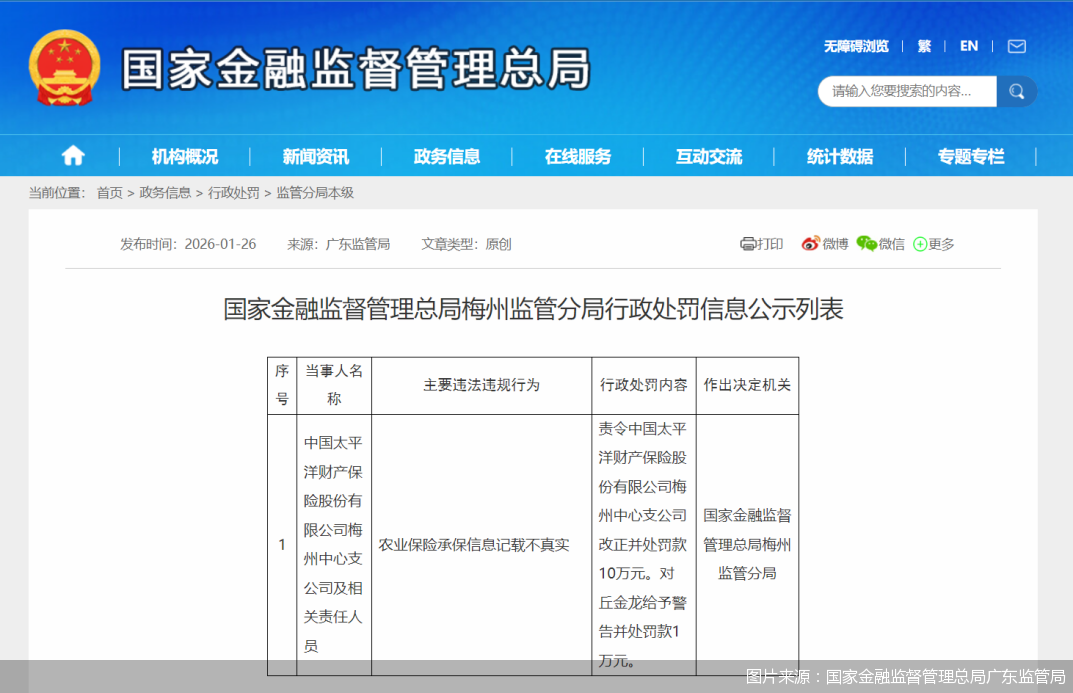
农险承保信息记载不真实,太保产险梅州中心支公司合计被罚11万元
Bei Jing Shang Bao· 2026-01-26 11:37
北京商报讯(记者 李秀梅)1月26日,国家金融监督管理总局梅州监管分局发布行政处罚信息显示,中国太平洋财产保险股份有限公司梅州中心支公司 及相关责任人员,存在农业保险承保信息记载不真实的违法违规行为,国家金融监督管理总局梅州监管分局责令中国太平洋财产保险股份有限公司梅州 中心支公司改正并处罚款10万元。对丘金龙给予警告并处罚款1万元。 | 国家金融监督管理总局 | | | | | | 无障碍浏览 繁 EN ▽ | | --- | --- | --- | --- | --- | --- | --- | | | | | | | | 请输入您要搜索的内容。 o | | 机构概况 | C | 新闻资讯 | 政务信息 | 在线服务 | 互动交流 | 专题专栏 统计数据 | | 当前位置: 首页 > 政务信息 > 行政处罚 > 监管分局本级 | | | | | | | | 发布时间:2026-01-26 | | 来源:广东监管局 | 文章类型:原创 | | | 合打印 6 微博 @微信 升更多 | | 国家金融监督管理总局梅州监管分局行政处罚信息公示列表 | | | | | | | | 当事人名 | | 序 를 称 | ...
非银金融25Q4重仓持股分析及板块最新观点:非银板块获增配、高景气延续,保持推荐-20260126
CMS· 2026-01-26 11:32
Investment Rating - The report maintains a "Recommend" rating for the non-bank financial sector, indicating a positive outlook for investment in this area [1][8]. Core Insights - The non-bank financial sector is experiencing a continued high level of activity, with significant increases in holdings in both the brokerage and insurance segments. The brokerage sector's holdings increased to 0.99%, while the insurance sector saw a substantial rise to 2.04% [1][7]. - The overall fund net asset value reached 36.8 trillion yuan, reflecting a year-on-year growth of 14% and a quarter-on-quarter increase of 2% [12]. - The brokerage sector is expected to benefit from improved market conditions, with a projected net profit increase of 26% year-on-year for Q4 2025 [19][20]. - The insurance sector is poised for strong performance in 2026, driven by favorable market conditions and a significant increase in new policy premiums [22][23]. Summary by Sections Public Fund Market Size - As of Q4 2025, the total net asset value of public funds was 36.8 trillion yuan, with a year-on-year increase of 14% and a quarter-on-quarter increase of 2% [12]. - The non-monetary fund size reached 21.7 trillion yuan, growing 16% year-on-year [12]. Non-Bank Sector Holdings Analysis Brokerage Sector - The brokerage sector's holdings increased to 0.99%, up 0.1 percentage points from the previous quarter, with a total of 7.71 billion shares held, reflecting a 17.9% quarter-on-quarter increase [20]. - Major brokerages such as CITIC Securities and Guotai Junan saw significant increases in their holdings, with respective increases of 0.14 and 0.07 percentage points [20][21]. Insurance Sector - The insurance sector's holdings rose to 2.04%, a significant increase of 0.97 percentage points from the previous quarter, exceeding the benchmark allocation [23]. - Key players like Ping An and China Life experienced notable increases in their holdings, with Ping An's allocation rising by 0.68 percentage points [23]. Investment Recommendations - The report suggests focusing on key stocks within the brokerage sector, including Guotai Junan, CITIC Securities, and Huatai Securities, as well as major insurance companies like Ping An and China Life [8].



ETF主力榜 | 信用债ETF(511190)主力资金净流出2739.27万元,居可比基金前2-20260126
Xin Lang Cai Jing· 2026-01-26 11:09
Group 1 - The credit bond ETF (511190.SH) closed down by 0.06% on January 26, 2026, with a net outflow of main funds (single transaction amount over 1 million yuan) amounting to 27.39 million yuan, ranking it among the top two in comparable funds [1] - The latest trading volume of the fund was 1.2245 million units, and the latest transaction amount fell below 130 million yuan, placing it among the bottom two in comparable funds [1]
ETF主力榜 | 科创债ETF招商(551900)主力资金净流出1446.39万元,居全市场第一梯队-20260126
Xin Lang Cai Jing· 2026-01-26 11:09
Group 1 - The core point of the article highlights that the Science and Technology Innovation Bond ETF (招商551900.SH) experienced a slight increase of 0.02% on January 26, 2026, despite facing significant net outflows of 14.46 million yuan from major funds (transactions over 1 million yuan) [1][1][1] - The latest trading volume for the fund was reported at 354,100 units, with the total transaction amount falling below 100 million yuan, placing it at the lower end compared to similar funds [1][1][1]
ETF主力榜 | 稀有金属ETF基金(561800)主力资金净流出565.52万元,居可比基金前2-20260126
Xin Lang Cai Jing· 2026-01-26 11:09
Group 1 - The Rare Metal ETF Fund (561800.SH) closed up by 3.06% on January 26, 2026 [1] - The fund experienced a net outflow of 565.52 million yuan from major funds (transactions over 1 million yuan), ranking it among the top two in comparable funds [1] - The latest trading volume for the fund was 49.2189 million shares, with a total transaction amount of 59.1863 million yuan, placing it at the bottom among comparable funds [1]
多机构召开健康保险高质量发展工作座谈会点评:聚力赋能精耕细作,重塑健康险新生态
ZHONGTAI SECURITIES· 2026-01-26 11:06
Investment Rating - The report assigns an "Overweight" rating for the health insurance industry, indicating a positive outlook for the sector in the next 6 to 12 months [11]. Core Insights - The report highlights the importance of the health insurance sector in supporting China's health strategy, with multiple institutions collaborating to enhance product offerings and data capabilities [5][6]. - The shift from passive reimbursement to proactive engagement in commercial health insurance is emphasized, with the establishment of standardized terms and drug payment lists to stabilize market expectations [5]. - The report notes that the commercial health insurance sector is expected to see significant growth, particularly in the area of innovative drug payments, with a projected total compensation amount of approximately 14.7 billion yuan for innovative drugs in 2025 [5]. Summary by Sections Industry Overview - The health insurance industry is experiencing a transformation, with a focus on high-quality development and collaboration among various institutions [5]. - The total market capitalization of the industry is reported at 34,888.11 billion yuan, with the same figure for circulating market capitalization [3]. Market Trends - The report indicates that commercial medical insurance is entering a phase of refinement, with efforts to standardize product designs and payment lists to enhance industry competitiveness [5]. - The establishment of a new data infrastructure for health insurance is being prioritized to improve risk management and operational efficiency [5]. Company Strategies - Major insurance companies are diversifying their health insurance offerings, with each company focusing on different operational models to enhance their service ecosystems [10]. - The report identifies key players such as China Life, China Ping An, and China Pacific Insurance, highlighting their unique approaches to health insurance and the integration of health management services [10]. Investment Recommendations - The report suggests a continued focus on leading insurance companies, including China Life, China Pacific, and AIA, as they are expected to benefit from the ongoing developments in the health insurance sector [5].



从 “靠运气” 到 “有底气”!“保险 +” 持续为乡村振兴注入新动能
Sou Hu Cai Jing· 2026-01-26 10:25
Core Viewpoint - The introduction of innovative agricultural insurance products, such as the "fattening pig income insurance," aims to stabilize farmers' income against market fluctuations and natural disasters, enhancing the resilience of the agricultural sector in China [1][2]. Group 1: Agricultural Insurance Innovations - The "fattening pig income insurance" combines pig futures prices with actual output to provide a comprehensive income protection scheme for farmers, addressing both price and quantity risks [2]. - This insurance product represents an evolution from the previous "insurance + futures" model, which primarily focused on price risk, to a model that directly safeguards farming outcomes [2]. - The insurance is designed to help farmers like Li Bin, who have experienced significant financial stress during market downturns, by providing a safety net that allows for better planning and management of farming operations [2]. Group 2: Support for Fruit Farming - China Pacific Insurance has launched 11 specialized insurance products for the fruit industry in Guangdong, providing 2.5 billion yuan in risk coverage for various fruits, including lychee and longan, covering over 830,000 acres [3]. - The company has developed a comprehensive risk management approach, including weather index insurance and blockchain traceability systems, to enhance the resilience of the fruit supply chain [3][4]. - The collaboration between insurance providers and agricultural enterprises has improved risk management precision and expanded the coverage of insurance services, enabling farmers to adopt proactive risk control measures [4]. Group 3: Overall Impact on Agriculture - In 2025, China Pacific Insurance offered nearly 5,000 agricultural insurance products, providing 1.3 trillion yuan in risk coverage to over 5.73 million farming households [4]. - The ongoing exploration of the "insurance +" model aims to support high-quality agricultural development and rural revitalization, focusing on refined management and diversified collaboration [4].