
CPIC(601601)

Search documents
湾财晚报|刘强东给老家送礼!村民们骑三轮车提货;广铁预测春节客流高峰时段;去年房地产贷款余额少了近万亿
Nan Fang Du Shi Bao· 2026-01-27 15:05
刘强东给老家送年货,村委会广播通知村民:骑三轮车来拉年货 1月27日,刘强东老家宿迁光明村村委会通过广播喊话村民领年货。"明天下午先来村口看演出,有咱自己村的村晚,后天29号早上10点,正式开始发年 货!今年给每家每户的年货还是特别实在,大家备好人手,三轮车、小推车,能用的都用上!" "小年"火车票开售!广铁预测2月7日现客流高峰 去年我国房地产贷款余额减少近万亿,普惠小微贷增长明显 1月27日,中国人民银行发布2025年四季度金融机构贷款投向统计报告。据中国人民银行统计,2025年四季度末,金融机构人民币各项贷款余额271.91万 亿元,同比增长6.4%,全年人民币贷款增加16.27万亿元。其中,普惠小微贷款余额同比增长11.1%,增速比各项贷款高4.7个百分点;房地产贷款余额同 比下降1.6%,全年减少9636亿元;不含个人住房贷款的消费性贷款余额同比增长0.7%。 长达18年的印度与欧盟的自由贸易协议谈判,终于落定。据央视新闻,当地时间1月27日,印欧领导人在新德里举行会晤。印度总理莫迪宣布,印度和欧 盟达成自由贸易协定。 欧盟委员会称,印度给予欧盟的关税减免将大幅改善欧盟出口产品的市场准入。例如,汽车 ...



连收多张罚单!太保产险广东多家分支机构共被罚209万元
Nan Fang Du Shi Bao· 2026-01-27 09:43
1月26日,国家金融监督管理总局梅州监管分局发布行政处罚信息显示,中国太平洋财产保险股份有限 公司(下称"太保产险")梅州中心支公司,存在农业保险承保信息记载不真实的违法违规行为,被责令 改正并处罚款10万元。对相关责任人丘金龙给予警告并处罚款1万元。 | Hally Pr | | --- | | 发布时间: 2026-01-26 来源:广 11 12 12 12 | | 序 | 当事人名 | 主要违法违规行为 | 行政处罚内容 | 作出决定机关 | | --- | --- | --- | --- | --- | | 号 | 称 | | | | | | 中国太平 洋财产保 险股份有 限公司梅 | | 责令中国太平 洋财产保险股 份有限公司梅 州中心支公司 | 国家金融监督 | | 1 | 州中心支 | 农业保险承保信息记载不真实 | 改正并处罚款 | 管理总局梅州 | | | | | 10万元。对丘 | 监管分局 | | | 公司及相 关责任人 | | 金龙给予整告 并处罚款1万 | | | | 员 | | 元。 | | 记者留意到,本月内,太保产险广东已有多家分支机构领罚单。1月6日,广东金融监管局已集中开 ...

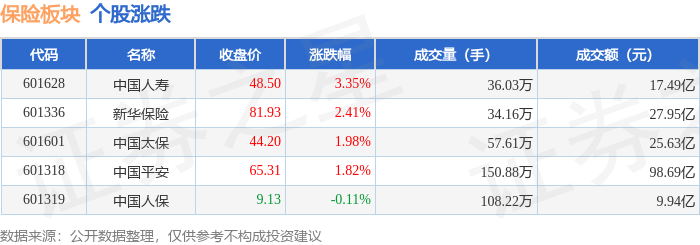
保险板块1月27日涨2.23%,中国人寿领涨,主力资金净流入11.78亿元
Zheng Xing Xing Ye Ri Bao· 2026-01-27 09:06
证券之星消息,1月27日保险板块较上一交易日上涨2.23%,中国人寿领涨。当日上证指数报收于 4139.9,上涨0.18%。深证成指报收于14329.91,上涨0.09%。保险板块个股涨跌见下表: | 代码 | 名称 | 主力净流入(元) | 主力净占比 游资净流入 (元) | | 游资净占比 散户净流入 (元) | | 散户净占比 | | --- | --- | --- | --- | --- | --- | --- | --- | | 601318 中国平安 | | 6.671Z | 6.75% | -5.42 Z | -5.49% | -1.25 Z | -1.26% | | 601336 新华保险 | | 2.17亿 | 7.76% | 9753.73万 | 3.49% | -3.14亿 | -11.25% | | 601601 中国太保 | | 1.56亿 | 6.10% | 9015.50万 | 3.52% | -2.47 Z | -9.62% | | 601319 中国人保 | | 7597.37万 | 7.64% | 3701.80万 | 3.72% | -1.13亿 | -11.37% | ...




2025Q4保险行业公募持仓分析:保险股公募持仓跃升至2.29%
Huachuang Securities· 2026-01-27 05:16
Investment Rating - The industry investment rating is "Recommended" for the insurance sector, indicating an expected increase in the industry index exceeding the benchmark index by more than 5% in the next 3-6 months [8][21]. Core Insights - The report highlights a significant increase in public fund holdings in the insurance sector, with the total holding rising to 2.29% in Q4 2025, reflecting a 1.19 percentage point increase from the previous quarter. This increase is attributed to improved annual performance expectations, public fund reforms, and the initiation of year-end promotional activities [3][6][7]. - The report notes that individual stock holdings within the insurance sector have generally increased, with China Ping An's holding rising to 1.20%, a substantial increase of 0.73 percentage points. Other companies like China Life and New China Life also saw increases in their holdings [6][7]. - The long-term interest rates are expected to stabilize in 2025, with a potential upward trend in 2026, which may alleviate previous concerns regarding "interest spread losses" and positively impact the valuation of the life insurance sector [6][7]. Summary by Sections Public Fund Holdings - The overall non-bank financial holdings increased by 1.19 percentage points, with the insurance sector's holdings at 2.29% and the securities sector at 0.84%. The multi-financial sector saw a decrease to 0.17% [3][4]. - The report provides a detailed breakdown of public fund holdings in major insurance companies, indicating a general trend of increased investment in the sector [9]. Market Dynamics - The report attributes the increase in public fund holdings to three main factors: reduced performance pressure due to base changes, structural market opportunities despite some adjustments, and the initiation of promotional activities by listed insurance companies [7][8]. - The anticipated performance of the insurance sector is expected to remain strong, supported by the equity market and the demand for savings products from residents [8][10]. Recommendations - The report recommends specific companies for investment, including China Taiping, China Ping An, China Life H, and China Pacific Insurance, based on their expected performance and market conditions [10].
保险股集体上扬 友邦保险涨超3% 中国人寿涨超2%
Zhi Tong Cai Jing· 2026-01-27 03:21
Group 1 - Insurance stocks collectively rose, with AIA Group (01299) up 3.55% to HKD 86, China Life (601628) (02628) up 2.86% to HKD 33.1, PICC (601319) (01339) up 2.47% to HKD 6.65, Xinhua Insurance (601336) (01336) up 2.23% to HKD 61.8, and Ping An (601318) (02318) up 2.06% to HKD 69.5 [1] - Several listed insurance companies have disclosed their 2025 full-year premium income or net profit data, with Xinhua Insurance achieving a cumulative original insurance premium income of CNY 195.99 billion, a year-on-year increase of 15%, and China Pacific Insurance (601601) reporting a total premium income of CNY 461.68 billion, a year-on-year increase of 4.43% [1] - Huachuang Securities expects listed insurance companies to achieve steady premium growth in 2025, driven mainly by investment performance, despite a recent two-week adjustment in the insurance sector due to slowing growth and high valuations [1] Group 2 - Morgan Stanley recently released a report predicting that 2026 will be a year when domestic insurance stocks outperform the market again, driven by strong sales growth, better business quality, and a favorable investment environment [2] - The report indicates that regulatory policies, interest rate trends, and market investment sentiment will be key catalysts for tracking the overall industry performance, with expectations for an increase in industry valuations [2] - Morgan Stanley anticipates that AIA Group will show continuous improvement in most key indicators in the fourth quarter of last year, maintaining a healthy growth outlook for new business value [2]

行业研究|行业周报|投资银行业与经纪业:政策推动行业长期稳定发展,看好非银板块绩优个股-20260126
Changjiang Securities· 2026-01-26 13:43
Investment Rating - The report maintains a "Positive" investment rating for the non-bank financial sector [7] Core Insights - The non-bank sector has shown weak overall performance this week, but some companies have disclosed high profit growth forecasts for 2025. The China Securities Regulatory Commission (CSRC) has issued guidelines to promote the return to fundamentals in the public offering securities investment fund industry, which is expected to drive long-term stable development [2][4] - The market trading volume has decreased, yet remains at historically high levels. The report suggests monitoring the sector's future performance [4] - In the insurance sector, the third-quarter reports have confirmed the logic of deposit migration, increased equity allocation, and improved new policy costs. The certainty of ROE improvement has increased, and valuations are expected to accelerate recovery [4] - The report highlights the increasing cost-effectiveness of overall allocations and ongoing revaluation in the sector [4] Summary by Sections Non-Bank Sector Performance - The non-bank financial index decreased by 1.5% this week, with an underperformance of 0.8% relative to the CSI 300, ranking 29th out of 31 sectors [5] - Year-to-date, the non-bank financial index has decreased by 1.6%, underperforming the CSI 300 by 3.1% [5] Market Overview - The average daily trading volume in the two markets was 27,988.78 billion yuan, down 19.23% week-on-week, with a daily turnover rate of 2.68%, down 68.47 basis points [5] - The leverage capital scale has rebounded, with a margin balance of 2.72 trillion yuan, up 0.23% [5] Insurance Sector Insights - The cumulative insurance premium income for November 2025 reached 57,629 billion yuan, a year-on-year increase of 7.56% [23] - Life insurance income was 41,472 billion yuan, up 9.06% year-on-year, while property insurance income was 16,157 billion yuan, up 3.88% [24] Company Recommendations - The report recommends companies with stable profit growth and dividend rates, including Jiangsu Jinzu, China Ping An, and China Pacific Insurance, due to their strong business models and market positions [4] - Additional recommendations include New China Life, China Life, Hong Kong Exchanges and Clearing, CITIC Securities, Dongfang Caifu, Tonghuashun, and Jiufang Zhitu Holdings based on performance elasticity and valuation levels [4]


中国太保:金融监管总局已核准黄显荣担任独立董事的任职资格
Zhi Tong Cai Jing· 2026-01-26 13:07
中国太保(601601)(02601)发布公告,公司近日收到国家金融监督管理总局(金融监管总局)《关于黄显 荣中国太平洋保险(集团)股份有限公司独立董事任职资格的批复》(金复[2026]43号)。金融监管总局已核 准了黄显荣先生担任公司独立董事的任职资格。黄显荣先生担任公司独立董事的任期自2026年1月22日 起生效。 公司同时宣佈,姜旭平先生于同日退任公司独立非执行董事。 ...
中国太保:黄显荣董事任职资格获核准
Ge Long Hui· 2026-01-26 13:05
格隆汇1月26日丨中国太保(02601.HK)宣布,公司近日收到国家金融监督管理总局《关于黄显荣中国太 平洋保险(集团)股份有限公司独立董事任职资格的批覆》(金复[2026]43号)。金融监管总局已核准了黄显 荣担任公司独立董事的任职资格。黄显荣担任公司独立董事的任期自2026年1月22日起生效。 ...
中国太保(02601):金融监管总局已核准黄显荣担任独立董事的任职资格
智通财经网· 2026-01-26 13:03
智通财经APP讯,中国太保(02601)发布公告,公司近日收到国家金融监督管理总局(金融监管总局)《关 于黄显荣中国太平洋保险(集团)股份有限公司独立董事任职资格的批复》(金复[2026]43号)。金融监管总 局已核准了黄显荣先生担任公司独立董事的任职资格。黄显荣先生担任公司独立董事的任期自2026年1 月22日起生效。 公司同时宣佈,姜旭平先生于同日退任公司独立非执行董事。 ...
中国太保(02601.HK):黄显荣董事任职资格获核准
Ge Long Hui· 2026-01-26 12:57
格隆汇1月26日丨中国太保(02601.HK)宣布,公司近日收到国家金融监督管理总局《关于黄显荣中国太 平洋保险(集团)股份有限公司独立董事任职资格的批覆》(金复[2026]43号)。金融监管总局已核准了黄显 荣担任公司独立董事的任职资格。黄显荣担任公司独立董事的任期自2026年1月22日起生效。 ...