
MYSE(601615)

Search documents
未知机构:电新周观点更新好看太空光伏储能锂钠电锂电全国容量电价-20260202
未知机构· 2026-02-02 02:00
Industry and Company Summary Industry: Lithium Battery and Energy Storage Key Points - **National Capacity Pricing Policy**: The introduction of the national capacity pricing policy is expected to increase the Internal Rate of Return (IRR) for energy storage by over 3%, with more provinces expected to adopt energy storage solutions by 2026 [1] - **Lithium Battery Production**: In February, lithium battery production is projected to decrease by over 10%, indicating that the production season is not as weak as anticipated [1] - **Sodium Battery Testing**: Ningde has initiated winter testing for multiple automotive companies regarding sodium batteries, with expectations for mass shipments in Q2 [1] - **Investment Focus**: The preferred investment hierarchy is as follows: energy storage cells (Penghui) > lithium iron phosphate cathodes > energy storage integration (Haibo) > separators (Enjie), copper and aluminum foils (Nord and Dingsheng) [1] Industry: Sodium Battery and Lithium Carbonate Key Points - **Lithium Carbonate Price Adjustment**: Following a price adjustment, there is a strong expectation for a new upward trend in lithium carbonate prices, with downstream procurement becoming more active after recent price drops [2] - **Wind Power Sector Performance**: The wind power sector has seen numerous earnings forecasts that fell short of expectations due to a decline in Q4 shipment volumes and year-end impairments, indicating a confirmed bottom for the main engine sector [2] - **Investment Recommendations**: Recommended stocks include Jinlei Co., Daikin Heavy Industries, and major turbine manufacturers (Goldwind, SANY, Yunda, Mingyang) [2] Industry: Photovoltaics Key Points - **Space Photovoltaics**: SpaceX's application to deploy 1 million satellites to create a space data center reinforces the logic behind space photovoltaics [3] - **Cost Reduction in Battery Production**: The high price of silver and technological breakthroughs have led to an average cost reduction of over 0.15 CNY/W in copper-based batteries, indicating a potential explosion in the no-silver production sector [3] - **Investment Focus in Photovoltaics**: The preferred investment hierarchy includes equipment manufacturers (Liancheng, Lap, Maiwei, Yujing) and battery and auxiliary material producers (Bojian, Foster, Kaisheng, Juhua, Dike, Risheng, Junda) [3] Industry: AIDC (Artificial Intelligence Data Center) Key Points - **New Bidding Round**: The domestic supply chain is entering a new round of bidding, with ByteDance shifting its bidding focus to high-voltage direct current solutions [3] - **NVIDIA Certification**: NVIDIA's GB300 liquid cooling certification is tightening, which may lead future investments to focus on core components and ASIC overflow [3] - **Increased Production Capacity**: The production capacity of Yingweike's QD is expected to increase by 20 times in Q1, strengthening ties with the NVIDIA ecosystem [3]


明阳智能战略入股振石股份,风电产业链垂直整合强化全球竞争力
Quan Jing Wang· 2026-02-01 13:27
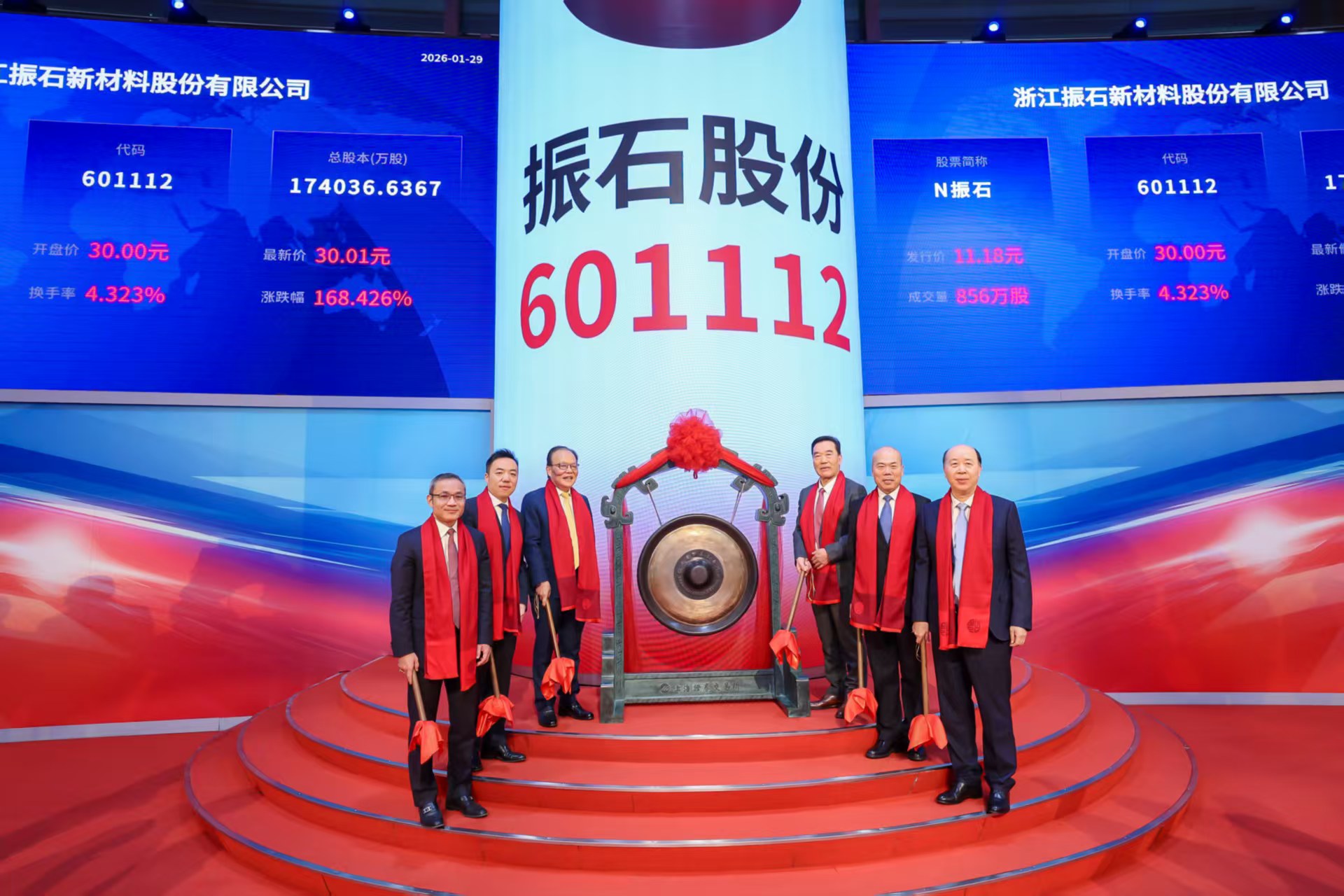
Core Viewpoint - Zhejiang Zhenstone New Materials Co., Ltd. (Zhenstone) has successfully listed on the Shanghai Stock Exchange, with Mingyang Smart Energy (601615) becoming the largest strategic investor by acquiring 10,187,512 shares, representing 3.90% of the initial issuance, marking a significant step in Mingyang's vertical integration into the upstream core materials sector [1][3]. Group 1: Company Overview - Zhenstone is a leading global supplier of fiberglass fabrics for wind power, holding over 35% market share and serving major international companies like Vestas and Siemens Gamesa, as well as domestic firms including Mingyang [3]. - The company has achieved global leadership in the mass production of high-modulus fiberglass pultruded boards and profiles, which are essential for the core framework of over 100-meter offshore wind turbine blades, contributing to their lightweight, high rigidity, and long-term reliability [3]. Group 2: Market Performance - On its first trading day, Zhenstone's stock price surged by 168.78% at opening and closed with a gain of 121.65%, reaching a market capitalization close to 40 billion yuan, indicating strong market confidence in its future prospects [3]. Group 3: Strategic Collaboration - The strategic investment by Mingyang will foster deep collaboration in three key areas: technology co-research, supply chain synergy, and international market expansion, leveraging both companies' strengths in turbine design and material science [3][4]. - The partnership aims to create a robust, transparent, and efficient supply chain system, ensuring long-term stability in the supply of critical raw materials for Mingyang while optimizing costs across the entire production chain [4]. - Together, the companies will focus on localizing supply chains to better serve global markets, particularly in Europe, the Middle East, and Africa, to capitalize on the rapidly growing offshore wind market [4].

光伏设备:低轨星座竞赛与太空算力革命,引爆太空光伏需求新周期
国盛证券有限责任公司· 2026-02-01 10:24
Investment Rating - The report provides a positive investment rating for solar equipment suppliers, specifically recommending "Buy" for companies like Gaoce Co., Ltd. and "Increase" for Maiwei Co., Ltd. and Mingyang Smart Energy [7][33]. Core Insights - The demand for space photovoltaic systems is expected to surge due to the explosive growth in satellite deployment and AI computing power in space. The competition between China and the U.S. for low Earth orbit resources is intensifying, with China planning to submit applications for 203,000 satellites by the end of 2025, while the U.S. has already launched over 10,000 satellites [1][10]. - New technological pathways such as P-type HJT and perovskite tandem cells are emerging, which promise lower costs and improved performance compared to traditional gallium arsenide batteries. These technologies are seen as the future of space photovoltaic systems [2][16]. - The global manufacturing landscape is shifting, presenting historic opportunities for Chinese equipment and battery manufacturers to expand internationally, particularly in the context of the growing demand for space energy [3][29]. Summary by Sections Section 1: Satellite Deployment and Space AI Computing - The report highlights the critical period for low Earth satellite deployment, emphasizing the fierce competition between China and the U.S. for orbital resources. The U.S. has launched a significant number of satellites under the SpaceX Starlink program, while China is advancing its national satellite constellation plans [1][10]. - The AI computing power explosion is creating a new paradigm for space-based data centers, which can operate continuously in sunlight and utilize the cold of space for cooling, leading to a substantial increase in demand for space photovoltaic systems [1][10]. Section 2: Technological Advancements - The report discusses the advantages of P-type HJT cells and perovskite tandem cells, which are expected to dominate the future of space photovoltaic technology due to their high efficiency and lower production costs. These technologies are particularly suited for the harsh conditions of space [2][16][27]. - The report notes that traditional gallium arsenide batteries, while efficient, are too costly for large-scale deployment in satellite constellations, thus paving the way for new technologies [2][26]. Section 3: Global Manufacturing Opportunities - The report identifies a mismatch in global manufacturing capabilities, with U.S. companies lacking the necessary equipment for HJT and perovskite production. Chinese manufacturers are positioned to benefit from this gap, as they have already established leadership in these technologies [3][29]. - The report suggests that the increasing demand for space energy, coupled with the restructuring of supply chains between China and the U.S., will create significant growth opportunities for Chinese photovoltaic companies [3][29]. Section 4: Key Companies and Recommendations - The report recommends several key companies for investment, including Maiwei Co., Ltd., Gaoce Co., Ltd., and others that are well-positioned to capitalize on the growing demand for space photovoltaic systems [7][33]. - It emphasizes the importance of companies with aerospace certification and proven technology in the context of the expanding space energy market [3][29].




低轨星座竞赛与太空算力革命,引爆太空光伏需求新周期
GOLDEN SUN SECURITIES· 2026-02-01 10:08
Investment Rating - The report provides a positive investment rating for solar equipment suppliers, particularly highlighting companies like Maiwei Co., Ltd. and others with potential capabilities in the solar photovoltaic sector [7][33]. Core Insights - The demand for space photovoltaic systems is expected to surge due to the explosive growth in satellite deployment and AI computing power in space, with China planning to submit applications for 203,000 satellites by the end of 2025, while the U.S. has already launched over 10,000 satellites [1][10]. - New technological pathways such as P-type HJT and perovskite tandem cells are emerging, offering lower costs and improved performance compared to traditional gallium arsenide batteries, which are currently too expensive for large-scale deployment [2][27]. - The global manufacturing landscape is shifting, presenting historic opportunities for Chinese equipment and battery manufacturers to expand internationally, especially as the U.S. lacks capabilities in HJT and perovskite production lines [3][29]. Summary by Sections Section 1: Satellite Deployment and Space AI - The global low Earth orbit satellite deployment is entering a critical phase, with intense competition between China and the U.S. for orbital resources and frequency bands [10]. - The AI computing explosion is creating a new paradigm for space-based data centers, which can operate continuously under sunlight and utilize the cold of space for cooling, leading to exponential growth in demand for space photovoltaic systems [1][10]. Section 2: Technological Advancements - P-type HJT batteries and silicon/perovskite tandem cells are identified as the main directions for future space photovoltaic technology, with significant advantages in efficiency and cost [2][16]. - The report highlights the limitations of traditional gallium arsenide batteries, which are costly and reliant on scarce materials, making them unsuitable for large-scale satellite constellations [2][26]. Section 3: Global Market Dynamics - The report emphasizes that the demand for solar photovoltaic systems in space is set to enter a new cycle, benefiting domestic equipment and battery manufacturers as they transition from ground support to core space applications [29][30]. - Companies like Junda Co., Ltd., Trina Solar, and others are noted for their advancements in space-grade batteries and solar technologies, positioning them well for future growth in the space photovoltaic market [30][33].
“太空光伏”概念走热,业内:目前仍处于0到1阶段
Di Yi Cai Jing Zi Xun· 2026-01-30 13:27
Core Insights - The "space photovoltaic" concept has gained significant attention in the secondary market, largely influenced by Tesla CEO Elon Musk's endorsements [2] - The Wind Space Photovoltaic Index has risen by 19.83% over the past month, outperforming the Shanghai and Shenzhen 300 Index, which increased by 1.18% [2] - Several photovoltaic companies have experienced substantial stock price increases, with JunDa Co., Ltd. rising by 84.62% and Mingyang Smart Energy increasing by 60.22% in the last 20 days [2] Market Performance - The stock prices of companies like Dongfang Risen and Laplace have shown abnormal fluctuations, with price deviations exceeding 30% over consecutive trading days [3] - The space photovoltaic sector is characterized by its potential to harness solar energy in outer space, providing power to satellites and space stations [3] Industry Challenges - Despite the market enthusiasm, the commercialization of space photovoltaics faces significant uncertainties related to technology maturity and economic viability [4] - Industry insiders indicate that the application scenarios for space photovoltaics are still in the exploratory phase, with many companies not yet supplying products to commercial satellite firms [4] Technological Considerations - Current leading materials for space photovoltaics include gallium arsenide, which is costly at approximately 1000 RMB per watt, and perovskite, which faces stability issues in extreme space conditions [5] - The cost of electricity generated from space photovoltaics is estimated to be 2-3 USD per kilowatt-hour, significantly higher than the ground-based photovoltaic cost of 0.03-0.05 USD per kilowatt-hour [5] Future Outlook - Several A-share listed companies express optimism about the future of space photovoltaics, with potential market size reaching trillions as technology advances [5] - Companies like Trina Solar and HaiMuxing are actively collaborating with leading aerospace institutions to develop practical applications for space solar energy [5] - The commercialization of space photovoltaics is projected to gradually occur over the next 10 to 15 years as launch costs decrease and battery technologies improve [6]




“太空光伏”概念走热 部分企业触发交易异常 业内:目前仍处于0到1阶段
Di Yi Cai Jing· 2026-01-30 12:05
Core Viewpoint - The "space photovoltaic" concept has become a major focus in the secondary market, significantly influenced by Tesla CEO Elon Musk's endorsements, with the relevant index rising 19.83% in the past month, outperforming the CSI 300 index by 18.65% [1] Market Performance - The space photovoltaic concept index has shown strong performance, with notable stock increases: JunDa Co., Ltd. up 84.62%, Mingyang Smart Energy up 60.22%, Jiejia Weichuang up 44.04%, Dier Laser up 41.54%, and Tuori New Energy up 35.94% over the past 20 days [1] - Several photovoltaic companies have experienced significant stock price surges, triggering trading anomalies, such as Dongfang Risheng and Laplace, both exceeding a cumulative price deviation of 30% within a short period [2] Industry Insights - Space photovoltaic energy refers to utilizing solar photovoltaic technology in outer space to generate and supply energy, with the potential to transmit power wirelessly to Earth or supply satellites and space stations [2] - The rationale for space photovoltaics includes abundant sunlight in space and the feasibility of deploying photovoltaic components on satellites, with near-Earth satellites experiencing over 60% sunlight exposure [2] Challenges in Industrialization - Despite the rising stock prices, the industry faces significant uncertainties regarding the industrialization of space photovoltaics, including technological maturity and economic viability for large-scale commercialization [3] - Current applications of space photovoltaics are still exploratory, with many companies in the secondary market not yet supplying products to commercial space satellite companies [3] - Analysts indicate that space photovoltaics are in the early stages of development, requiring validation of technology and economic benefits for large-scale applications [3] Technological Considerations - Gallium arsenide is the mainstream material for space photovoltaics, but its high cost (approximately 1000 RMB per watt) poses challenges for large-scale deployment [4] - Perovskite technology shows promise but has stability concerns in extreme space conditions, necessitating further validation [4] - Multiple technological routes are being explored, with a focus on solving power and cost issues as critical for the commercialization of space energy solutions [4] Cost Analysis - Current estimates suggest that the cost of electricity from space photovoltaics is around $2-3 per kilowatt-hour, compared to $0.03-0.05 per kilowatt-hour for ground-based photovoltaics, indicating a potential cost disparity of up to 100 times [5] - Companies like Trina Solar and HaiMuxing express optimism about the future of space photovoltaics, citing collaborations with leading aerospace institutions and advancements in reusable rocket technology [5] Commercialization Timeline - Predictions indicate that space photovoltaics may gradually commercialize over the next 10 to 15 years, contingent on decreasing launch costs and breakthroughs in battery technology [6]
“太空光伏”概念走热,部分企业触发交易异常,业内:目前仍处于0到1阶段
Di Yi Cai Jing Zi Xun· 2026-01-30 11:37
Core Viewpoint - The "space photovoltaic" concept has gained significant attention in the secondary market, largely influenced by Tesla CEO Elon Musk's endorsements, with the relevant index rising 19.83% in the past month, outperforming the CSI 300 index by 18.65% [1] Market Performance - The space photovoltaic concept index has seen a notable increase, with specific stocks like JunDa Co., Ltd. rising by 84.62%, Mingyang Smart Energy by 60.22%, and Jiejia Weichuang by 44.04% over the past 20 days [1] - Several photovoltaic companies have experienced stock price surges, triggering trading anomalies, such as Dongfang Risheng and Laplace, which saw price deviations exceeding 30% [3] Technology and Feasibility - Space photovoltaic energy involves utilizing solar photovoltaic technology in outer space to generate and supply energy, with the potential for direct power transmission to Earth [3] - The advantages of space photovoltaic systems include abundant sunlight and reduced atmospheric interference, making them a viable option for satellite power supply [3] Industry Challenges - Despite the market enthusiasm, the space photovoltaic industry faces significant uncertainties regarding technological maturity, long-term reliability, and economic viability for large-scale commercialization [4][5] - Current applications are still in the exploratory phase, with many companies not yet supplying products to commercial space satellite firms [5] Technological Development - Various technological routes are being explored, with gallium arsenide being the mainstream material, but its high cost poses challenges for large-scale deployment [5][6] - The cost of space photovoltaic energy is currently estimated at $2-3 per kilowatt-hour, significantly higher than ground-based photovoltaic costs of $0.03-0.05 per kilowatt-hour, indicating a need for cost reduction and efficiency improvements [6] Future Outlook - Companies like Trina Solar and HaiMuxing express optimism about the future of space photovoltaic technology, citing collaborations with leading aerospace institutions and advancements in reusable rocket technology [6][7] - The commercial viability of space photovoltaic systems is projected to develop over the next 10 to 15 years, contingent on decreasing launch costs and breakthroughs in battery technology [7]
27股获推荐 宁德时代目标价涨幅达75%丨券商评级观察
2 1 Shi Ji Jing Ji Bao Dao· 2026-01-30 01:26
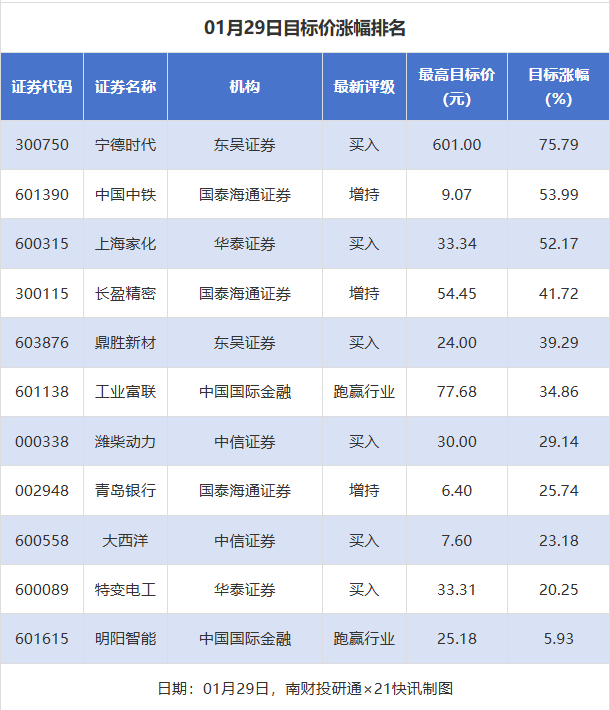
Group 1 - The core viewpoint of the article highlights the target price increases for several listed companies, with notable gains for Ningde Times, China Railway, and Shanghai Jahwa, reflecting strong market confidence in these sectors [1][2]. Group 2 - On January 29, the companies with the highest target price increases were Ningde Times (75.79%), China Railway (53.99%), and Shanghai Jahwa (52.17%), indicating significant bullish sentiment in the battery, infrastructure, and cosmetics industries respectively [1][2]. - A total of 27 listed companies received broker recommendations on January 29, with Qingdao Bank receiving the most recommendations at 5, followed by Mingyang Smart Energy and Ruoyuchen with 2 each [1][3]. - Three companies had their ratings upgraded on January 29, including TBEA, which was upgraded from "Hold" to "Buy" by Huatai Securities, reflecting improved outlooks for these firms [4][6]. - Five companies received initial coverage on January 29, with Qingdao Bank rated "Recommended" by Guolian Minsheng Securities, indicating new interest from analysts in these stocks [6][7].




明阳智能:2025年业绩预告点评:Q4同比转正,收购德华芯片进军国内卫星电源Tier1勘误版-20260129
Soochow Securities· 2026-01-29 10:45
Investment Rating - The investment rating for the company is "Buy" (maintained) [1] Core Views - The company is expected to achieve a net profit attributable to shareholders of approximately 897.66 million yuan in 2025, representing a year-on-year increase of 159% [8] - The fourth quarter of 2025 is projected to show a positive year-on-year growth in net profit, with estimates ranging from 34.24 million to 234.24 million yuan, a significant recovery from a loss of 460 million yuan in the same quarter of the previous year [8] - The acquisition of Dehua Chip positions the company among the top tier in domestic satellite power supply, enhancing its competitive edge in the photovoltaic sector [8] Financial Forecasts - Total revenue is forecasted to be 41.215 billion yuan in 2025, reflecting a year-on-year growth of 51.76% [1] - The company's earnings per share (EPS) is expected to reach 0.40 yuan in 2025, with a projected price-to-earnings (P/E) ratio of 59.88 [1] - The company anticipates a gross margin of 7% for wind turbines in Q4 2025, indicating stability and a release of historical quality risk [8] Market Data - The closing price of the company's stock is 24.88 yuan, with a market capitalization of approximately 56.27 billion yuan [5] - The company has a price-to-book (P/B) ratio of 2.14 and a debt-to-asset ratio of 69.98% [6] Strategic Initiatives - The acquisition of Dehua Chip is expected to enhance the company's capabilities in high-end compound semiconductor research and development, particularly in the photovoltaic field [8] - The company has made significant advancements in photovoltaic technology, achieving a third-party certified efficiency of 22.4% for its perovskite modules [8]
明阳智能(601615):2025年业绩预告点评:Q4同比转正,收购德华芯片进军国内卫星电源Tier1勘误版
Soochow Securities· 2026-01-29 10:30
Investment Rating - The investment rating for the company is "Buy" (maintained) [1] Core Insights - The company is expected to achieve a net profit attributable to shareholders of approximately 897.66 million yuan in 2025, representing a year-on-year growth of 159% [8] - The fourth quarter of 2025 is projected to show a positive year-on-year net profit, with estimates ranging from 34.24 million to 234.24 million yuan, a significant recovery from a loss of 460 million yuan in the same quarter of the previous year [8] - The acquisition of Dehua Chip positions the company in the top tier of domestic satellite power supply, enhancing its competitive edge in the photovoltaic sector [8] Financial Forecasts - Total revenue is forecasted to reach 41.215 billion yuan in 2025, reflecting a year-on-year increase of 51.76% [1] - The company's earnings per share (EPS) is expected to be 0.40 yuan in 2025, with a projected price-to-earnings (P/E) ratio of 59.88 [1] - The company anticipates a gross margin of 7% for wind turbines in Q4 2025, indicating stability and a release of historical quality risk [8] Market Data - The closing price of the company's stock is 24.88 yuan, with a market capitalization of approximately 56.27 billion yuan [5] - The company has a price-to-book (P/B) ratio of 2.14 and a debt-to-asset ratio of 69.98% [6] Strategic Developments - The company plans to leverage its acquisition of Dehua Chip to enhance its capabilities in high-end compound semiconductor technology and energy systems, aiming for comprehensive solutions in the photovoltaic industry [8] - The company has achieved significant advancements in photovoltaic technology, with a certified efficiency of 22.4% for its perovskite modules and breakthroughs in tandem solar cells [8]