
China Life(601628)

Search documents
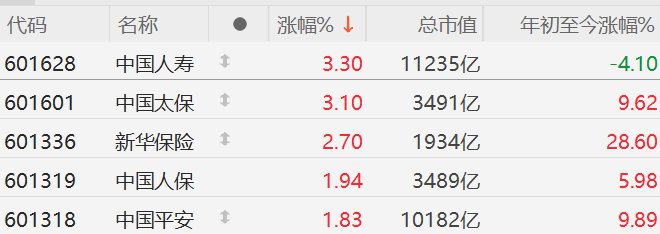
A股保险股走强,中国人寿涨超3%
Ge Long Hui A P P· 2025-09-29 05:39
Core Viewpoint - The A-share market has seen a strong performance in insurance stocks, with notable increases in share prices for major companies such as China Life, China Pacific Insurance, and New China Life [1] Summary by Category Stock Performance - China Life (601628) increased by 3.30%, with a total market capitalization of 1,123.5 billion and a year-to-date decline of 4.10% [2] - China Pacific Insurance (601601) rose by 3.10%, with a market cap of 349.1 billion and a year-to-date increase of 9.62% [2] - New China Life (601336) saw a rise of 2.70%, with a market cap of 193.4 billion and a year-to-date increase of 28.60% [2] - China Insurance (601319) increased by 1.94%, with a market cap of 348.9 billion and a year-to-date increase of 5.98% [2] - Ping An Insurance (601318) rose by 1.83%, with a market cap of 1,018.2 billion and a year-to-date increase of 9.89% [2] Technical Indicators - The formation of a MACD golden cross signal indicates a positive trend in the stock prices of these insurance companies [2]






信阳监管分局同意中国人寿财险信阳市浉河区支公司变更营业场所
Jin Tou Wang· 2025-09-29 04:05
二、中国人寿财产保险股份有限公司应按照有关规定及时办理变更及许可证换领事宜。 2025年9月25日,国家金融监督管理总局信阳监管分局发布批复称,《关于中国人寿(601628)财产保 险股份有限公司信阳市浉河区支公司变更营业地址的请示》(国寿财险信发〔2025〕53号)收悉。经审 核,现批复如下: 一、同意中国人寿财产保险股份有限公司信阳市浉河区支公司将营业场所变更为:河南省信阳市浉河区 北京路正通桂花苑14号楼5层507号。 ...
广发银行高层人事变动:林朝晖接任党委书记,王凯辞去行长职务
Guan Cha Zhe Wang· 2025-09-29 03:27
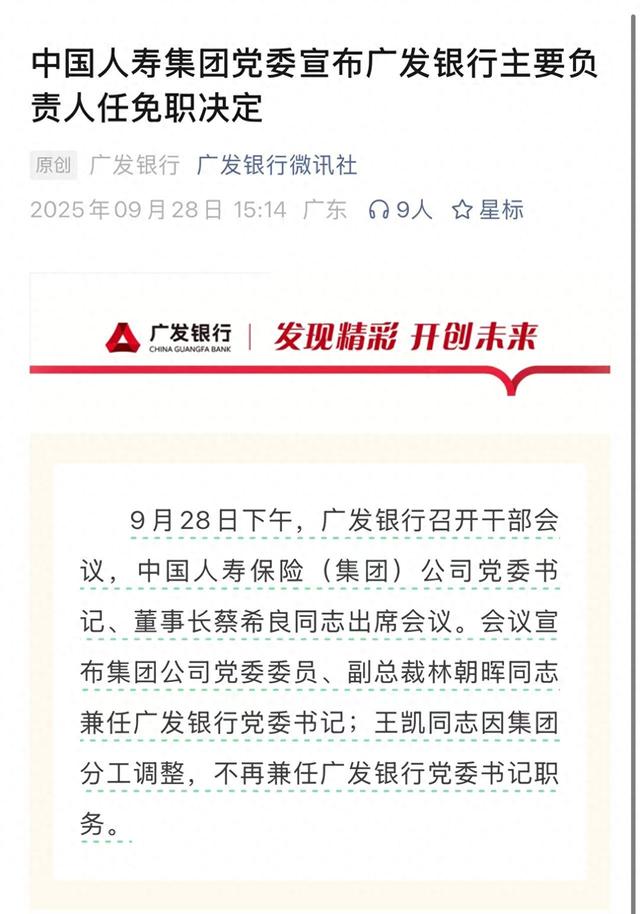
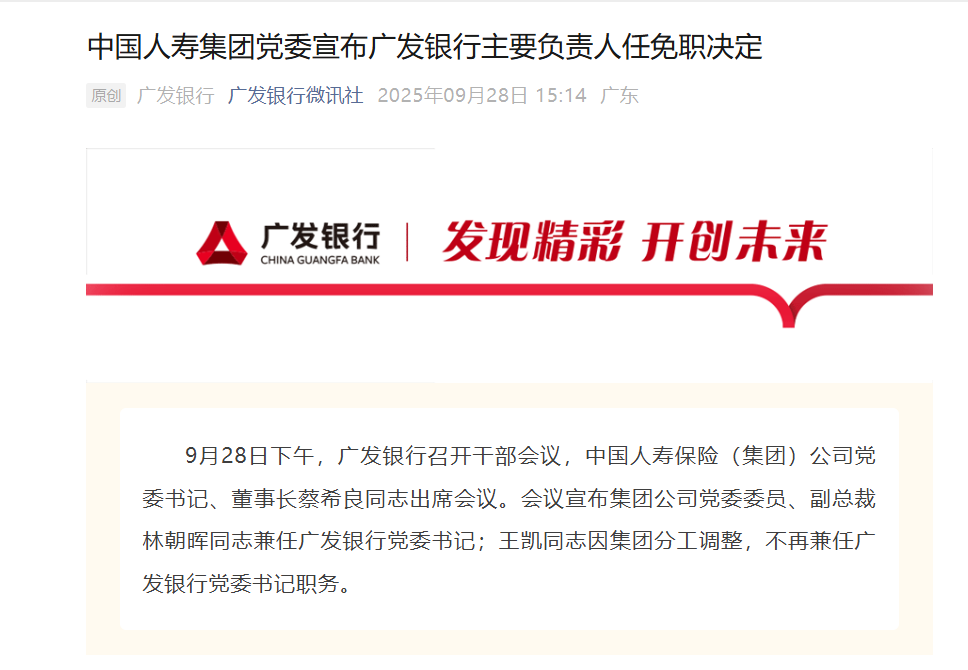
【文/羽扇观金工作室】 9月28日,广发银行举行高级管理人员调整会议,会议正式宣布,中国人寿集团党委委员、副总裁林朝 晖将兼任广发银行党委书记一职,同时王凯因集团内部工作重新分配,卸任广发银行党委书记职务。 从经营业绩来看,广发银行2024年年度报告显示,截至报告期结束时,该行资产总规模达到3.64万亿 元,较年初实现3.86%的增长。报告期内,该行合并口径营业收入为692.37亿元,同比减少0.63%,主要 原因是响应国家政策要求,持续降低企业和个人客户的融资成本,导致利息净收入出现下降;全年实现 净利润152.84亿元,同比下滑4.58%。 按照银行业惯例,林朝晖在担任党委书记后,预计还将接任广发银行行长职务。目前林朝晖和王凯均为 中国人寿保险集团的党委委员和副总裁。现年50岁的林朝晖成为国寿集团高管团队中最年轻的成员之 一。 此次人事调整是王凯自2021年1月担任广发银行党委书记,随后出任行长职务以来的首次重大变动。当 时王凯接替的是调任中国太平保险集团总经理的尹兆君,而尹兆君目前已升任中国太平党委书记、董事 长。 根据公开资料,新任党委书记林朝晖生于1974年,持有法学硕士学位,具备高级经济师资格。他 ...
中国人寿亮相 2025 服贸会:国寿好服务 传递金融温度
Bei Jing Shang Bao· 2025-09-29 02:04
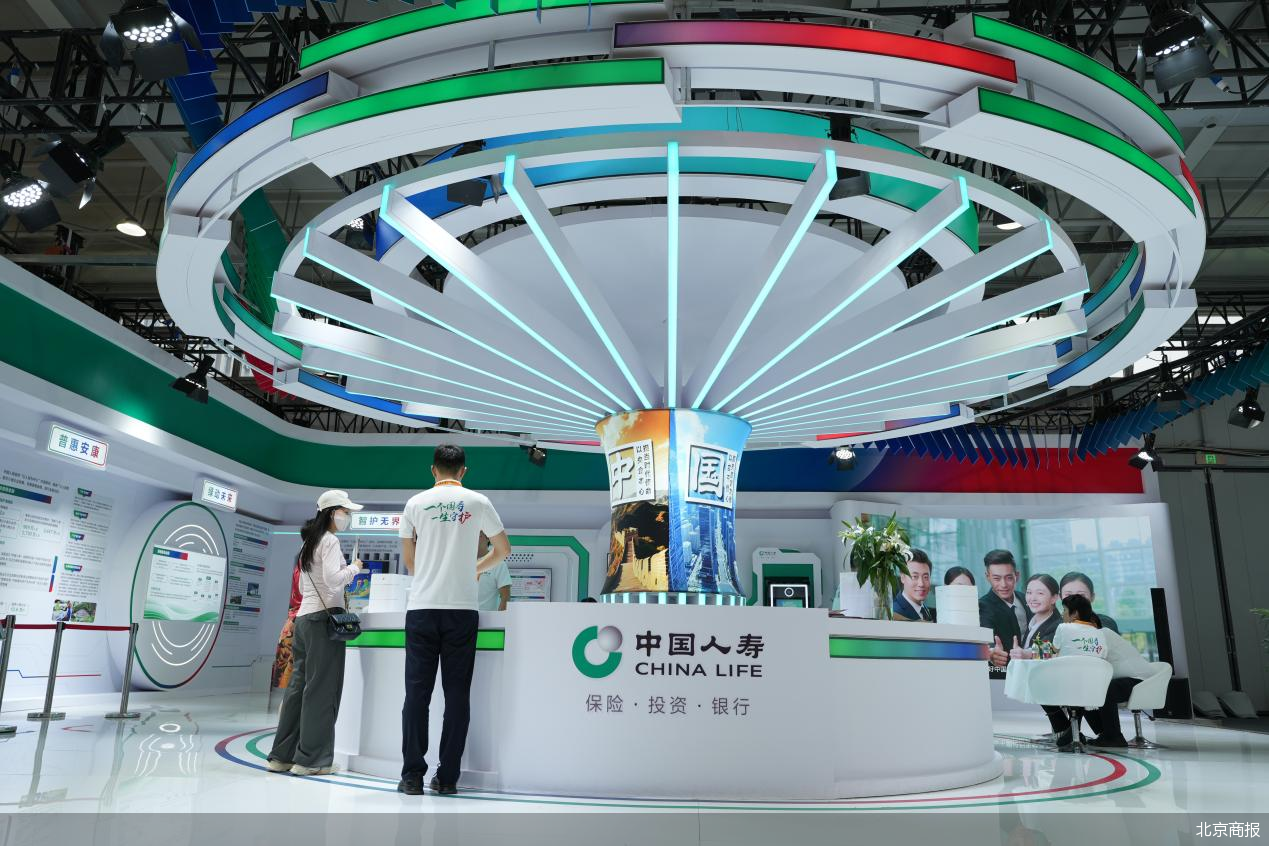
Core Viewpoint - The 2025 China International Service Trade Fair (CIFTIS) is being held from September 10 to 14, with a focus on financial services and a theme of "Digital Intelligence Leading, Service Trade Renewed" [1] Group 1: Event Overview - The financial services section of the fair aims to create a comprehensive platform for global financial innovation, policy release, cooperation discussions, and cutting-edge experiences [1] - China Life Insurance is showcasing its commitment to providing comprehensive financial and insurance services throughout the customer lifecycle under the theme "One China Life, Lifelong Protection" [1] Group 2: Exhibition Highlights - The centerpiece of the exhibition is the "Guardian Tree," symbolizing China Life's role in providing solid protection for families and businesses [2] - The exhibition emphasizes audience engagement and experience, featuring interactive areas such as the "National Life Health Competition" and the "Smart Protection Without Boundaries" display [5] Group 3: Community Engagement - A specialized lecture on retirement planning was held on September 13, addressing public concerns about retirement needs and offering professional advice [6] - The lecture included a Q&A session, allowing attendees to share their retirement concerns and receive immediate expert responses [6] Group 4: Service Ecosystem Upgrade - China Life is committed to a customer-centric approach, enhancing service channels and integrating online and offline services for better accessibility [7][8] - The company has developed a comprehensive service system that includes various service modes to meet diverse customer needs [8] Group 5: Claims and Customer Experience - In 2024, China Life processed approximately 848,800 claims, with a total payout of 1.185 billion yuan and a claim approval rate of 99.81% [8] - The company is focused on providing efficient and warm claims services, enhancing customer trust and satisfaction [8] Group 6: Future Directions - China Life aims to strengthen its core competitiveness and enhance its product and service offerings to meet the growing demands of customers [10] - The company will continue to implement its "333 strategy" and uphold its operational philosophy of "One China Life, Lifelong Protection" [10]
金管局再提保险法修订,预定利率下调预期带动8月保费表现亮眼:——非银金融行业周报(2025/9/22-2025/9/26)-20250928
Shenwan Hongyuan Securities· 2025-09-28 11:49
Investment Rating - The report maintains a positive outlook on the non-bank financial sector, indicating an "Overweight" rating for the industry, suggesting it will outperform the overall market [58]. Core Insights - The report highlights that the implementation of significant financial policies over the past year has provided strong support for market stabilization and confidence recovery, with a notable increase in A-share market activity [5][17]. - The insurance sector has shown robust growth, with total insurance premium income reaching CNY 4.80 trillion from January to August 2025, reflecting a year-on-year increase of 9.6% [5][12]. - The report emphasizes the importance of regulatory changes in the insurance industry, particularly the ongoing revision of the Insurance Law, which is expected to enhance risk management and improve the competitive landscape [5][10]. Summary by Sections 1. Market Review - The Shanghai Composite Index reported a gain of 1.07% during the week of September 22-26, 2025, while the non-bank index experienced a slight decline of 0.09% [8]. - The insurance sector index increased by 0.46%, although it underperformed compared to the Shanghai Composite [8]. 2. Non-Bank Financial Data - As of September 26, 2025, the average daily trading volume in the stock market was CNY 23,134.62 billion, reflecting an increase of 54.56% year-on-year [13]. - The financing balance in the margin trading market reached CNY 24,443.66 billion, up 31.1% from the end of 2024 [13]. 3. Key Announcements - The report notes that the basic pension insurance fund's investment scale has doubled compared to the end of the 13th Five-Year Plan, now standing at CNY 2.6 trillion [14]. - The introduction of cross-border bond repurchase business is expected to enhance liquidity for foreign institutions in the onshore bond market [15]. 4. Individual Stock Highlights - In the insurance sector, notable stock performances included New China Life (+2.67%) and China Pacific Insurance (+0.89%) in A-shares, while several H-shares experienced declines [10]. - In the brokerage sector, Xiangcai Securities saw a significant increase of 16.87%, while Tianfeng Securities faced a decline of 4.60% [10].


金融圈大消息!刚宣布,林朝晖履新
Zhong Guo Ji Jin Bao· 2025-09-28 11:11
【导读】中国人寿党委委员、副总裁林朝晖兼任广发银行党委书记 林朝晖拟任广发银行行长 据悉,在9月28日下午,广发银行干部任命大会落下帷幕,中国人寿保险(集团)公司党委书记、董事长蔡希良出席会议,本次会议宣布 任命中国人寿保险(集团)党委委员、副总裁林朝晖兼任广发银行党委书记,并拟任行长。 同时,因该集团分工调整,王凯不再兼任广发银行党委书记职务。广发银行同日公告,董事会于2025年9月28日收到王凯先生提交的书面 辞呈。王凯先生因集团分工调整,请求辞去本行第十届董事会董事、副董事长、行长、董事会战略/消费者权益保护委员会主任委员等职 务。王凯先生确认与该行董事会和高级管理层无不同意见,没有任何与辞任有关的事项需要通知本行股东。广发银行董事会对王凯先生任 职期间为本行做出的重要贡献表示衷心感谢。 9月28日,据广发银行官微,该行于今日下午召开干部会议,中国人寿(601628)保险(集团)党委委员、副总裁林朝晖兼任广发银行党 委书记。 从过往履历来看,林朝晖长期深耕金融领域,具备丰富经验,曾任建设银行北京市分行党委书记、行长、建设银行总行办公室(党委办公 室)主任。2024年1月,其被调任中国人寿集团党委委员后, ...
金融圈大消息!刚宣布,林朝晖履新
中国基金报· 2025-09-28 11:06
【 导读 】 中国人寿党委委员、副总裁林朝晖兼任广发银行党委书记 中国基金报记者 嘉合 9月28日,据广发银行官微,该行于今日下午召开干部会议,中国人寿保险(集团)党委委员、副总裁林朝晖兼任广发银行党委书记。 公开资料显示,林朝晖,1974年出生,法学硕士学位,高级经济师。现任中国人寿保险(集团)公司党委委员、副总裁,中国人寿保险 (海外)股份有限公司董事长。 林朝晖拟任广发银行行长 据悉,在9月28日下午,广发银行干部任命大会落下帷幕,中国人寿保险(集团)公司党委书记、董事长蔡希良出席会议,本次会议宣布任 命中国人寿保险(集团)党委委员、副总裁林朝晖兼任广发银行党委书记,并拟任行长。 同时,因该集团分工调整,王凯不再兼任广发银行党委书记职务。广发银行同日公告, 董事会于2025年9月28日收到王凯先生提交的书面 辞呈。 王凯先生因集团分工调整, 请求辞去本行第十届董事会董事、 副董事长、 行长、 董事会战略/消费者权益保护委员会主任委员等 职务。 王凯先生确认与该行董事会和高级管理层无不同意见, 没有任何与辞任有关的事项需要通知本行股东。广发银行董事会对王凯先生 任职期间为本行做出的重要贡献表示衷心感谢。 ...


非银行业周报20250928:季度切换在即,积极布局回调后的非银板块-20250928
Minsheng Securities· 2025-09-28 10:59
Investment Rating - The report maintains a "Recommended" rating for the insurance and securities sectors, indicating a positive outlook for these industries [6]. Core Insights - The insurance sector experienced significant growth in premium income, with total insurance premium income reaching 479.98 billion yuan from January to August 2025, a year-on-year increase of 9.6%. In August alone, the premium income was 59.13 billion yuan, up 35.6% year-on-year [1]. - The report highlights the ongoing reforms in the capital market, which are expected to enhance its attractiveness. The direct financing proportion has increased to 31.6%, up 2.8 percentage points from the end of the 13th Five-Year Plan [3]. - The report emphasizes the importance of stable monetary policy and the implementation of tools to maintain capital market stability, which has improved the resilience and risk resistance of the A-share market [4]. Summary by Sections Market Review - The broad market indices showed a rebound, with the Shanghai Composite Index increasing by 0.21% and the ChiNext Index rising by 1.96% during the week [10]. Securities Sector - The total trading volume in the Shanghai and Shenzhen markets reached 11.46 trillion yuan, with a daily average trading amount of 2.29 trillion yuan, reflecting a year-on-year increase of 116.72% [17]. - The IPO underwriting scale for the year reached 69.90 billion yuan, marking a 112% increase compared to 2024 [17]. Insurance Sector - The life insurance premium income for the first eight months of 2025 was 357.97 billion yuan, up 11.4% year-on-year, while property insurance premium income was 122.01 billion yuan, up 4.7% [1]. Liquidity Tracking - The central bank conducted 2.47 trillion yuan in reverse repos and 600 billion yuan in MLF operations, resulting in a net injection of 880.6 billion yuan [28]. Industry News and Company Announcements - The report notes significant achievements in the financial sector during the 14th Five-Year Plan, including a total of 10.6 trillion yuan in dividends and buybacks by listed companies, which is an increase of over 80% compared to the previous plan [2][35]. Investment Recommendations - The report suggests focusing on key insurance companies such as Sunshine Insurance, China Pacific Insurance, and China Life, as well as top securities firms like CITIC Securities and Huatai Securities [38].
广发银行行长辞任!中国人寿副总裁林朝晖兼任该行党委书记
Nan Fang Du Shi Bao· 2025-09-28 10:53
"本行董事会对王凯先生任职期间为本行作出的重要贡献表示衷心感谢。"广发银行在公告中表示。 广发银行迎来重要人事调整。据广发银行9月28日发布的消息,该行行长王凯因集团分工调整辞任。同 时,广发银行召开干部会议,宣布中国人寿保险(集团)公司党委委员、副总裁林朝晖兼任广发银行党 委书记。在业内人士看来,按照惯例,待走完相关流程后,林朝晖将出任广发银行行长。 王凯因集团分工调整辞任 广发银行官网9月28日发布的公告显示,公司董事会于2025年9月28日收到王凯提交的书面辞呈。王凯因 集团分工调整,请求辞去该行第十届董事会董事、副董事长、行长、董事会战略/消费者权益保护委员 会主任委员等职务。王凯确认与本行董事会和高级管理层无不同意见,没有任何与辞任有关的事项需要 通知本行股东。 | 投资者关系 | 股份信息 | 公司治理 | 公司公告 | 财务信息 | | --- | --- | --- | --- | --- | | 当前位置:首页 > 投资者关系 > 公司公告 > 临时公告 | | | | | | 【字号: 大 中 小】 | | | | | | 广发银行股份有限公司关于董事、行长辞任的公告 3.11.77880 ...

中国人寿保险(集团)党委委员、副总裁林朝晖兼任广发银行党委书记
Bei Jing Shang Bao· 2025-09-28 10:52
北京商报讯(记者 孟凡霞 周义力)据广发银行官方微信公众号消息,9月28日下午,广发银行召开干部 会议,中国人寿保险(集团)公司党委书记、董事长蔡希良出席会议。会议宣布集团公司党委委员、副 总裁林朝晖兼任广发银行党委书记;王凯因集团分工调整,不再兼任广发银行党委书记职务。 ...